Reading Comprehension Quiz
A free english worksheet ready for your classroom. Open in Kuraplan to grab the print-ready PDF, customize it for your students, or generate a fresh version in seconds.
Reading Comprehension Quiz
WALT: Sort and match information from texts to show understanding of meaning.
Success Criteria: I can match words to their meanings, sort sentences into categories, and match paragraphs to main ideas.
📖 Read This First!
💡 Tip: Read each section slowly. Use your finger to track each line. It's okay to re-read!
Read the passage below, then answer the questions in Parts 1, 2, and 3.
The Kākāpō — A Unique New Zealand Bird
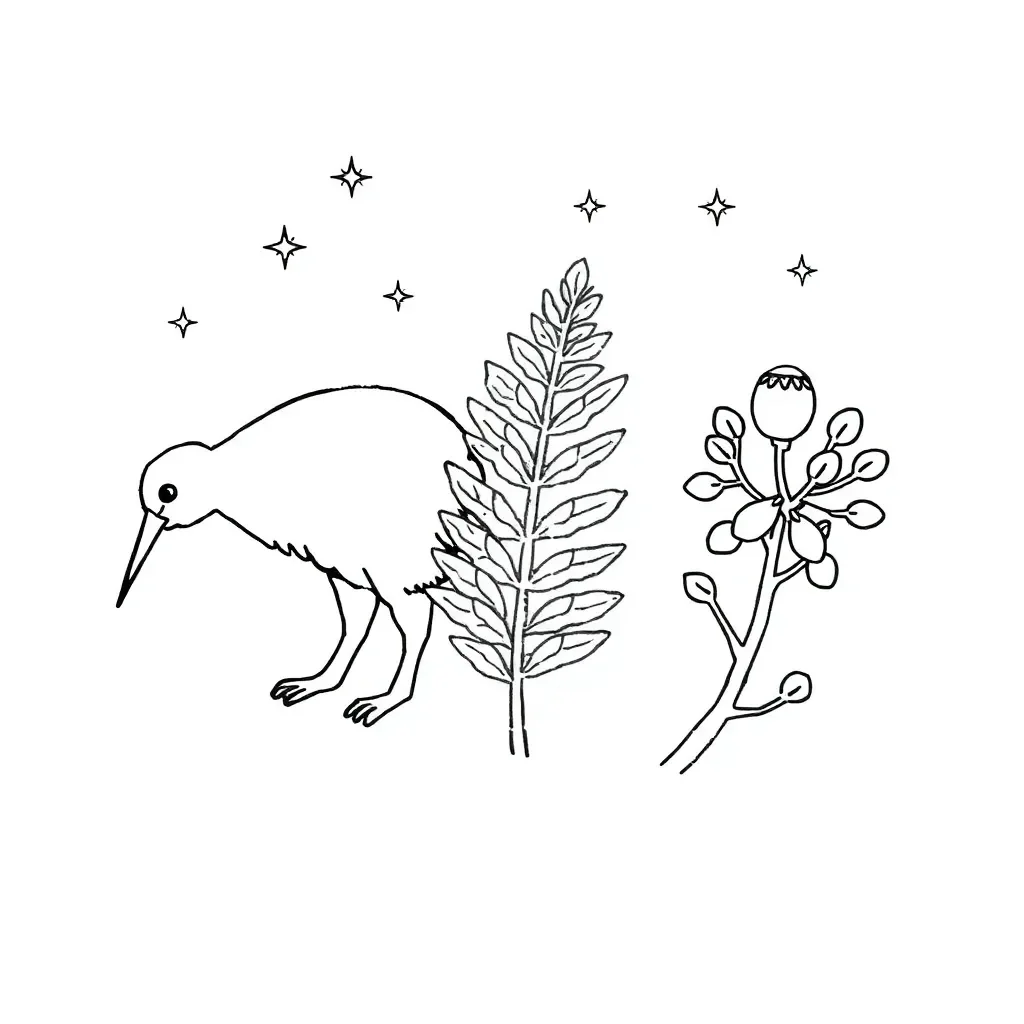
The kākāpō is a large, flightless parrot found only in New Zealand. It is the world's heaviest parrot and can weigh up to 4 kilograms. Unlike most birds, the kākāpō is nocturnal, which means it is active at night.
Kākāpō are herbivores. They eat plants, seeds, fruit, and pollen. They use their strong beaks to grind up tough plant material. Kākāpō have a strong, pleasant smell, which unfortunately helps predators like stoats and rats find them.
Because of introduced predators, kākāpō nearly became extinct. Today, conservation workers move kākāpō to predator-free islands to keep them safe. As of 2024, there are around 250 kākāpō left. Scientists and volunteers work hard to protect this taonga species.
🔗 Part 1: Match Words to Meanings
Instructions: Draw a line from each word on the left to its correct meaning on the right. The first one has been done for you as an example.
💡 Tip: Try saying each meaning out loud to see which word fits best!
Answer Key (for teacher): 1-B, 2-E, 3-A, 4-C, 5-D
📂 Part 2: Sort the Sentences
Instructions: Read each sentence below. Write the sentence number into the correct category box. Some sentences may fit more than one category — choose the BEST one.
💡 Tip: Re-read the passage if you're not sure. Look for key words that match the category!
Sentences to sort:
A. Kākāpō eat seeds, fruit, and pollen.
B. Stoats and rats are a danger to kākāpō.
C. Kākāpō sleep during the day and wake up at night.
D. Workers move kākāpō to safe, predator-free islands.
E. The kākāpō can weigh up to 4 kilograms.
F. Kākāpō use their beaks to grind up plants.
Answer Key (for teacher): Category 1: A, F | Category 2: B | Category 3: D | (C and E are general facts — accept reasonable justification)
🌟 Extension Activity
For students who finish early or want an extra challenge:
🧩 Part 3: Match Paragraphs to Main Ideas
Instructions: The passage has three paragraphs. Match each paragraph number to its main idea by circling the correct answer.
💡 Tip: The main idea is what the whole paragraph is mostly about — not just one detail!
Answer Key (for teacher): 1-B, 2-A, 3-C
💬 Thinking Further (Short Answer)
🌟 Differentiation Support
For students who need extra support: Re-read just the first sentence of each paragraph. That sentence often tells you the main idea!
For advanced students: Write a short paragraph explaining what YOU would do to help protect the kākāpō if you were a conservation worker.
About This Worksheet
Free in Kuraplan
Sign up free, grab the PDF, and customize it for your class.
Print-Ready
Formatted for standard paper. Clean layout, easy to read.
AI-Generated
Created with Kuraplan's AI, designed for real classroom use.
For Teachers & Parents
Use in classrooms, for homework, tutoring, or homeschool.
Need a custom version of this worksheet?
Kuraplan's AI generates custom worksheets in seconds — differentiated for every learner, aligned to your curriculum.
Generate Custom Worksheets — FreeMore English Worksheets
Camp D Tent Reading Comprehension
Free
Discover Tonga Reading Text
Free
Possum Text Evidence Worksheet
Free
Possum Fluency Practice
Free
Author’s Purpose P.I.E.
Free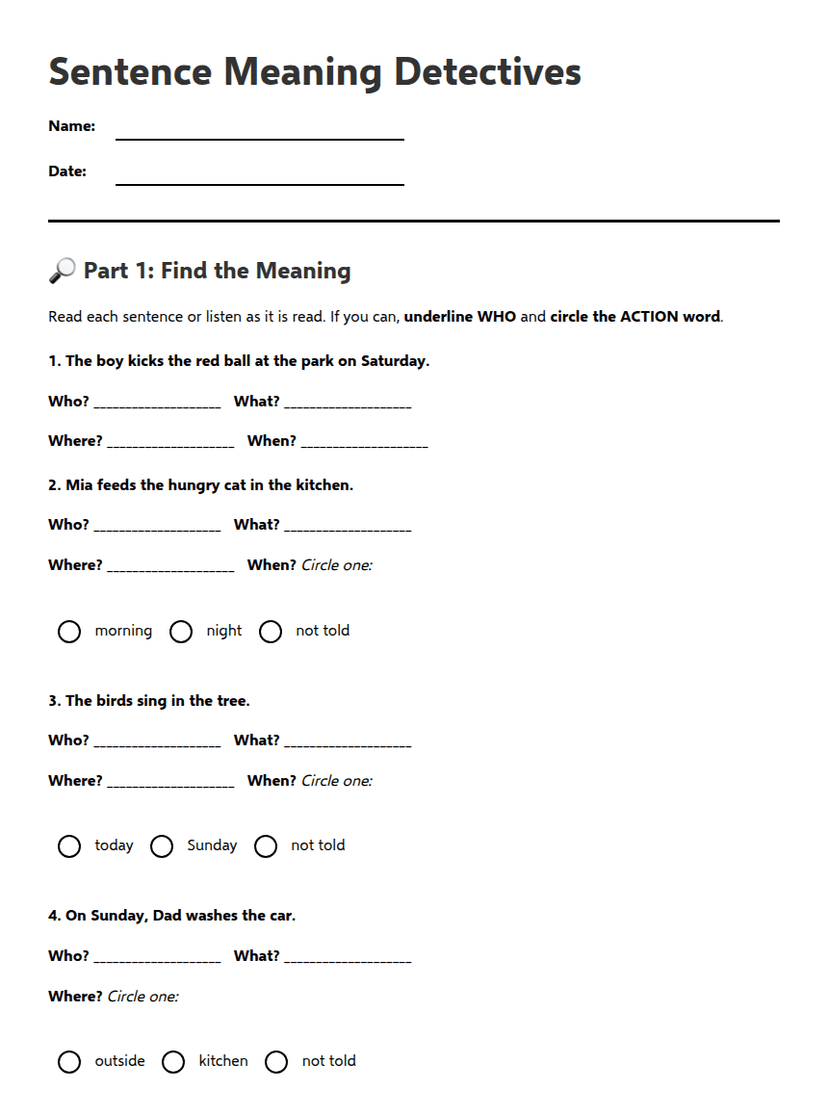
Sentence Meaning Detectives
Free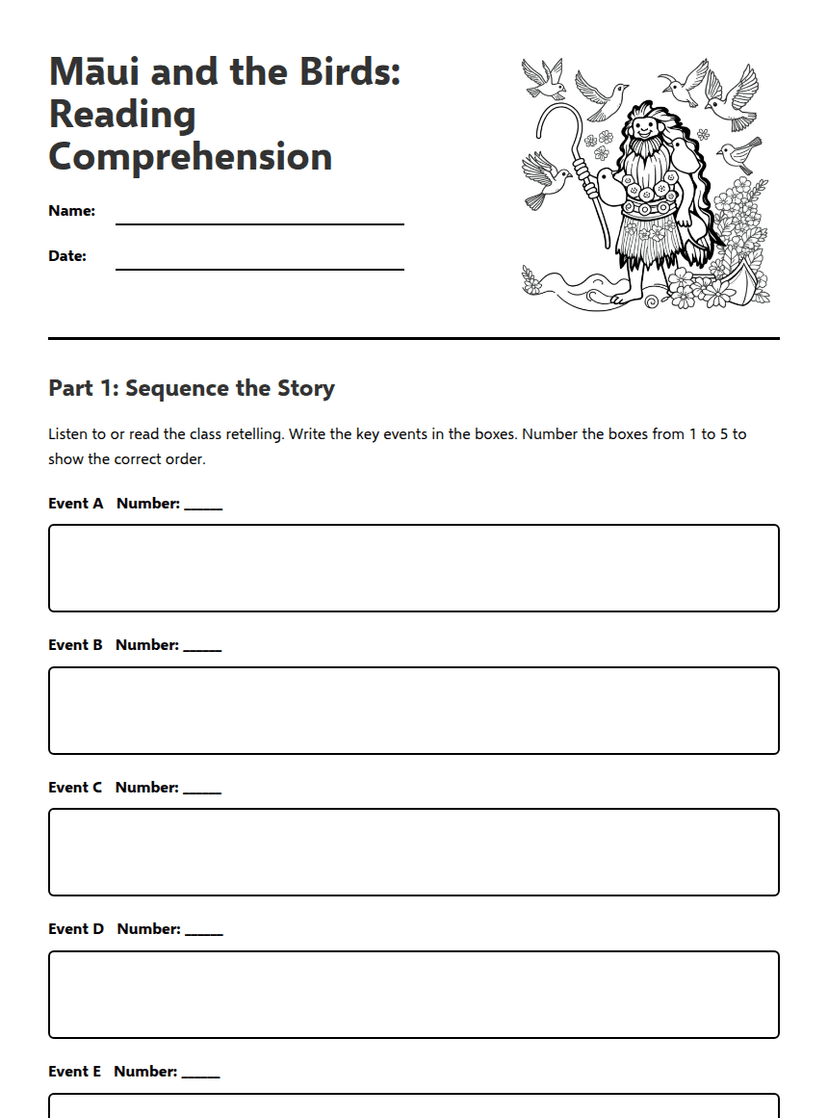
Māui and the Birds: Reading Comprehension
Free