Reproduction and Inheritance Concepts
A free science worksheet ready for your classroom. Open in Kuraplan to grab the print-ready PDF, customize it for your students, or generate a fresh version in seconds.
Reproduction and Inheritance Concepts
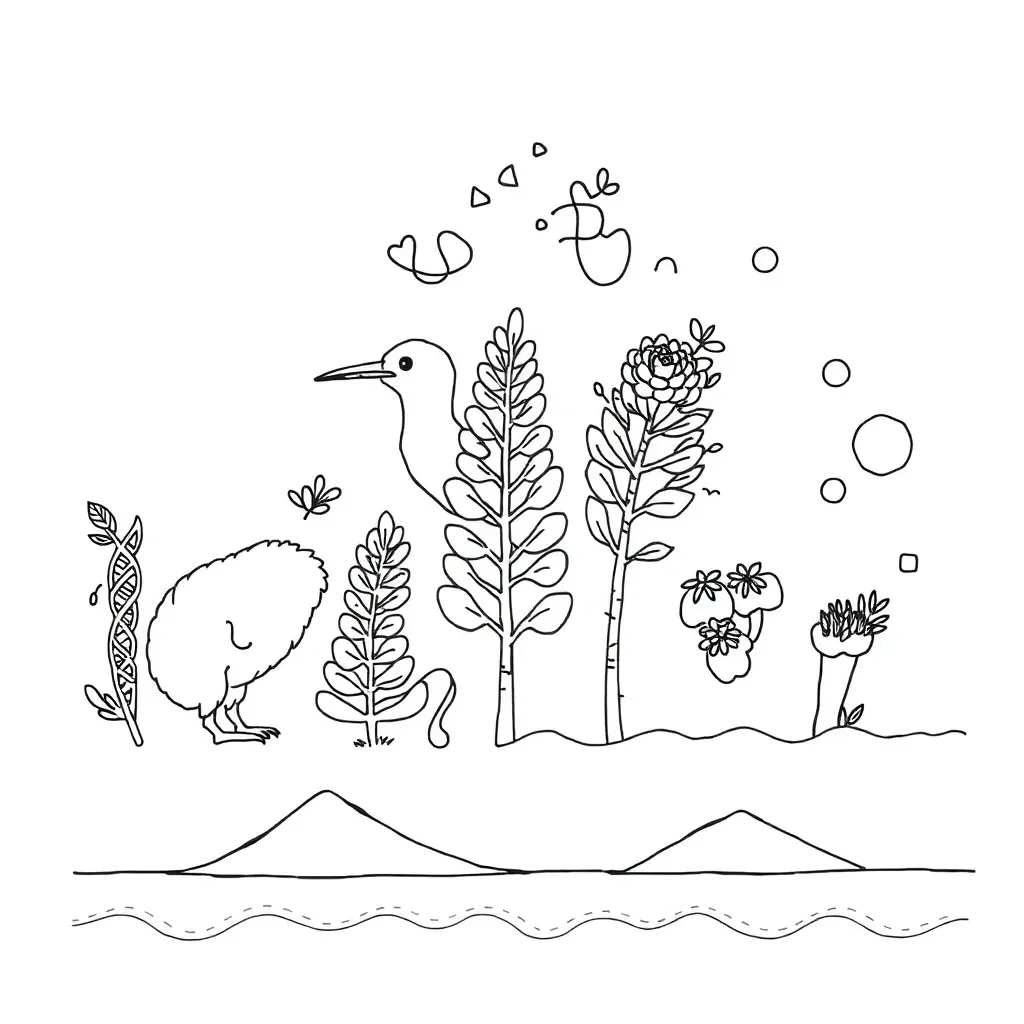
📚 Part 1: Multiple Choice, One-word & Fill-the-blanks
WALT: We are learning to identify differences between sexual and asexual reproduction, describe types of variation, and recall the role of DNA and karyotypes.
Success criteria: I can choose the correct reproduction type, name continuous/discontinuous variation, and fill key DNA/karyotype facts.
DNA is stored in the __________. A photograph or organised display of an organism's chromosomes is called a __________. Typical female sex chromosomes: ____ and male: ____.
✏️ Part 2: Punnett Squares, Prediction & Application
WALT: We are learning to predict inheritance using Punnett squares and interpret results for sex determination and simple traits.
Success criteria: I can draw Punnett squares for XX × XY, complete crosses for dominant/recessive traits and explain implications for whakapapa and health.
📝 Teacher notes, differentiation, dyslexia-friendly options & Answer Key
Differentiation strategies: Provide sentence starters for students who need support (e.g., "Dominant means..."). Allow labelled diagrams for EAL learners. Give manipulatives (coloured counters) to build Punnett squares for kinaesthetic learners.
Extension activities: Research a real genetic condition and prepare a short explanation of inheritance pattern; model polygenic traits and continuous variation using class data (e.g., height).
Dyslexia-friendly reading options: Use larger sans-serif fonts, increase line spacing, provide an audio version of the worksheet, and supply colour overlays or high-contrast printouts if needed.
Answer Key (brief)
Correct: Fusion of gametes to form a zygote (sexual reproduction involves gamete fusion).
Correct: Meiosis (produces new combinations of alleles leading to variation).
Answer: continuous
Answers: nucleus; karyotype; XX (female), XY (male).
Correct choices: Codes for proteins; Controls cell activities; Determines eye colour. (Not: causes identical clones)
Sample answer: A dominant allele is one that expresses its trait when at least one copy is present (masks a recessive allele).
Punnett square: Mother XX across top, Father X and Y down side → Boxes: X (from mum)+X (dad)=XX, X+Y=XY, XX and XY each 50%. Probability: 50% daughter, 50% son.
Punnett square for Hh × Hh gives genotypes: HH, Hh, Hh, hh → 25% hh (hitchhiker's thumb), 50% carriers (Hh), 25% homozygous dominant (HH).
Sample points: Family whakapapa shows patterns of inherited conditions and carrier status, helps doctors assess risk and recommend screening or early interventions.
For Aa × Aa: Genotypes = AA (25%), Aa (50%), aa (25%). Probabilities: affected (aa) 25%, carrier (Aa) 50%, unaffected non-carrier (AA) 25%.
About This Worksheet
Free in Kuraplan
Sign up free, grab the PDF, and customize it for your class.
Print-Ready
Formatted for standard paper. Clean layout, easy to read.
AI-Generated
Created with Kuraplan's AI, designed for real classroom use.
For Teachers & Parents
Use in classrooms, for homework, tutoring, or homeschool.
Need a custom version of this worksheet?
Kuraplan's AI generates custom worksheets in seconds — differentiated for every learner, aligned to your curriculum.
Generate Custom Worksheets — Free