ScienceFreePrintable

Scaled Solar System Model

A free science worksheet ready for your classroom. Open in Kuraplan to grab the print-ready PDF, customize it for your students, or generate a fresh version in seconds.
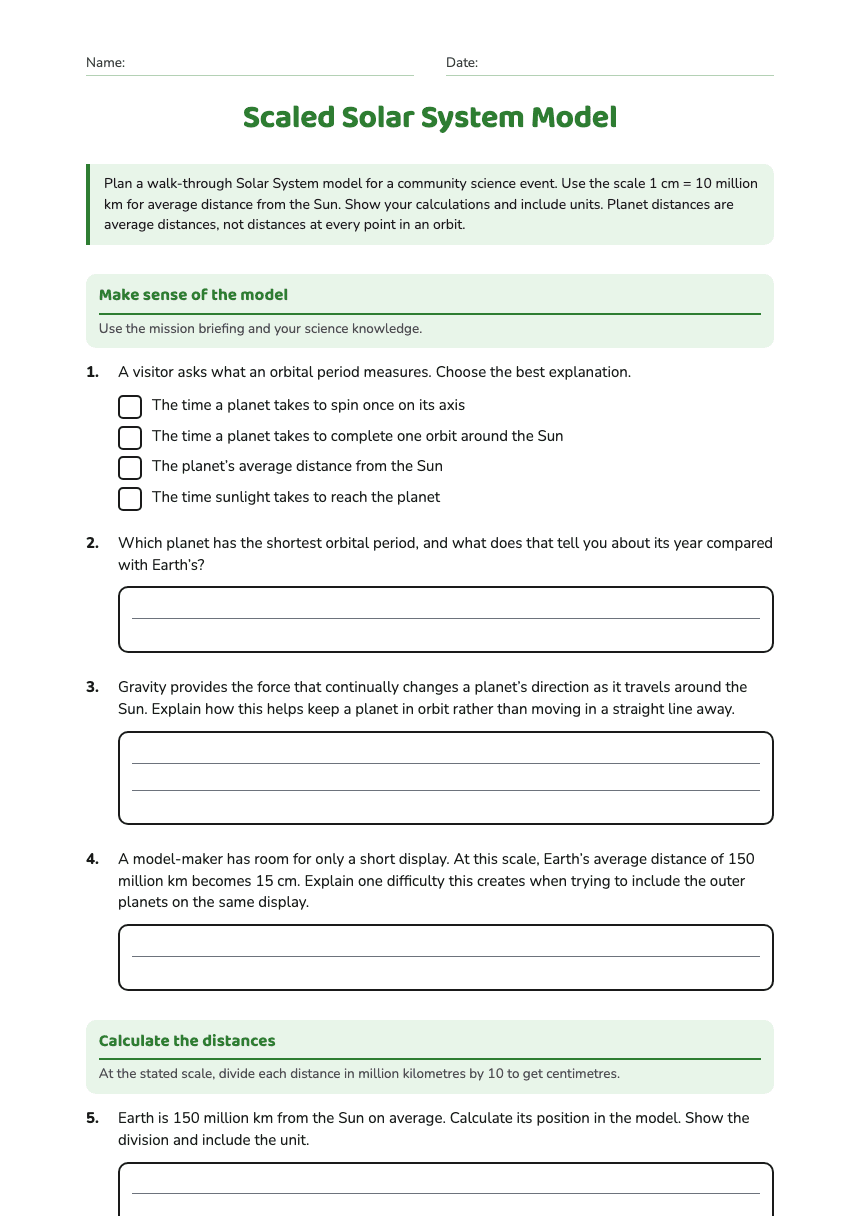
Scaled Solar System Model worksheet preview
Name:Date:

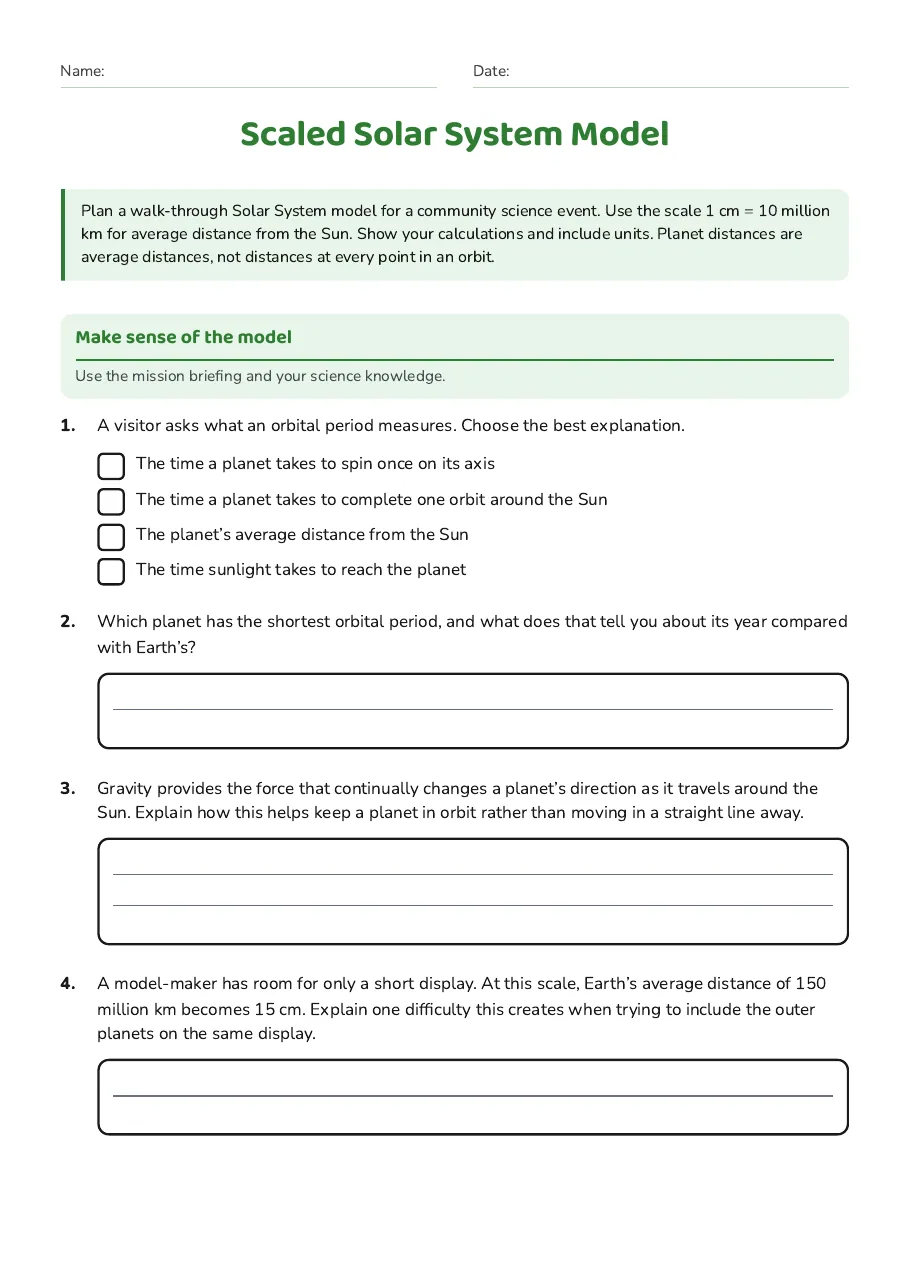
Scaled Solar System Model

Plan a walk-through Solar System model for a community science event. Use the scale 1 cm = 10 million km for average distance from the Sun. Show your calculations and include units. Planet distances are average distances, not distances at every point in an orbit.

Make sense of the model

Use the mission briefing and your science knowledge.

1.A visitor asks what an orbital period measures. Choose the best explanation.
  • The time a planet takes to spin once on its axis
  • The time a planet takes to complete one orbit around the Sun
  • The planet’s average distance from the Sun
  • The time sunlight takes to reach the planet
2.Which planet has the shortest orbital period, and what does that tell you about its year compared with Earth’s?
3.Gravity provides the force that continually changes a planet’s direction as it travels around the Sun. Explain how this helps keep a planet in orbit rather than moving in a straight line away.
4.A model-maker has room for only a short display. At this scale, Earth’s average distance of 150 million km becomes 15 cm. Explain one difficulty this creates when trying to include the outer planets on the same display.

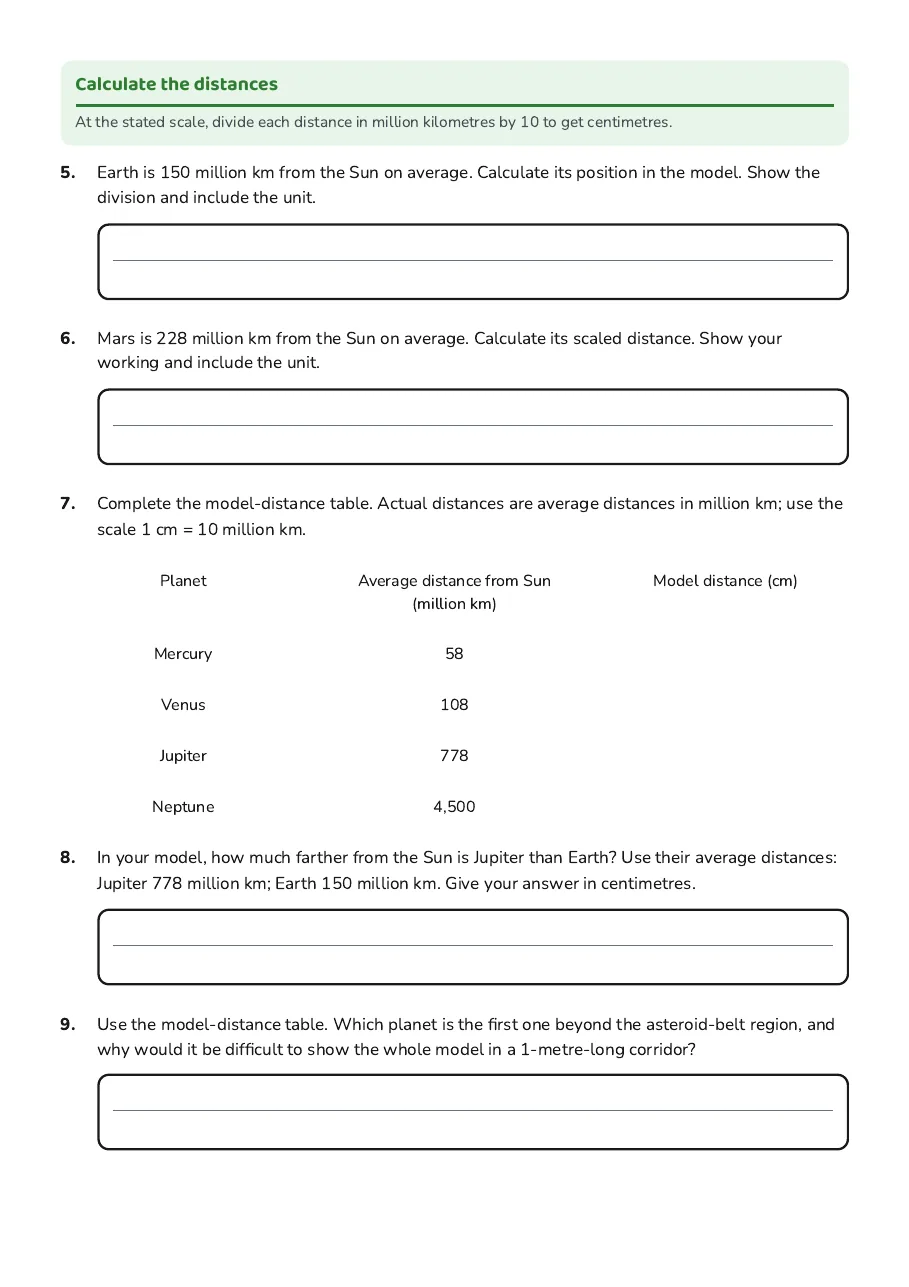
Calculate the distances

At the stated scale, divide each distance in million kilometres by 10 to get centimetres.

5.Earth is 150 million km from the Sun on average. Calculate its position in the model. Show the division and include the unit.
6.Mars is 228 million km from the Sun on average. Calculate its scaled distance. Show your working and include the unit.
7.Complete the model-distance table. Actual distances are average distances in million km; use the scale 1 cm = 10 million km.

Planet

Average distance from Sun (million km)

Model distance (cm)

Mercury

58

Venus

108

Jupiter

778

Neptune

4,500

8.In your model, how much farther from the Sun is Jupiter than Earth? Use their average distances: Jupiter 778 million km; Earth 150 million km. Give your answer in centimetres.
9.Use the model-distance table. Which planet is the first one beyond the asteroid-belt region, and why would it be difficult to show the whole model in a 1-metre-long corridor?

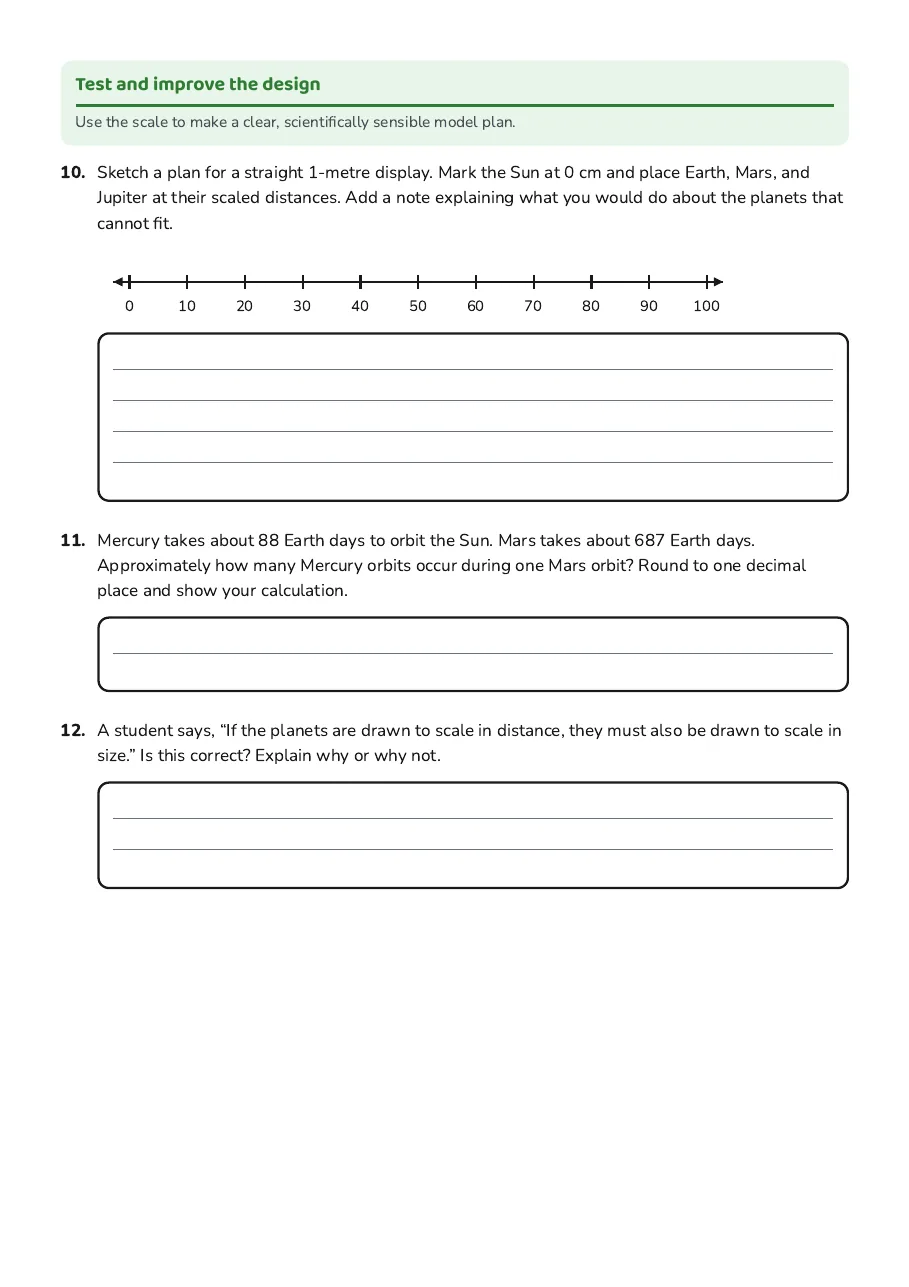
Test and improve the design

Use the scale to make a clear, scientifically sensible model plan.

10.Sketch a plan for a straight 1-metre display. Mark the Sun at 0 cm and place Earth, Mars, and Jupiter at their scaled distances. Add a note explaining what you would do about the planets that cannot fit.
0102030405060708090100
11.Mercury takes about 88 Earth days to orbit the Sun. Mars takes about 687 Earth days. Approximately how many Mercury orbits occur during one Mars orbit? Round to one decimal place and show your calculation.
12.A student says, “If the planets are drawn to scale in distance, they must also be drawn to scale in size.” Is this correct? Explain why or why not.

3 printable pages

  • Scaled Solar System Model, page 1 of 3: Make sense of the model

    Page 1

  • Scaled Solar System Model, page 2 of 3: Calculate the distances

    Page 2

  • Scaled Solar System Model, page 3 of 3: Test and improve the design

    Page 3

About This Worksheet

Free in Kuraplan

Sign up free, grab the PDF, and customize it for your class.

Print-Ready

Formatted for standard paper. Clean layout, easy to read.

AI-Generated

Created with Kuraplan's AI, designed for real classroom use.

For Teachers & Parents

Use in classrooms, for homework, tutoring, or homeschool.

Need a custom version of this worksheet?

Kuraplan's AI generates custom worksheets in seconds — differentiated for every learner, aligned to your curriculum.

Generate Custom Worksheets — Free
No credit card Curriculum-aligned Under 60 seconds