Solar System Reading Comprehension
A free english worksheet ready for your classroom. Open in Kuraplan to grab the print-ready PDF, customize it for your students, or generate a fresh version in seconds.
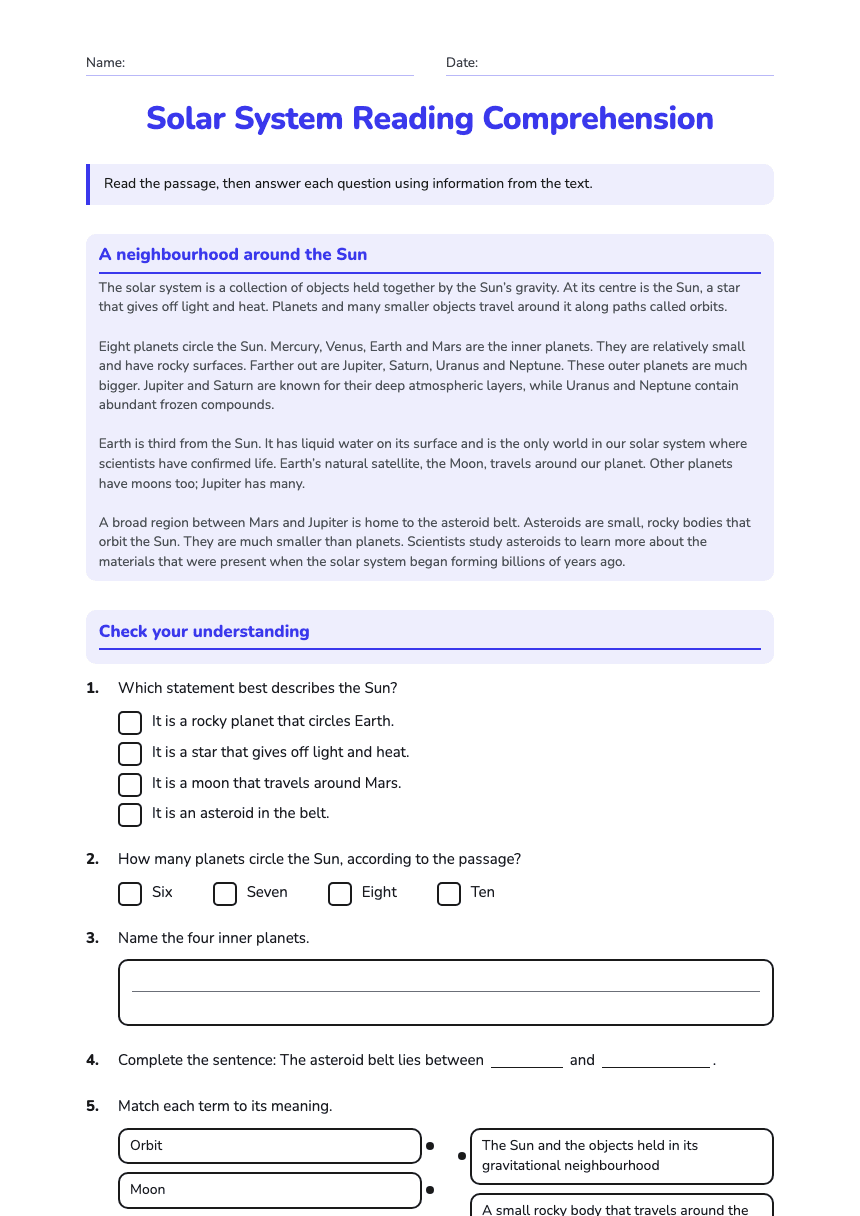
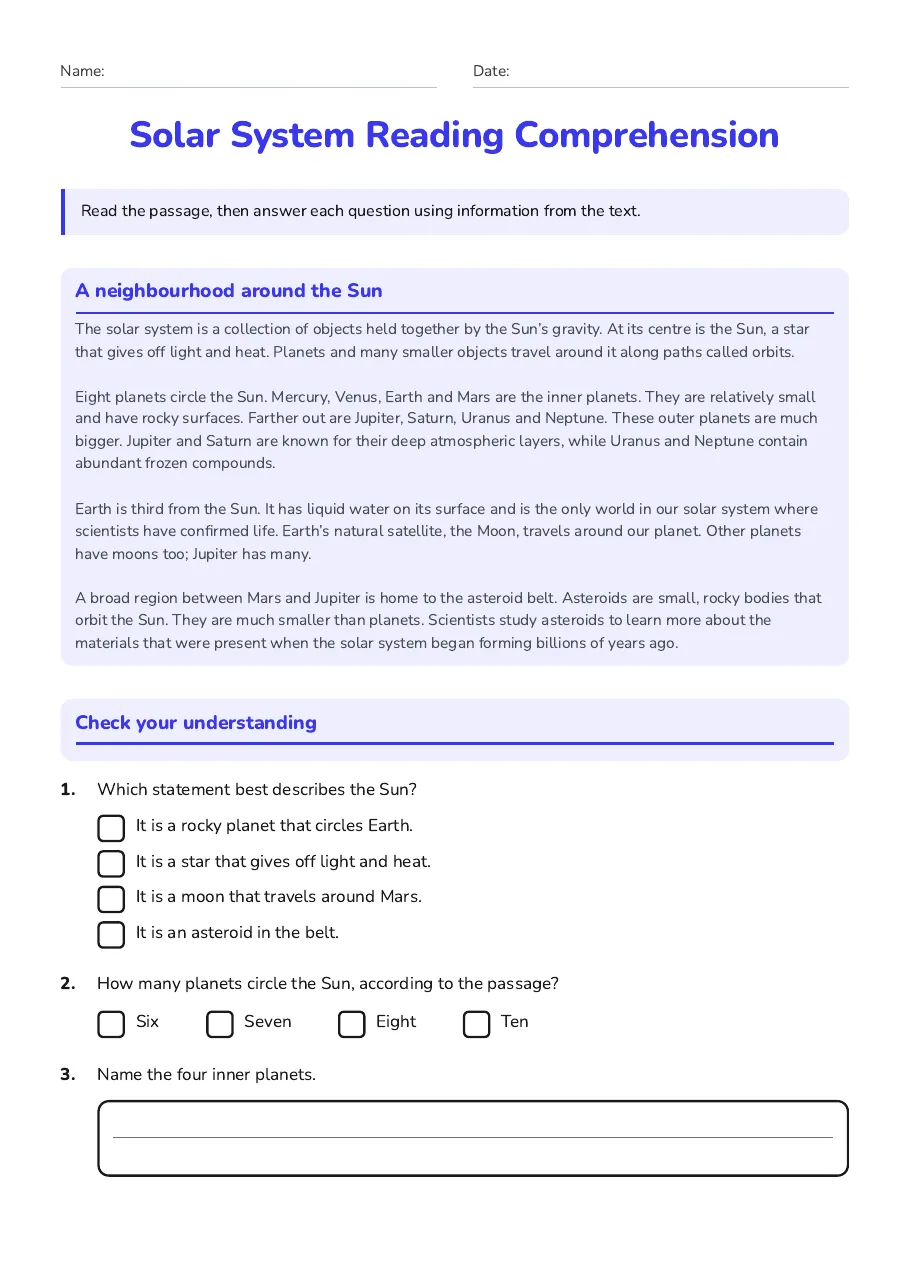
Solar System Reading Comprehension
A neighbourhood around the Sun
The solar system is a collection of objects held together by the Sun’s gravity. At its centre is the Sun, a star that gives off light and heat. Planets and many smaller objects travel around it along paths called orbits. Eight planets circle the Sun. Mercury, Venus, Earth and Mars are the inner planets. They are relatively small and have rocky surfaces. Farther out are Jupiter, Saturn, Uranus and Neptune. These outer planets are much bigger. Jupiter and Saturn are known for their deep atmospheric layers, while Uranus and Neptune contain abundant frozen compounds. Earth is third from the Sun. It has liquid water on its surface and is the only world in our solar system where scientists have confirmed life. Earth’s natural satellite, the Moon, travels around our planet. Other planets have moons too; Jupiter has many. A broad region between Mars and Jupiter is home to the asteroid belt. Asteroids are small, rocky bodies that orbit the Sun. They are much smaller than planets. Scientists study asteroids to learn more about the materials that were present when the solar system began forming billions of years ago.
Check your understanding
- It is a rocky planet that circles Earth.
- It is a star that gives off light and heat.
- It is a moon that travels around Mars.
- It is an asteroid in the belt.
- Six
- Seven
- Eight
- Ten
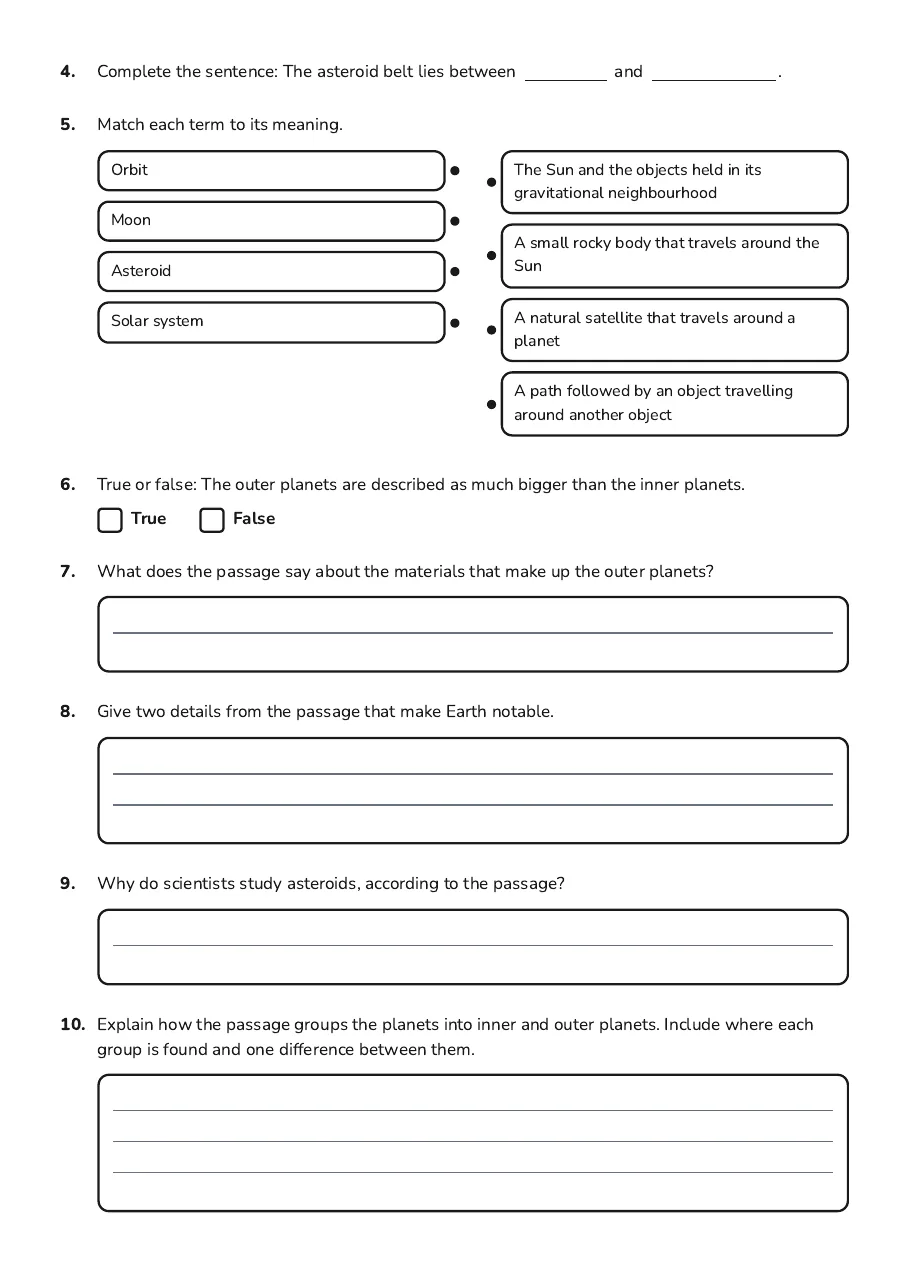
- Orbit
- Moon
- Asteroid
- Solar system
- The Sun and the objects held in its gravitational neighbourhood
- A small rocky body that travels around the Sun
- A natural satellite that travels around a planet
- A path followed by an object travelling around another object
2 printable pages
Page 1
Page 2
About This Worksheet
Free in Kuraplan
Sign up free, grab the PDF, and customize it for your class.
Print-Ready
Formatted for standard paper. Clean layout, easy to read.
AI-Generated
Created with Kuraplan's AI, designed for real classroom use.
For Teachers & Parents
Use in classrooms, for homework, tutoring, or homeschool.
Need a custom version of this worksheet?
Kuraplan's AI generates custom worksheets in seconds — differentiated for every learner, aligned to your curriculum.
Generate Custom Worksheets — Free