Space Systems Synthesis Worksheet
A free science worksheet ready for your classroom. Open in Kuraplan to grab the print-ready PDF, customize it for your students, or generate a fresh version in seconds.
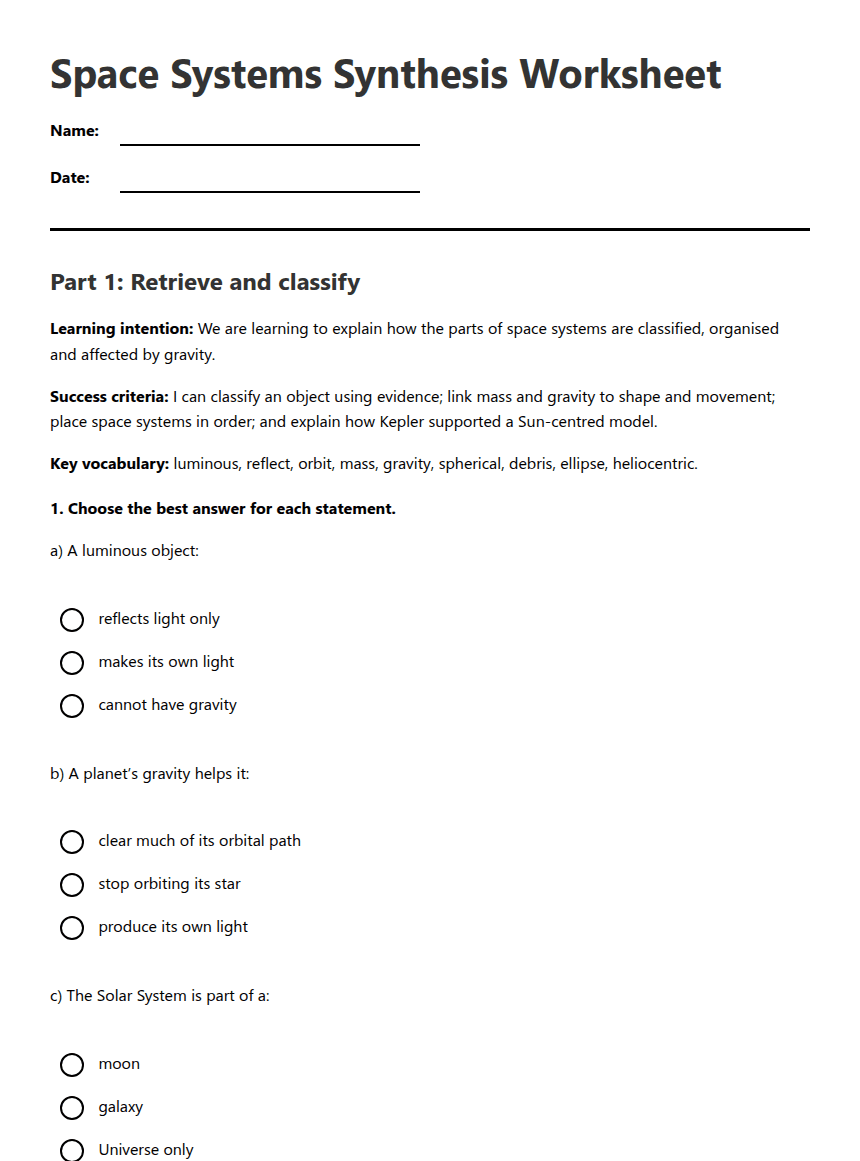
Space Systems Synthesis Worksheet
Part 1: Retrieve and classify
Learning intention: We are learning to explain how the parts of space systems are classified, organised and affected by gravity.
Success criteria: I can classify an object using evidence; link mass and gravity to shape and movement; place space systems in order; and explain how Kepler supported a Sun-centred model.
Key vocabulary: luminous, reflect, orbit, mass, gravity, spherical, debris, ellipse, heliocentric.
a) A luminous object:
b) A planet’s gravity helps it:
c) The Solar System is part of a:
Part 2: Model, evidence and relationships
Remember: this model shows relationships, not accurate sizes or distances.
More __________ means __________ gravity. Gravity can pull a large body into a __________ shape, bend the movement of an object into an __________, and help a planet clear nearby __________.
Claim: Kepler’s observations supported the heliocentric model because …
Evidence and reasoning: What did observations of planetary paths show, and why did this fit a Sun-centred model better?
Smallest → largest: ______________ → ______________ → ______________ → ______________
Example of a galaxy: ______________________________
Part 3: Exit synthesis
Teacher answer key
1. a) makes its own light; b) clear much of its orbital path; c) galaxy.
2. A–3, B–5, C–2, D–4, E–1.
3. Dwarf planet. It is round and orbits the Sun but has not cleared its orbital path. It reflects sunlight rather than producing its own light.
4. The Moon orbits Earth; Earth orbits the Sun. Arrows should show these relationships.
5. The Moon does not make its own light; it reflects sunlight. An elliptical orbit is a stable curved orbit, so Earth does not automatically crash into the Sun.
6. mass; stronger gravity; spherical; orbit; debris.
7. Kepler found that planets travel in elliptical paths, with the Sun at one focus. These observations matched a Sun-centred model more accurately than an Earth-centred model.
8. Moon → planetary system → galaxy → Universe. Example: the Milky Way.
9–10. Accept scientifically accurate answers that use evidence and correctly link mass, gravity, shape, orbits and clearing debris.
About This Worksheet
Free in Kuraplan
Sign up free, grab the PDF, and customize it for your class.
Print-Ready
Formatted for standard paper. Clean layout, easy to read.
AI-Generated
Created with Kuraplan's AI, designed for real classroom use.
For Teachers & Parents
Use in classrooms, for homework, tutoring, or homeschool.
Need a custom version of this worksheet?
Kuraplan's AI generates custom worksheets in seconds — differentiated for every learner, aligned to your curriculum.
Generate Custom Worksheets — Free