EnglishFreePrintable
Taika Waititi Vocabulary
A free english worksheet ready for your classroom. Open in Kuraplan to grab the print-ready PDF, customize it for your students, or generate a fresh version in seconds.
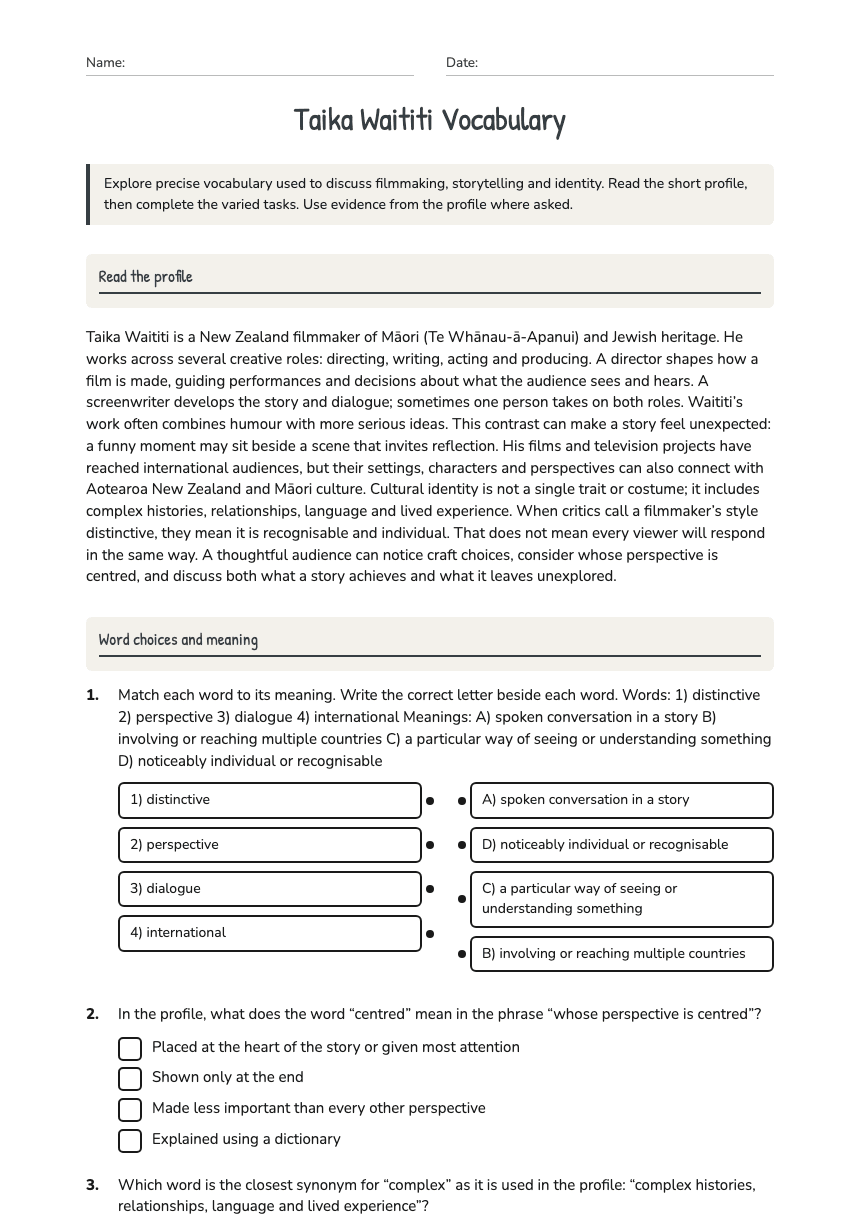
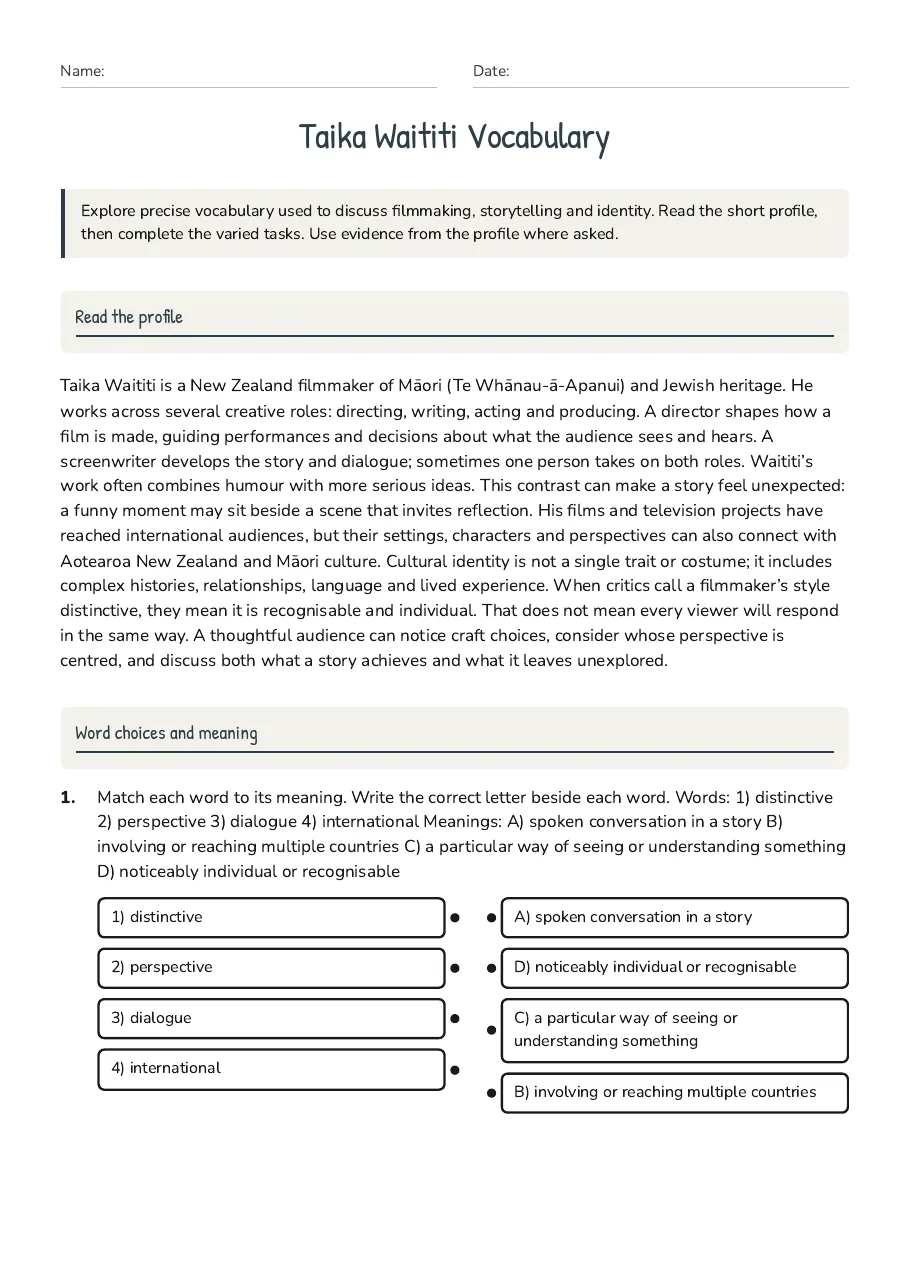
Name:Date:
Taika Waititi Vocabulary
Explore precise vocabulary used to discuss filmmaking, storytelling and identity. Read the short profile, then complete the varied tasks. Use evidence from the profile where asked.
Read the profile
Taika Waititi is a New Zealand filmmaker of Māori (Te Whānau-ā-Apanui) and Jewish heritage. He works across several creative roles: directing, writing, acting and producing. A director shapes how a film is made, guiding performances and decisions about what the audience sees and hears. A screenwriter develops the story and dialogue; sometimes one person takes on both roles.
Waititi’s work often combines humour with more serious ideas. This contrast can make a story feel unexpected: a funny moment may sit beside a scene that invites reflection. His films and television projects have reached international audiences, but their settings, characters and perspectives can also connect with Aotearoa New Zealand and Māori culture. Cultural identity is not a single trait or costume; it includes complex histories, relationships, language and lived experience.
When critics call a filmmaker’s style distinctive, they mean it is recognisable and individual. That does not mean every viewer will respond in the same way. A thoughtful audience can notice craft choices, consider whose perspective is centred, and discuss both what a story achieves and what it leaves unexplored.
Word choices and meaning
1.Match each word to its meaning. Write the correct letter beside each word.
Words: 1) distinctive 2) perspective 3) dialogue 4) international
Meanings: A) spoken conversation in a story B) involving or reaching multiple countries C) a particular way of seeing or understanding something D) noticeably individual or recognisable
- 1) distinctive
- 2) perspective
- 3) dialogue
- 4) international
- A) spoken conversation in a story
- D) noticeably individual or recognisable
- C) a particular way of seeing or understanding something
- B) involving or reaching multiple countries
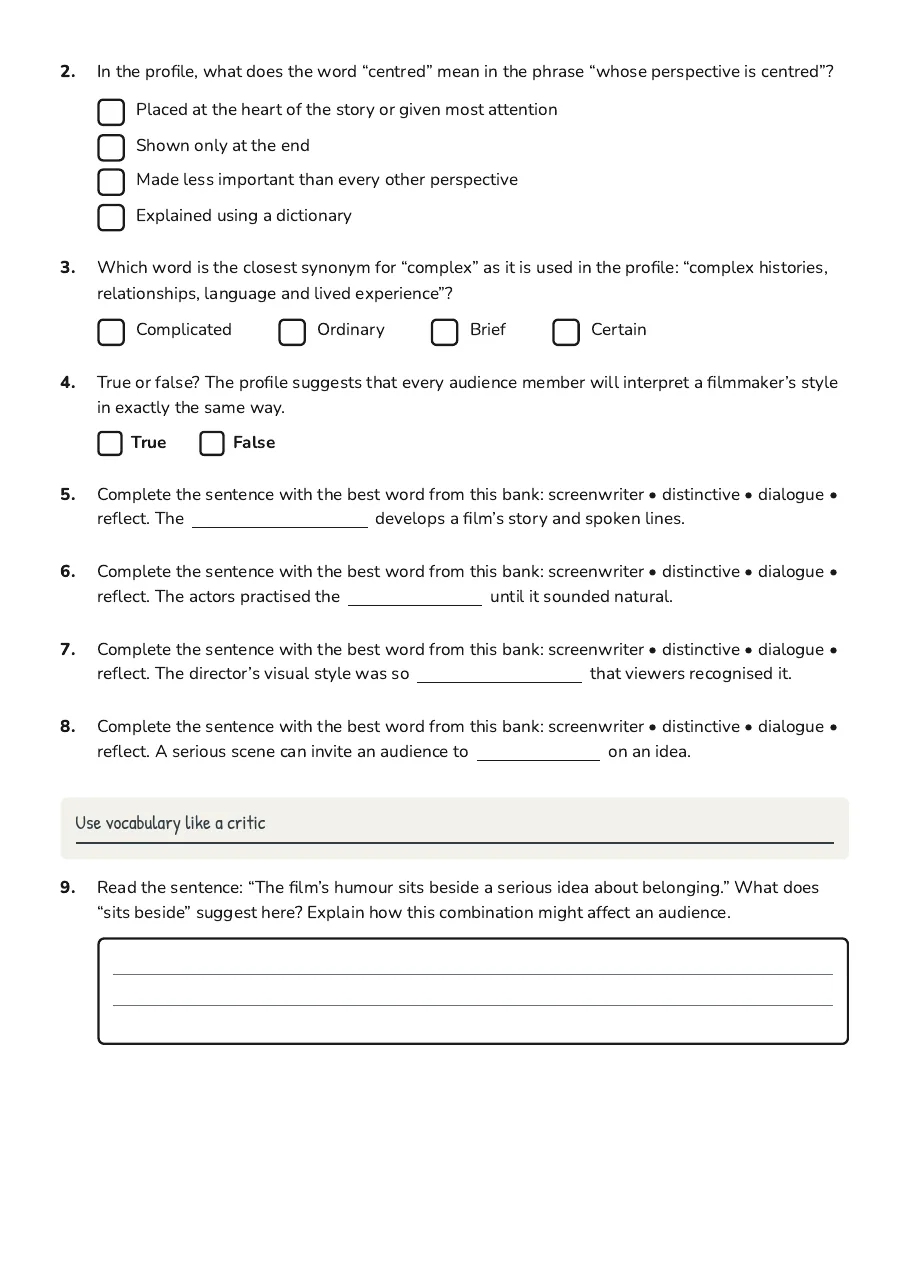
2.In the profile, what does the word “centred” mean in the phrase “whose perspective is centred”?
- Placed at the heart of the story or given most attention
- Shown only at the end
- Made less important than every other perspective
- Explained using a dictionary
3.Which word is the closest synonym for “complex” as it is used in the profile: “complex histories, relationships, language and lived experience”?
- Complicated
- Ordinary
- Brief
- Certain
4.True or false? The profile suggests that every audience member will interpret a filmmaker’s style in exactly the same way.
TrueFalse
5.Complete the sentence with the best word from this bank: screenwriter • distinctive • dialogue • reflect.
The develops a film’s story and spoken lines.
6.Complete the sentence with the best word from this bank: screenwriter • distinctive • dialogue • reflect.
The actors practised the until it sounded natural.
7.Complete the sentence with the best word from this bank: screenwriter • distinctive • dialogue • reflect.
The director’s visual style was so that viewers recognised it.
8.Complete the sentence with the best word from this bank: screenwriter • distinctive • dialogue • reflect.
A serious scene can invite an audience to on an idea.
Use vocabulary like a critic
9.Read the sentence: “The film’s humour sits beside a serious idea about belonging.” What does “sits beside” suggest here? Explain how this combination might affect an audience.
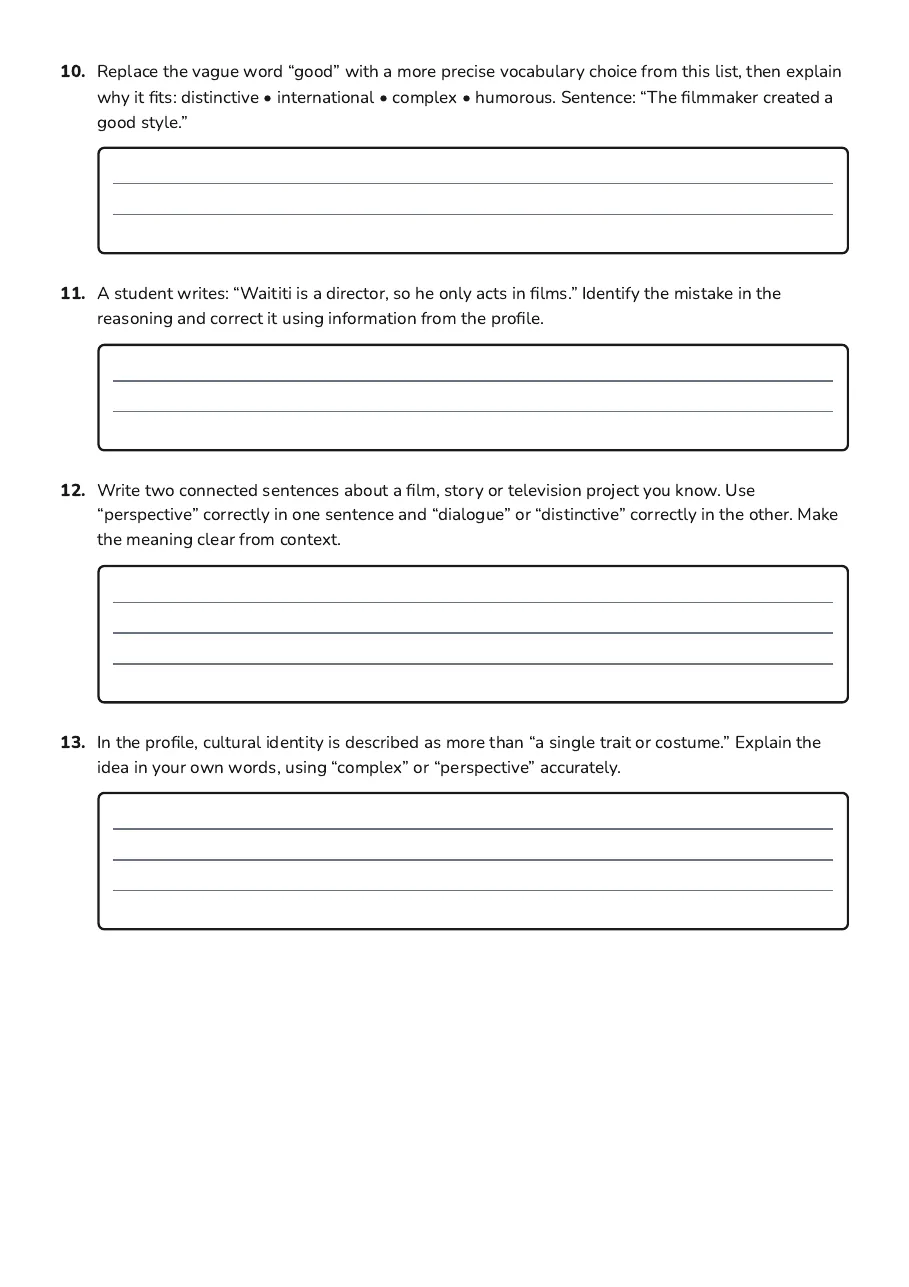
10.Replace the vague word “good” with a more precise vocabulary choice from this list, then explain why it fits: distinctive • international • complex • humorous.
Sentence: “The filmmaker created a good style.”
11.A student writes: “Waititi is a director, so he only acts in films.” Identify the mistake in the reasoning and correct it using information from the profile.
12.Write two connected sentences about a film, story or television project you know. Use “perspective” correctly in one sentence and “dialogue” or “distinctive” correctly in the other. Make the meaning clear from context.
13.In the profile, cultural identity is described as more than “a single trait or costume.” Explain the idea in your own words, using “complex” or “perspective” accurately.
3 printable pages
Page 1
Page 2
Page 3
About This Worksheet
Free in Kuraplan
Sign up free, grab the PDF, and customize it for your class.
Print-Ready
Formatted for standard paper. Clean layout, easy to read.
AI-Generated
Created with Kuraplan's AI, designed for real classroom use.
For Teachers & Parents
Use in classrooms, for homework, tutoring, or homeschool.
Need a custom version of this worksheet?
Kuraplan's AI generates custom worksheets in seconds — differentiated for every learner, aligned to your curriculum.
Generate Custom Worksheets — Free No credit card Curriculum-aligned Under 60 seconds