Te Ao Haka Quiz
A free te reo māori worksheet ready for your classroom. Open in Kuraplan to grab the print-ready PDF, customize it for your students, or generate a fresh version in seconds.

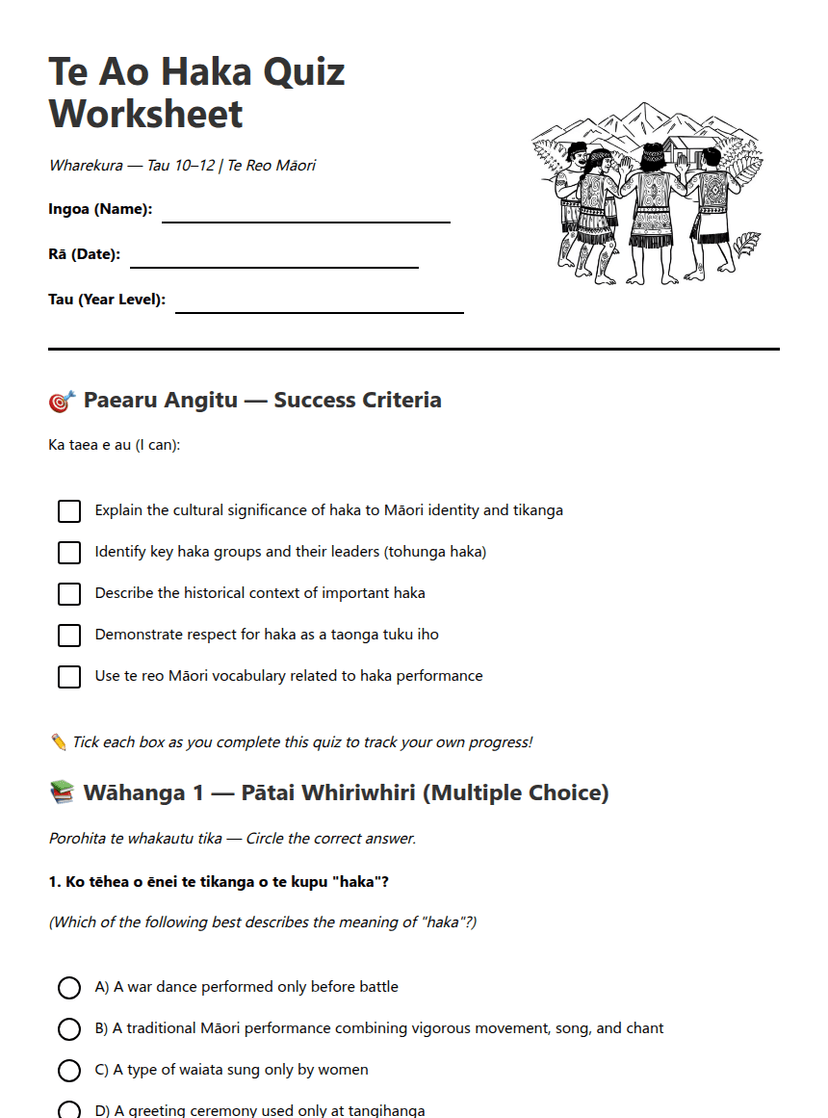
Te Ao Haka Quiz
Tau 11 | Te Reo Māori
📋 Ngā Tohutohu — Instructions
Read each question carefully before answering. This quiz covers the cultural, historical, and social aspects of Haka within Te Ao Māori.
Section 1: Circle the correct answer for each multiple choice question.
Section 2: Answer each written response question in full sentences where possible.
Section 3: Extended response — write as much detail as you can.
Āputa katoa: 50 marks total. Kia kaha — do your best! 💪
✅ Paearu Angitu — Success Criteria
By the end of this quiz, you will have demonstrated that you can:
🔹 Explain the cultural significance of Haka within Te Ao Māori.
🔹 Identify key types of Haka and their purposes.
🔹 Describe the historical origins and social roles of Haka.
🔹 Use te reo Māori terminology related to Haka accurately.
🎯 Wāhanga 1 — Multiple Choice (2 marks each | 14 marks total)
Tohutohu: Circle ONE correct answer for each question.
✏️ Wāhanga 2 — Short Answer (4 marks each | 24 marks total)
Tohutohu: Answer each question using full sentences. Use te reo Māori where you can.
🌟 Wāhanga 3 — Extended Response (12 marks)
Tohutohu: Answer the following question in as much detail as possible. Use te reo Māori terminology where appropriate. You will be assessed on: content knowledge, use of examples, and clarity of explanation.
Using this whakataukī as your starting point, discuss the cultural, historical, and social importance of Haka within Te Ao Māori. In your response, include: the origins of Haka, its role in Māori society (past and present), and why it is important to protect and preserve it. (12 marks)
🔑 Key to Answers
Wāhanga 1 — Multiple Choice Answers
1. b) Tūmatauenga
2. b) To welcome and acknowledge guests onto a marae
3. a) Te Rauparaha
4. b) A war Haka performed with weapons, including jumping
5. b) Haka is only ever performed as a war challenge
6. b) The lead caller or leader of the Haka
7. b) Every two years
Wāhanga 2 — Suggested Key Points for Short Answers
8. Types of Haka: peruperu (war Haka) - used in battle; haka pōwhiri - used to welcome guests.
9. Pūkana (wide eyes) and whetero (protruding tongue) enhance expression and convey emotion, adding to the performance's impact.
10. Haka reflects mana (prestige), tapu (sacredness), and whakapapa (genealogy) through its storytelling and connection to ancestors.
11. Agree/Disagree with reasons related to respect for culture and authenticity.
12. Connection to Tūmatauenga as a warrior and the embodiment of strength and resilience.
13. Historical context: traditional Haka in battles; contemporary context: Haka in sports and cultural events.
Wāhanga 3 — Suggested Key Points for Extended Response
14. Discuss origins, roles in society, and importance of preservation with examples.
About This Worksheet
Free in Kuraplan
Sign up free, grab the PDF, and customize it for your class.
Print-Ready
Formatted for standard paper. Clean layout, easy to read.
AI-Generated
Created with Kuraplan's AI, designed for real classroom use.
For Teachers & Parents
Use in classrooms, for homework, tutoring, or homeschool.
Need a custom version of this worksheet?
Kuraplan's AI generates custom worksheets in seconds — differentiated for every learner, aligned to your curriculum.
Generate Custom Worksheets — Free