Time, Fractions & Sunlight
A free maths worksheet ready for your classroom. Open in Kuraplan to grab the print-ready PDF, customize it for your students, or generate a fresh version in seconds.
Time, Fractions & Sunlight
📋 Lesson Plan — Years 2–3 Maths
🌞 Lesson Overview
Duration: 31 minutes | Class Size: 25 students | Year Level: 2–3
A hands-on lesson exploring the concept of time using sundials and the sun's movement. Students integrate basic fractions with creative writing and art, aligned with the New Zealand Curriculum Refresh, Phase 1 Mathematics & Statistics — focusing on measurement, rational numbers, and patterns.
🎯 Learning Objectives
Measurement & Geometry
• Identify and describe the passing of time including days, hours, and seasons; understand duration and sequence of events.
• Use everyday language of time: 'o'clock', 'half past', 'quarter past', and 'quarter to'.
• Investigate angles and turns, linking quarter and half turns to fractions (half, quarter).
Rational Numbers (Fractions)
• Identify, represent, and name halves, quarters, and eighths using equal parts of sets and regions.
• Use mathematical language: numerator, denominator, equal parts, shared equally, partition.
• Compare and order simple fractions and represent fractions on number lines.
Language & Creative Arts
• Use mathematical language to explain patterns and sequences in writing.
• Represent concepts artistically through sundial diagrams and fraction art.
🔑 Key Competencies
• Thinking: Critical thinking examining sun movement and time fractions.
• Using language, symbols and texts: Explain time and fractions verbally and in writing.
• Participating and contributing: Work in pairs to explore and discuss findings.
• Managing Self: Engage with time measurement activities independently and creatively.
🧰 Materials Preparation
Gather the following before the lesson:
⏱️ Lesson Plan with Timings
1. Starter: Introduction to Time and Sundials (5 minutes)
• Brief discussion: How did people use the sun long ago to tell time using sundials?
• Show an image or model of a sundial to the class.
• Explain that the sun moves across the sky, casting shadows that change length and position throughout the day.
Curriculum link: Measurement — time concepts, using everyday language of time.
2. Main Activity Part 1: Making Simple Sundials (10 minutes)
• Students work in pairs to create sundials using paper plates with a straw inserted in the centre as the gnomon.
• Mark the plate to represent clock hours, beginning with observation of the sun's shadow direction.
• Take sundials outside briefly (or observe shadows near a light source inside) to watch shadow movement.
Focus: Understand how shadow position changes with time — linking real-world sun movement to analogue clock times.
Curriculum link: Measurement — duration, sequence, and everyday time language.
3. Main Activity Part 2: Fractions Using Sundial Shadows (7 minutes)
• Use the sundial to explore time fractions: half past, quarter past, quarter to.
• Demonstrate with paper plates divided into halves and quarters — relate these to parts of the clock face (e.g., half the clock = 30 minutes).
• Students colour and label fractions on their sundial templates, linking fractional parts to time passed.
Key vocabulary to use: numerator, denominator, equal parts, half, quarter, partition.
Curriculum link: Rational numbers — halves, quarters, equal parts, number lines.
4. Linking Writing & Art (7 minutes)
• Students write simple sentences about their observations. Prompt questions:
– How did the shadow change over time?
– What does 'half past' mean on your sundial?
– What does 'quarter to' look like as a fraction?
• Students create an artistic sundial illustration or decorate fraction strips related to their sundial.
Curriculum link: Language and communication; Creative Arts — connecting mathematical understanding with expressive arts.
5. Wrap-up and Reflection (2 minutes)
• Ask students to share one thing they learned about time and fractions.
• Recap: How does the sun help us tell time? How do fractions explain parts of an hour?
• Briefly connect sundial shadows to analogue clock positions as a closing link.
📊 Assessment & Teacher Notes
Assessment Strategies
• Observation: Monitor student participation and understanding during sundial construction and pair work.
• Work sample: Check accuracy of fraction labelling on sundial templates and written sentences about time concepts.
• Informal questioning: Use wrap-up discussion to assess conceptual grasp of time fractions and shadow movement.
✏️ Teacher Reflection Notes
🌟 Extension Ideas
• Outdoor tracking: Take sundials outside at different times of the day to track shadow changes across a full school day.
• Cultural connections: Connect to Māori concepts of time and seasons — integrate te reo Māori language for days, months, and time (e.g., ata — morning, ahiahi — afternoon). Supported by curriculum emphasis on cultural contexts.
• Digital clocks: After sundial exploration, compare analogue sundial readings with digital clock displays for comparative learning.
• Fractions extension: Introduce eighths — divide the clock face into 8 equal parts and link to 7.5-minute intervals.
📌 Curriculum Alignment Summary
NZ Curriculum Refresh — Phase 1, Mathematics & Statistics:
• Measurement & Geometry: Time, duration, sequence, angles and turns.
• Rational Numbers: Halves, quarters, eighths; equal parts; number lines.
• Patterns & Relationships: Observing and describing patterns in shadow movement.
• Cross-curricular: Language Arts (writing), Creative Arts (visual art), Science (sun and shadows).
About This Worksheet
Free in Kuraplan
Sign up free, grab the PDF, and customize it for your class.
Print-Ready
Formatted for standard paper. Clean layout, easy to read.
AI-Generated
Created with Kuraplan's AI, designed for real classroom use.
For Teachers & Parents
Use in classrooms, for homework, tutoring, or homeschool.
Need a custom version of this worksheet?
Kuraplan's AI generates custom worksheets in seconds — differentiated for every learner, aligned to your curriculum.
Generate Custom Worksheets — FreeMore Maths Worksheets
Same-Denominator Fractions
Free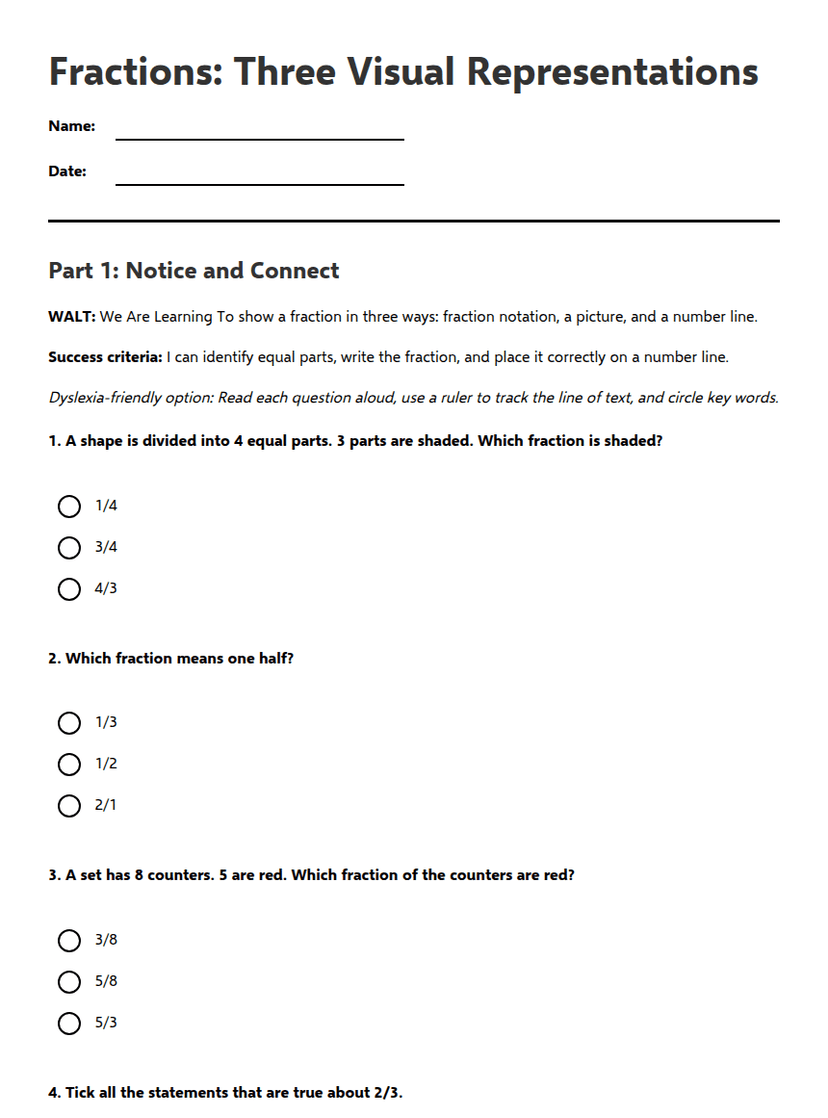
Fractions: Three Visual Representations
Free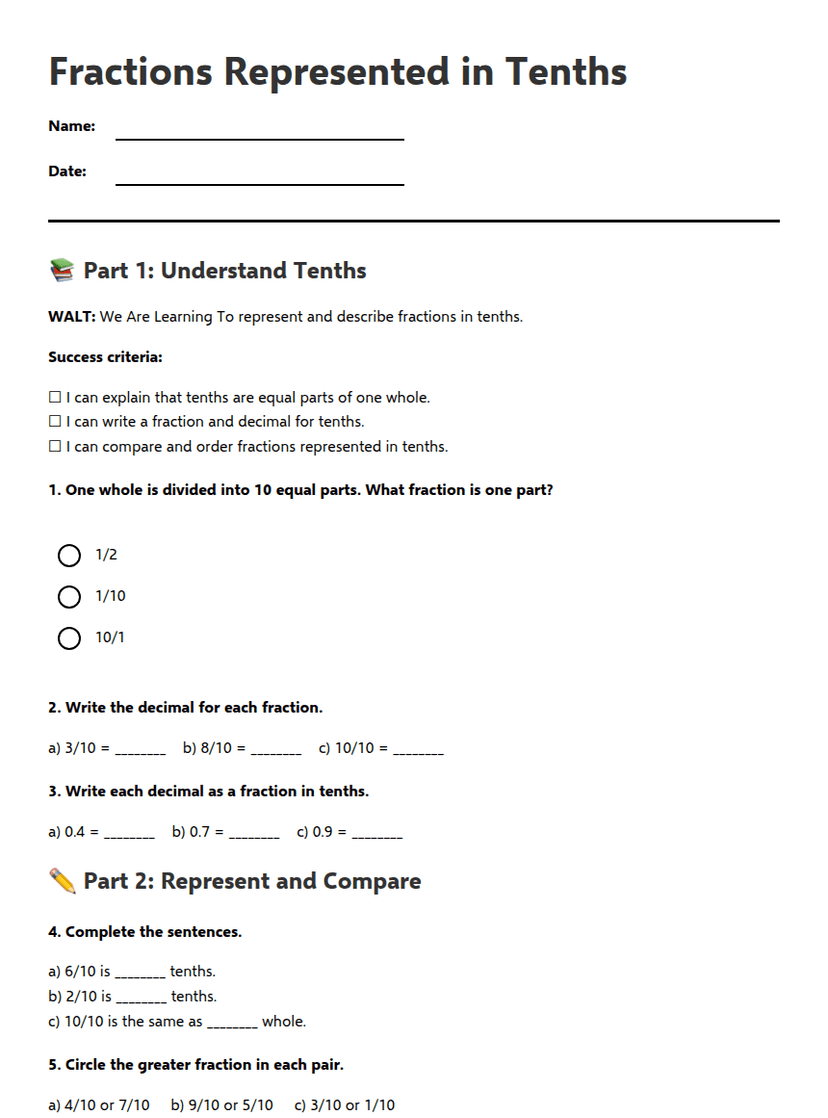
Fractions Represented in Tenths
Free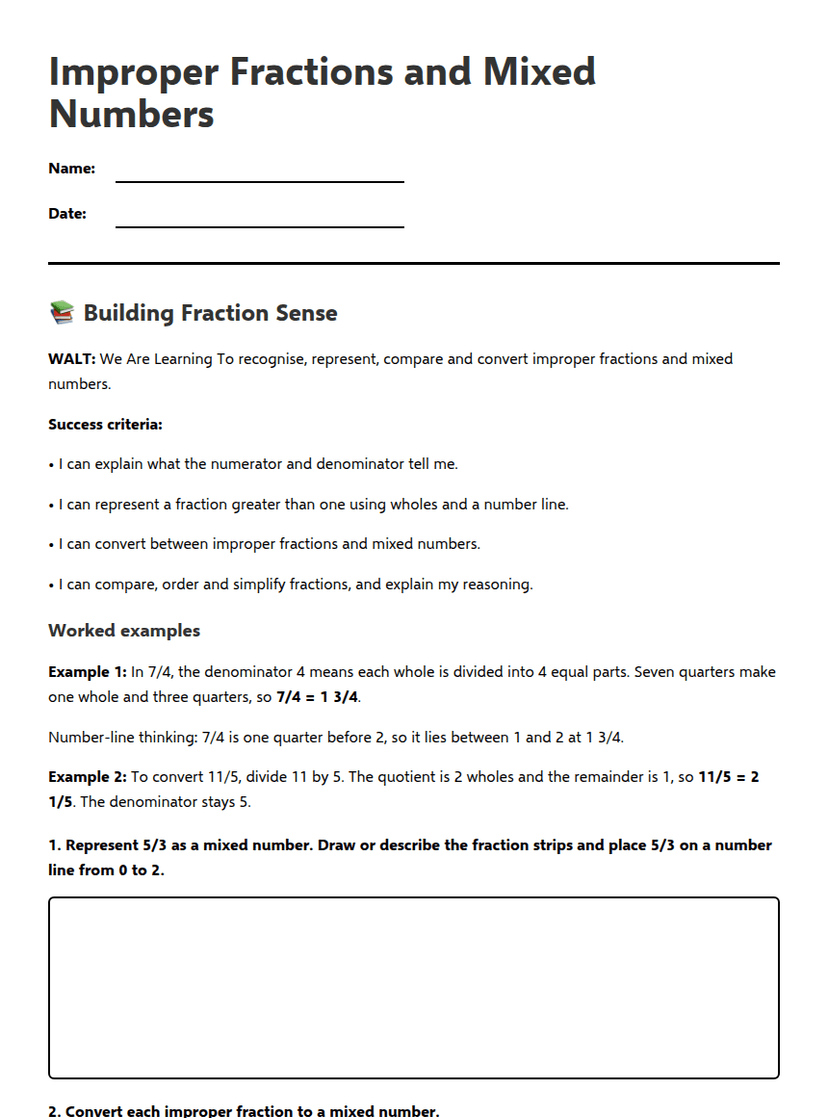
Improper Fractions and Mixed Numbers
Free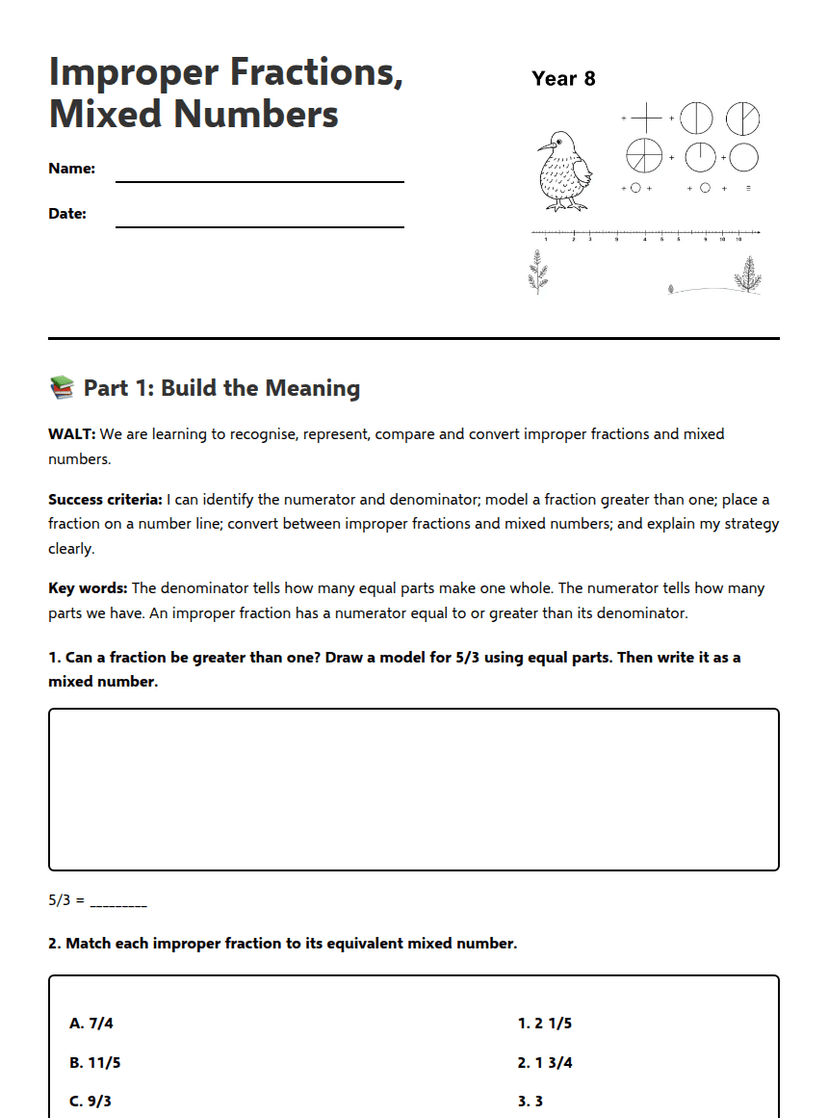
Improper Fractions, Mixed Numbers
Free
Improper Fractions and Mixed Numbers
Free
Sharing Fairly: Whole and Half
Free