Understanding Te Tiriti o Waitangi
A free social sciences worksheet ready for your classroom. Open in Kuraplan to grab the print-ready PDF, customize it for your students, or generate a fresh version in seconds.
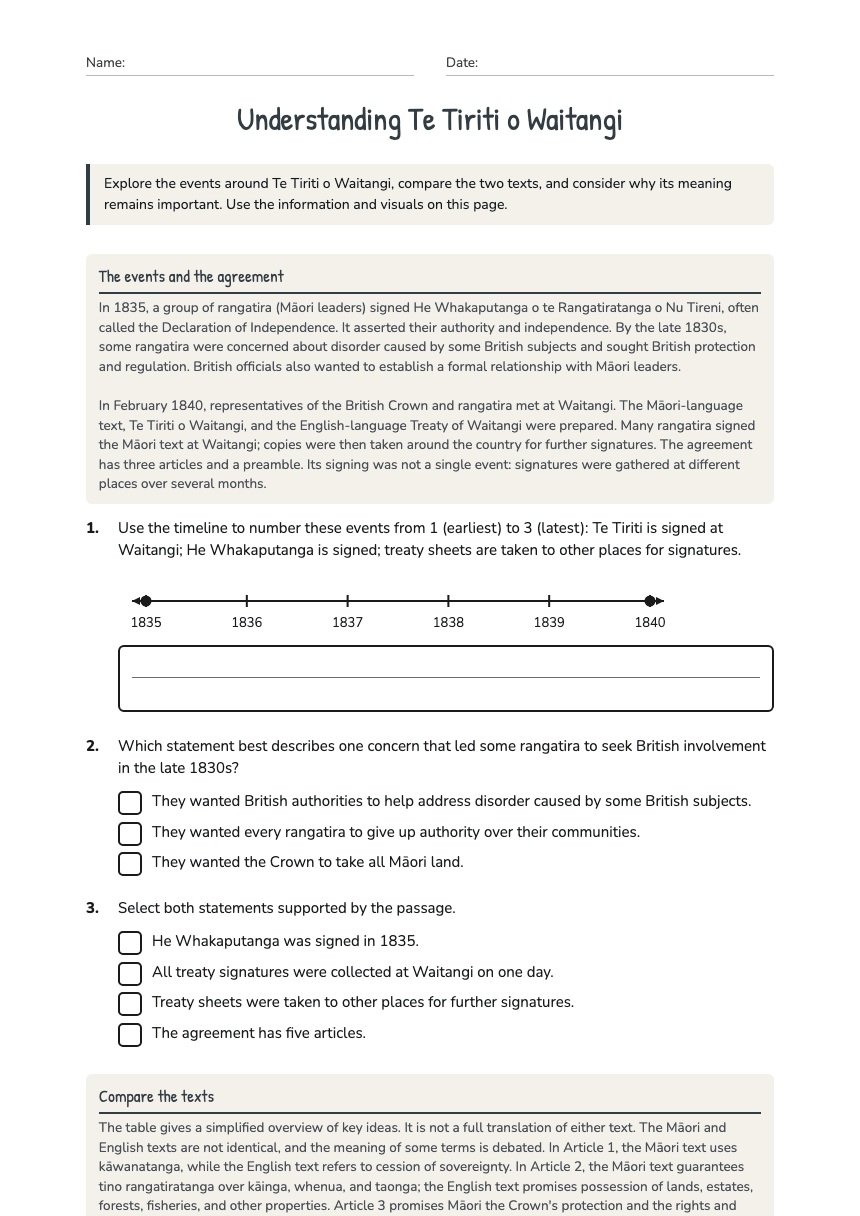
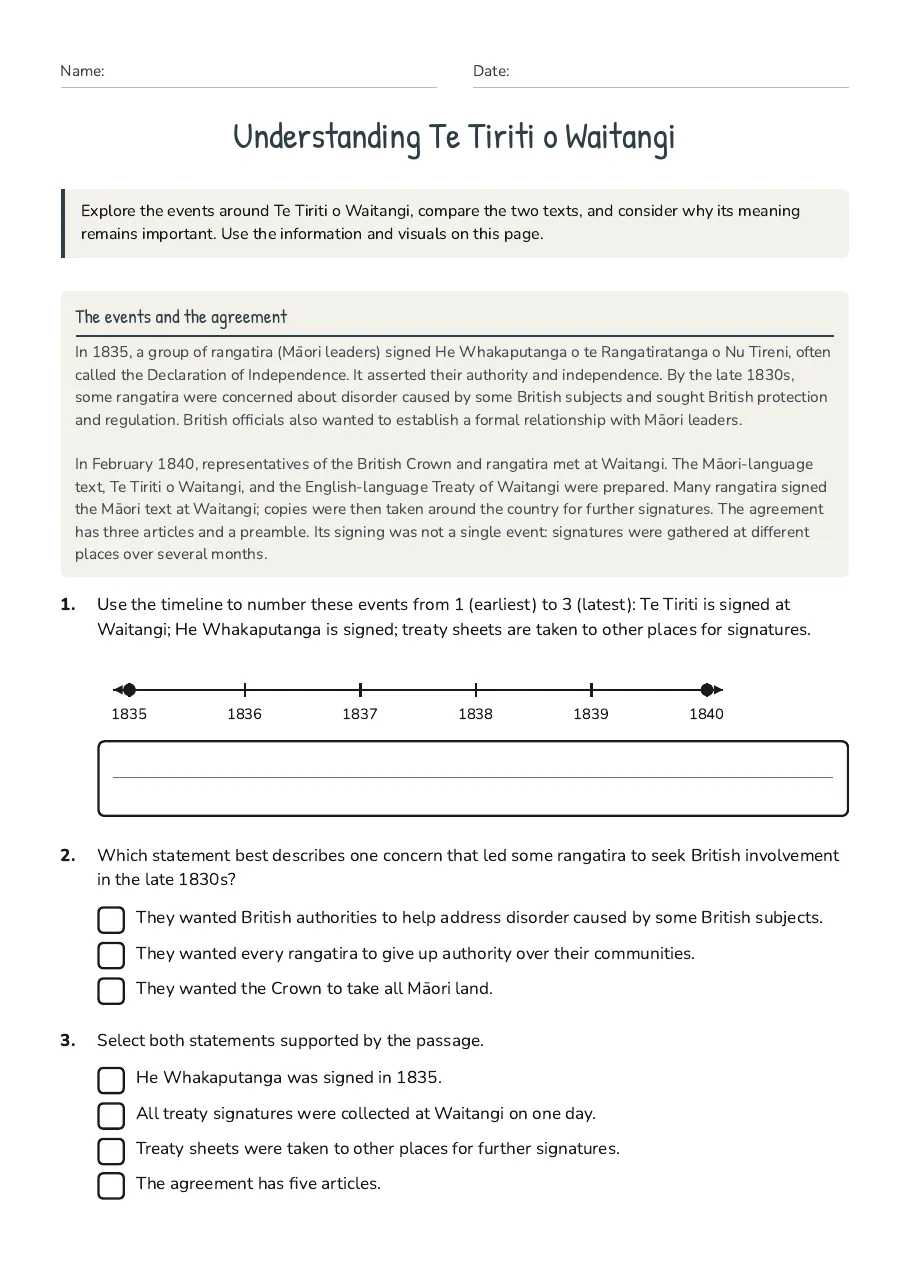
Understanding Te Tiriti o Waitangi
The events and the agreement
In 1835, a group of rangatira (Māori leaders) signed He Whakaputanga o te Rangatiratanga o Nu Tireni, often called the Declaration of Independence. It asserted their authority and independence. By the late 1830s, some rangatira were concerned about disorder caused by some British subjects and sought British protection and regulation. British officials also wanted to establish a formal relationship with Māori leaders. In February 1840, representatives of the British Crown and rangatira met at Waitangi. The Māori-language text, Te Tiriti o Waitangi, and the English-language Treaty of Waitangi were prepared. Many rangatira signed the Māori text at Waitangi; copies were then taken around the country for further signatures. The agreement has three articles and a preamble. Its signing was not a single event: signatures were gathered at different places over several months.
- They wanted British authorities to help address disorder caused by some British subjects.
- They wanted every rangatira to give up authority over their communities.
- They wanted the Crown to take all Māori land.
- He Whakaputanga was signed in 1835.
- All treaty signatures were collected at Waitangi on one day.
- Treaty sheets were taken to other places for further signatures.
- The agreement has five articles.
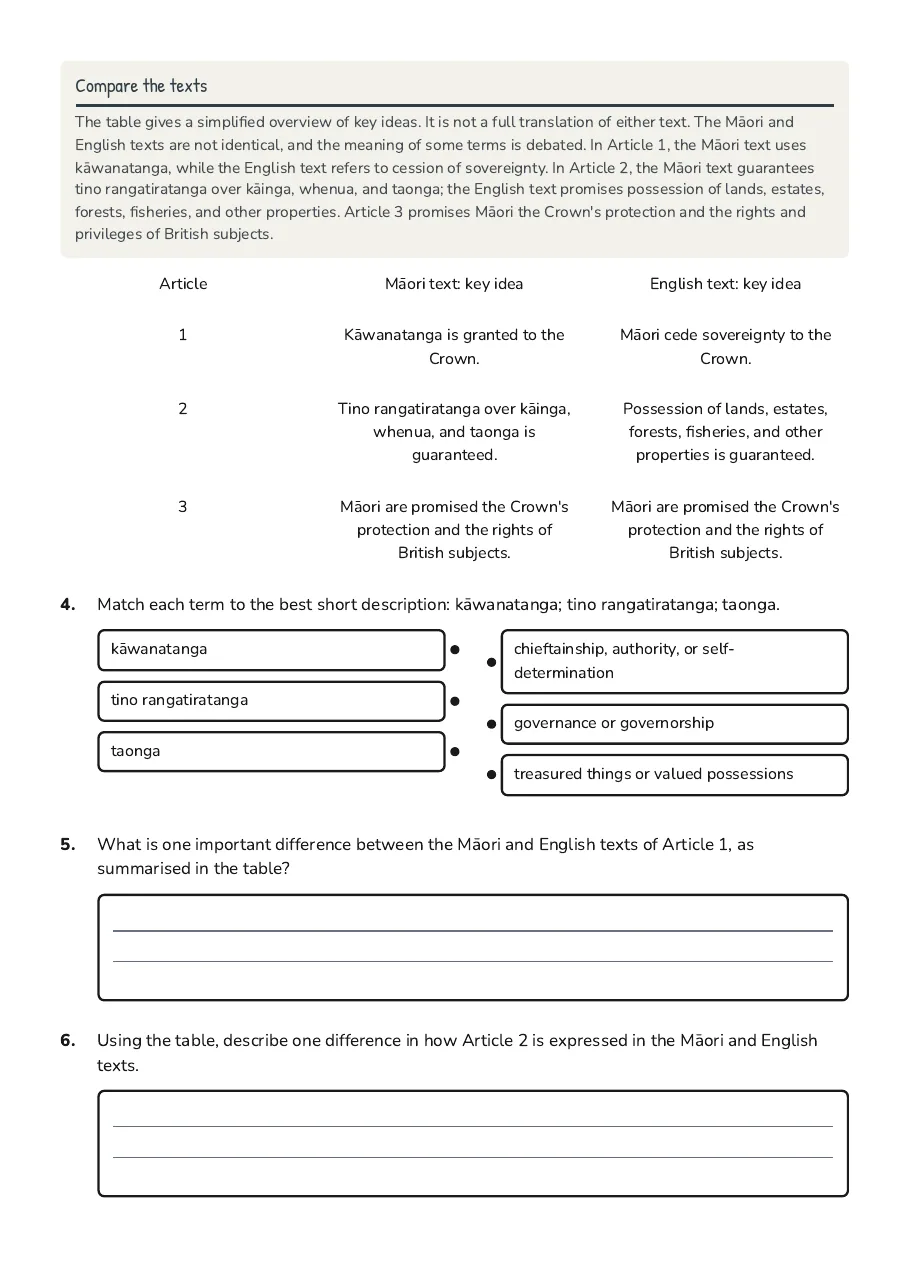
Compare the texts
The table gives a simplified overview of key ideas. It is not a full translation of either text. The Māori and English texts are not identical, and the meaning of some terms is debated. In Article 1, the Māori text uses kāwanatanga, while the English text refers to cession of sovereignty. In Article 2, the Māori text guarantees tino rangatiratanga over kāinga, whenua, and taonga; the English text promises possession of lands, estates, forests, fisheries, and other properties. Article 3 promises Māori the Crown's protection and the rights and privileges of British subjects.
Article
Māori text: key idea
English text: key idea
1
Kāwanatanga is granted to the Crown.
Māori cede sovereignty to the Crown.
2
Tino rangatiratanga over kāinga, whenua, and taonga is guaranteed.
Possession of lands, estates, forests, fisheries, and other properties is guaranteed.
3
Māori are promised the Crown's protection and the rights of British subjects.
Māori are promised the Crown's protection and the rights of British subjects.
- kāwanatanga
- tino rangatiratanga
- taonga
- chieftainship, authority, or self-determination
- governance or governorship
- treasured things or valued possessions
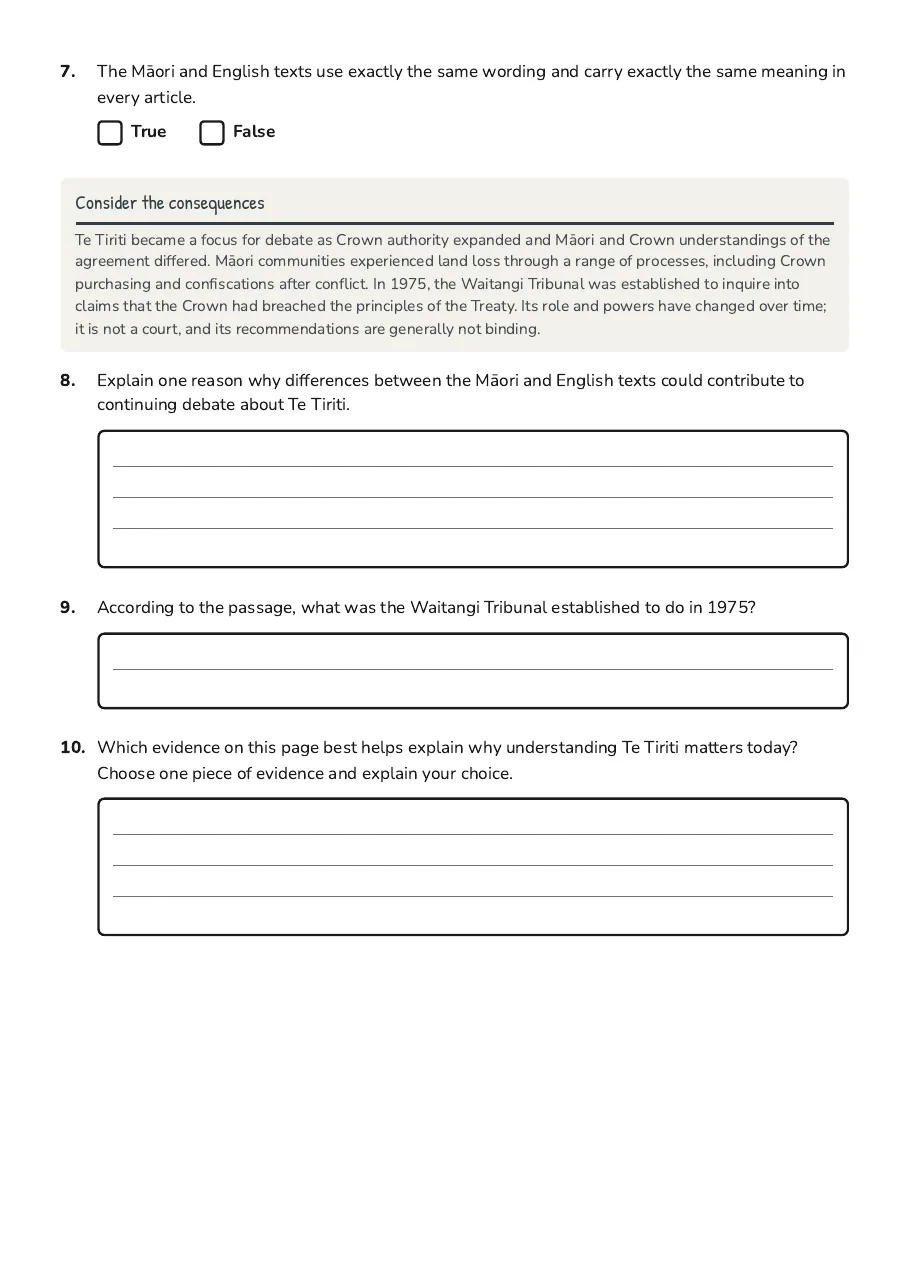
Consider the consequences
Te Tiriti became a focus for debate as Crown authority expanded and Māori and Crown understandings of the agreement differed. Māori communities experienced land loss through a range of processes, including Crown purchasing and confiscations after conflict. In 1975, the Waitangi Tribunal was established to inquire into claims that the Crown had breached the principles of the Treaty. Its role and powers have changed over time; it is not a court, and its recommendations are generally not binding.
3 printable pages
Page 1
Page 2
Page 3
About This Worksheet
Free in Kuraplan
Sign up free, grab the PDF, and customize it for your class.
Print-Ready
Formatted for standard paper. Clean layout, easy to read.
AI-Generated
Created with Kuraplan's AI, designed for real classroom use.
For Teachers & Parents
Use in classrooms, for homework, tutoring, or homeschool.
Need a custom version of this worksheet?
Kuraplan's AI generates custom worksheets in seconds — differentiated for every learner, aligned to your curriculum.
Generate Custom Worksheets — FreeMore Social Sciences Worksheets
Parihaka: Historical Perspectives Worksheet
Free
Ancient Egyptian Burial Practices
Free
Russell Church Research
Free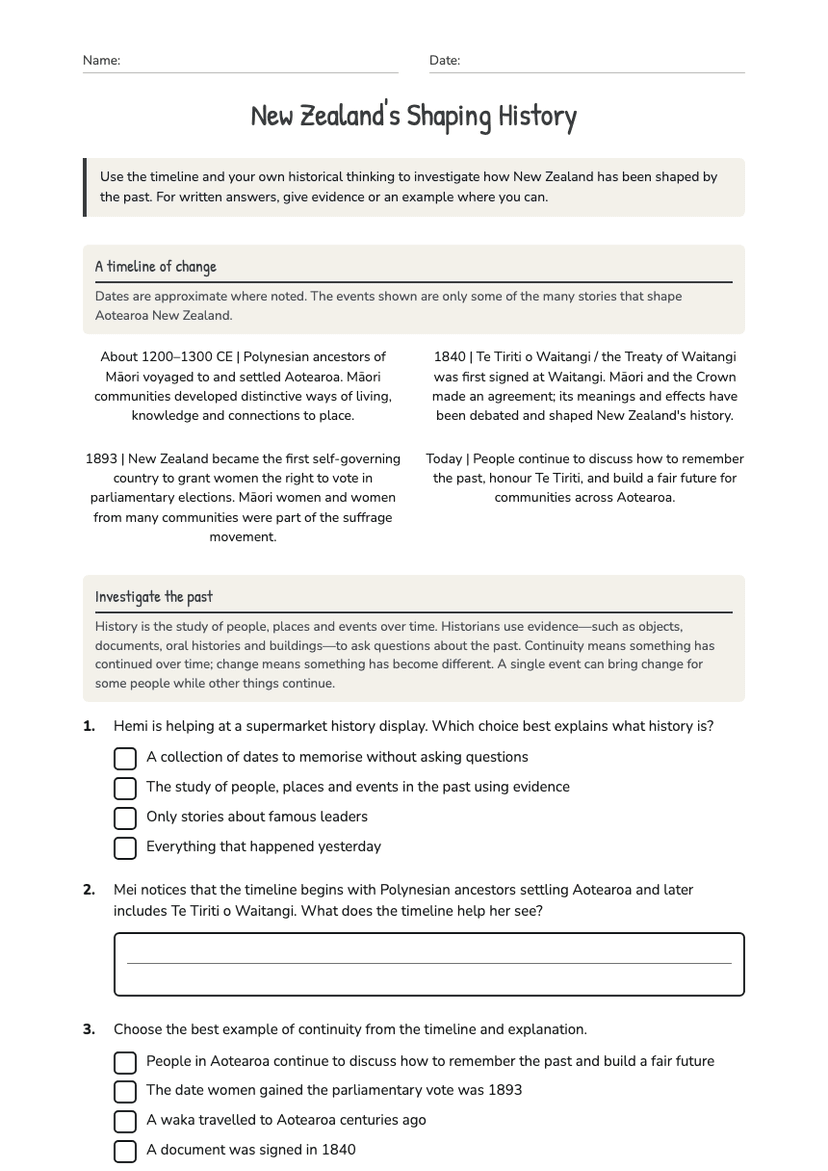
New Zealand's Shaping History
Free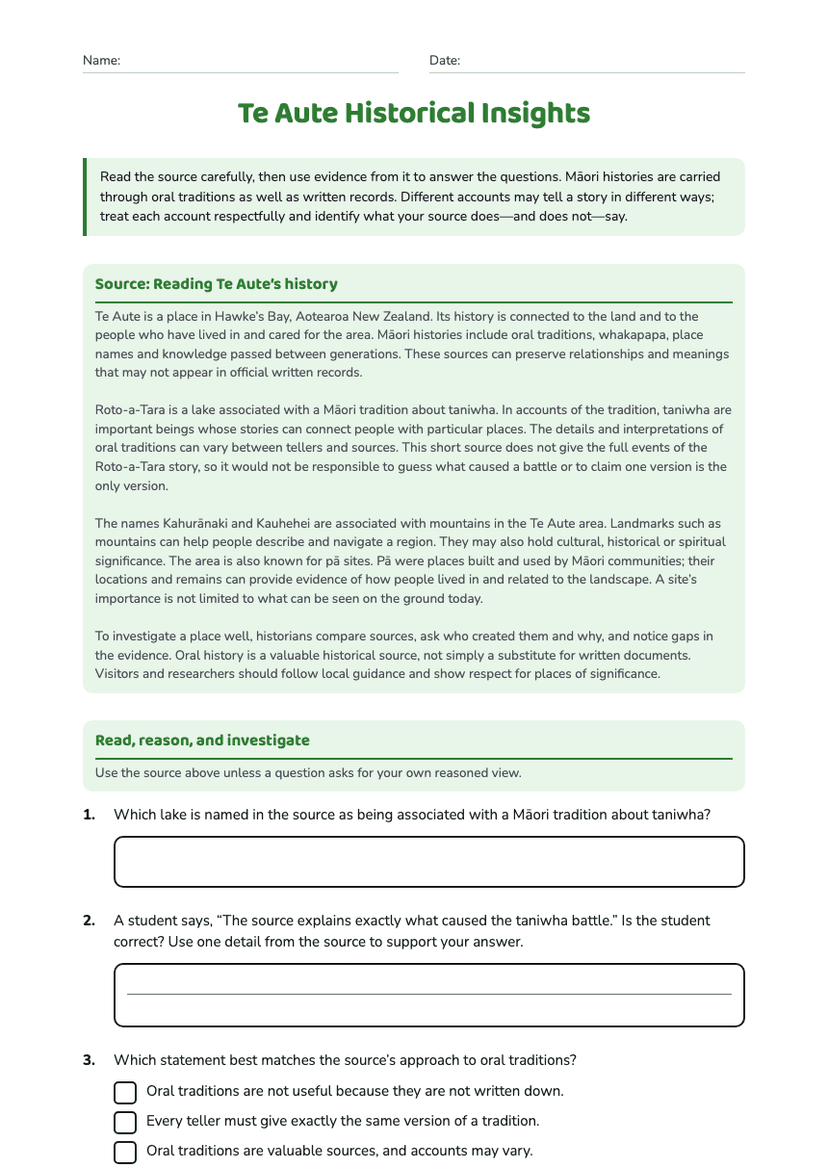
Te Aute Historical Insights
Free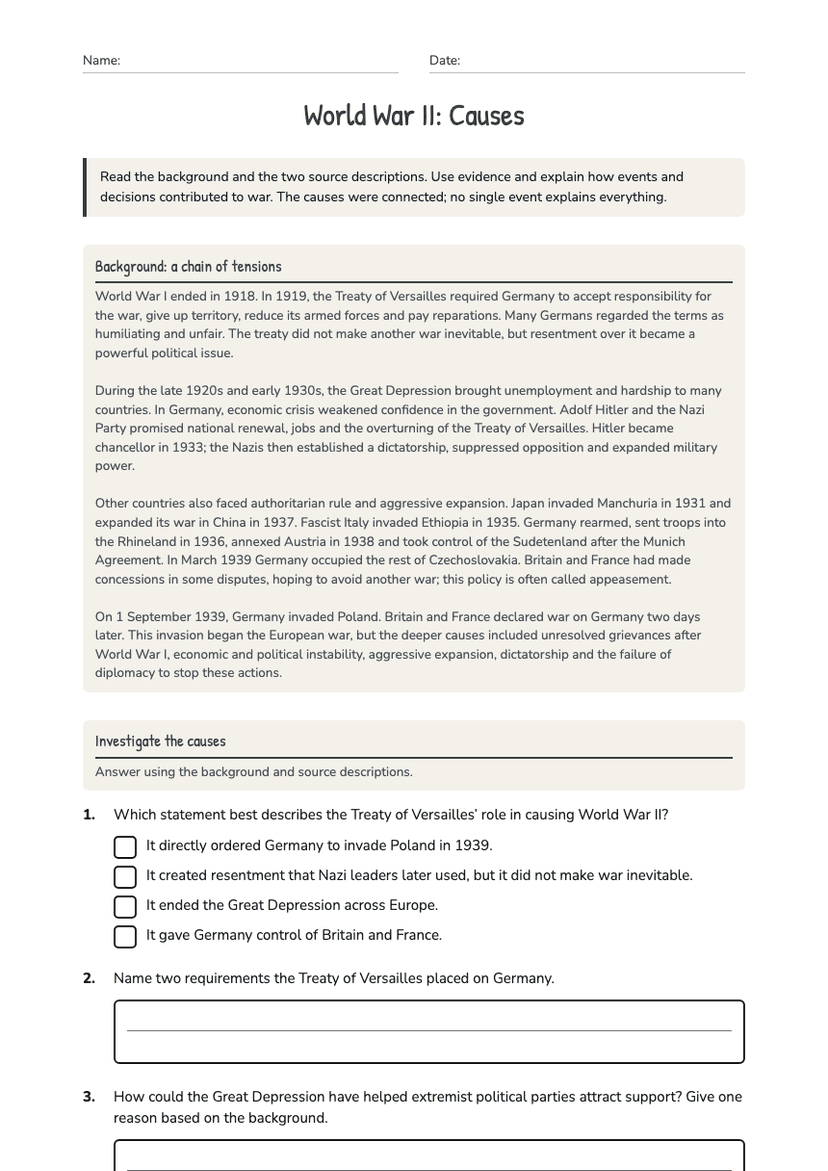
World War II: Causes
Free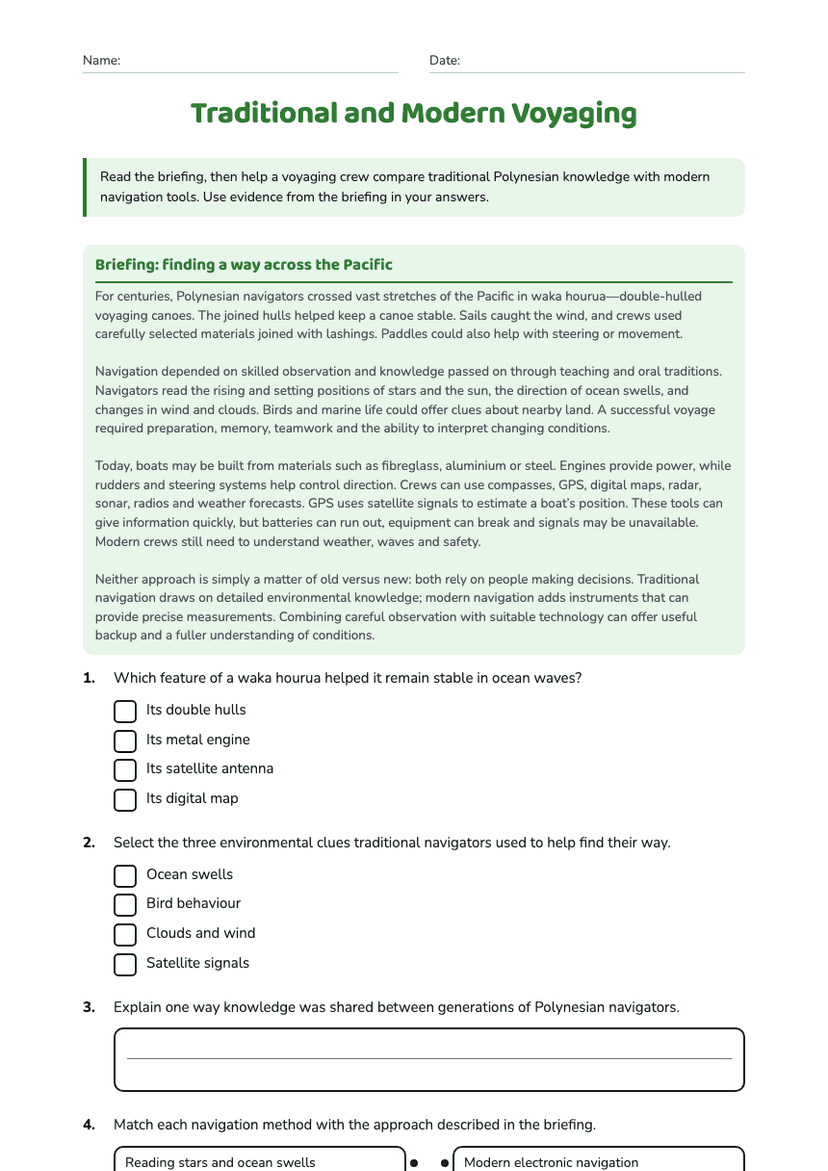
Traditional and Modern Voyaging
Free