A free te reo māori worksheet ready for your classroom. Open in Kuraplan to grab the print-ready PDF, customize it for your students, or generate a fresh version in seconds.
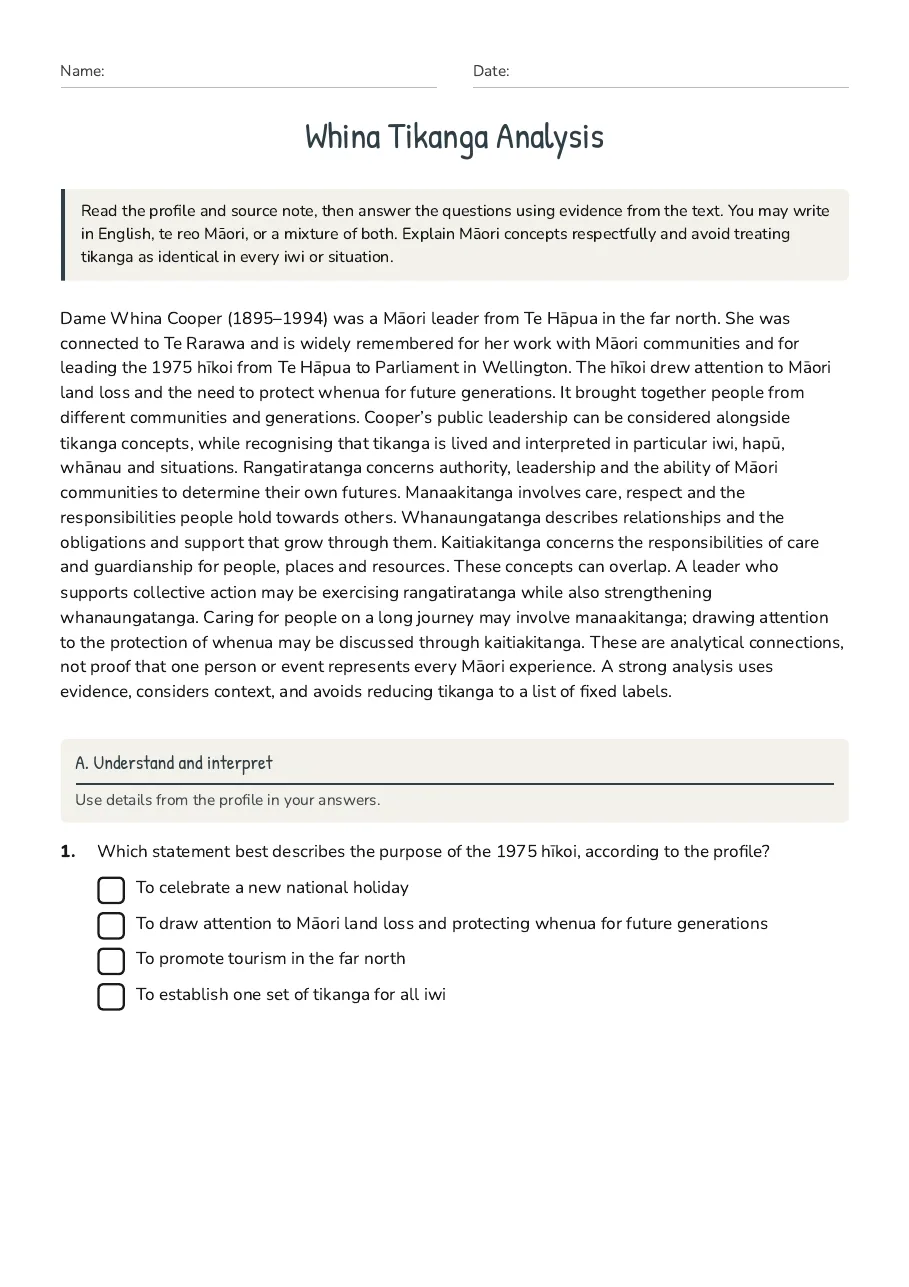
Read the profile and source note, then answer the questions using evidence from the text. You may write in English, te reo Māori, or a mixture of both. Explain Māori concepts respectfully and avoid treating tikanga as identical in every iwi or situation.
Dame Whina Cooper (1895–1994) was a Māori leader from Te Hāpua in the far north. She was connected to Te Rarawa and is widely remembered for her work with Māori communities and for leading the 1975 hīkoi from Te Hāpua to Parliament in Wellington. The hīkoi drew attention to Māori land loss and the need to protect whenua for future generations. It brought together people from different communities and generations.
Cooper’s public leadership can be considered alongside tikanga concepts, while recognising that tikanga is lived and interpreted in particular iwi, hapū, whānau and situations. Rangatiratanga concerns authority, leadership and the ability of Māori communities to determine their own futures. Manaakitanga involves care, respect and the responsibilities people hold towards others. Whanaungatanga describes relationships and the obligations and support that grow through them. Kaitiakitanga concerns the responsibilities of care and guardianship for people, places and resources.
These concepts can overlap. A leader who supports collective action may be exercising rangatiratanga while also strengthening whanaungatanga. Caring for people on a long journey may involve manaakitanga; drawing attention to the protection of whenua may be discussed through kaitiakitanga. These are analytical connections, not proof that one person or event represents every Māori experience. A strong analysis uses evidence, considers context, and avoids reducing tikanga to a list of fixed labels.
A. Understand and interpret
Use details from the profile in your answers.
1.Which statement best describes the purpose of the 1975 hīkoi, according to the profile?
To celebrate a new national holiday
To draw attention to Māori land loss and protecting whenua for future generations
To promote tourism in the far north
To establish one set of tikanga for all iwi
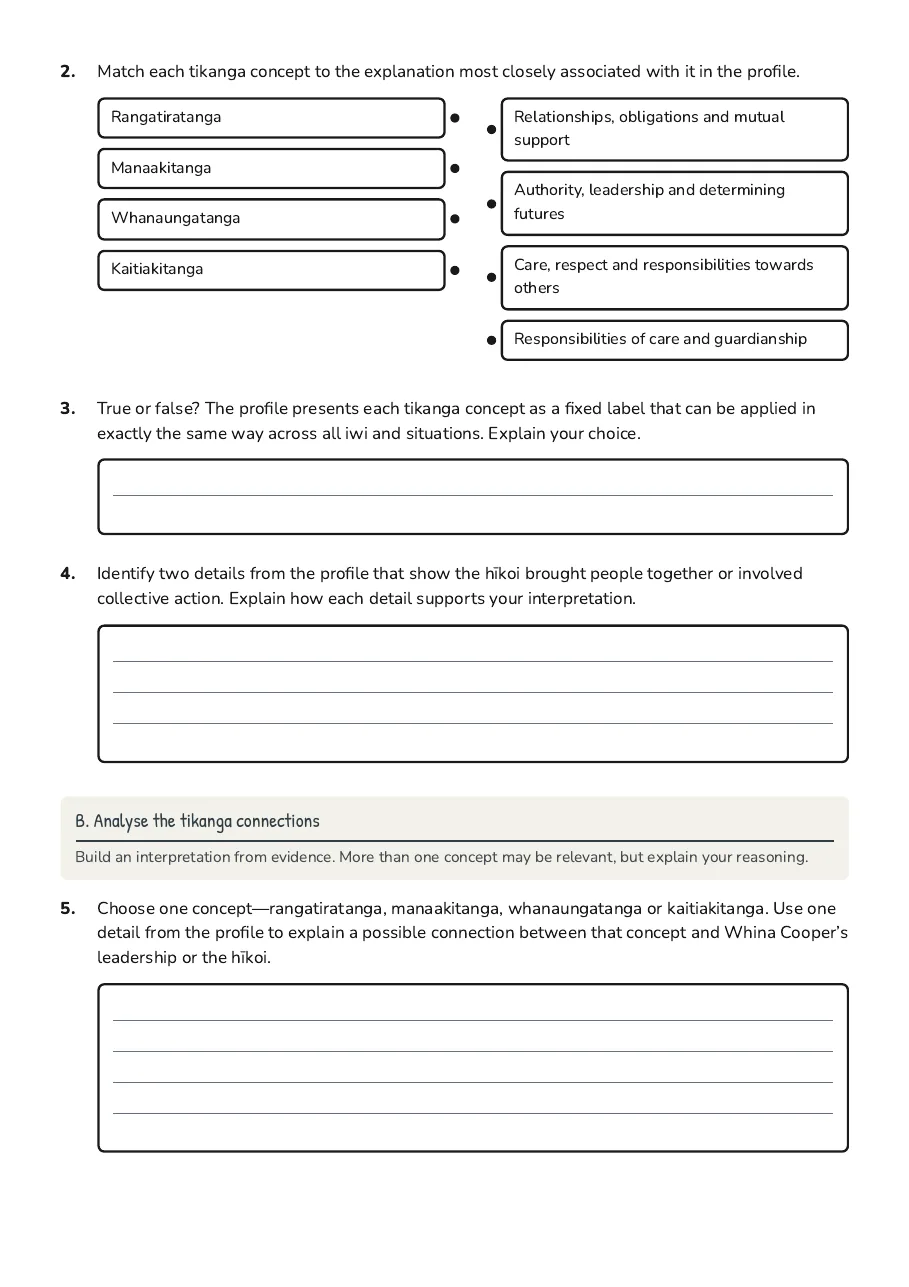
2.Match each tikanga concept to the explanation most closely associated with it in the profile.
Rangatiratanga
Manaakitanga
Whanaungatanga
Kaitiakitanga
Relationships, obligations and mutual support
Authority, leadership and determining futures
Care, respect and responsibilities towards others
Responsibilities of care and guardianship
3.True or false? The profile presents each tikanga concept as a fixed label that can be applied in exactly the same way across all iwi and situations. Explain your choice.
4.Identify two details from the profile that show the hīkoi brought people together or involved collective action. Explain how each detail supports your interpretation.
B. Analyse the tikanga connections
Build an interpretation from evidence. More than one concept may be relevant, but explain your reasoning.
5.Choose one concept—rangatiratanga, manaakitanga, whanaungatanga or kaitiakitanga. Use one detail from the profile to explain a possible connection between that concept and Whina Cooper’s leadership or the hīkoi.
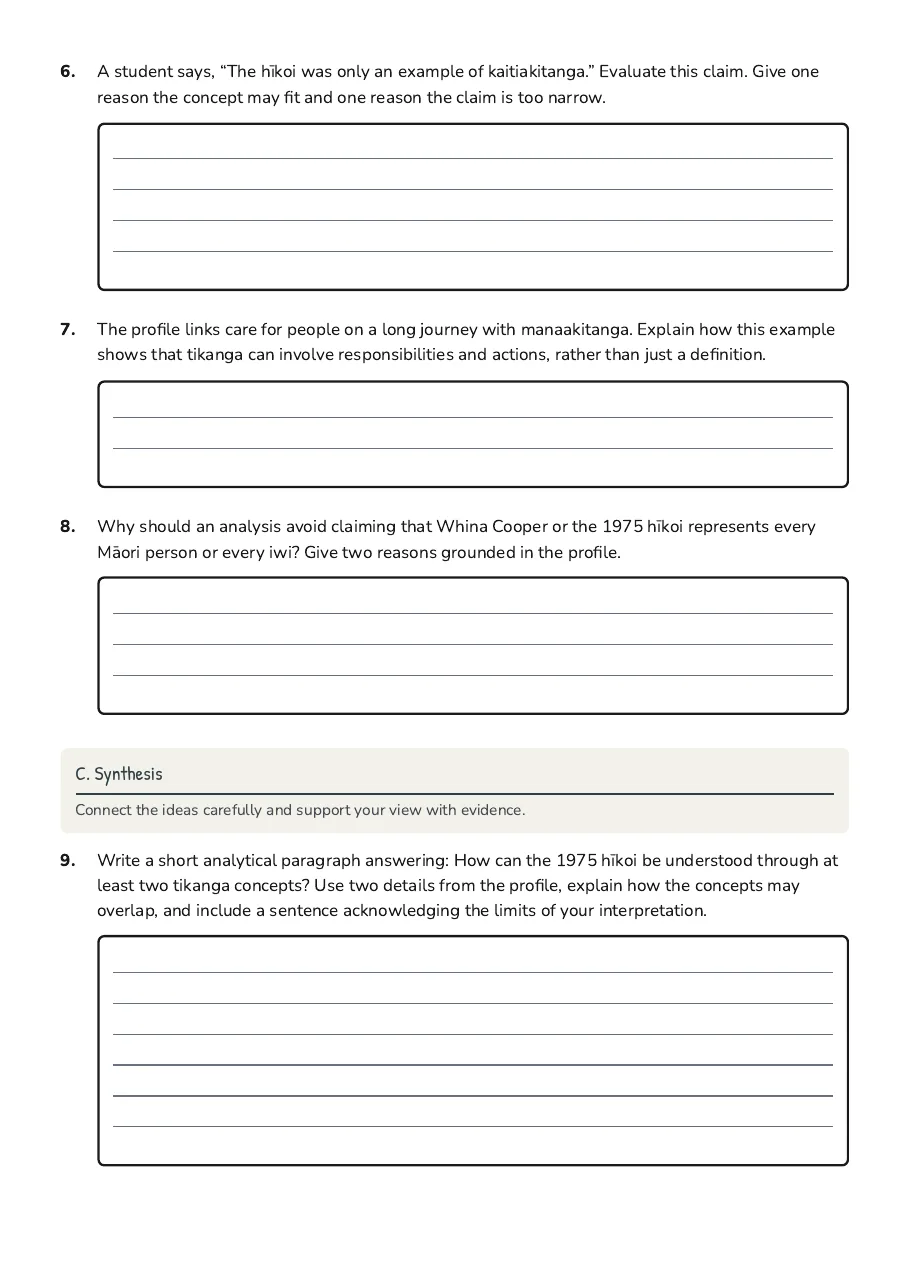
6.A student says, “The hīkoi was only an example of kaitiakitanga.” Evaluate this claim. Give one reason the concept may fit and one reason the claim is too narrow.
7.The profile links care for people on a long journey with manaakitanga. Explain how this example shows that tikanga can involve responsibilities and actions, rather than just a definition.
8.Why should an analysis avoid claiming that Whina Cooper or the 1975 hīkoi represents every Māori person or every iwi? Give two reasons grounded in the profile.
C. Synthesis
Connect the ideas carefully and support your view with evidence.
9.Write a short analytical paragraph answering: How can the 1975 hīkoi be understood through at least two tikanga concepts? Use two details from the profile, explain how the concepts may overlap, and include a sentence acknowledging the limits of your interpretation.