"Exploring Effective Haka"
A free te reo māori worksheet ready for your classroom. Open in Kuraplan to grab the print-ready PDF, customize it for your students, or generate a fresh version in seconds.
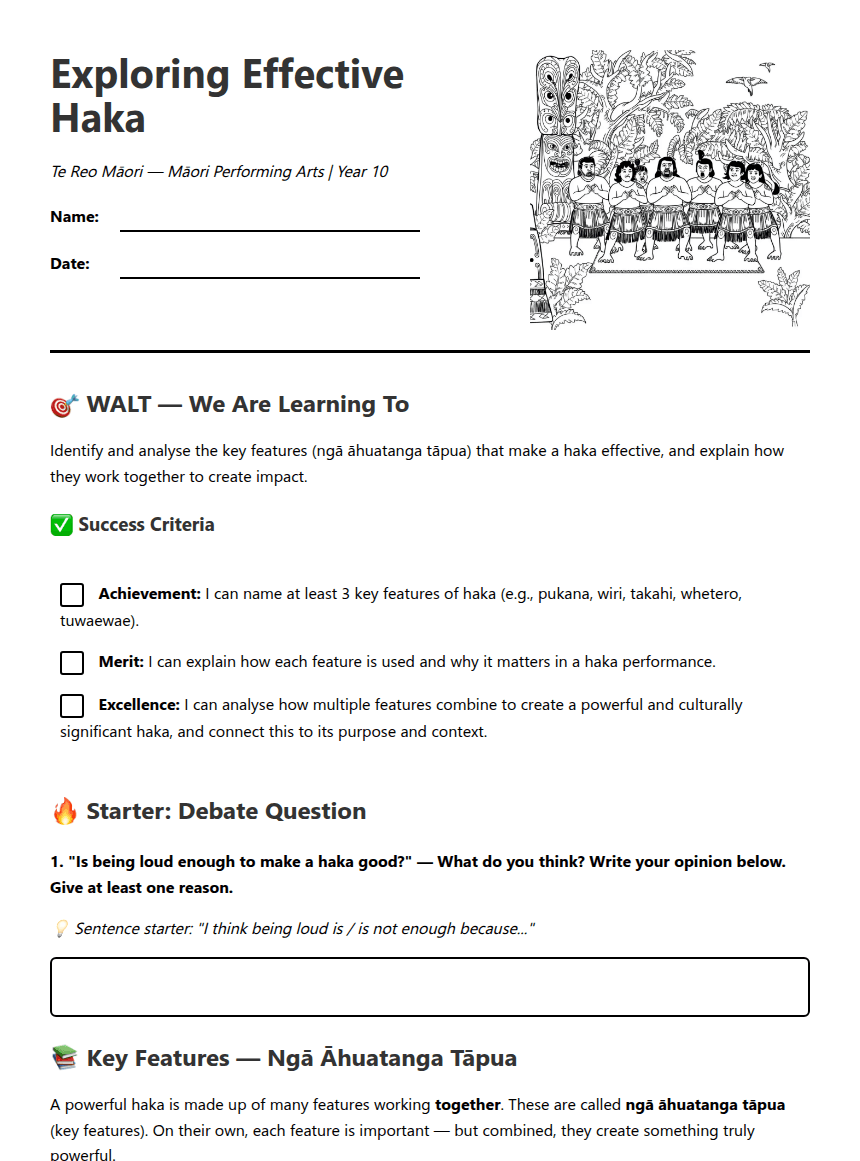
Exploring Effective Haka
Te Reo Māori — Māori Performing Arts | Year 10
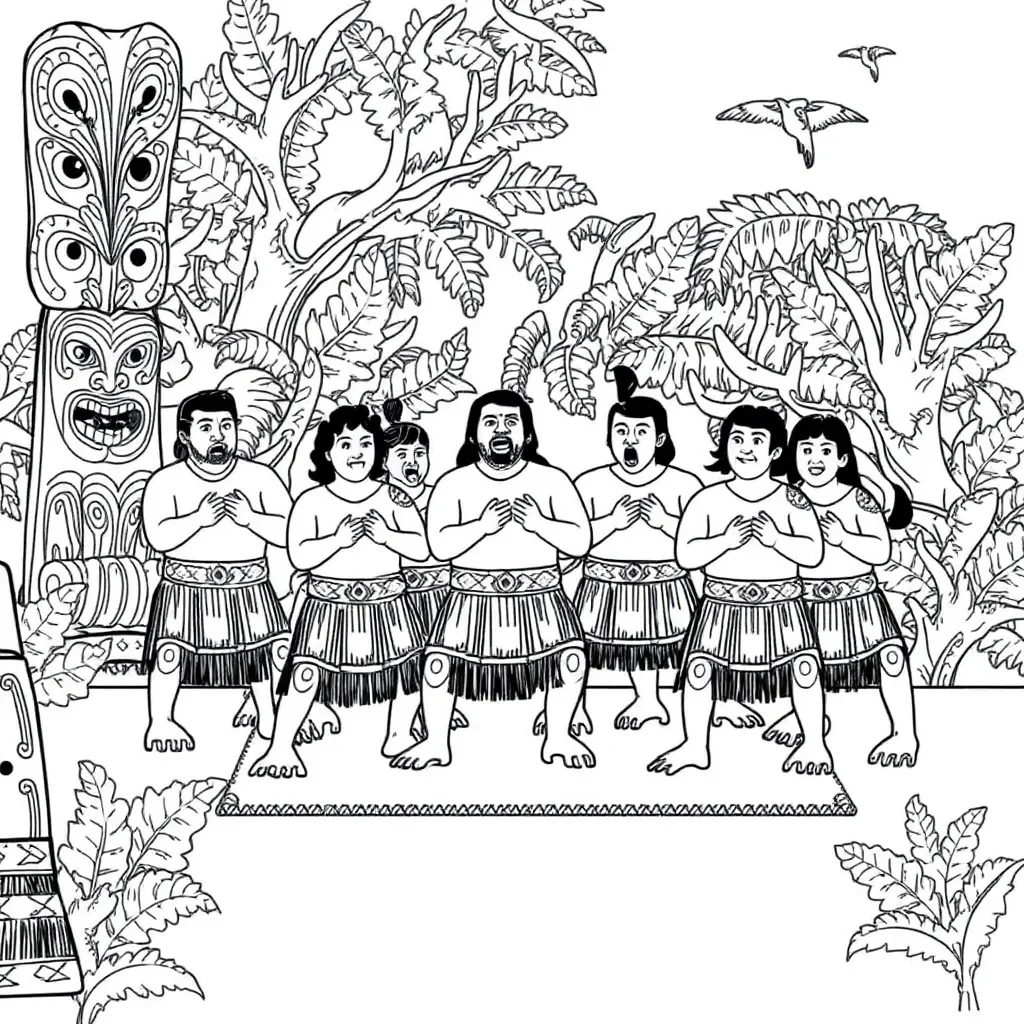
🎯 WALT — We Are Learning To
Identify and analyse the key features (ngā āhuatanga tāpua) that make a haka effective, and explain how they work together to create impact.
✅ Success Criteria
🔥 Starter: Debate Question
💡 Sentence starter: "I think being loud is / is not enough because..."
📚 Key Features — Ngā Āhuatanga Tāpua
A powerful haka is made up of many features working together. These are called ngā āhuatanga tāpua (key features). On their own, each feature is important — but combined, they create something truly powerful.
Key Features to Know:
👁️ Pukana — Wide eyes, intense facial expression (used by wāhine and tāne)
👅 Whetero — Tongue protrusion (used by tāne only)
🤲 Wiri — Quivering of the hands and fingers
🦶 Takahi / Tuwaewae — Foot stamping / footwork
📐 Stance — Body position, posture, and grounding
🔊 Reo (Voice) — Volume, clarity, projection, and unity of words
⏱️ Taiea (Timing) — Synchronisation of movement and voice
😤 Hihiri (Energy/Expression) — Commitment, intensity, and emotional presence
🪢 Formations — Group positioning and spatial awareness
🎬 Comparative Activity — Watch Two Haka Clips
Your teacher will show you two different haka performances. As you watch, analyse each one using the table below. Rate each feature: Strong / Developing / Weak.
Haka Comparison Table
Feature | Haka A | Haka B
🔊 Voice (Reo) — volume, unity, clarity
Haka A:
Strong Developing WeakHaka B:
Strong Developing Weak⏱️ Timing (Taiea) — synchronisation, togetherness
Haka A:
Strong Developing WeakHaka B:
Strong Developing Weak😤 Expression (Pukana / Whetero) — facial intensity
Haka A:
Strong Developing WeakHaka B:
Strong Developing Weak⚡ Energy (Hihiri) — commitment, power, presence
Haka A:
Strong Developing WeakHaka B:
Strong Developing Weak🦶 Footwork / Stance (Tuwaewae) — grounding, power
Haka A:
Strong Developing WeakHaka B:
Strong Developing Weak💡 Sentence starter: "I think Haka ___ was more effective because..."
✍️ Guided Writing — Three Levels of Analysis
Good analysis moves through three levels. Practise each level below using one feature from the haka you watched.
I noticed the feature of _________________________________________ in the haka.
💡 Sentence starter: "This feature was used by... / when... / to..."
💡 Sentence starter: "This was effective because it created... / This connects to the purpose of haka by..."
🌟 Extension — Cultural Significance
For students ready for a deeper challenge:
👥 Group Challenge
💡 Remember: Name it → Explain it → Analyse its effect
Features to consider: pukana, whetero, wiri, takahi, tuwaewae, reo, taiea, hihiri, formations, stance
🎟️ Exit Ticket
💡 Sentence starter: "A haka is effective when... because..."
Self-Assessment — How did I go today?
📎 Differentiation Notes for Students
If you need support: Use the sentence starters provided, refer to the key features list in Section 2, and discuss ideas with a partner before writing.
If you want a challenge: Complete the Extension question (Q7) and explore the cultural whakapapa of haka — research the origins of a specific haka (e.g., Ka Mate or Tūtūngāhau) and connect its features to its historical purpose.
About This Worksheet
Free in Kuraplan
Sign up free, grab the PDF, and customize it for your class.
Print-Ready
Formatted for standard paper. Clean layout, easy to read.
AI-Generated
Created with Kuraplan's AI, designed for real classroom use.
For Teachers & Parents
Use in classrooms, for homework, tutoring, or homeschool.
Need a custom version of this worksheet?
Kuraplan's AI generates custom worksheets in seconds — differentiated for every learner, aligned to your curriculum.
Generate Custom Worksheets — Free