ScienceFreePrintable
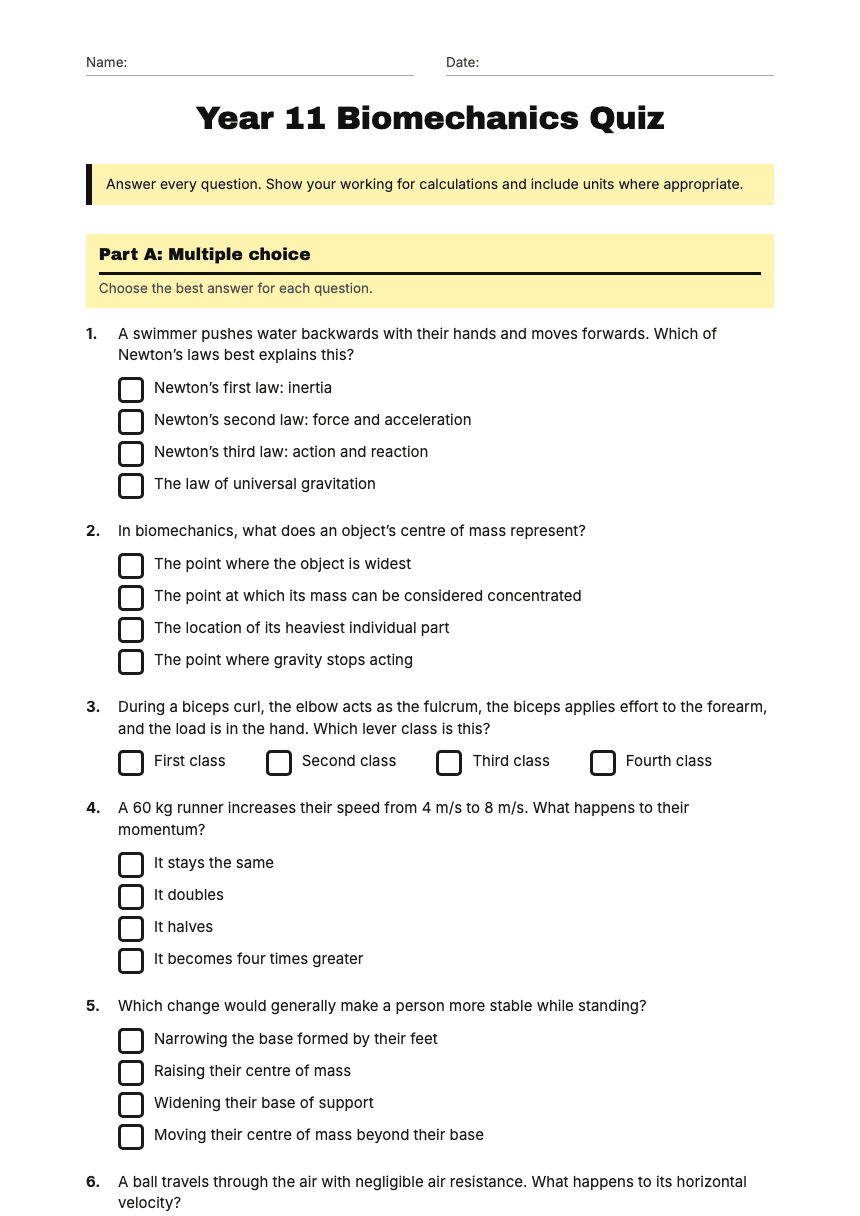
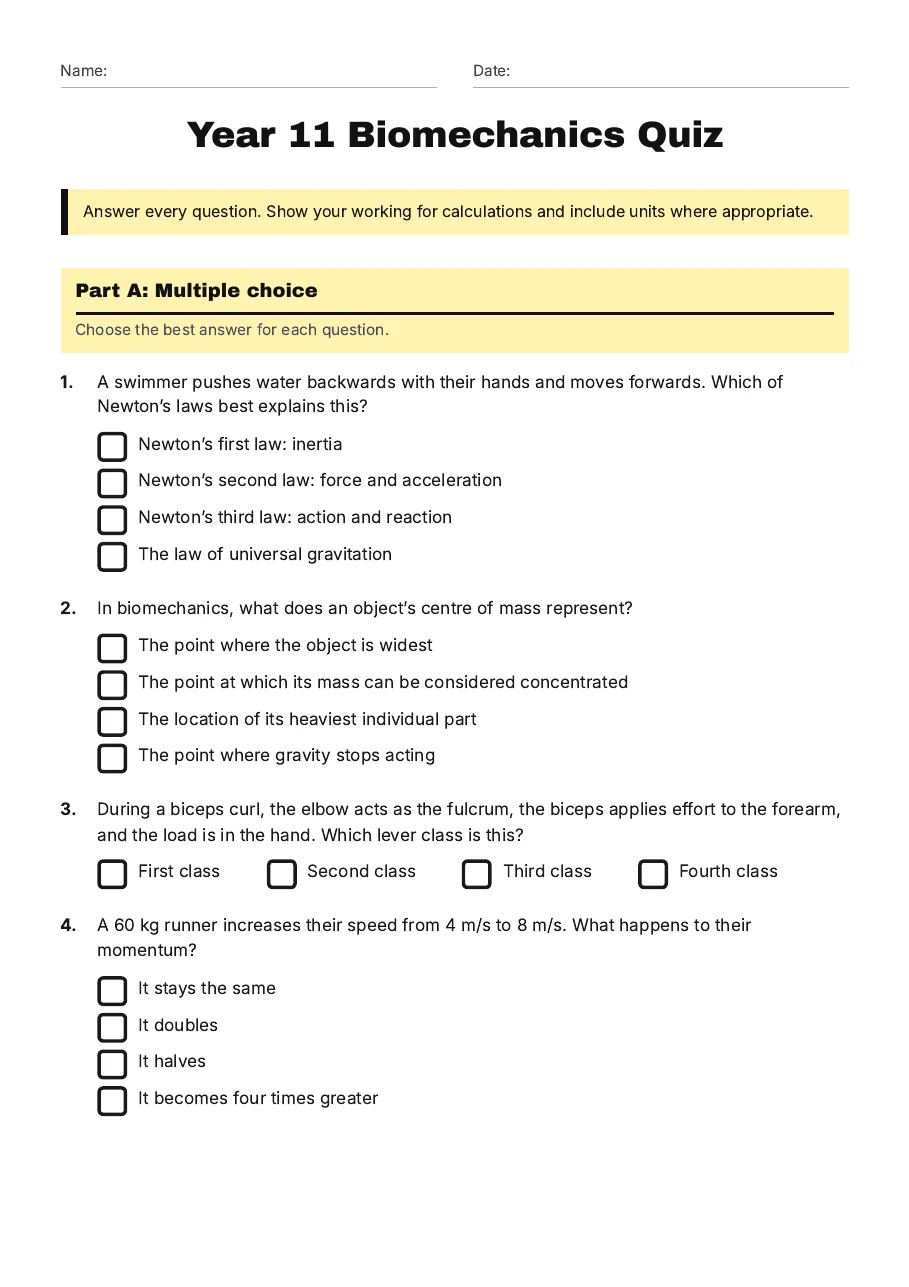
Year 11 Biomechanics Quiz
A free science worksheet ready for your classroom. Open in Kuraplan to grab the print-ready PDF, customize it for your students, or generate a fresh version in seconds.
Name:Date:
Year 11 Biomechanics Quiz
Answer every question. Show your working for calculations and include units where appropriate.
Part A: Multiple choice
Choose the best answer for each question.
1.A swimmer pushes water backwards with their hands and moves forwards. Which of Newton’s laws best explains this?
- Newton’s first law: inertia
- Newton’s second law: force and acceleration
- Newton’s third law: action and reaction
- The law of universal gravitation
2.In biomechanics, what does an object’s centre of mass represent?
- The point where the object is widest
- The point at which its mass can be considered concentrated
- The location of its heaviest individual part
- The point where gravity stops acting
3.During a biceps curl, the elbow acts as the fulcrum, the biceps applies effort to the forearm, and the load is in the hand. Which lever class is this?
- First class
- Second class
- Third class
- Fourth class
4.A 60 kg runner increases their speed from 4 m/s to 8 m/s. What happens to their momentum?
- It stays the same
- It doubles
- It halves
- It becomes four times greater
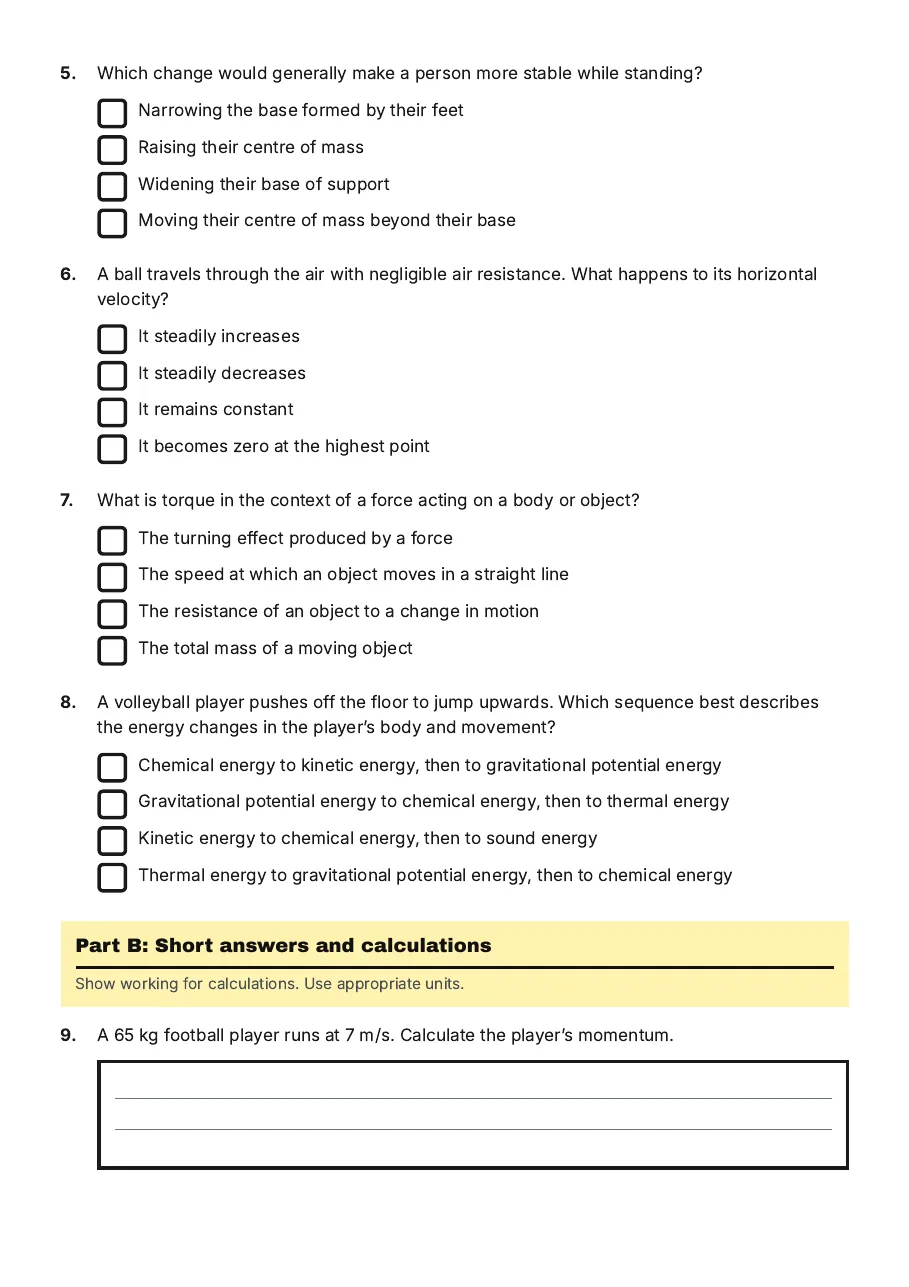
5.Which change would generally make a person more stable while standing?
- Narrowing the base formed by their feet
- Raising their centre of mass
- Widening their base of support
- Moving their centre of mass beyond their base
6.A ball travels through the air with negligible air resistance. What happens to its horizontal velocity?
- It steadily increases
- It steadily decreases
- It remains constant
- It becomes zero at the highest point
7.What is torque in the context of a force acting on a body or object?
- The turning effect produced by a force
- The speed at which an object moves in a straight line
- The resistance of an object to a change in motion
- The total mass of a moving object
8.A volleyball player pushes off the floor to jump upwards. Which sequence best describes the energy changes in the player’s body and movement?
- Chemical energy to kinetic energy, then to gravitational potential energy
- Gravitational potential energy to chemical energy, then to thermal energy
- Kinetic energy to chemical energy, then to sound energy
- Thermal energy to gravitational potential energy, then to chemical energy
Part B: Short answers and calculations
Show working for calculations. Use appropriate units.
9.A 65 kg football player runs at 7 m/s. Calculate the player’s momentum.
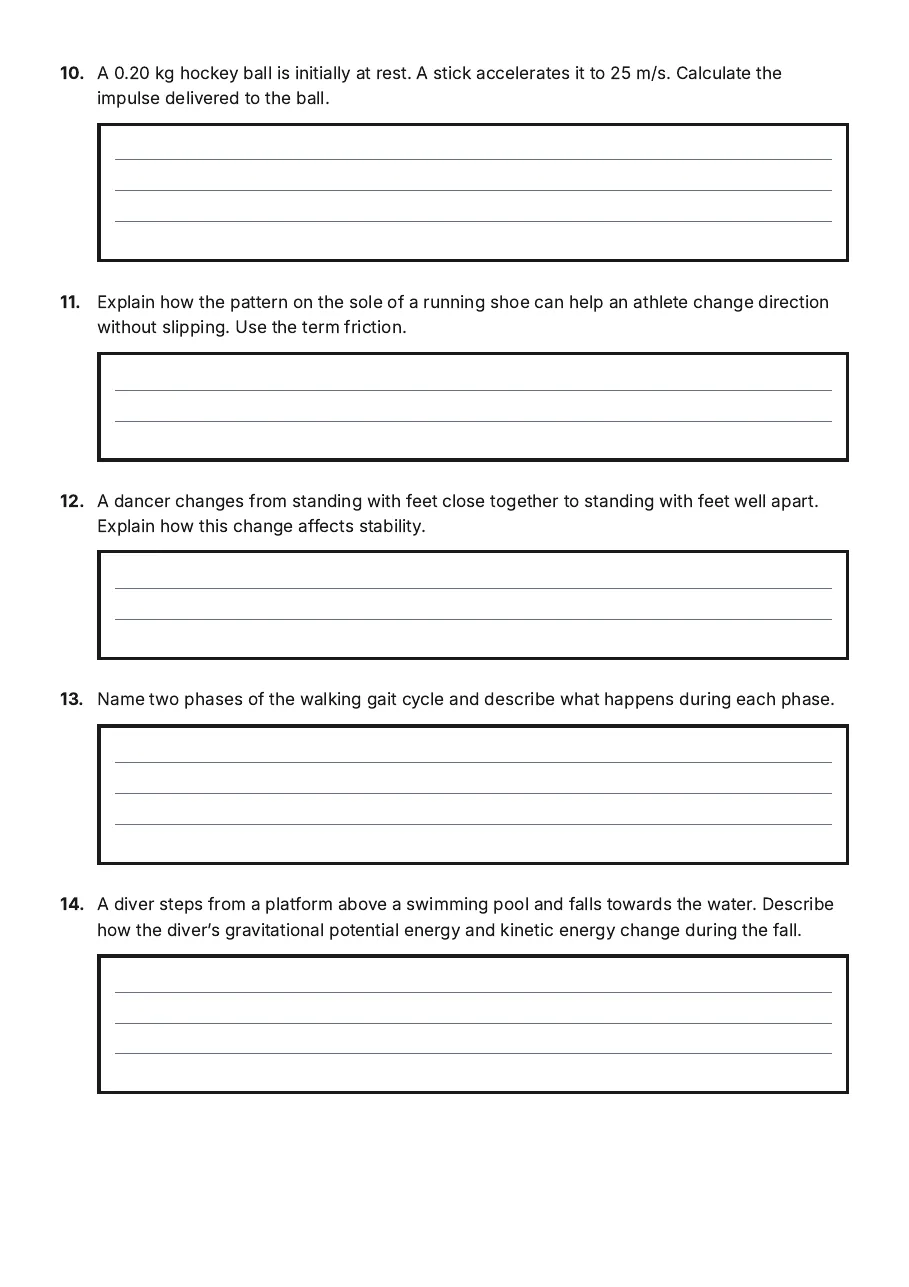
10.A 0.20 kg hockey ball is initially at rest. A stick accelerates it to 25 m/s. Calculate the impulse delivered to the ball.
11.Explain how the pattern on the sole of a running shoe can help an athlete change direction without slipping. Use the term friction.
12.A dancer changes from standing with feet close together to standing with feet well apart. Explain how this change affects stability.
13.Name two phases of the walking gait cycle and describe what happens during each phase.
14.A diver steps from a platform above a swimming pool and falls towards the water. Describe how the diver’s gravitational potential energy and kinetic energy change during the fall.
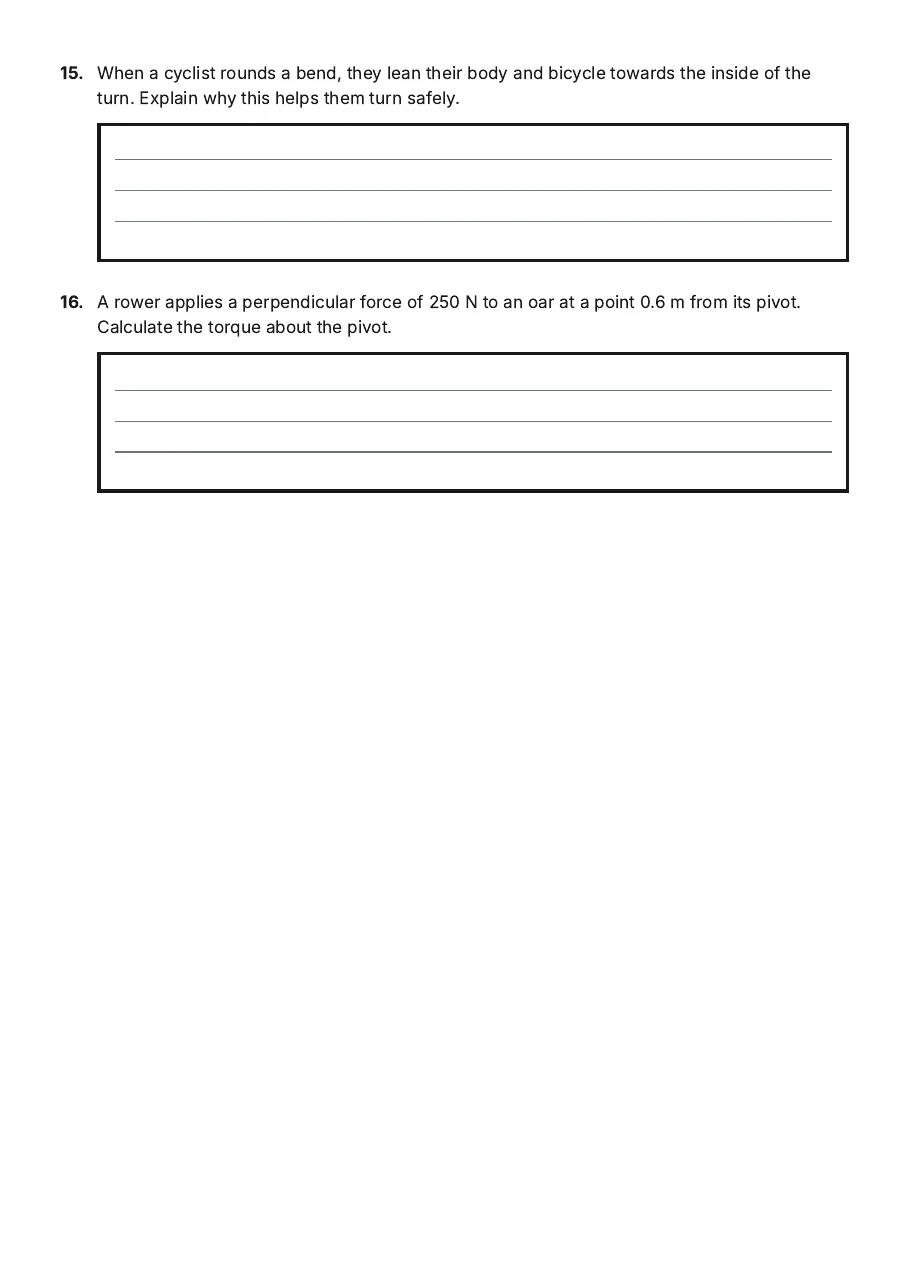
15.When a cyclist rounds a bend, they lean their body and bicycle towards the inside of the turn. Explain why this helps them turn safely.
16.A rower applies a perpendicular force of 250 N to an oar at a point 0.6 m from its pivot. Calculate the torque about the pivot.
4 printable pages
Page 1
Page 2
Page 3
Page 4
About This Worksheet
Free in Kuraplan
Sign up free, grab the PDF, and customize it for your class.
Print-Ready
Formatted for standard paper. Clean layout, easy to read.
AI-Generated
Created with Kuraplan's AI, designed for real classroom use.
For Teachers & Parents
Use in classrooms, for homework, tutoring, or homeschool.
Need a custom version of this worksheet?
Kuraplan's AI generates custom worksheets in seconds — differentiated for every learner, aligned to your curriculum.
Generate Custom Worksheets — Free No credit card Curriculum-aligned Under 60 seconds