Year 12 PE Review
🦴 Part 1: Anatomy
1. Name three bones found in the arm:
2. Circle the type of joint found at the shoulder:
Hinge joint
Ball and socket joint
Pivot joint
Fixed joint
3. Match the muscle with its location:
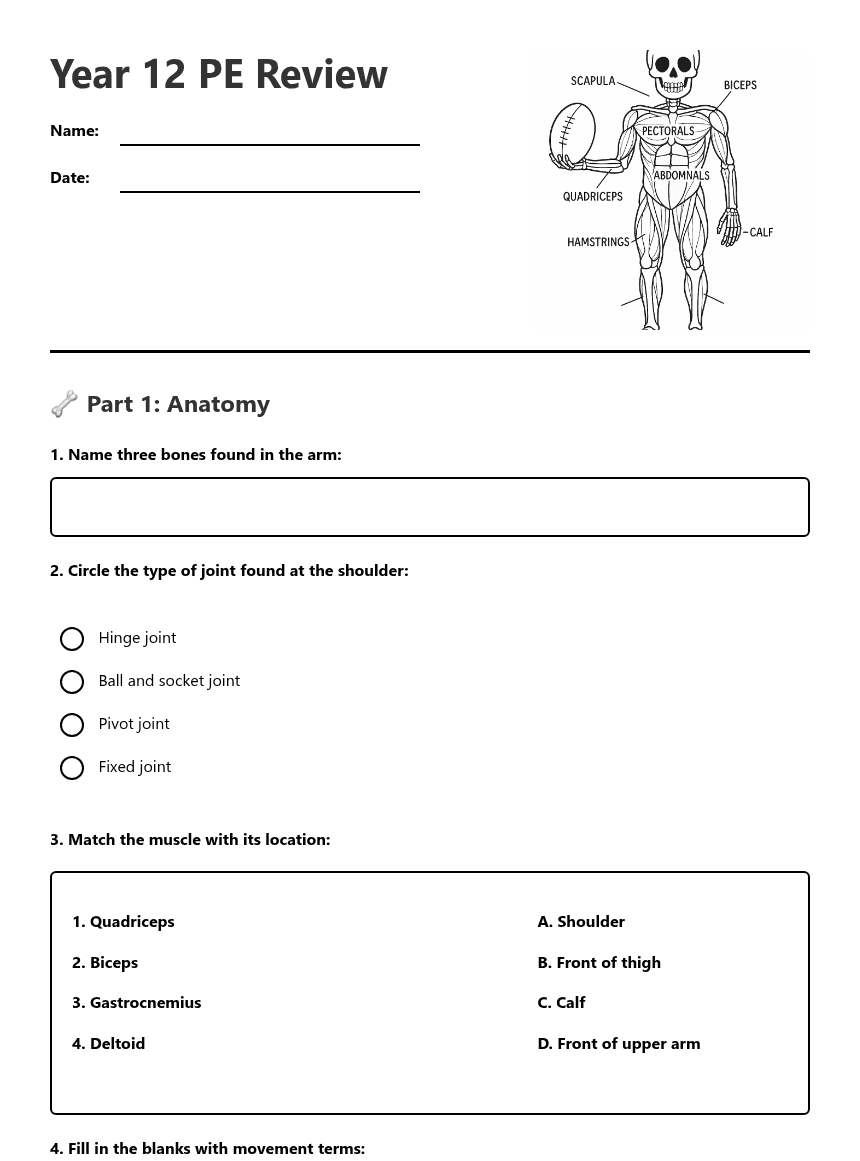
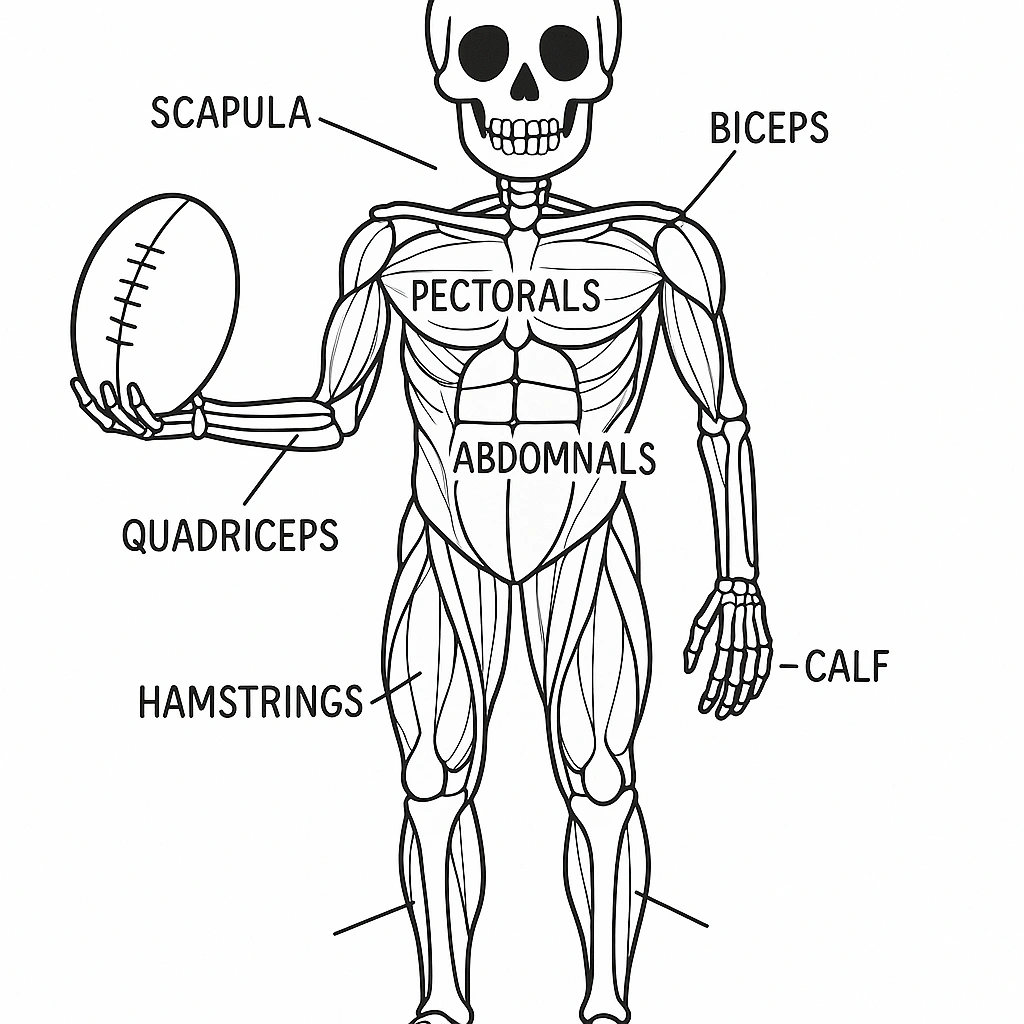
1. Quadriceps
2. Biceps
3. Gastrocnemius
4. Deltoid
A. Shoulder
B. Front of thigh
C. Calf
D. Front of upper arm
4. Fill in the blanks with movement terms:
When you bend your elbow, this movement is called __________. When you straighten it, this is called __________. Moving your arm away from your body is __________ and moving it back towards your body is __________.
5. Check all the muscles that are involved in jumping:
Quadriceps
Hamstrings
Gastrocnemius
Gluteus maximus
Biceps
⚡ Part 2: Biomechanics
6. State Newton's First Law of Motion:
7. Circle the correct answer: Which class of lever is demonstrated when using your calf muscles to stand on your toes?
First class lever
Second class lever
Third class lever
8. Calculate momentum: If a rugby player with a mass of 85kg is running at 6 metres per second, what is their momentum?
9. Explain how force summation applies to throwing a javelin:
10. Fill in the blanks about projectile motion:
The optimal angle for maximum distance in projectile motion is approximately _____ degrees. The two components of projectile motion are __________ and __________ velocity.
11. Check all factors that increase stability:
Lower centre of gravity
Wider base of support
Higher centre of gravity
Line of gravity within base of support
Increased mass
🎯 Part 3: Skill Learning
12. Match the stage of learning with its characteristics:
1. Cognitive Stage
2. Associative Stage
3. Autonomous Stage
A. Automatic performance
B. Many errors, inconsistent
C. Fewer errors, more consistent
13. Circle the type of practice best for learning a tennis serve:
Massed practice
Distributed practice
Mental practice only
14. List four factors that can affect skill learning:
15. Check all methods used in performance appraisal:
Video analysis
Peer assessment
Self-evaluation
Coach feedback
Statistical analysis
16. Explain the difference between blocked and random practice:
🧠 Part 4: Sports Psychology
17. Fill in the blanks about arousal and performance:
According to the __________ theory, optimal performance occurs at __________ levels of arousal. Too much arousal can lead to __________ while too little can result in __________.
18. Circle the most effective type of goal setting:
Outcome goals only
Process goals only
A combination of outcome and process goals
No specific goals
19. Match the psychological technique with its description:
1. Visualisation
2. Self-talk
3. Centering
4. Progressive relaxation
A. Mental rehearsal of skills
B. Focusing on breathing and balance
C. Tensing and releasing muscle groups
D. Internal dialogue and motivation
20. Check all symptoms of anxiety in sport:
Increased heart rate
Muscle tension
Negative thoughts
Improved concentration
Sweating
21. Describe how pre-performance routines can help an athlete:
22. Explain the difference between confidence and concentration in sport:
23. List three relaxation techniques that athletes can use to manage stress: