ScienceFreePrintable
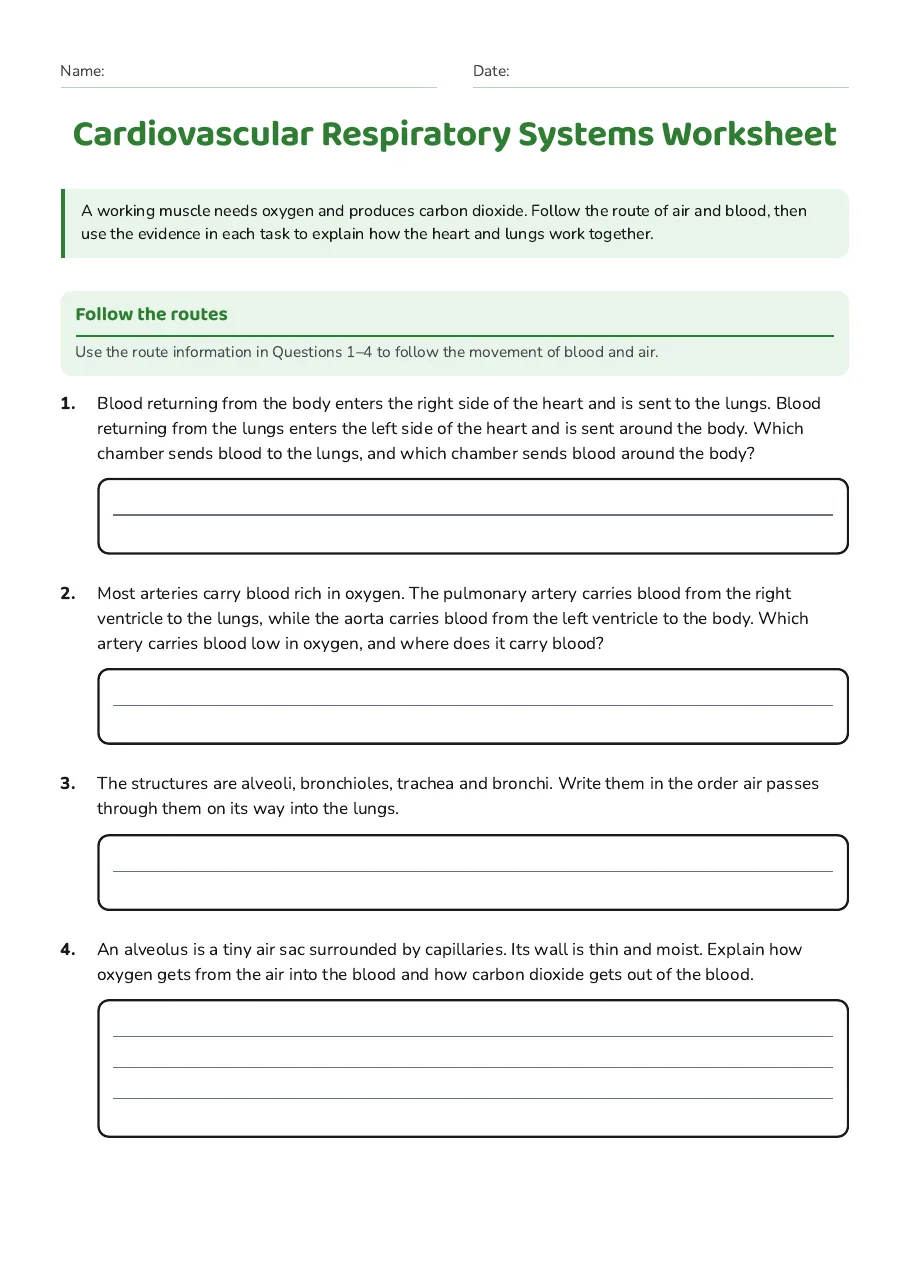
Cardiovascular Respiratory Systems Worksheet
A free science worksheet ready for your classroom. Open in Kuraplan to grab the print-ready PDF, customize it for your students, or generate a fresh version in seconds.

Name:Date:
Cardiovascular Respiratory Systems Worksheet
A working muscle needs oxygen and produces carbon dioxide. Follow the route of air and blood, then use the evidence in each task to explain how the heart and lungs work together.
Follow the routes
Use the route information in Questions 1–4 to follow the movement of blood and air.
1.Blood returning from the body enters the right side of the heart and is sent to the lungs. Blood returning from the lungs enters the left side of the heart and is sent around the body. Which chamber sends blood to the lungs, and which chamber sends blood around the body?
2.Most arteries carry blood rich in oxygen. The pulmonary artery carries blood from the right ventricle to the lungs, while the aorta carries blood from the left ventricle to the body. Which artery carries blood low in oxygen, and where does it carry blood?
3.The structures are alveoli, bronchioles, trachea and bronchi. Write them in the order air passes through them on its way into the lungs.
4.An alveolus is a tiny air sac surrounded by capillaries. Its wall is thin and moist. Explain how oxygen gets from the air into the blood and how carbon dioxide gets out of the blood.
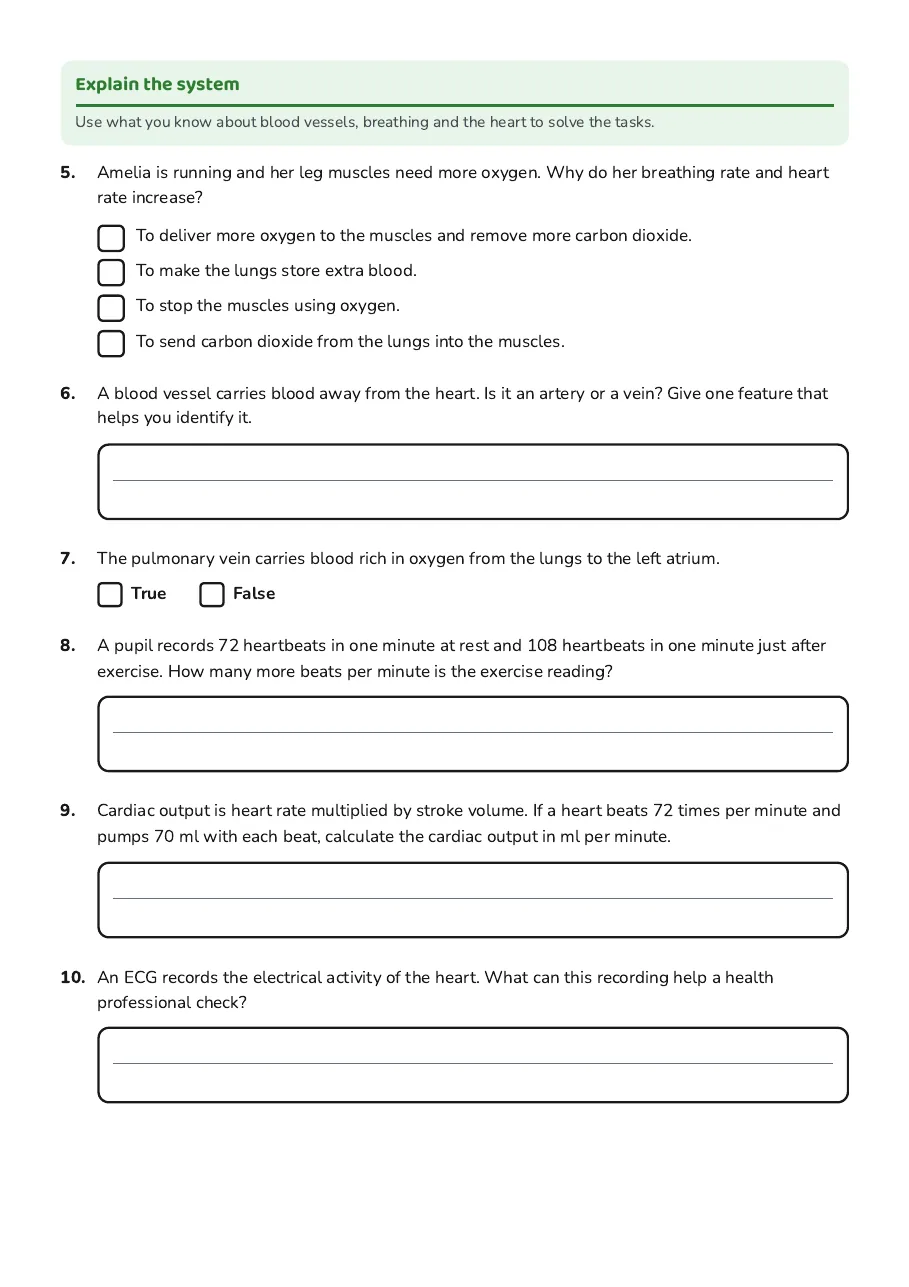
Explain the system
Use what you know about blood vessels, breathing and the heart to solve the tasks.
5.Amelia is running and her leg muscles need more oxygen. Why do her breathing rate and heart rate increase?
- To deliver more oxygen to the muscles and remove more carbon dioxide.
- To make the lungs store extra blood.
- To stop the muscles using oxygen.
- To send carbon dioxide from the lungs into the muscles.
6.A blood vessel carries blood away from the heart. Is it an artery or a vein? Give one feature that helps you identify it.
7.The pulmonary vein carries blood rich in oxygen from the lungs to the left atrium.
TrueFalse
8.A pupil records 72 heartbeats in one minute at rest and 108 heartbeats in one minute just after exercise. How many more beats per minute is the exercise reading?
9.Cardiac output is heart rate multiplied by stroke volume. If a heart beats 72 times per minute and pumps 70 ml with each beat, calculate the cardiac output in ml per minute.
10.An ECG records the electrical activity of the heart. What can this recording help a health professional check?
2 printable pages
Page 1
Page 2
About This Worksheet
Free in Kuraplan
Sign up free, grab the PDF, and customize it for your class.
Print-Ready
Formatted for standard paper. Clean layout, easy to read.
AI-Generated
Created with Kuraplan's AI, designed for real classroom use.
For Teachers & Parents
Use in classrooms, for homework, tutoring, or homeschool.
Need a custom version of this worksheet?
Kuraplan's AI generates custom worksheets in seconds — differentiated for every learner, aligned to your curriculum.
Generate Custom Worksheets — Free No credit card Curriculum-aligned Under 60 seconds