Holocaust Historical Introduction
A free english worksheet ready for your classroom. Open in Kuraplan to grab the print-ready PDF, customize it for your students, or generate a fresh version in seconds.
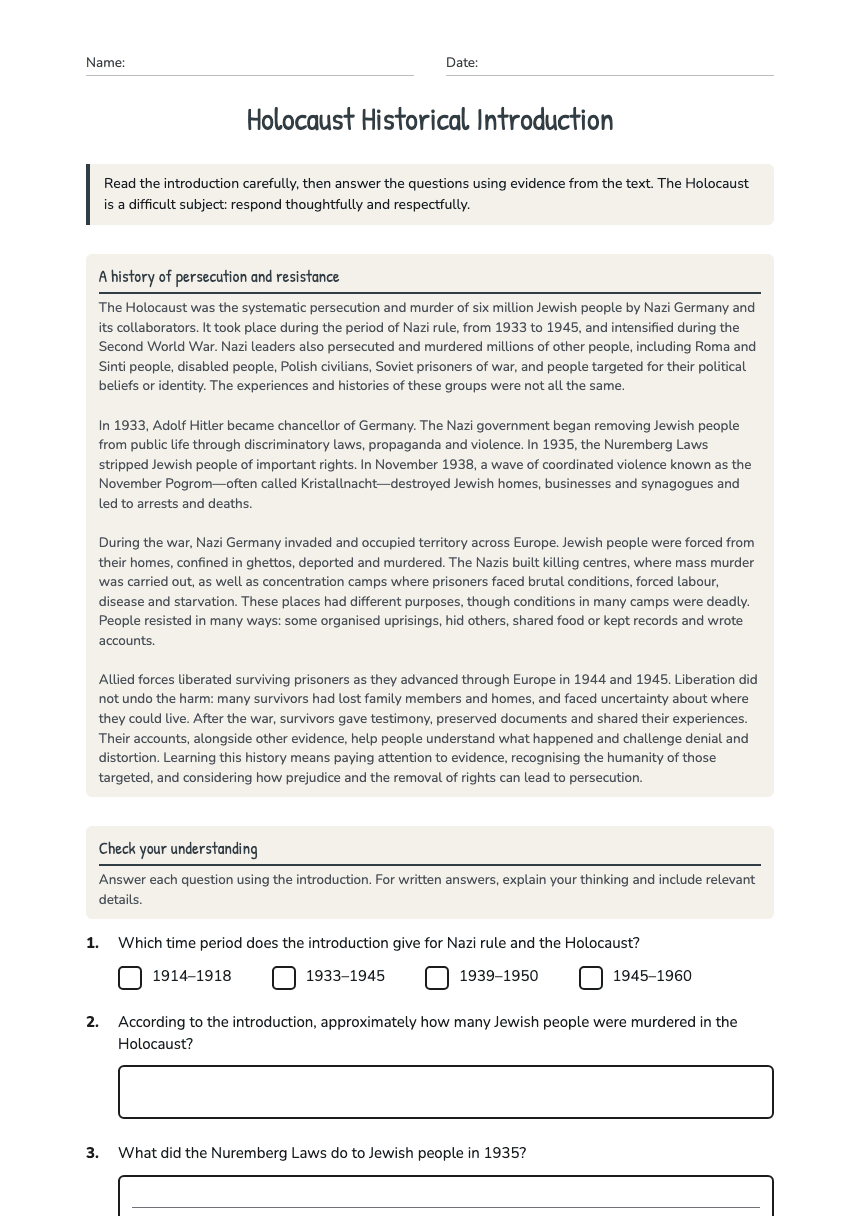
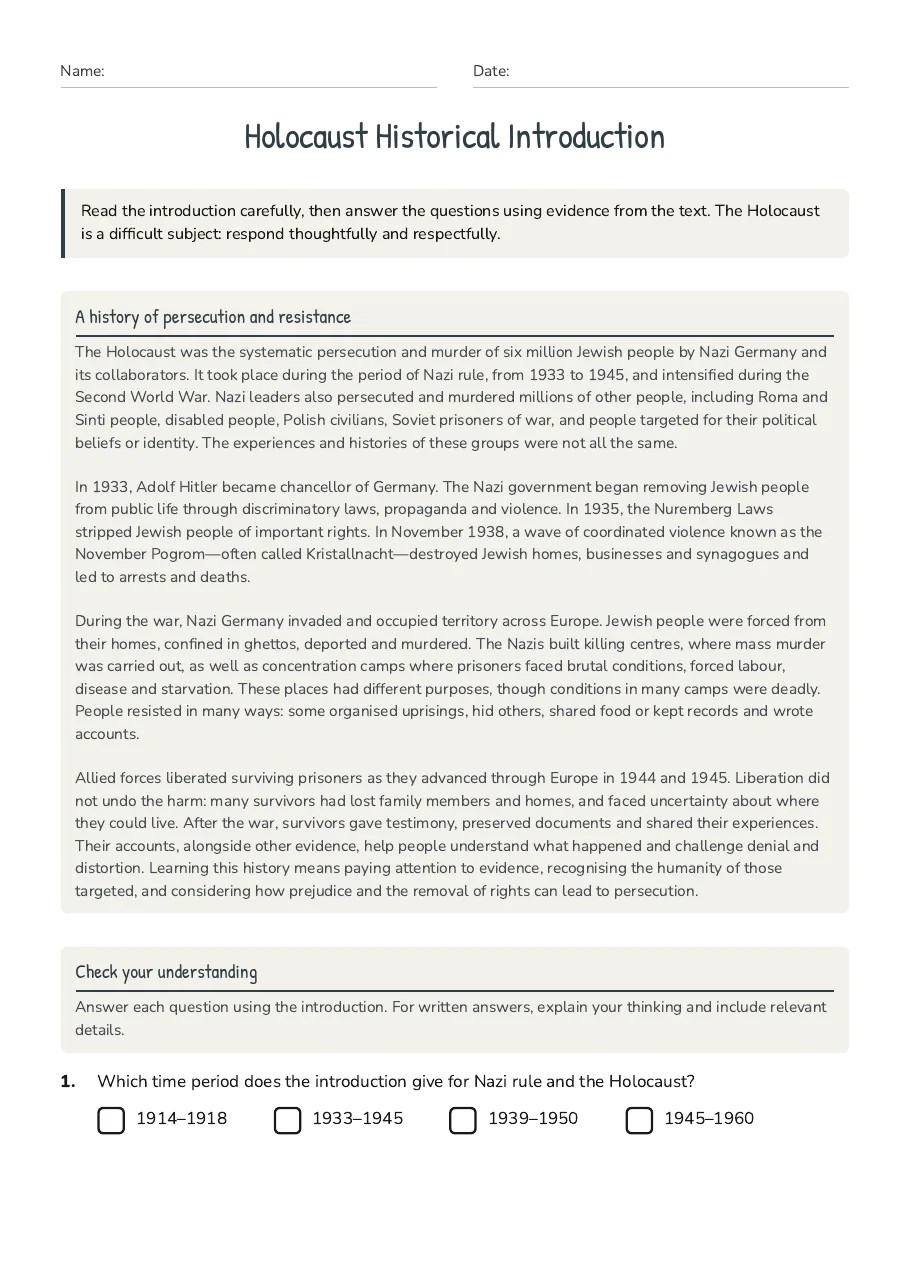
Holocaust Historical Introduction
A history of persecution and resistance
The Holocaust was the systematic persecution and murder of six million Jewish people by Nazi Germany and its collaborators. It took place during the period of Nazi rule, from 1933 to 1945, and intensified during the Second World War. Nazi leaders also persecuted and murdered millions of other people, including Roma and Sinti people, disabled people, Polish civilians, Soviet prisoners of war, and people targeted for their political beliefs or identity. The experiences and histories of these groups were not all the same. In 1933, Adolf Hitler became chancellor of Germany. The Nazi government began removing Jewish people from public life through discriminatory laws, propaganda and violence. In 1935, the Nuremberg Laws stripped Jewish people of important rights. In November 1938, a wave of coordinated violence known as the November Pogrom—often called Kristallnacht—destroyed Jewish homes, businesses and synagogues and led to arrests and deaths. During the war, Nazi Germany invaded and occupied territory across Europe. Jewish people were forced from their homes, confined in ghettos, deported and murdered. The Nazis built killing centres, where mass murder was carried out, as well as concentration camps where prisoners faced brutal conditions, forced labour, disease and starvation. These places had different purposes, though conditions in many camps were deadly. People resisted in many ways: some organised uprisings, hid others, shared food or kept records and wrote accounts. Allied forces liberated surviving prisoners as they advanced through Europe in 1944 and 1945. Liberation did not undo the harm: many survivors had lost family members and homes, and faced uncertainty about where they could live. After the war, survivors gave testimony, preserved documents and shared their experiences. Their accounts, alongside other evidence, help people understand what happened and challenge denial and distortion. Learning this history means paying attention to evidence, recognising the humanity of those targeted, and considering how prejudice and the removal of rights can lead to persecution.
Check your understanding
Answer each question using the introduction. For written answers, explain your thinking and include relevant details.
- 1914–1918
- 1933–1945
- 1939–1950
- 1945–1960
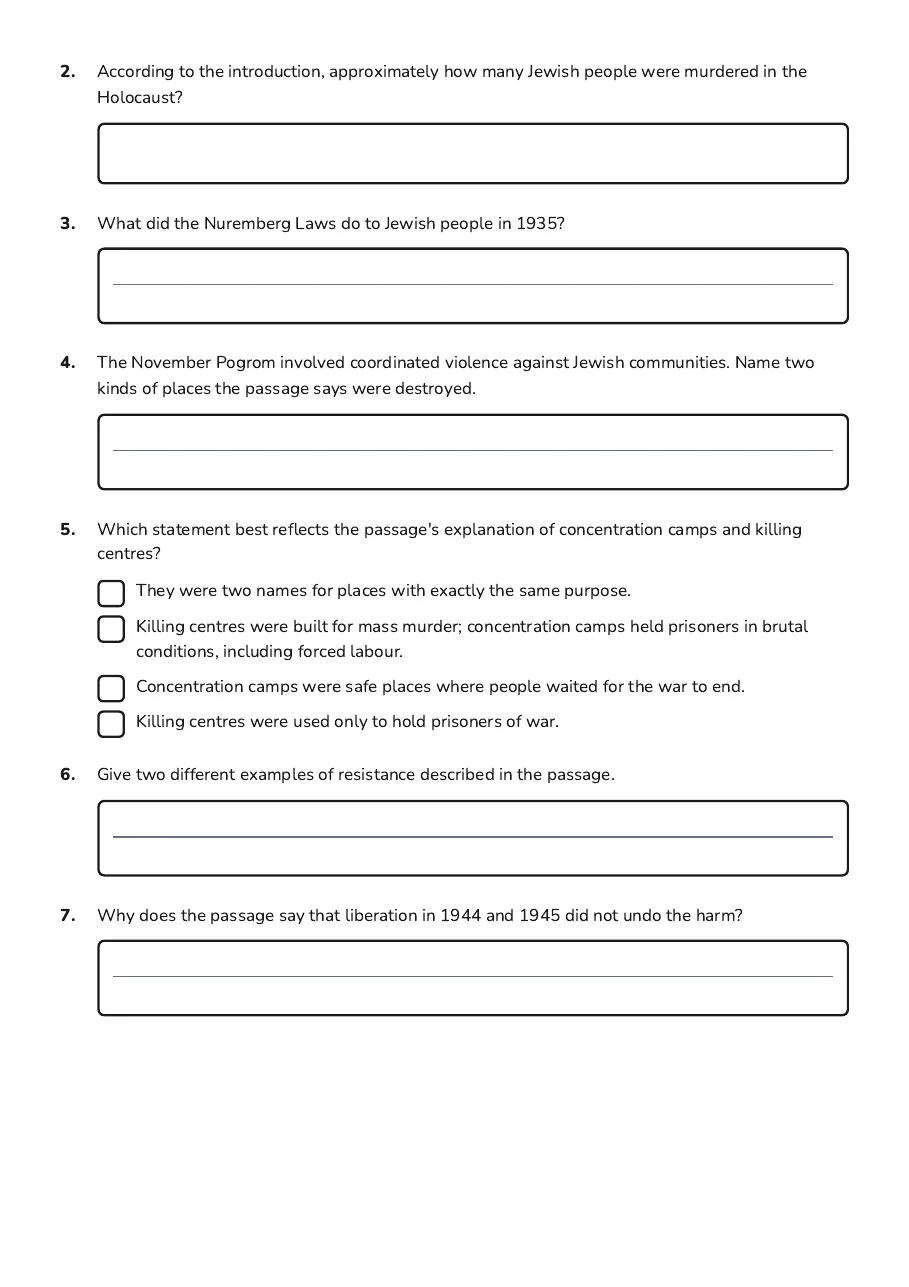
- They were two names for places with exactly the same purpose.
- Killing centres were built for mass murder; concentration camps held prisoners in brutal conditions, including forced labour.
- Concentration camps were safe places where people waited for the war to end.
- Killing centres were used only to hold prisoners of war.
3 printable pages
Page 1
Page 2
Page 3
About This Worksheet
Free in Kuraplan
Sign up free, grab the PDF, and customize it for your class.
Print-Ready
Formatted for standard paper. Clean layout, easy to read.
AI-Generated
Created with Kuraplan's AI, designed for real classroom use.
For Teachers & Parents
Use in classrooms, for homework, tutoring, or homeschool.
Need a custom version of this worksheet?
Kuraplan's AI generates custom worksheets in seconds — differentiated for every learner, aligned to your curriculum.
Generate Custom Worksheets — Free