Inventive Solutions Through History
A free english worksheet ready for your classroom. Open in Kuraplan to grab the print-ready PDF, customize it for your students, or generate a fresh version in seconds.
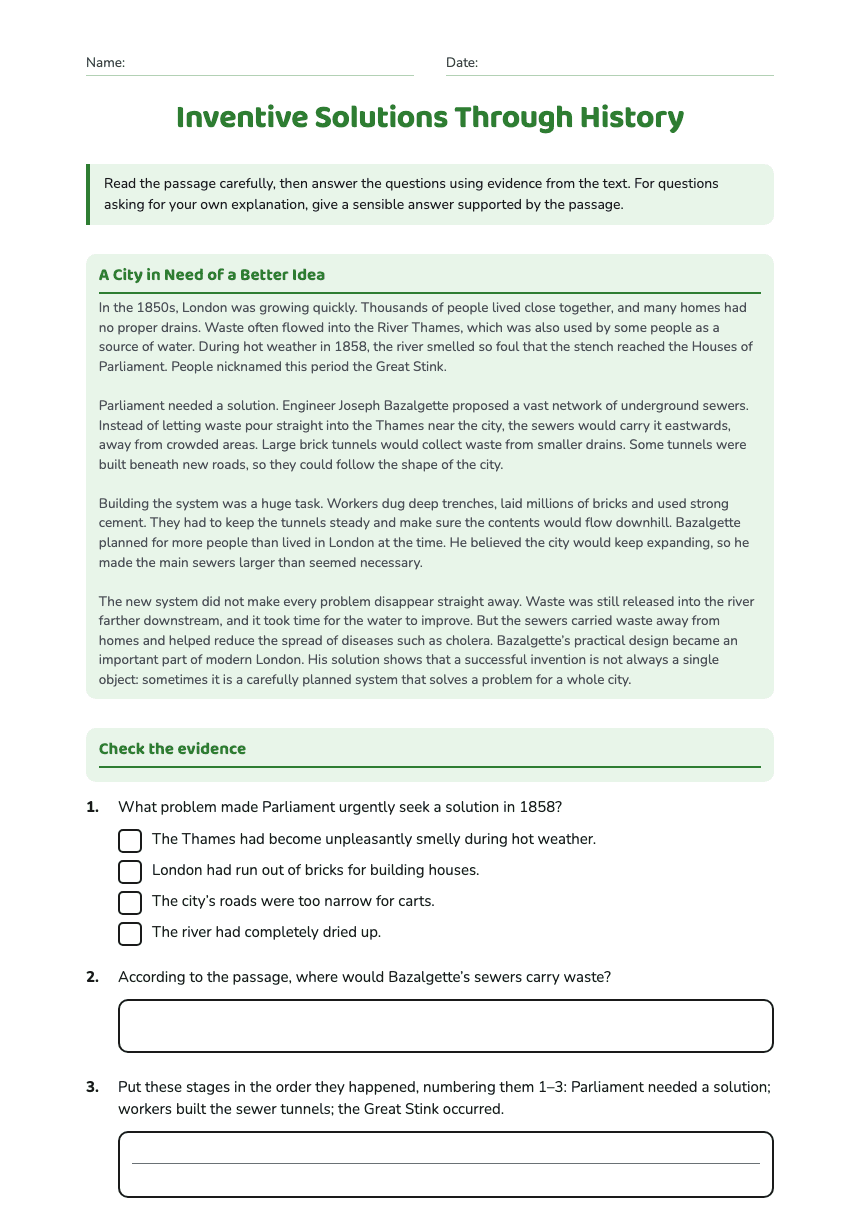
Inventive Solutions Through History
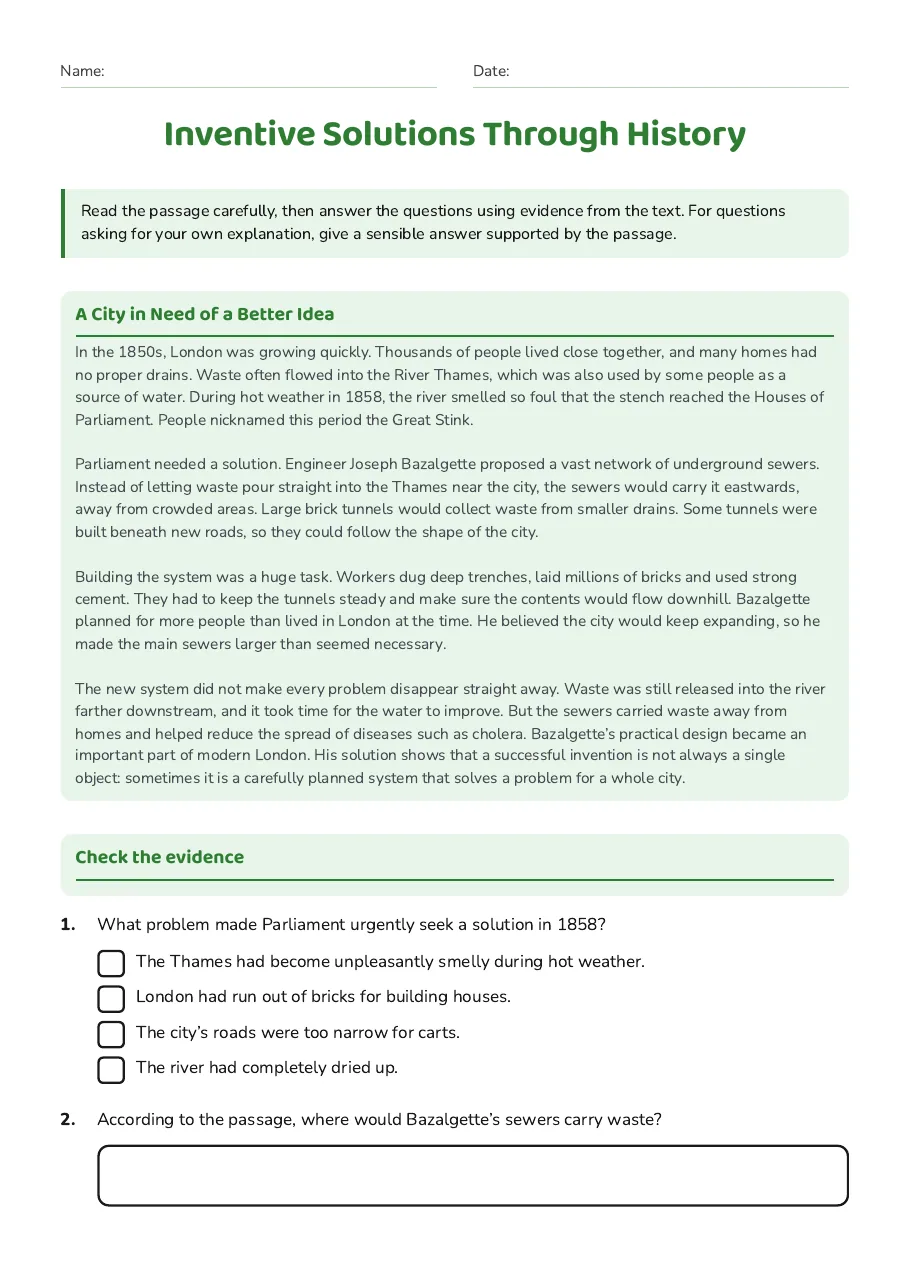
A City in Need of a Better Idea
In the 1850s, London was growing quickly. Thousands of people lived close together, and many homes had no proper drains. Waste often flowed into the River Thames, which was also used by some people as a source of water. During hot weather in 1858, the river smelled so foul that the stench reached the Houses of Parliament. People nicknamed this period the Great Stink. Parliament needed a solution. Engineer Joseph Bazalgette proposed a vast network of underground sewers. Instead of letting waste pour straight into the Thames near the city, the sewers would carry it eastwards, away from crowded areas. Large brick tunnels would collect waste from smaller drains. Some tunnels were built beneath new roads, so they could follow the shape of the city. Building the system was a huge task. Workers dug deep trenches, laid millions of bricks and used strong cement. They had to keep the tunnels steady and make sure the contents would flow downhill. Bazalgette planned for more people than lived in London at the time. He believed the city would keep expanding, so he made the main sewers larger than seemed necessary. The new system did not make every problem disappear straight away. Waste was still released into the river farther downstream, and it took time for the water to improve. But the sewers carried waste away from homes and helped reduce the spread of diseases such as cholera. Bazalgette’s practical design became an important part of modern London. His solution shows that a successful invention is not always a single object: sometimes it is a carefully planned system that solves a problem for a whole city.
Check the evidence
- The Thames had become unpleasantly smelly during hot weather.
- London had run out of bricks for building houses.
- The city’s roads were too narrow for carts.
- The river had completely dried up.
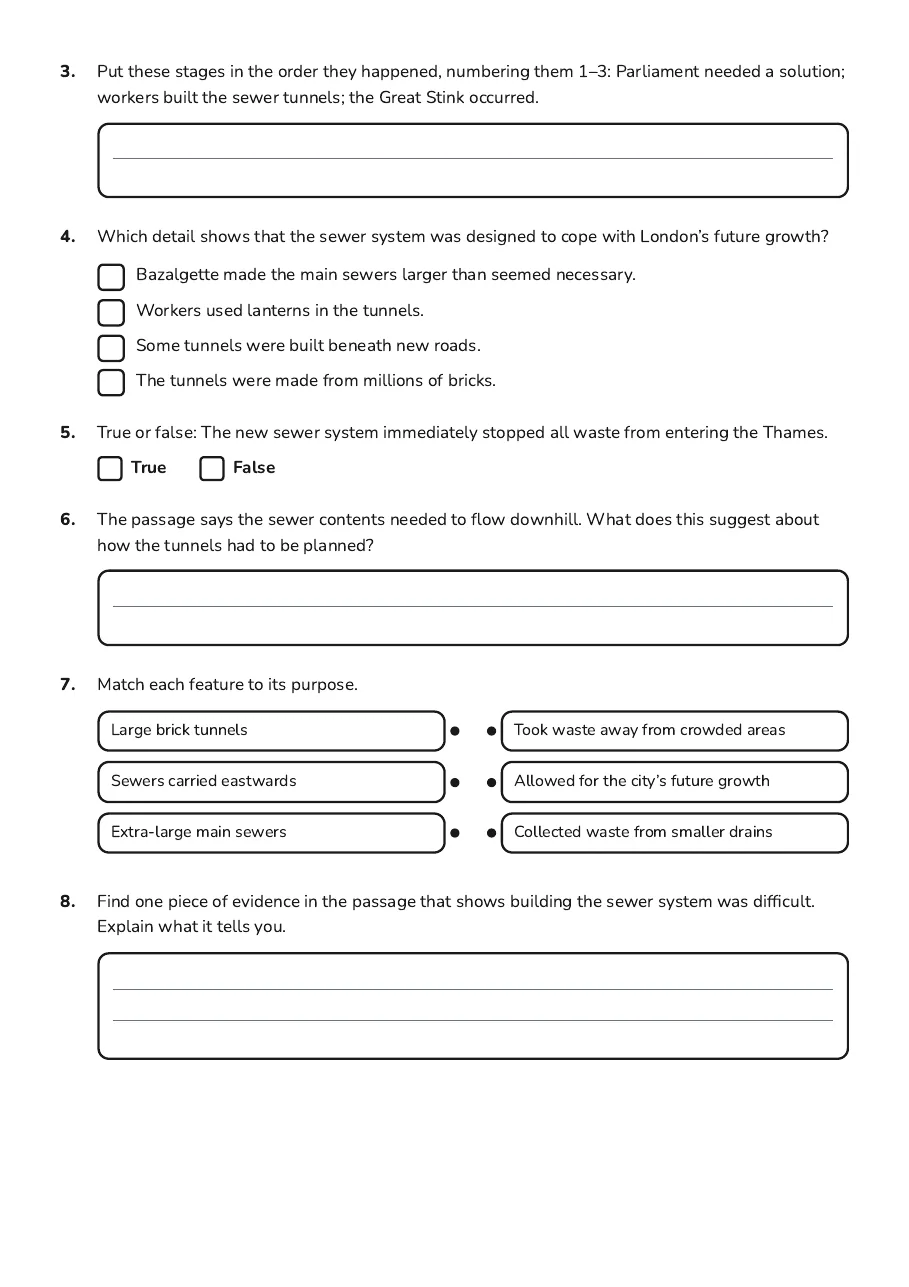
- Bazalgette made the main sewers larger than seemed necessary.
- Workers used lanterns in the tunnels.
- Some tunnels were built beneath new roads.
- The tunnels were made from millions of bricks.
- Large brick tunnels
- Sewers carried eastwards
- Extra-large main sewers
- Took waste away from crowded areas
- Allowed for the city’s future growth
- Collected waste from smaller drains
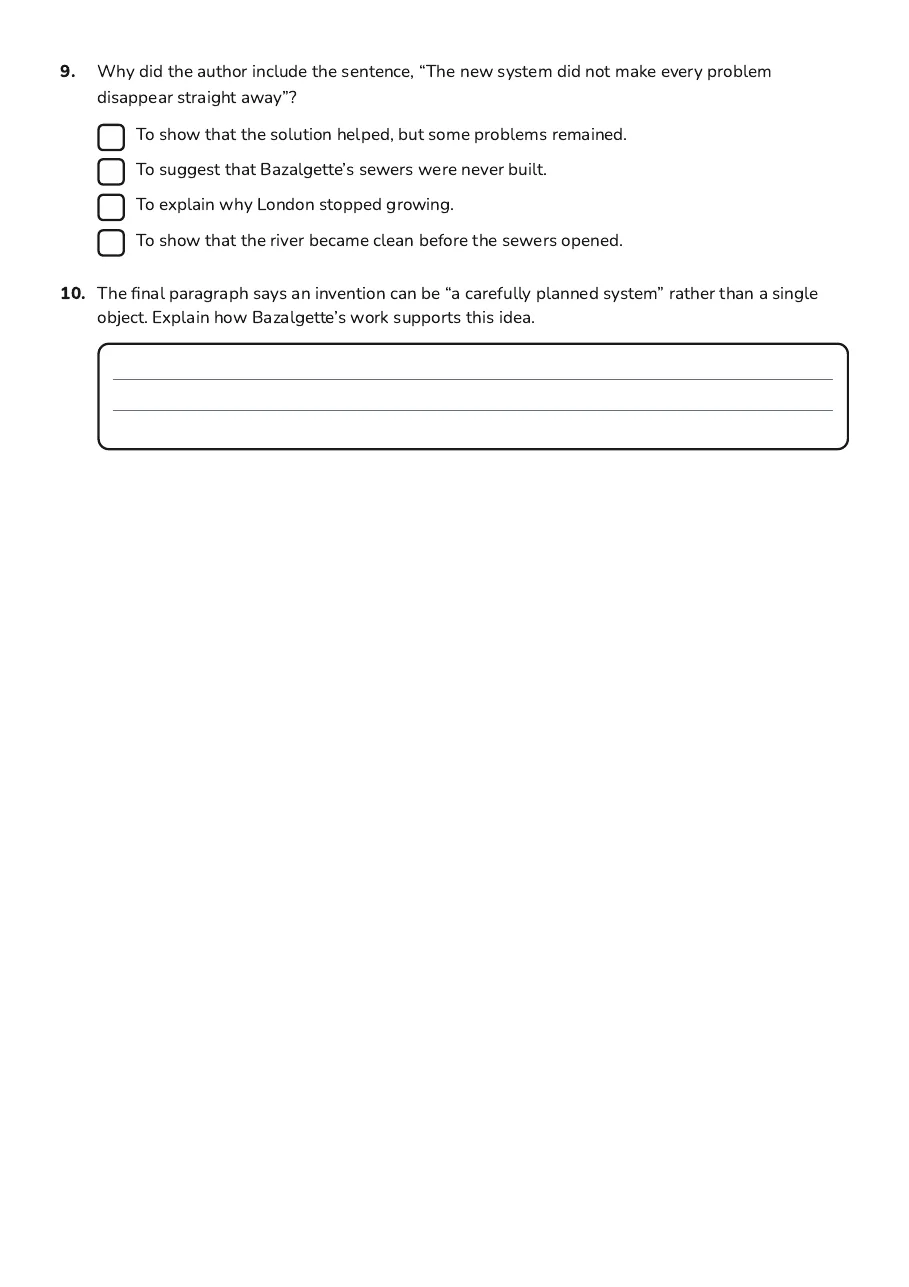
- To show that the solution helped, but some problems remained.
- To suggest that Bazalgette’s sewers were never built.
- To explain why London stopped growing.
- To show that the river became clean before the sewers opened.
3 printable pages
Page 1
Page 2
Page 3
About This Worksheet
Free in Kuraplan
Sign up free, grab the PDF, and customize it for your class.
Print-Ready
Formatted for standard paper. Clean layout, easy to read.
AI-Generated
Created with Kuraplan's AI, designed for real classroom use.
For Teachers & Parents
Use in classrooms, for homework, tutoring, or homeschool.
Need a custom version of this worksheet?
Kuraplan's AI generates custom worksheets in seconds — differentiated for every learner, aligned to your curriculum.
Generate Custom Worksheets — Free