MathsFreePrintable

Linear Algebra Fundamentals

A free maths worksheet ready for your classroom. Open in Kuraplan to grab the print-ready PDF, customize it for your students, or generate a fresh version in seconds.
Linear Algebra Fundamentals worksheet preview
Name:Date:

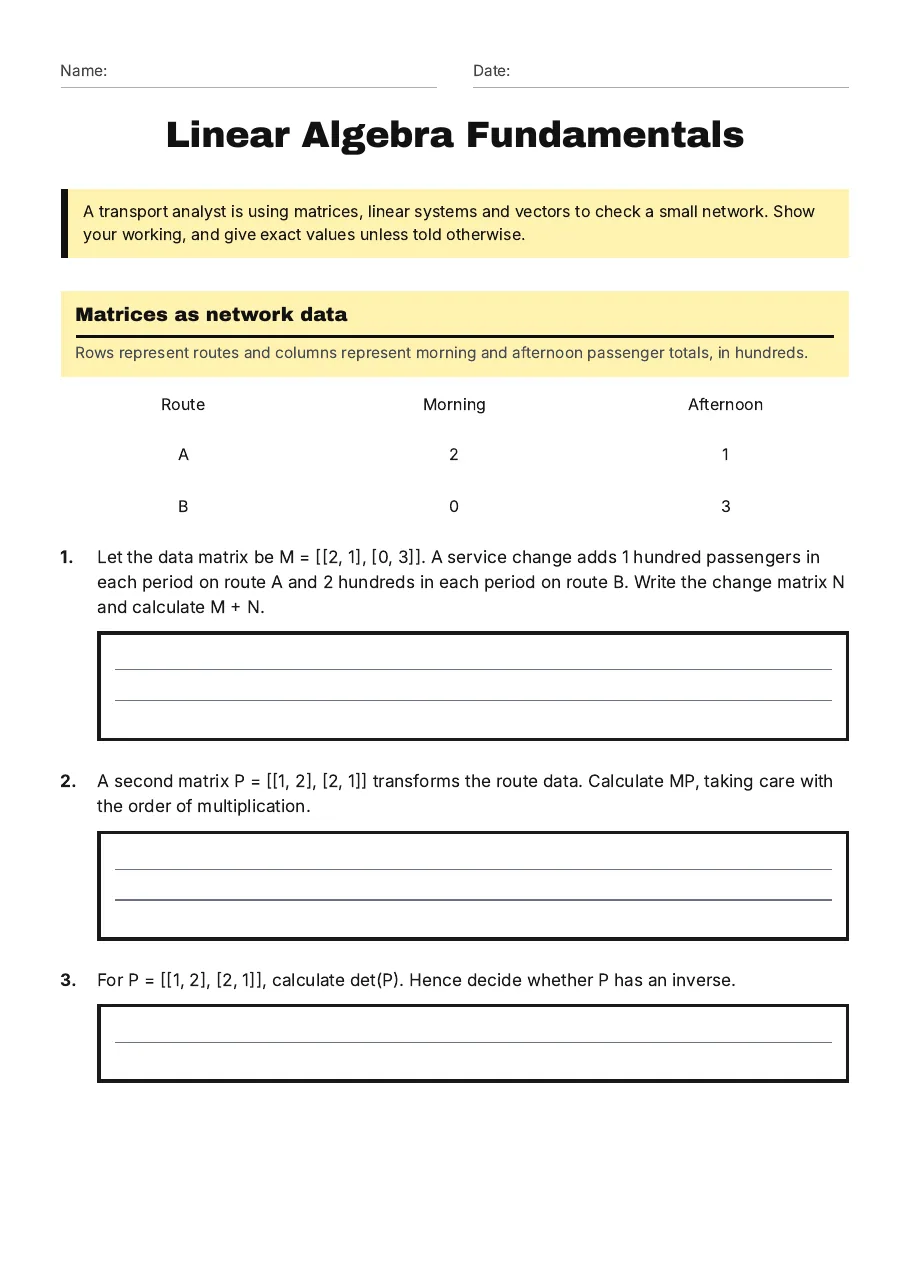
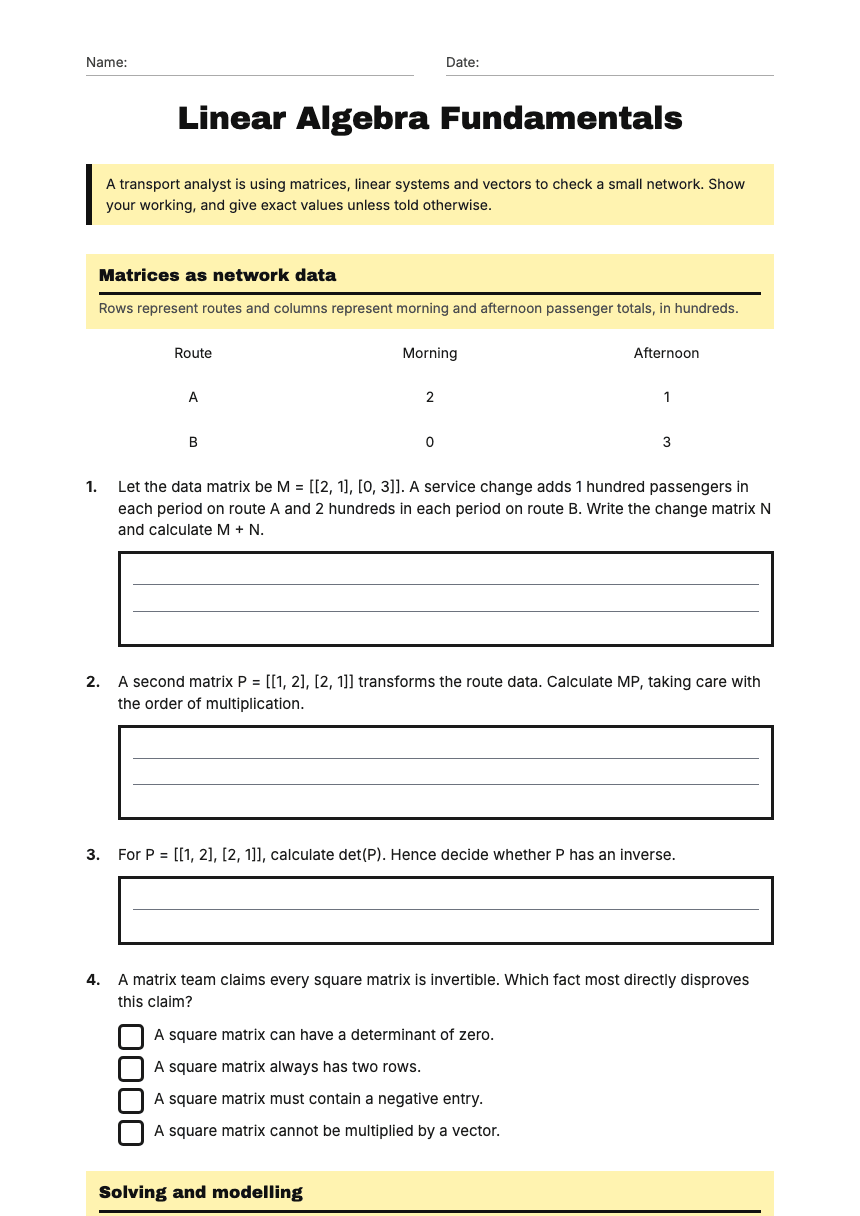
Linear Algebra Fundamentals

A transport analyst is using matrices, linear systems and vectors to check a small network. Show your working, and give exact values unless told otherwise.

Matrices as network data

Rows represent routes and columns represent morning and afternoon passenger totals, in hundreds.

Route

Morning

Afternoon

A

2

1

B

0

3

1.Let the data matrix be M = [[2, 1], [0, 3]]. A service change adds 1 hundred passengers in each period on route A and 2 hundreds in each period on route B. Write the change matrix N and calculate M + N.
2.A second matrix P = [[1, 2], [2, 1]] transforms the route data. Calculate MP, taking care with the order of multiplication.
3.For P = [[1, 2], [2, 1]], calculate det(P). Hence decide whether P has an inverse.
4.A matrix team claims every square matrix is invertible. Which fact most directly disproves this claim?
  • A square matrix can have a determinant of zero.
  • A square matrix always has two rows.
  • A square matrix must contain a negative entry.
  • A square matrix cannot be multiplied by a vector.

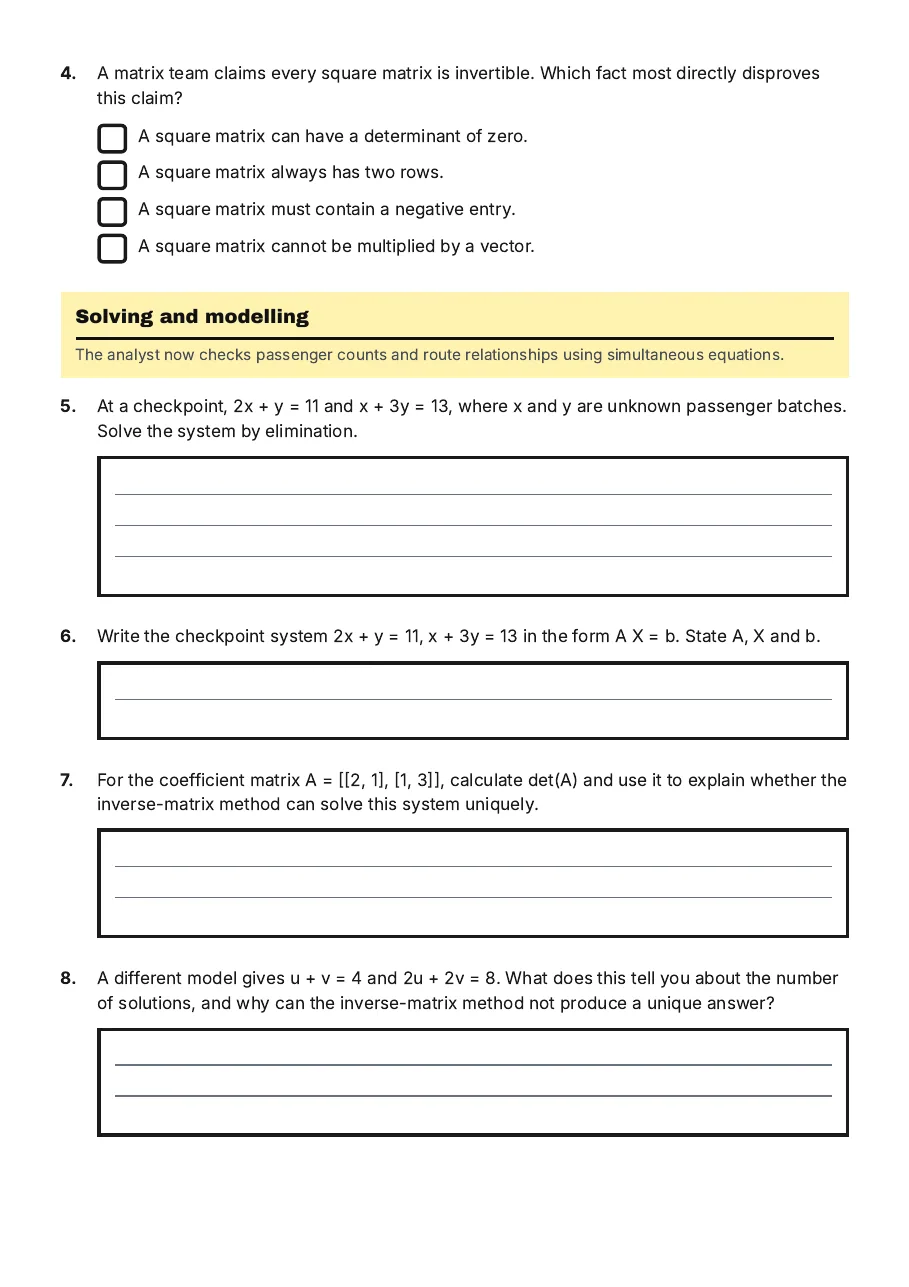
Solving and modelling

The analyst now checks passenger counts and route relationships using simultaneous equations.

5.At a checkpoint, 2x + y = 11 and x + 3y = 13, where x and y are unknown passenger batches. Solve the system by elimination.
6.Write the checkpoint system 2x + y = 11, x + 3y = 13 in the form A X = b. State A, X and b.
7.For the coefficient matrix A = [[2, 1], [1, 3]], calculate det(A) and use it to explain whether the inverse-matrix method can solve this system uniquely.
8.A different model gives u + v = 4 and 2u + 2v = 8. What does this tell you about the number of solutions, and why can the inverse-matrix method not produce a unique answer?

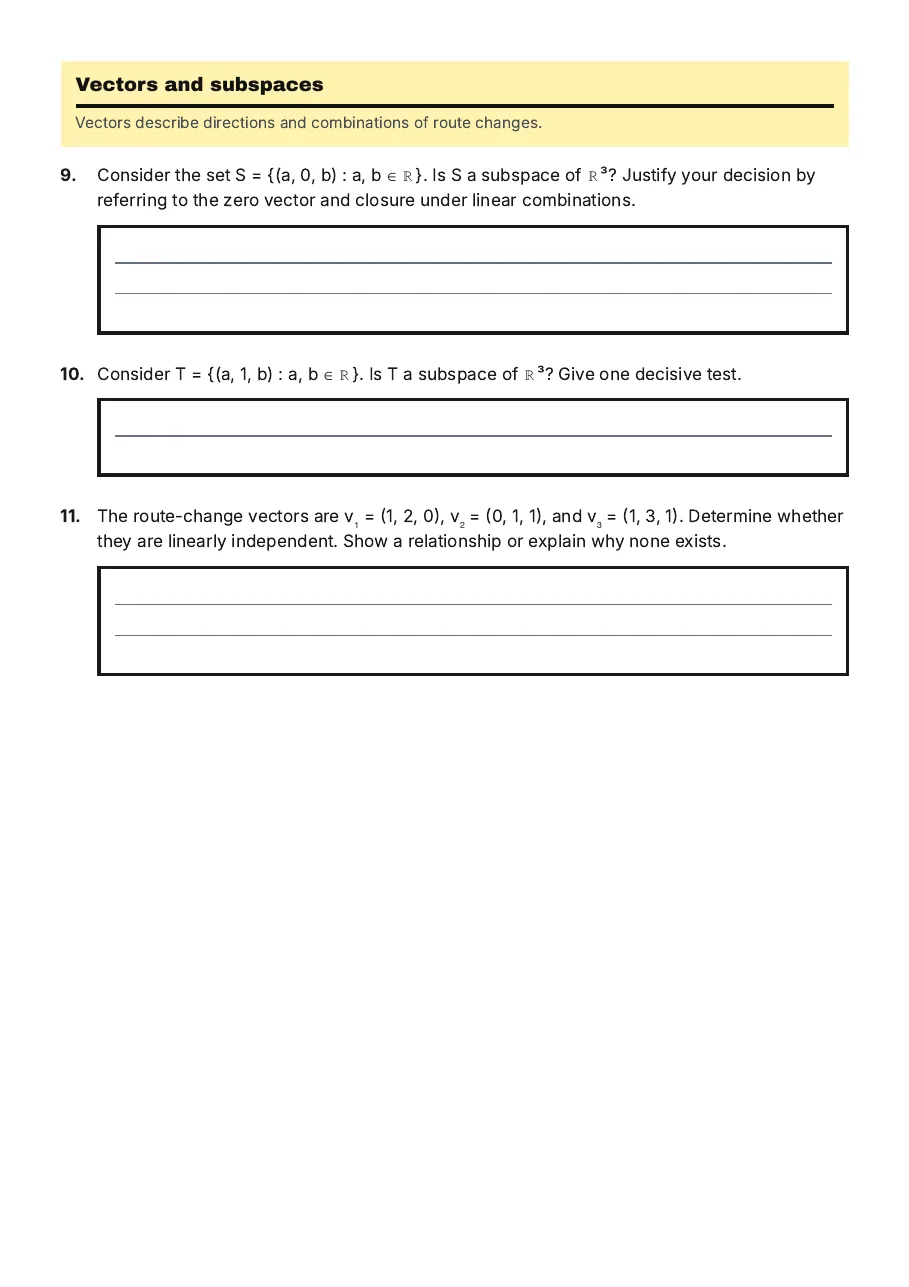
Vectors and subspaces

Vectors describe directions and combinations of route changes.

9.Consider the set S = {(a, 0, b) : a, b ∈ ℝ}. Is S a subspace of ℝ³? Justify your decision by referring to the zero vector and closure under linear combinations.
10.Consider T = {(a, 1, b) : a, b ∈ ℝ}. Is T a subspace of ℝ³? Give one decisive test.
11.The route-change vectors are v₁ = (1, 2, 0), v₂ = (0, 1, 1), and v₃ = (1, 3, 1). Determine whether they are linearly independent. Show a relationship or explain why none exists.

3 printable pages

  • Linear Algebra Fundamentals, page 1 of 3: Matrices as network data

    Page 1

  • Linear Algebra Fundamentals, page 2 of 3: Solving and modelling

    Page 2

  • Linear Algebra Fundamentals, page 3 of 3: Vectors and subspaces

    Page 3

About This Worksheet

Free in Kuraplan

Sign up free, grab the PDF, and customize it for your class.

Print-Ready

Formatted for standard paper. Clean layout, easy to read.

AI-Generated

Created with Kuraplan's AI, designed for real classroom use.

For Teachers & Parents

Use in classrooms, for homework, tutoring, or homeschool.

Need a custom version of this worksheet?

Kuraplan's AI generates custom worksheets in seconds — differentiated for every learner, aligned to your curriculum.

Generate Custom Worksheets — Free
No credit card Curriculum-aligned Under 60 seconds