ScienceFreePrintable

Metals and Non-Metals

A free science worksheet ready for your classroom. Open in Kuraplan to grab the print-ready PDF, customize it for your students, or generate a fresh version in seconds.
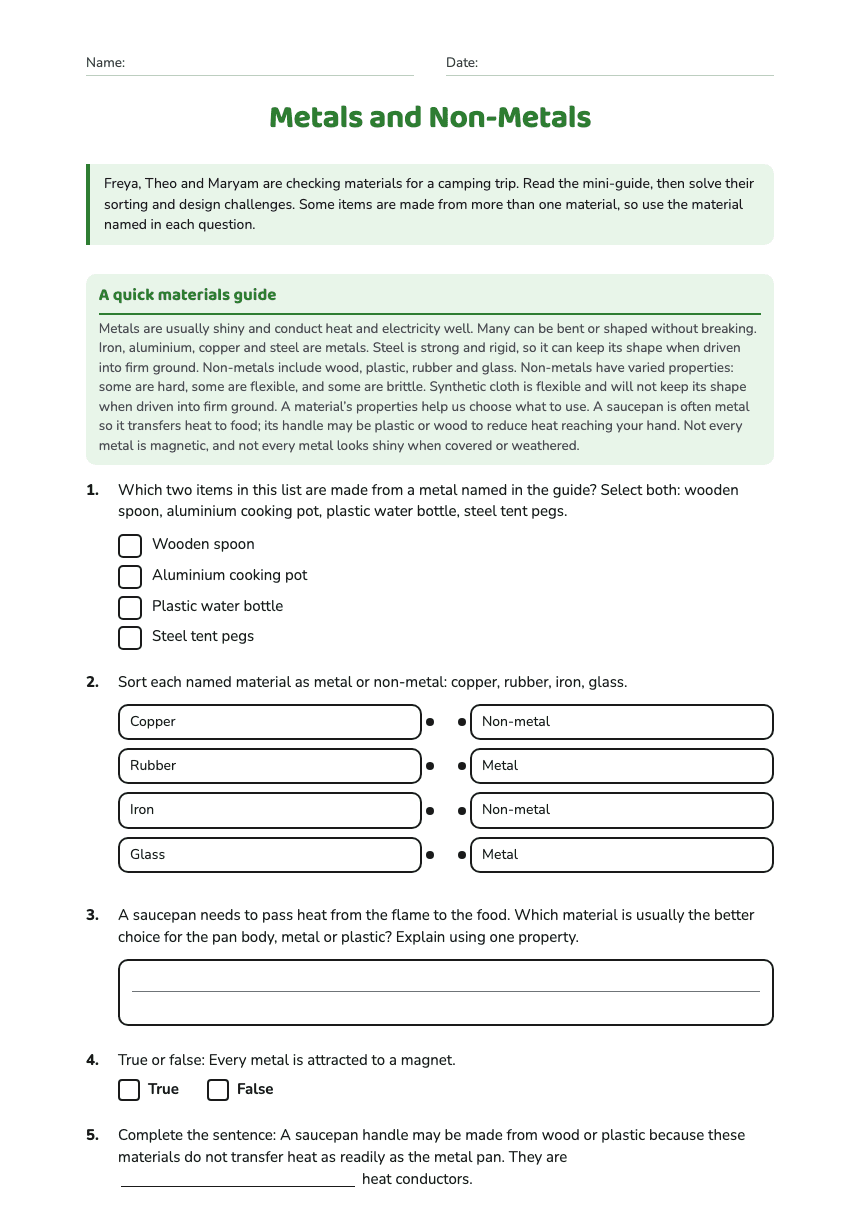
Metals and Non-Metals worksheet preview
Name:Date:

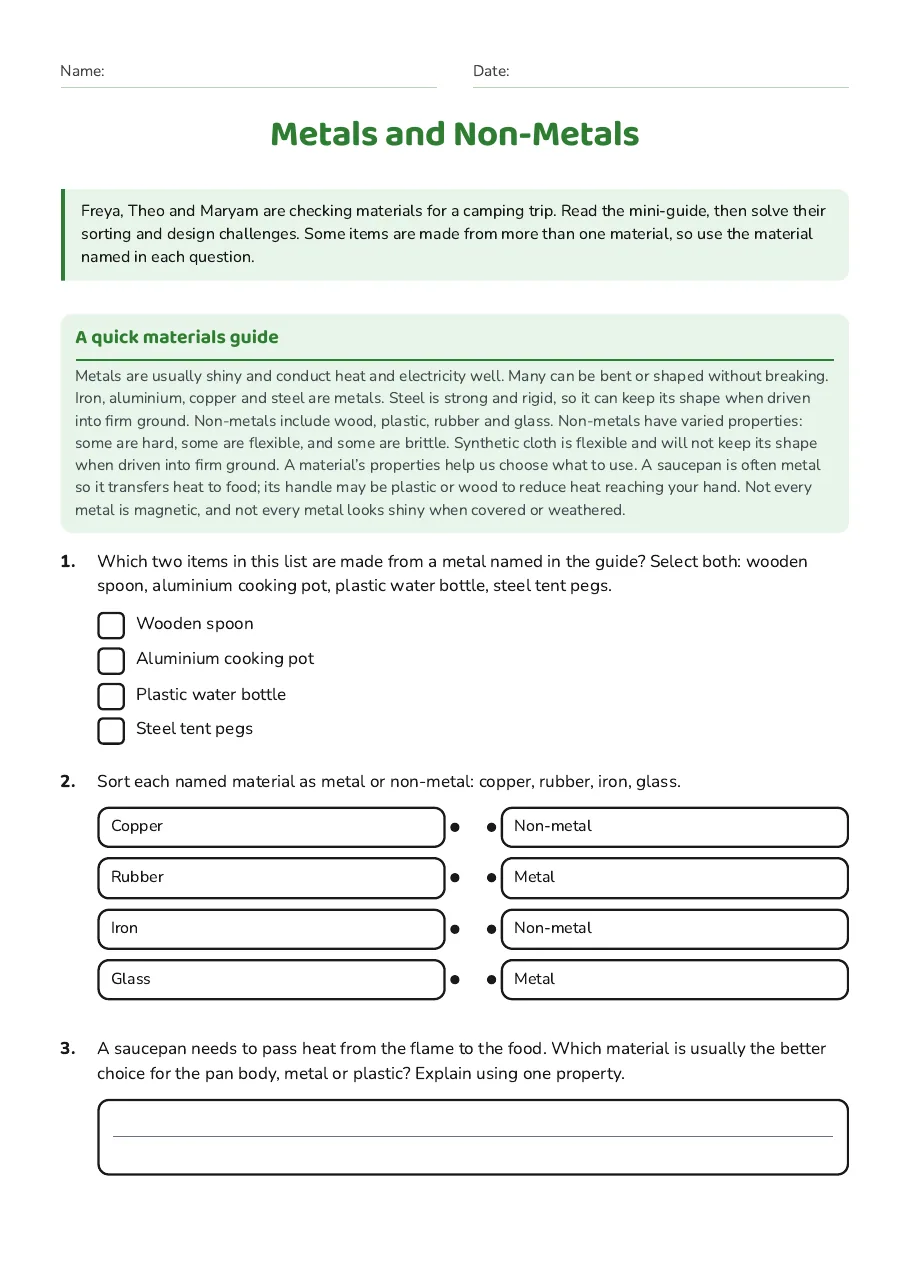
Metals and Non-Metals

Freya, Theo and Maryam are checking materials for a camping trip. Read the mini-guide, then solve their sorting and design challenges. Some items are made from more than one material, so use the material named in each question.

A quick materials guide

Metals are usually shiny and conduct heat and electricity well. Many can be bent or shaped without breaking. Iron, aluminium, copper and steel are metals. Steel is strong and rigid, so it can keep its shape when driven into firm ground. Non-metals include wood, plastic, rubber and glass. Non-metals have varied properties: some are hard, some are flexible, and some are brittle. Synthetic cloth is flexible and will not keep its shape when driven into firm ground. A material’s properties help us choose what to use. A saucepan is often metal so it transfers heat to food; its handle may be plastic or wood to reduce heat reaching your hand. Not every metal is magnetic, and not every metal looks shiny when covered or weathered.

1.Which two items in this list are made from a metal named in the guide? Select both: wooden spoon, aluminium cooking pot, plastic water bottle, steel tent pegs.
  • Wooden spoon
  • Aluminium cooking pot
  • Plastic water bottle
  • Steel tent pegs
2.Sort each named material as metal or non-metal: copper, rubber, iron, glass.
  • Copper
  • Rubber
  • Iron
  • Glass
  • Non-metal
  • Metal
  • Non-metal
  • Metal
3.A saucepan needs to pass heat from the flame to the food. Which material is usually the better choice for the pan body, metal or plastic? Explain using one property.
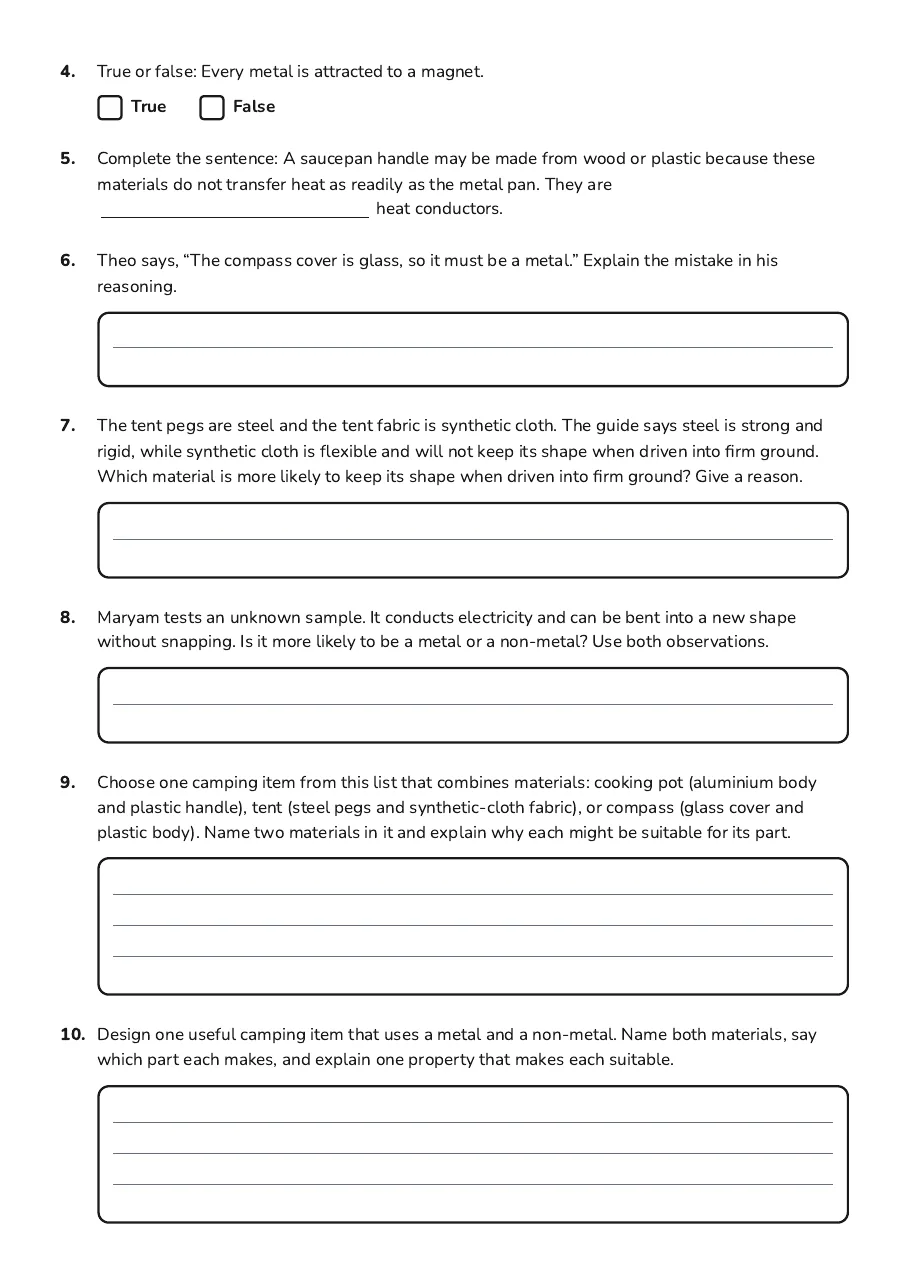
4.True or false: Every metal is attracted to a magnet.
TrueFalse
5.Complete the sentence: A saucepan handle may be made from wood or plastic because these materials do not transfer heat as readily as the metal pan. They are heat conductors.
6.Theo says, “The compass cover is glass, so it must be a metal.” Explain the mistake in his reasoning.
7.The tent pegs are steel and the tent fabric is synthetic cloth. The guide says steel is strong and rigid, while synthetic cloth is flexible and will not keep its shape when driven into firm ground. Which material is more likely to keep its shape when driven into firm ground? Give a reason.
8.Maryam tests an unknown sample. It conducts electricity and can be bent into a new shape without snapping. Is it more likely to be a metal or a non-metal? Use both observations.
9.Choose one camping item from this list that combines materials: cooking pot (aluminium body and plastic handle), tent (steel pegs and synthetic-cloth fabric), or compass (glass cover and plastic body). Name two materials in it and explain why each might be suitable for its part.
10.Design one useful camping item that uses a metal and a non-metal. Name both materials, say which part each makes, and explain one property that makes each suitable.

2 printable pages

  • Metals and Non-Metals, page 1 of 2: A quick materials guide

    Page 1

  • Metals and Non-Metals, page 2 of 2: 4. True or false: Every metal is attracted to a magnet.

    Page 2

About This Worksheet

Free in Kuraplan

Sign up free, grab the PDF, and customize it for your class.

Print-Ready

Formatted for standard paper. Clean layout, easy to read.

AI-Generated

Created with Kuraplan's AI, designed for real classroom use.

For Teachers & Parents

Use in classrooms, for homework, tutoring, or homeschool.

Need a custom version of this worksheet?

Kuraplan's AI generates custom worksheets in seconds — differentiated for every learner, aligned to your curriculum.

Generate Custom Worksheets — Free
No credit card Curriculum-aligned Under 60 seconds