PSHEFreePrintable
Microfinance and Poverty
A free pshe worksheet ready for your classroom. Open in Kuraplan to grab the print-ready PDF, customize it for your students, or generate a fresh version in seconds.
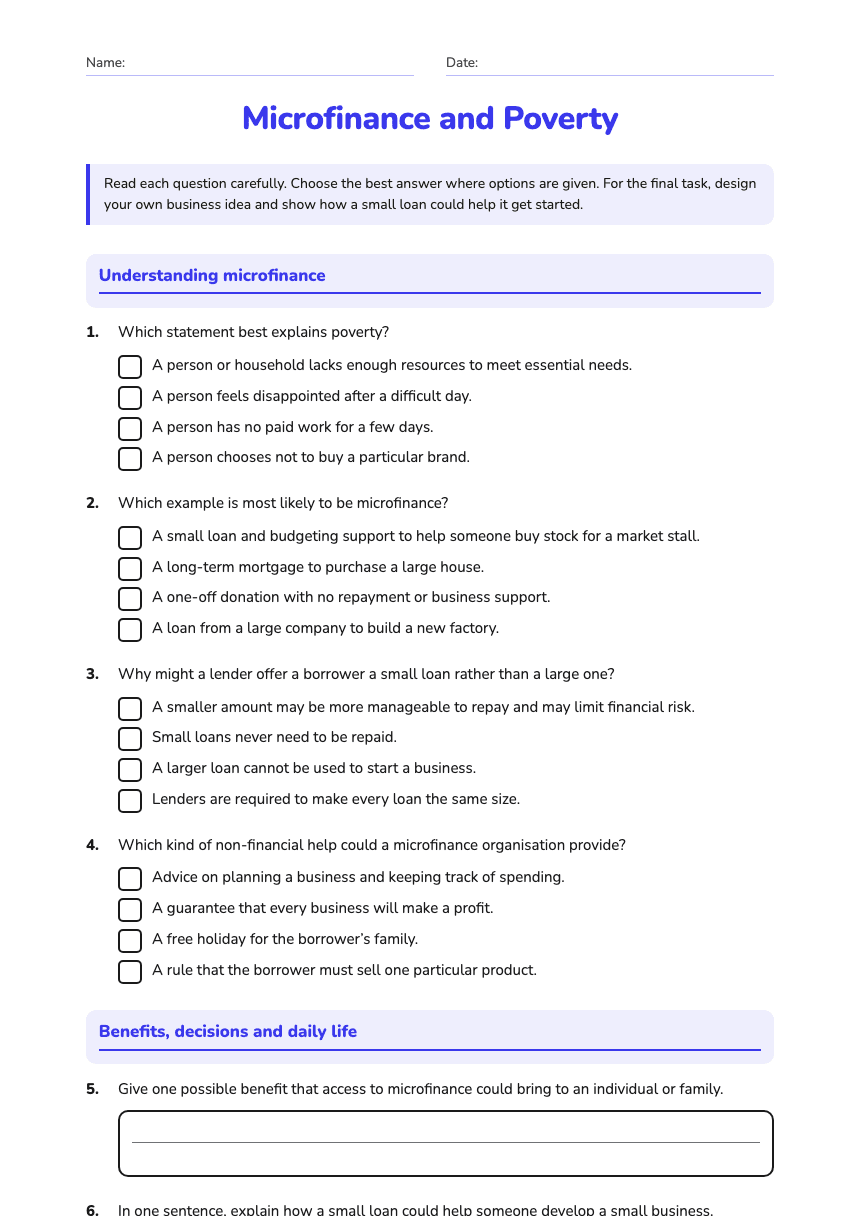
Name:Date:
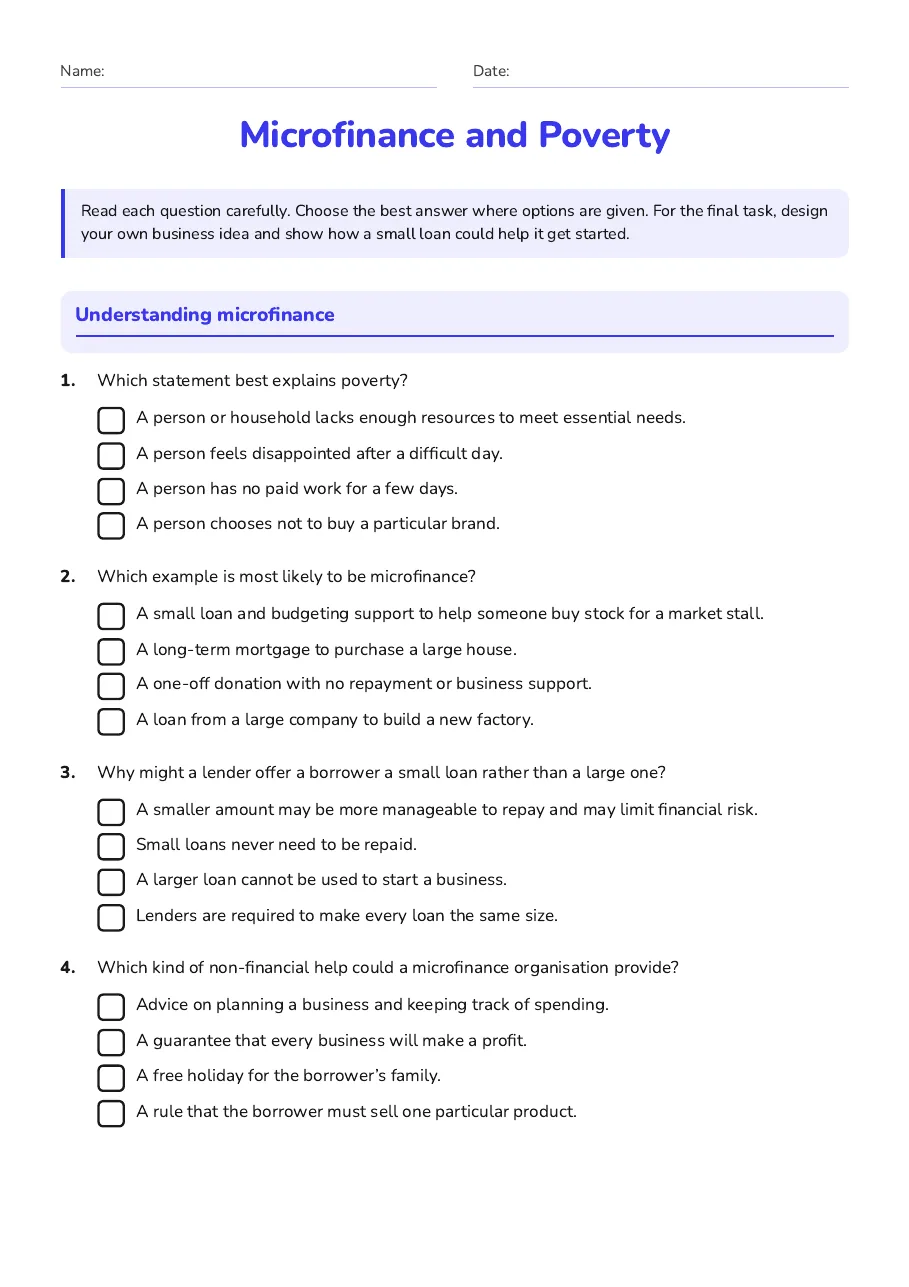
Microfinance and Poverty
Read each question carefully. Choose the best answer where options are given. For the final task, design your own business idea and show how a small loan could help it get started.
Understanding microfinance
1.Which statement best explains poverty?
- A person or household lacks enough resources to meet essential needs.
- A person feels disappointed after a difficult day.
- A person has no paid work for a few days.
- A person chooses not to buy a particular brand.
2.Which example is most likely to be microfinance?
- A small loan and budgeting support to help someone buy stock for a market stall.
- A long-term mortgage to purchase a large house.
- A one-off donation with no repayment or business support.
- A loan from a large company to build a new factory.
3.Why might a lender offer a borrower a small loan rather than a large one?
- A smaller amount may be more manageable to repay and may limit financial risk.
- Small loans never need to be repaid.
- A larger loan cannot be used to start a business.
- Lenders are required to make every loan the same size.
4.Which kind of non-financial help could a microfinance organisation provide?
- Advice on planning a business and keeping track of spending.
- A guarantee that every business will make a profit.
- A free holiday for the borrower’s family.
- A rule that the borrower must sell one particular product.
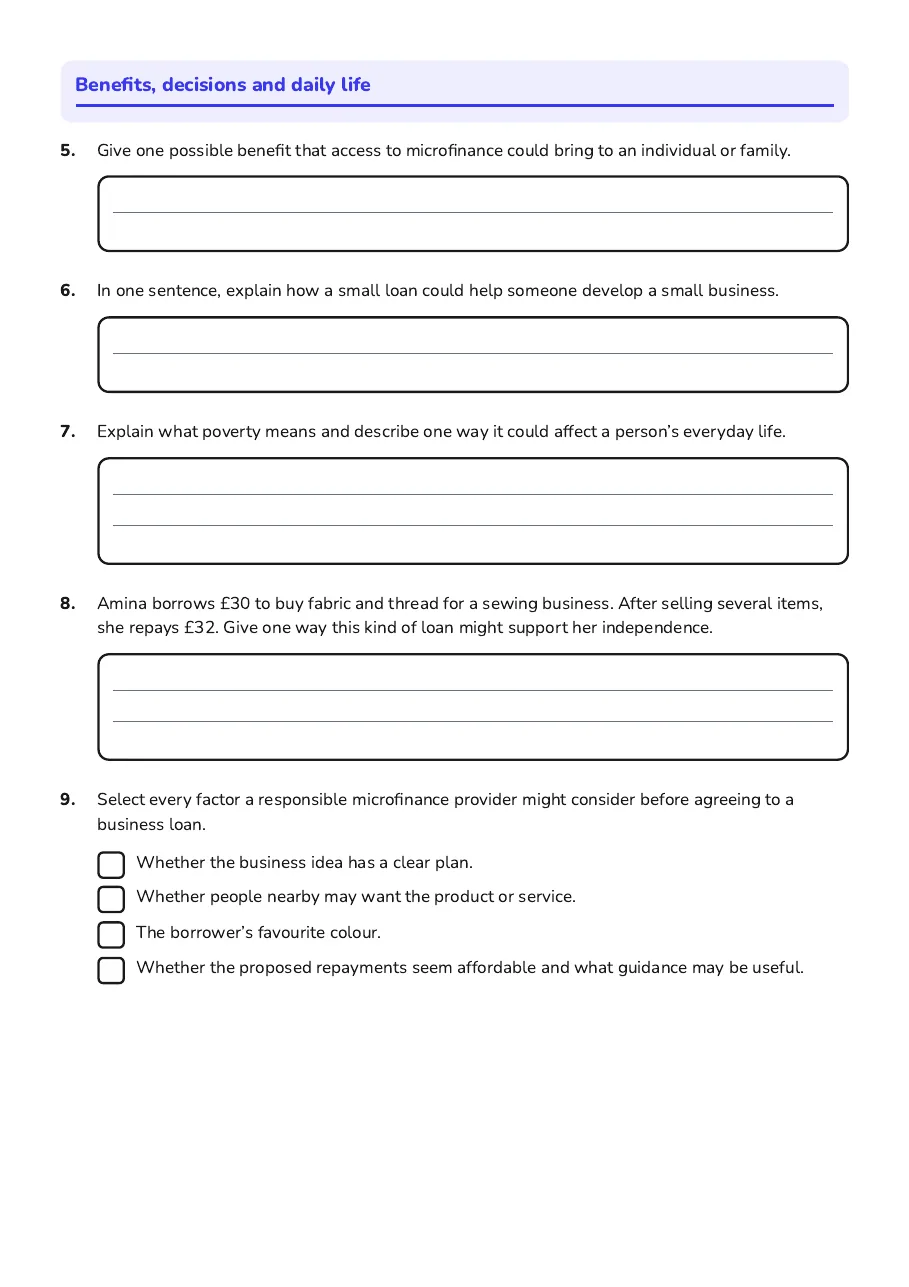
Benefits, decisions and daily life
5.Give one possible benefit that access to microfinance could bring to an individual or family.
6.In one sentence, explain how a small loan could help someone develop a small business.
7.Explain what poverty means and describe one way it could affect a person’s everyday life.
8.Amina borrows £30 to buy fabric and thread for a sewing business. After selling several items, she repays £32. Give one way this kind of loan might support her independence.
9.Select every factor a responsible microfinance provider might consider before agreeing to a business loan.
- Whether the business idea has a clear plan.
- Whether people nearby may want the product or service.
- The borrower’s favourite colour.
- Whether the proposed repayments seem affordable and what guidance may be useful.
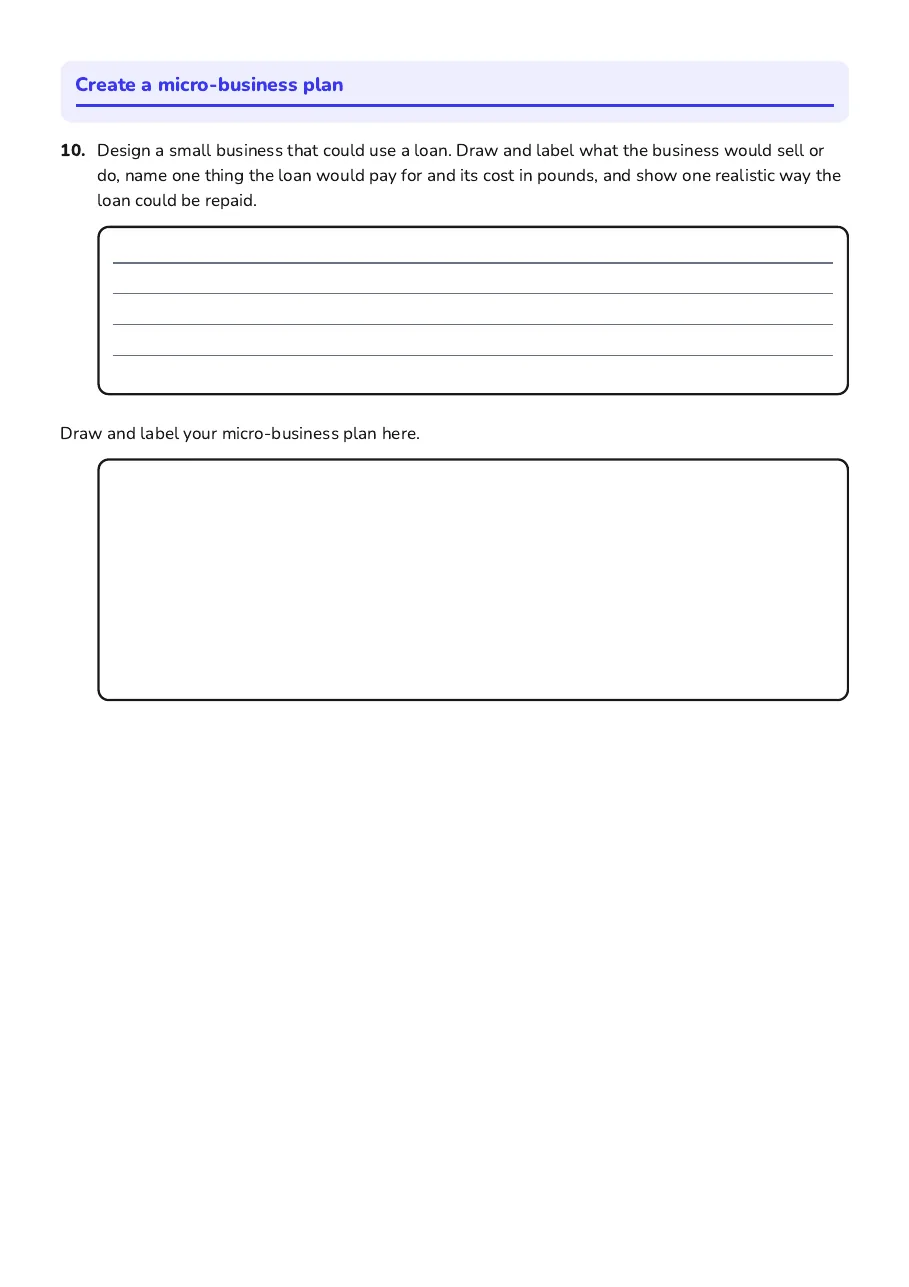
Create a micro-business plan
10.Design a small business that could use a loan. Draw and label what the business would sell or do, name one thing the loan would pay for and its cost in pounds, and show one realistic way the loan could be repaid.
Draw and label your micro-business plan here.
3 printable pages
Page 1
Page 2
Page 3
About This Worksheet
Free in Kuraplan
Sign up free, grab the PDF, and customize it for your class.
Print-Ready
Formatted for standard paper. Clean layout, easy to read.
AI-Generated
Created with Kuraplan's AI, designed for real classroom use.
For Teachers & Parents
Use in classrooms, for homework, tutoring, or homeschool.
Need a custom version of this worksheet?
Kuraplan's AI generates custom worksheets in seconds — differentiated for every learner, aligned to your curriculum.
Generate Custom Worksheets — Free No credit card Curriculum-aligned Under 60 seconds