ScienceFreePrintable

Digestive System Labelling

A free science worksheet ready for your classroom. Open in Kuraplan to grab the print-ready PDF, customize it for your students, or generate a fresh version in seconds.
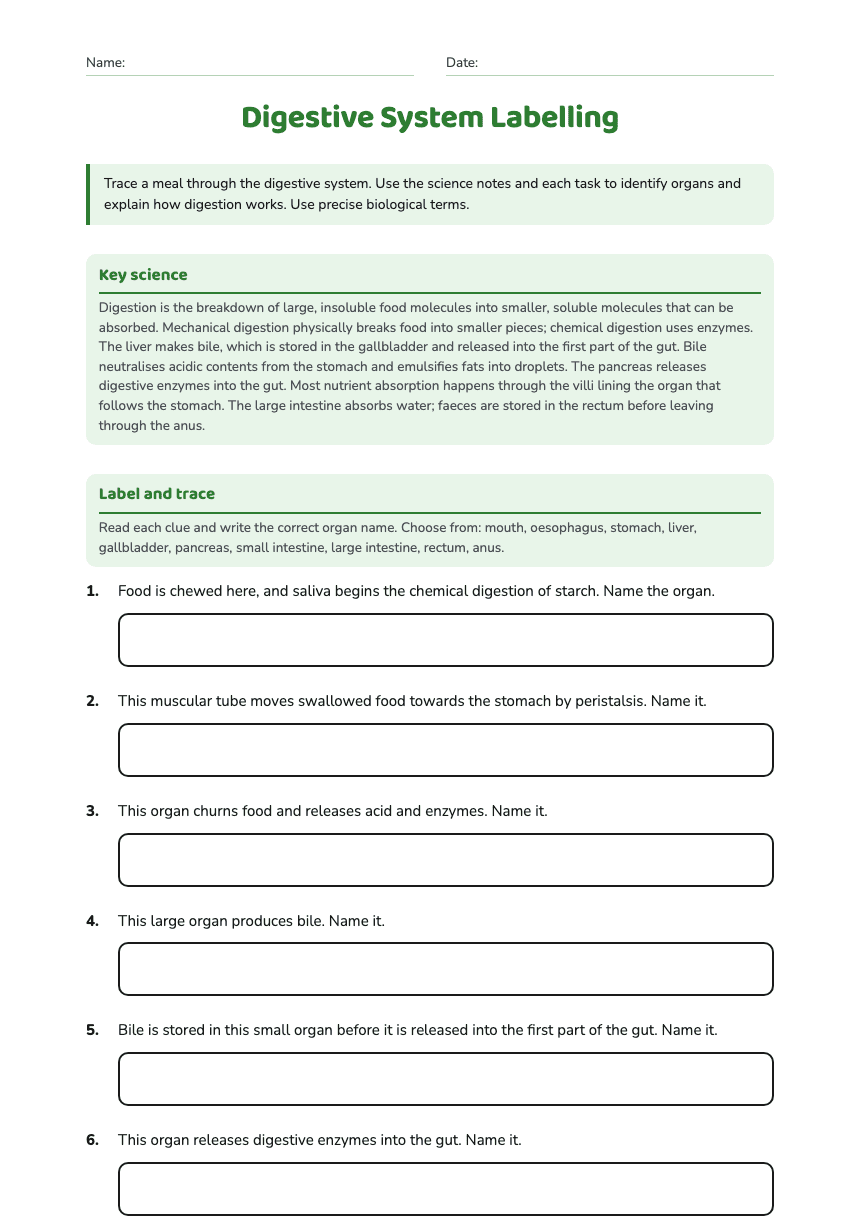
Digestive System Labelling worksheet preview
Name:Date:

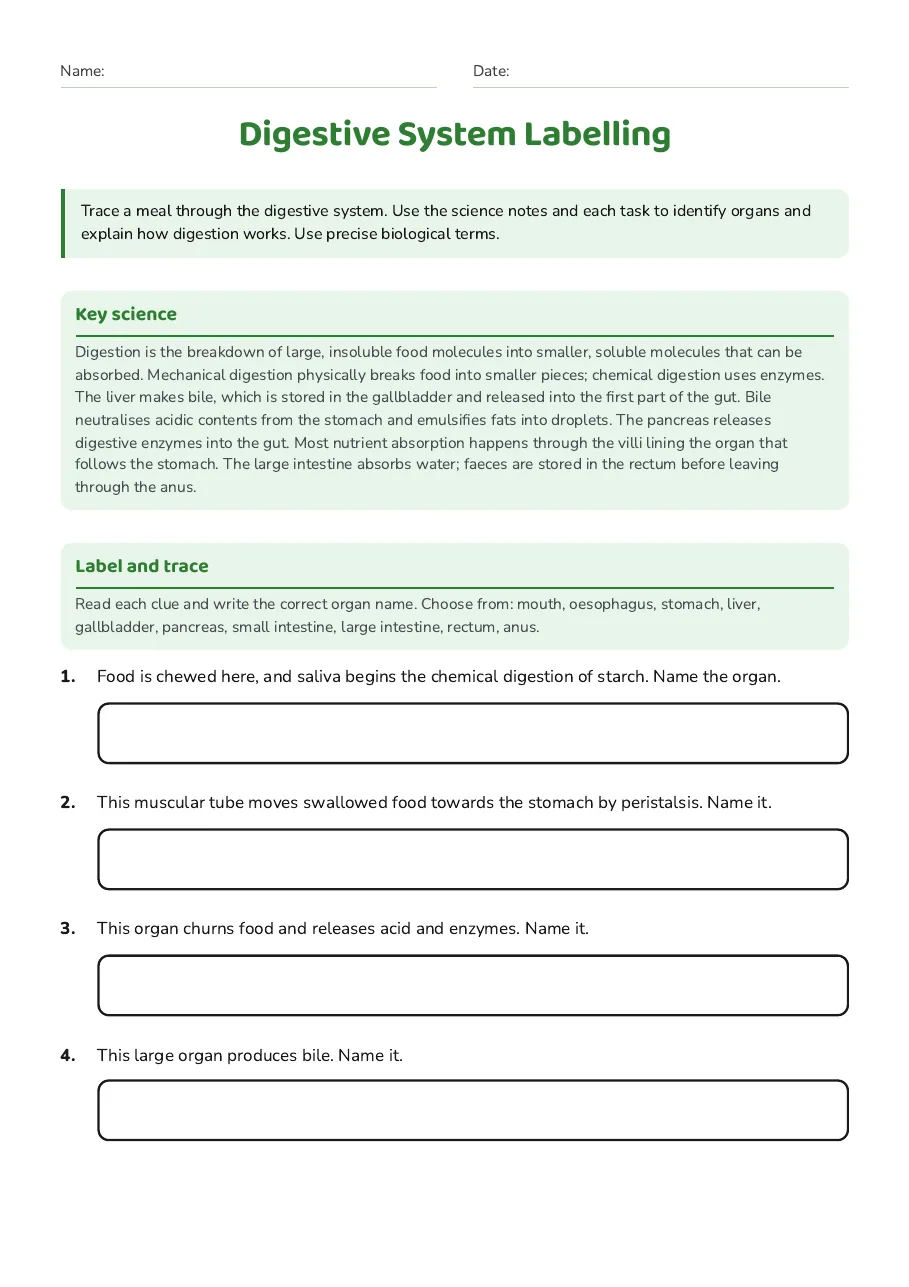
Digestive System Labelling

Trace a meal through the digestive system. Use the science notes and each task to identify organs and explain how digestion works. Use precise biological terms.

Key science

Digestion is the breakdown of large, insoluble food molecules into smaller, soluble molecules that can be absorbed. Mechanical digestion physically breaks food into smaller pieces; chemical digestion uses enzymes. The liver makes bile, which is stored in the gallbladder and released into the first part of the gut. Bile neutralises acidic contents from the stomach and emulsifies fats into droplets. The pancreas releases digestive enzymes into the gut. Most nutrient absorption happens through the villi lining the organ that follows the stomach. The large intestine absorbs water; faeces are stored in the rectum before leaving through the anus.

Label and trace

Read each clue and write the correct organ name. Choose from: mouth, oesophagus, stomach, liver, gallbladder, pancreas, small intestine, large intestine, rectum, anus.

1.Food is chewed here, and saliva begins the chemical digestion of starch. Name the organ.
2.This muscular tube moves swallowed food towards the stomach by peristalsis. Name it.
3.This organ churns food and releases acid and enzymes. Name it.
4.This large organ produces bile. Name it.
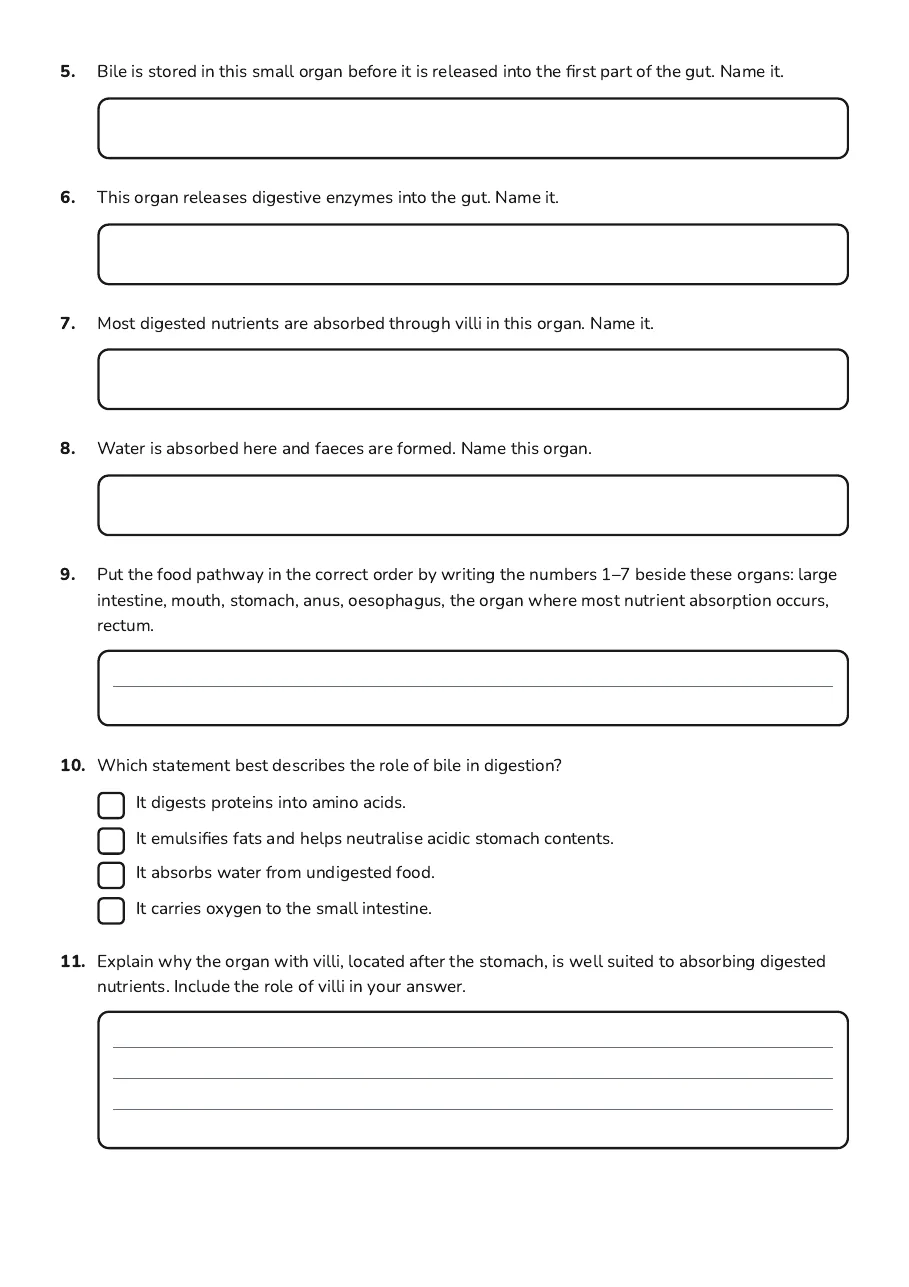
5.Bile is stored in this small organ before it is released into the first part of the gut. Name it.
6.This organ releases digestive enzymes into the gut. Name it.
7.Most digested nutrients are absorbed through villi in this organ. Name it.
8.Water is absorbed here and faeces are formed. Name this organ.
9.Put the food pathway in the correct order by writing the numbers 1–7 beside these organs: large intestine, mouth, stomach, anus, oesophagus, the organ where most nutrient absorption occurs, rectum.
10.Which statement best describes the role of bile in digestion?
  • It digests proteins into amino acids.
  • It emulsifies fats and helps neutralise acidic stomach contents.
  • It absorbs water from undigested food.
  • It carries oxygen to the small intestine.
11.Explain why the organ with villi, located after the stomach, is well suited to absorbing digested nutrients. Include the role of villi in your answer.
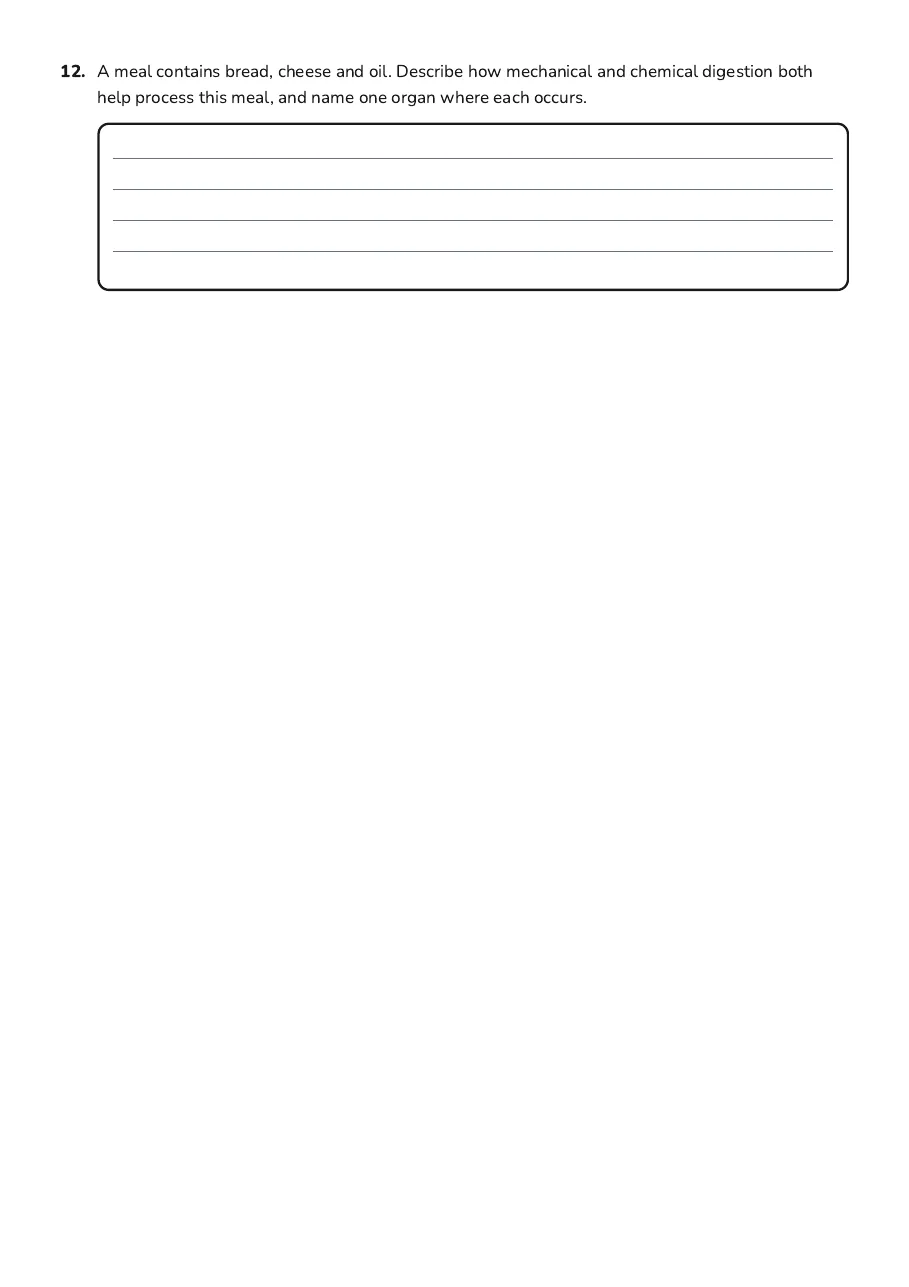
12.A meal contains bread, cheese and oil. Describe how mechanical and chemical digestion both help process this meal, and name one organ where each occurs.

3 printable pages

  • Digestive System Labelling, page 1 of 3: Key science, Label and trace

    Page 1

  • Digestive System Labelling, page 2 of 3: 5. Bile is stored in this small organ before it is released into the first part of the…

    Page 2

  • Digestive System Labelling, page 3 of 3: 12. A meal contains bread, cheese and oil. Describe how mechanical and chemical digestion…

    Page 3

About This Worksheet

Free in Kuraplan

Sign up free, grab the PDF, and customize it for your class.

Print-Ready

Formatted for standard paper. Clean layout, easy to read.

AI-Generated

Created with Kuraplan's AI, designed for real classroom use.

For Teachers & Parents

Use in classrooms, for homework, tutoring, or homeschool.

Need a custom version of this worksheet?

Kuraplan's AI generates custom worksheets in seconds — differentiated for every learner, aligned to your curriculum.

Generate Custom Worksheets — Free
No credit card Curriculum-aligned Under 60 seconds