Feedback Mechanisms Coloring Sheet
A free science worksheet ready for your classroom. Open in Kuraplan to grab the print-ready PDF, customize it for your students, or generate a fresh version in seconds.
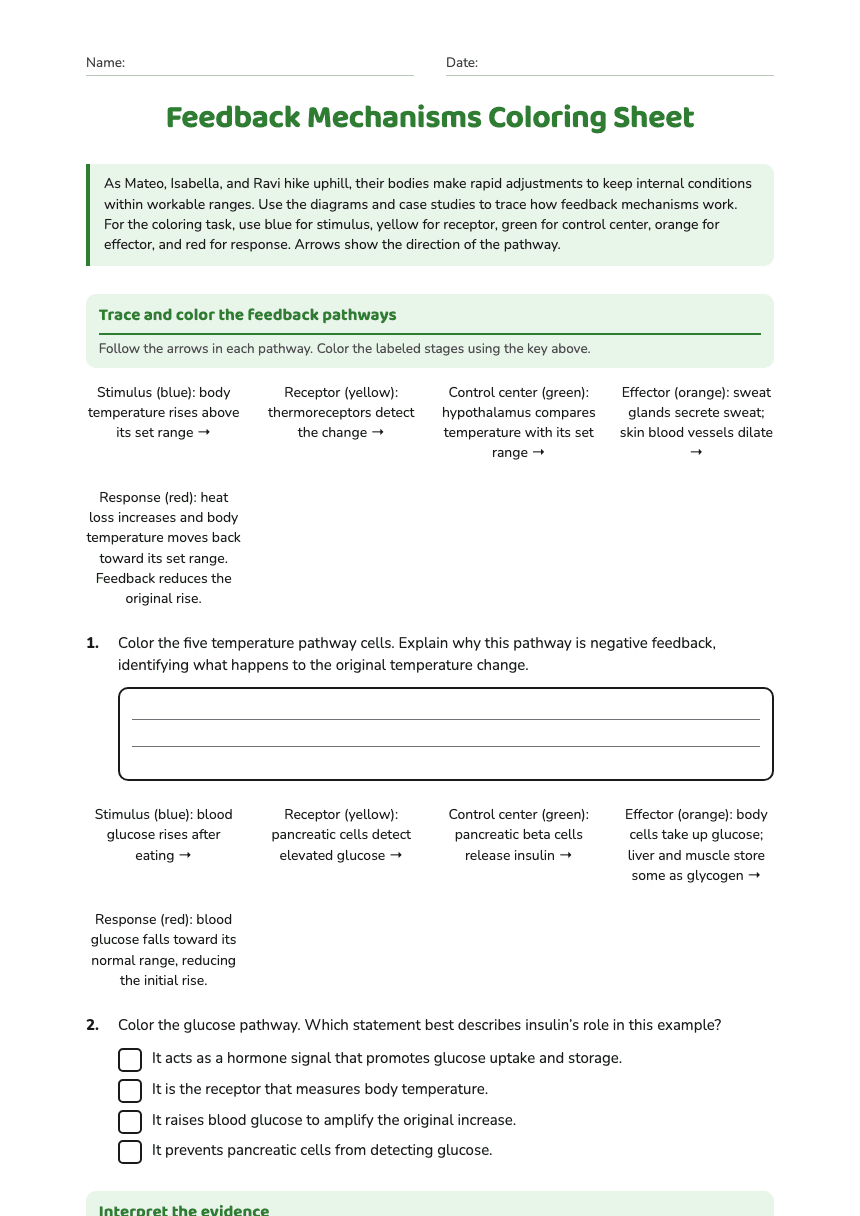
Feedback Mechanisms Coloring Sheet
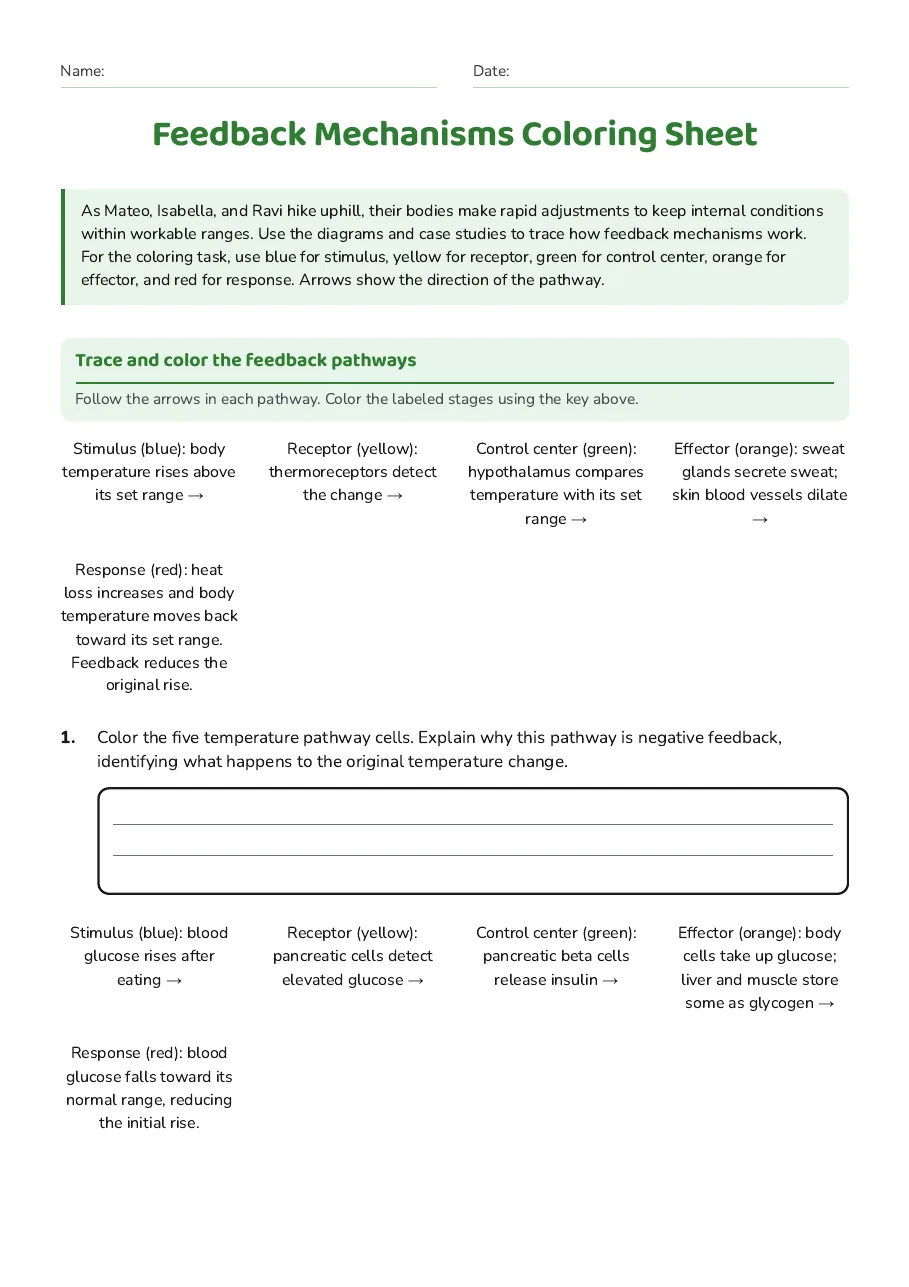
Trace and color the feedback pathways
Follow the arrows in each pathway. Color the labeled stages using the key above.
Stimulus (blue): body temperature rises above its set range →
Receptor (yellow): thermoreceptors detect the change →
Control center (green): hypothalamus compares temperature with its set range →
Effector (orange): sweat glands secrete sweat; skin blood vessels dilate →
Response (red): heat loss increases and body temperature moves back toward its set range. Feedback reduces the original rise.
Stimulus (blue): blood glucose rises after eating →
Receptor (yellow): pancreatic cells detect elevated glucose →
Control center (green): pancreatic beta cells release insulin →
Effector (orange): body cells take up glucose; liver and muscle store some as glycogen →
Response (red): blood glucose falls toward its normal range, reducing the initial rise.
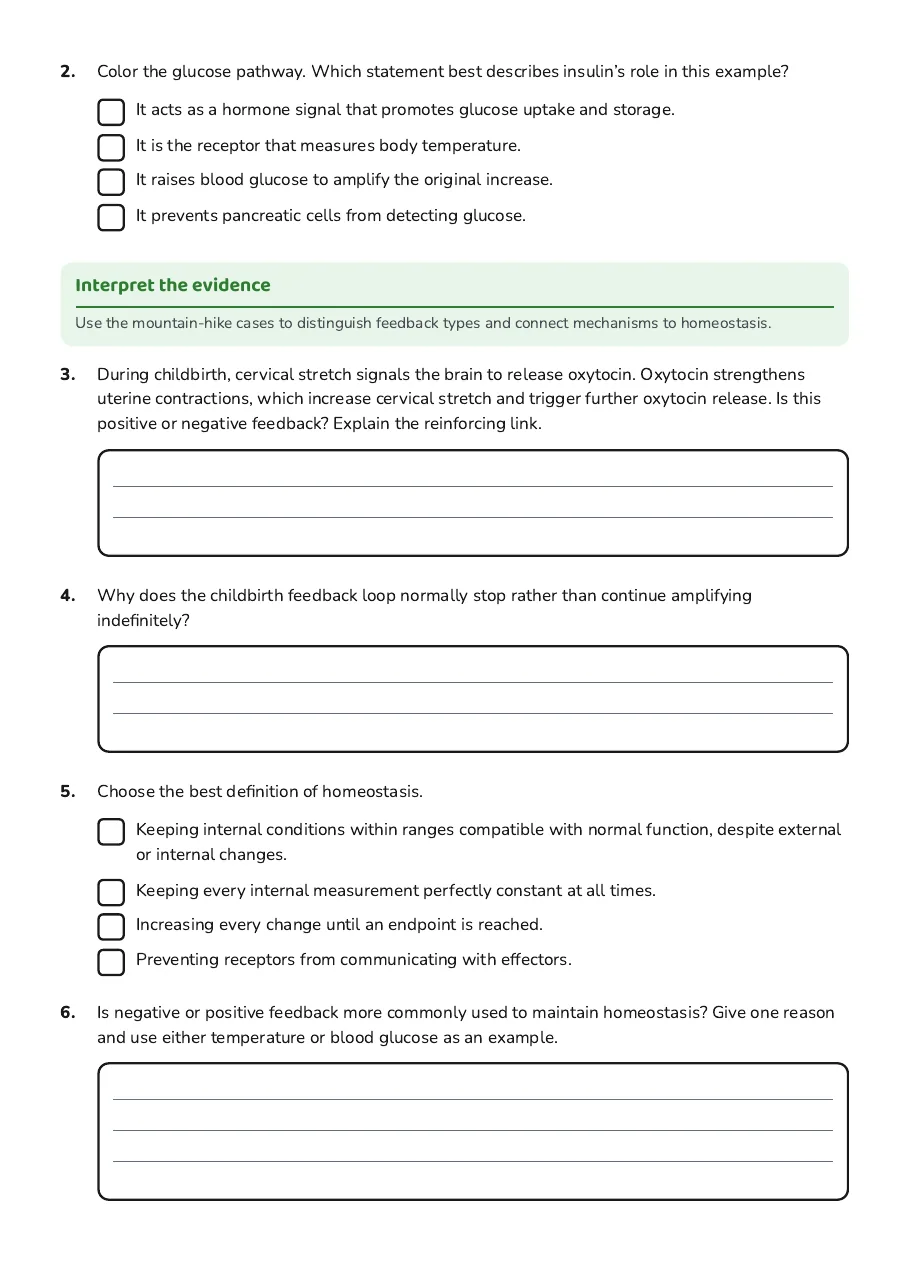
- It acts as a hormone signal that promotes glucose uptake and storage.
- It is the receptor that measures body temperature.
- It raises blood glucose to amplify the original increase.
- It prevents pancreatic cells from detecting glucose.
Interpret the evidence
Use the mountain-hike cases to distinguish feedback types and connect mechanisms to homeostasis.
- Keeping internal conditions within ranges compatible with normal function, despite external or internal changes.
- Keeping every internal measurement perfectly constant at all times.
- Increasing every change until an endpoint is reached.
- Preventing receptors from communicating with effectors.
3 printable pages
Page 1
Page 2
Page 3
About This Worksheet
Free in Kuraplan
Sign up free, grab the PDF, and customize it for your class.
Print-Ready
Formatted for standard paper. Clean layout, easy to read.
AI-Generated
Created with Kuraplan's AI, designed for real classroom use.
For Teachers & Parents
Use in classrooms, for homework, tutoring, or homeschool.
Need a custom version of this worksheet?
Kuraplan's AI generates custom worksheets in seconds — differentiated for every learner, aligned to your curriculum.
Generate Custom Worksheets — Free