Local Ecosystem Food Web Investigation
A free science worksheet ready for your classroom. Open in Kuraplan to grab the print-ready PDF, customize it for your students, or generate a fresh version in seconds.
Local Ecosystem Food Web Investigation
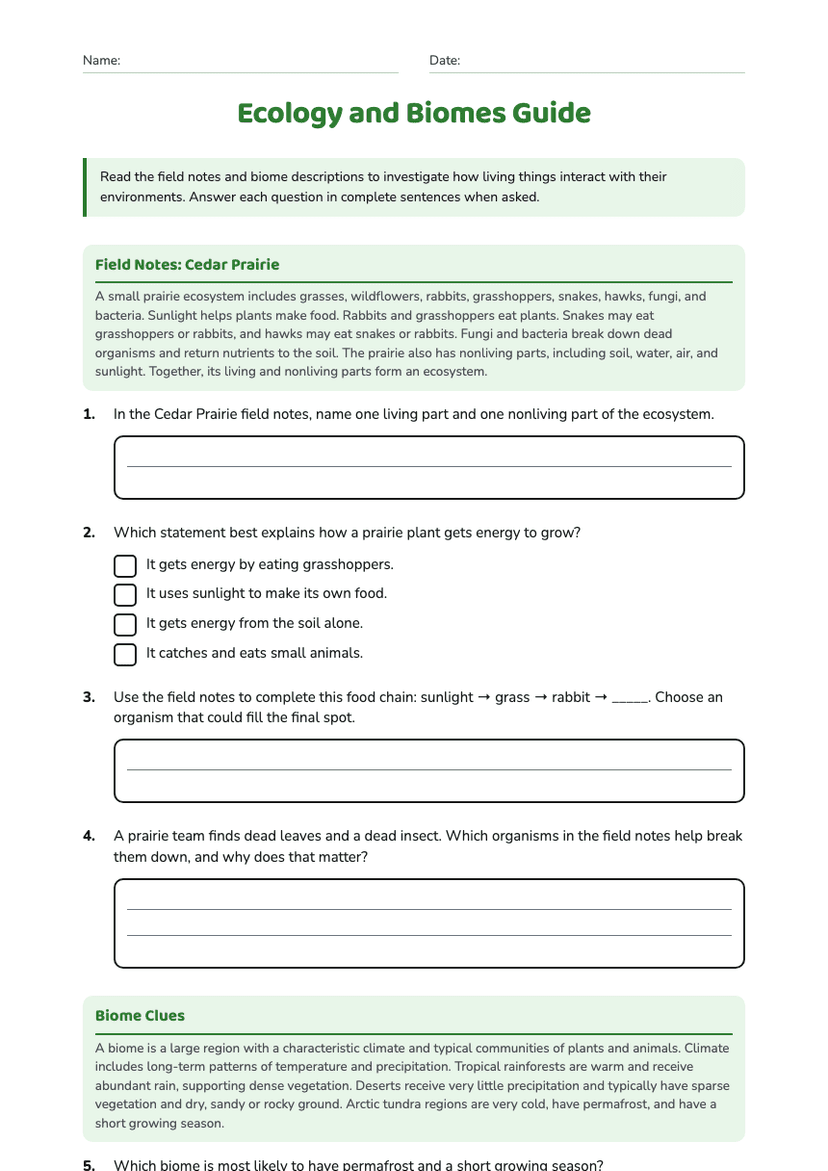
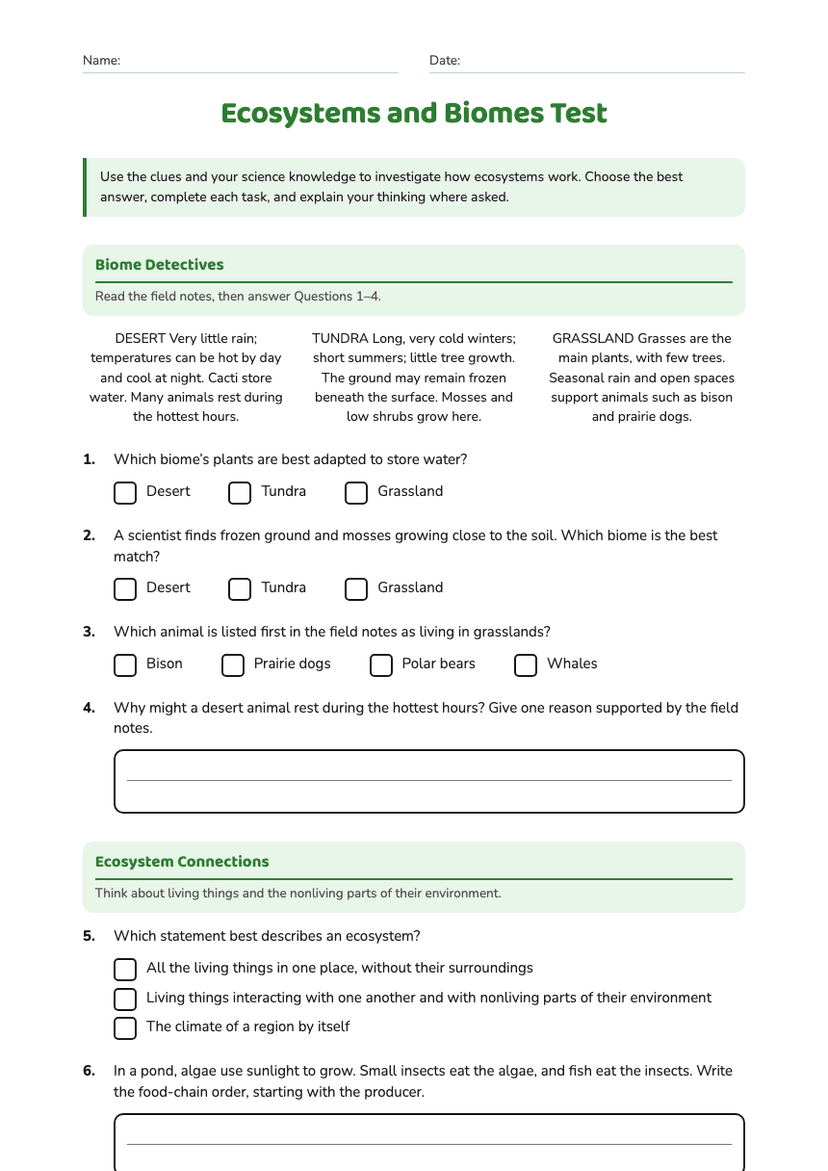
Part 1: Observe and Classify
Purpose: Investigate how organisms in a local ecosystem depend on one another and their environment. Use observations, photographs, remembered evidence, or classroom specimens. Do not collect living organisms.
Look for: sunlight, water, plants, animals, decomposers, and evidence of human impact such as litter, mowed areas, roads, fences, pesticides, or protected spaces.
Vocabulary support: A producer makes its own food, usually using sunlight. A consumer gets energy by eating plants or animals. A decomposer breaks down dead material. A habitat is the place where an organism lives. Biodiversity means the variety of living things in an area. A predator hunts; its prey is hunted.
1. Organism: ____________ Role: ____________ Habitat: ____________ Evidence: ____________________
2. Organism: ____________ Role: ____________ Habitat: ____________ Evidence: ____________________
3. Organism: ____________ Role: ____________ Habitat: ____________ Evidence: ____________________
4. Organism: ____________ Role: ____________ Habitat: ____________ Evidence: ____________________
5. Organism: ____________ Role: ____________ Habitat: ____________ Evidence: ____________________
6. Organism: ____________ Role: ____________ Habitat: ____________ Evidence: ____________________
7. Organism: ____________ Role: ____________ Habitat: ____________ Evidence: ____________________
8. Organism: ____________ Role: ____________ Habitat: ____________ Evidence: ____________________
Respectful learning reminder: If local First Nations or Métis knowledge is shared by community members, listen carefully, name the source when appropriate, and follow community guidance about what may be recorded or shared.
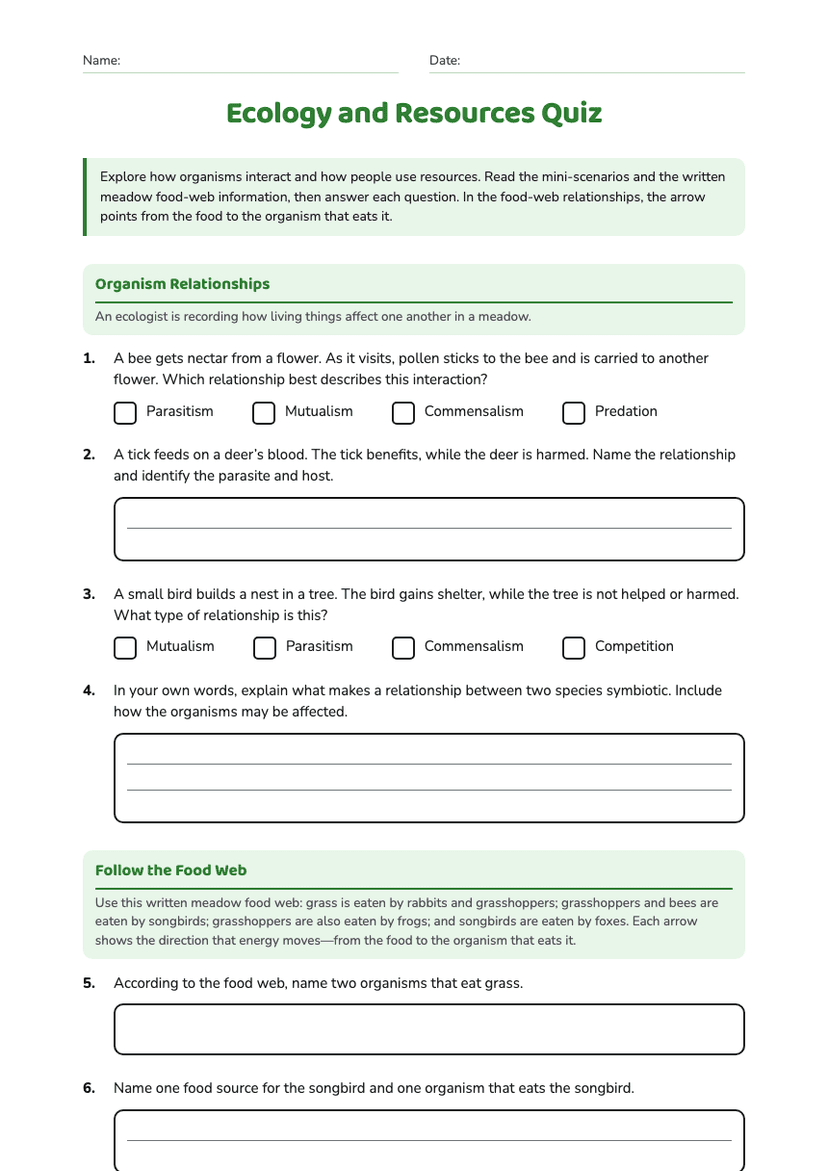
Part 2: Show Energy Flow
____________________ → ____________________ → ____________________ → ____________________
Energy moves from ____________________ to ____________________ because ________________________________.
Relationship 1: The __________________ eats __________________ because ________________________________.
Relationship 2: The __________________ eats __________________ because ________________________________.
If ____________________ declined, ____________________ might ____________________ because ________________________________.
The feature is ____________________. It supports biodiversity because __________________________________________.
Part 3: Explain, Reflect, and Extend
In this ecosystem, organisms depend on one another and their environment. One organism depends on ____________________ because ________________________________. Energy begins with ____________________ and moves to ____________________. One responsible stewardship action is ____________________ because ________________________________.
Sentence frames: “The __________ is a __________ because __________.” “Energy moves from __________ to __________.” “If __________ disappeared, __________ might __________.” “We could support biodiversity by __________ because __________.”
Simplified option: Choose three organisms. Draw one producer, one consumer, and one decomposer. Add one arrow and complete: “The __________ depends on the __________ because __________.” You may draw, speak, dictate, or write your answer.
Extension: Analyze a possible keystone species or human impact. What might happen to at least three other organisms if that species changed, or if an invasive plant, pesticide, or habitat loss affected the ecosystem? Use your food web as evidence.
About This Worksheet
Free in Kuraplan
Sign up free, grab the PDF, and customize it for your class.
Print-Ready
Formatted for standard paper. Clean layout, easy to read.
AI-Generated
Created with Kuraplan's AI, designed for real classroom use.
For Teachers & Parents
Use in classrooms, for homework, tutoring, or homeschool.
Need a custom version of this worksheet?
Kuraplan's AI generates custom worksheets in seconds — differentiated for every learner, aligned to your curriculum.
Generate Custom Worksheets — Free