Photosynthesis Pathway Worksheet
A free science worksheet ready for your classroom. Open in Kuraplan to grab the print-ready PDF, customize it for your students, or generate a fresh version in seconds.
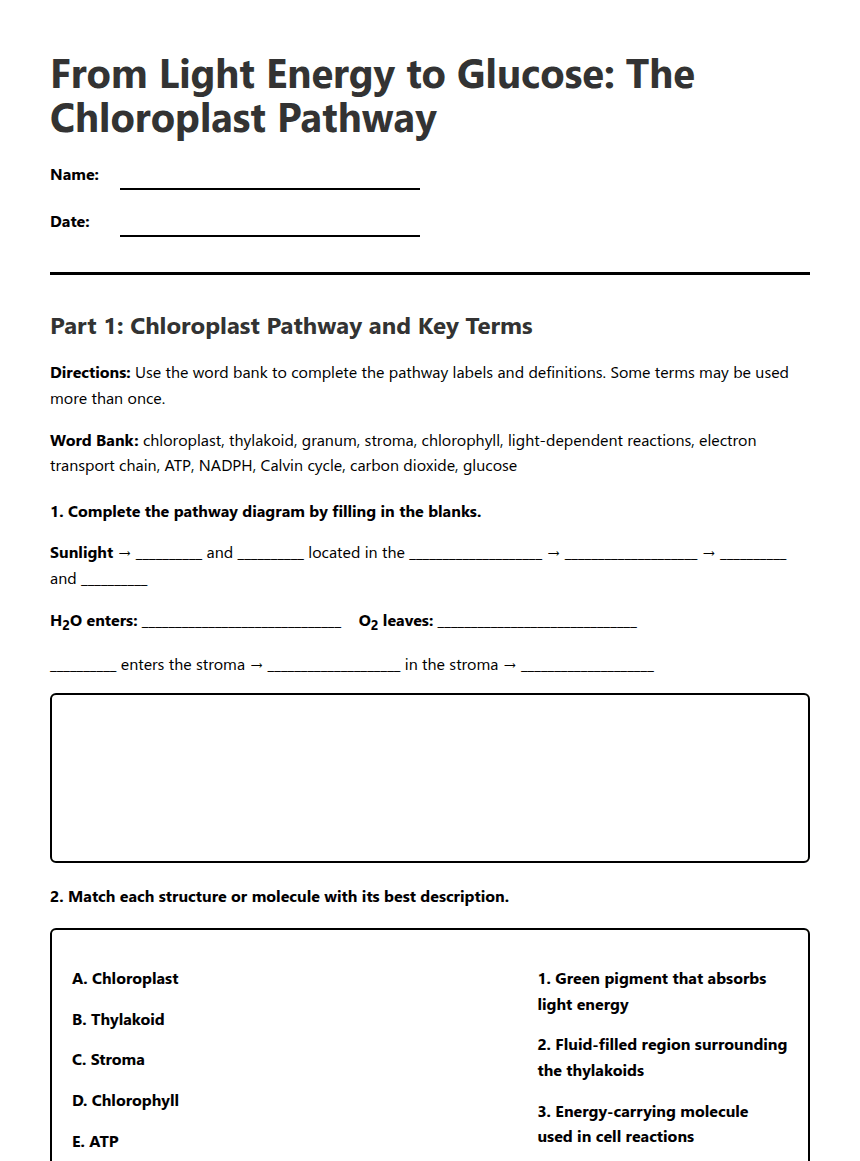
From Light Energy to Glucose: The Chloroplast Pathway
Part 1: Chloroplast Pathway and Key Terms
Directions: Use the word bank to complete the pathway labels and definitions. Some terms may be used more than once.
Word Bank: chloroplast, thylakoid, granum, stroma, chlorophyll, light-dependent reactions, electron transport chain, ATP, NADPH, Calvin cycle, carbon dioxide, glucose
Sunlight → __________ and __________ located in the ____________________ → ____________________ → __________ and __________
H2O enters: ______________________________ O2 leaves: ______________________________
__________ enters the stroma → ____________________ in the stroma → ____________________
Part 2: Energy, Inputs, Outputs, and Evidence
_____ The Calvin cycle uses carbon dioxide to build carbohydrate.
_____ Light excites electrons in chlorophyll.
_____ ATP and NADPH carry energy to the stroma.
_____ The electron transport chain helps produce ATP and NADPH.
Inputs: ________________________________________________________________
Outputs: _______________________________________________________________
6CO2 + 6H2O + light energy → C6H12O6 + 6O2
Reactants: __________________________ Products: __________________________
Which product stores chemical energy? __________________________
Answer Key — Final Page
1. Sunlight → chlorophyll and photosystems located in the thylakoid membranes → electron transport chain → ATP and NADPH. H2O enters the light-dependent reactions; O2 leaves. Carbon dioxide enters the stroma → Calvin cycle in the stroma → glucose.
2. A–4, B–5, C–2, D–1, E–3, F–6.
3. A thylakoid is a membrane sac containing photosystems. A granum is a stack of thylakoids.
4. The Calvin cycle is a series of reactions that uses carbon dioxide, ATP, and NADPH to produce carbohydrate. It occurs in the stroma.
5. The light-dependent reactions.
6. Calvin cycle uses carbon dioxide: 4; light excites electrons: 1; ATP and NADPH carry energy: 3; electron transport chain produces ATP and NADPH: 2.
7. Inputs: light energy and water. Outputs: oxygen, ATP, and NADPH.
8. ATP supplies energy and NADPH supplies high-energy electrons and hydrogen to the Calvin cycle. They transfer energy captured during the light-dependent reactions to the reactions that build carbohydrate.
9. Reactants: 6CO2, 6H2O, and light energy. Products: C6H12O6 and 6O2. Glucose stores chemical energy. Light energy is used in the light-dependent reactions.
10. Dim light reduces the rate of the light-dependent reactions, so less ATP and NADPH are produced. The Calvin cycle slows because it has less ATP and NADPH available, which generally reduces glucose production.
About This Worksheet
Free in Kuraplan
Sign up free, grab the PDF, and customize it for your class.
Print-Ready
Formatted for standard paper. Clean layout, easy to read.
AI-Generated
Created with Kuraplan's AI, designed for real classroom use.
For Teachers & Parents
Use in classrooms, for homework, tutoring, or homeschool.
Need a custom version of this worksheet?
Kuraplan's AI generates custom worksheets in seconds — differentiated for every learner, aligned to your curriculum.
Generate Custom Worksheets — FreeMore Science Worksheets
Danforth: Authority and Conscience
Free
Natural Resources Science
Free
Natural Resources Science
Free
Vitamins, Minerals, and Protein Science
Free
Exploring Science Materials
Free
Waka Buoyancy Science Worksheet
Free
Science Skills Made Simple
Free