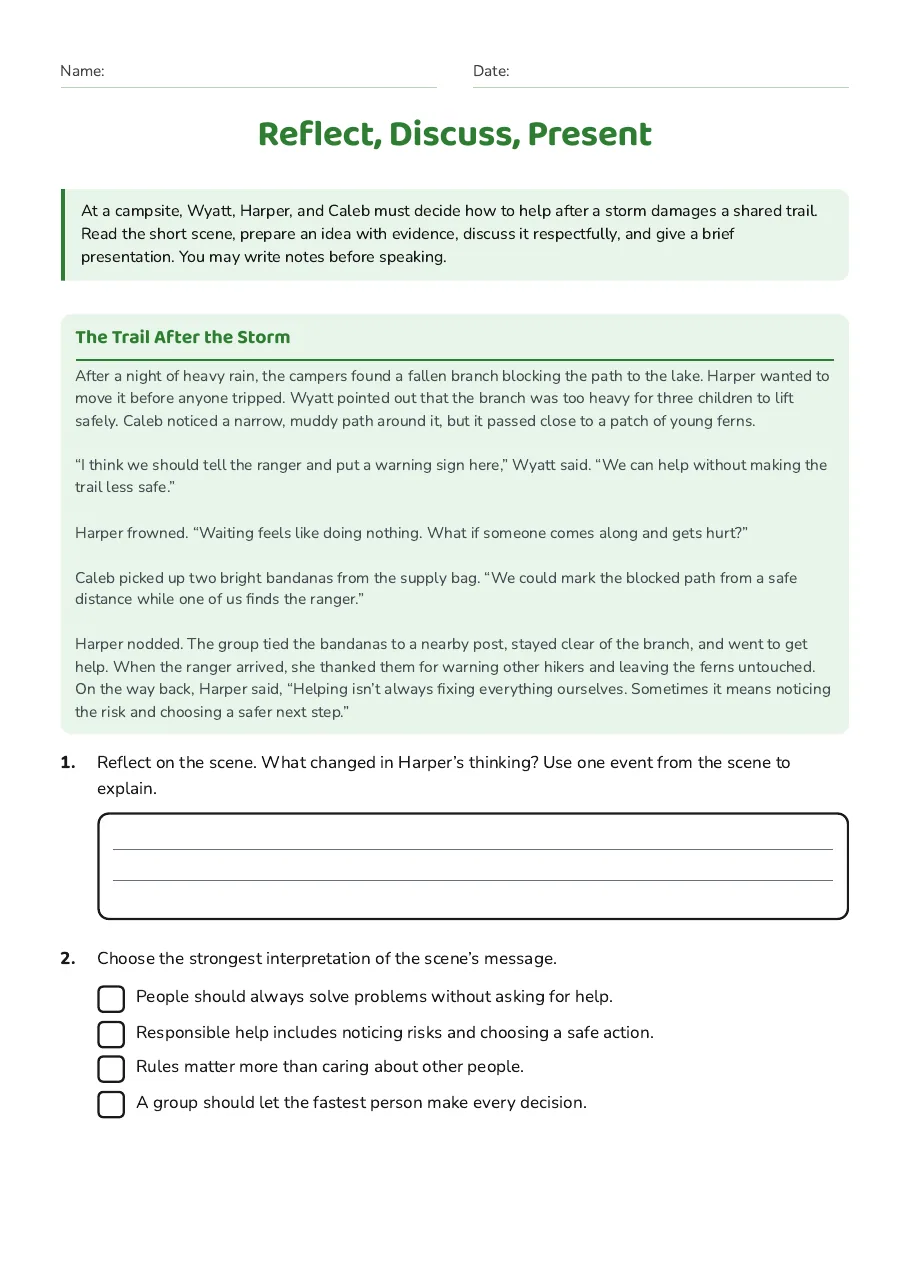
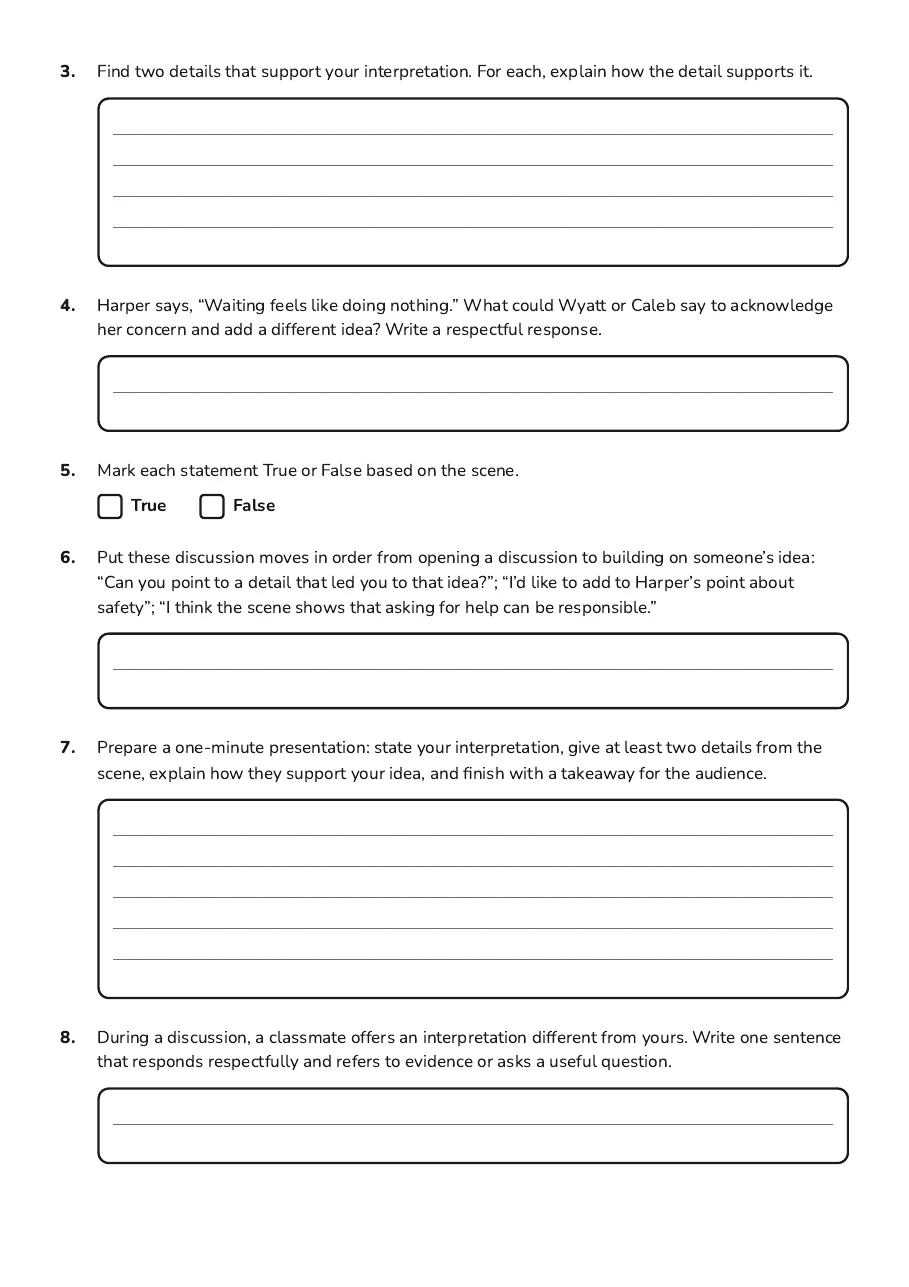
Reflect, Discuss, Present
A free english (ela) worksheet ready for your classroom. Open in Kuraplan to grab the print-ready PDF, customize it for your students, or generate a fresh version in seconds.
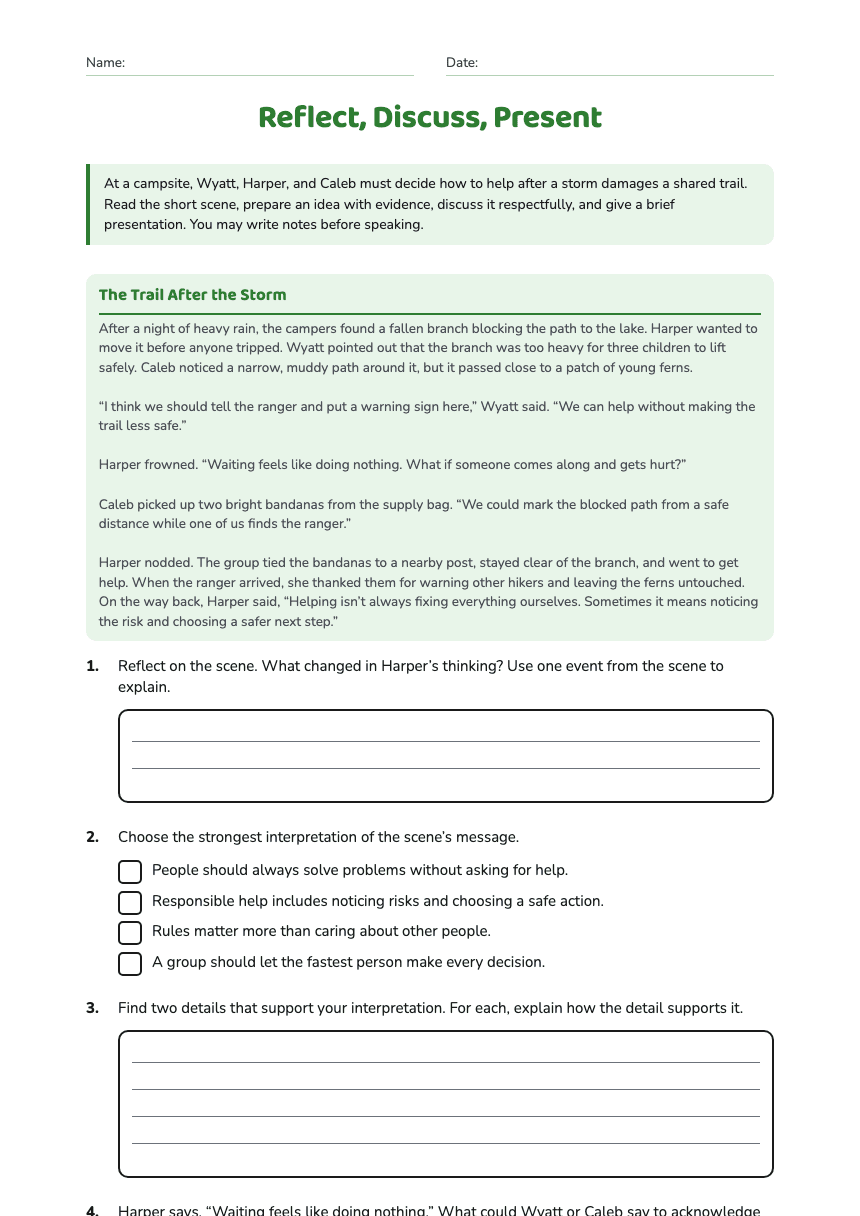
Reflect, Discuss, Present
Part 1: Reflect and Prepare to Discuss
Learning target: I can explain an interpretation of our text, support it with details, listen respectfully, and share my ideas clearly.
Standards: CCSS SL.5.1, SL.6.1, SL.7.1, SL.8.1, and SL.8.1a
Success criteria:
I can present a supported interpretation. I can use at least three specific text details. I can listen respectfully and respond to another person’s idea. I can identify one goal for my continued reading, speaking, listening, or writing growth.
At first ________________________________, but later ________________________________ because ________________________________.
The most important theme, character change, or ethical question is ________________________________.
☐ What theme does the text communicate, and how does it develop?
☐ How does a character’s growth affect another person or the community?
☐ What ethical question does the story raise about forgiveness, honesty, service, courage, or caring for others?
Detail 1: __________________________________________________________________________________
How it supports my claim: _____________________________________________________________________
Detail 2: __________________________________________________________________________________
How it supports my claim: _____________________________________________________________________
__________________________________________________________________________________________________
Discussion sentence frames:
“I agree with __________________ because __________________.”
“I would like to add __________________.”
“Another detail that supports this is __________________.”
“I see it differently because __________________.”
“Can you explain which part of the text led you to that idea?”
Part 2: Plan, Present, and Reflect
☐ One-minute oral presentation ☐ Poster or illustrated response ☐ Recorded presentation ☐ Short written response
Opening: Introduce the text and my main idea.
Main point and evidence:
Another main point, evidence, or example:
Third detail and explanation:
Closing: What should the audience remember? Connect to personal learning or respectful community values.
☐ I listened without interrupting.
☐ I took turns and invited another person to speak.
☐ I spoke clearly or communicated my ideas in an understandable way.
☐ I responded to or built on someone else’s idea.
One discussion move I used or noticed: __________________________________________________________
My goal is to improve my ☐ reading ☐ speaking ☐ listening ☐ writing ☐ vocabulary by ____________________________.
Supports for different learners:
Emerging EAL readers and writers: Use a bilingual or illustrated word bank, rehearse with a trusted partner, use the sentence frames, present from notes, or draw and label your ideas.
On-level learners: Explain how each detail supports your claim and use complete sentences with precise vocabulary.
Advanced learners: Compare two possible interpretations, explain a counterargument, or use a detail that could support more than one idea.
Extension challenge: Compare this text with another class text, or create an alternative ending that preserves the original theme. Explain how your choices maintain or deepen the story’s message.
Teacher Answer and Assessment Guide
Use as a separate final page.
Responses will vary. Look for an interpretation connected to the class text, accurate and relevant evidence, explanations that connect evidence to the claim, respectful discussion behavior, clear communication, and a specific growth goal.
Discussion and presentation checklist:
☐ Claim or interpretation is clear.
☐ At least three accurate text details are used or planned.
☐ Student explains how the details support the claim.
☐ Student listens, takes turns, and responds respectfully.
☐ Presentation has an opening, organized main points, evidence or examples, and a closing.
☐ Student identifies a meaningful reading, language, or participation goal.
Four-point assessment:
4 — Strong: Clear, thoughtful interpretation; three or more specific details are accurately explained; participation builds on others’ ideas; presentation is organized and clear; reflection gives a specific next step.
3 — Secure: Clear interpretation; at least three relevant details; respectful participation; mostly organized communication; reflection identifies a useful goal.
2 — Developing: Interpretation or evidence is partly clear; fewer than three details or limited explanations; participation needs reminders; presentation or reflection needs more organization.
1 — Beginning: Response is incomplete or difficult to connect to the text; little evidence; limited participation; student needs substantial support to communicate and set a goal.
Suggested supports during assessment: Accept oral, visual, recorded, or written responses. Allow notes, speech-to-text, extra planning time, teacher-selected evidence tabs, bilingual vocabulary support, and partner rehearsal. Assess the student’s ideas and communication growth rather than grammar alone.
Standards alignment: SL.5.1, SL.6.1, SL.7.1, and SL.8.1: prepare for and participate effectively in collaborative discussions. SL.8.1a: come prepared with evidence and other material that stimulates a thoughtful, well-reasoned exchange of ideas.
About This Worksheet
Free in Kuraplan
Sign up free, grab the PDF, and customize it for your class.
Print-Ready
Formatted for standard paper. Clean layout, easy to read.
AI-Generated
Created with Kuraplan's AI, designed for real classroom use.
For Teachers & Parents
Use in classrooms, for homework, tutoring, or homeschool.
Need a custom version of this worksheet?
Kuraplan's AI generates custom worksheets in seconds — differentiated for every learner, aligned to your curriculum.
Generate Custom Worksheets — Free