Strong Paragraph Builder
A free english (ela) worksheet ready for your classroom. Open in Kuraplan to grab the print-ready PDF, customize it for your students, or generate a fresh version in seconds.
Strong Paragraph Builder
📚 Part 1: Build a Strong Paragraph
A strong paragraph has four parts:
Topic sentence or claim: Answers the question and names the main idea.
Supporting detail or evidence: Gives a fact, example, quotation, or paraphrase.
Explanation: Tells how the evidence supports the claim and why it matters.
Concluding sentence: Restates the main idea in a fresh way.
Helpful words: because, for example, this shows, this reveals, demonstrates, suggests, therefore, as a result
(____) Lena shows responsibility when she finds a lost wallet at school.
(____) She takes it to the office instead of keeping the money.
(____) This action demonstrates that she chooses to do what is right, even when no one is watching.
(____) Lena’s honest choice reveals her strong values.
Sentence frames for EAL writers:
The character shows __________ because __________.
For example, the text says, “________________________.”
This evidence shows that ____________________________.
This matters because ________________________________.
Therefore, _________________________________________.
✏️ Part 2: Plan Your Response Paragraph
Choose one familiar topic or use your teacher’s shared class text.
Topic choices: How does a character show courage? How does one small choice reveal a person’s values? How does a person solve a problem?
Word bank: brave, honest, responsible, caring, determined, fair, respectful, reveals, demonstrates, suggests, proves, changes, supports
Partner check: Read your plan aloud. Ask your partner, “How does that prove your claim?” Revise one part after receiving feedback.
📝 Part 3: Draft, Check, and Extend
Success Criteria
Check each box when you can say “I can...”
I can write a clear claim that answers the question. I can include relevant evidence from the text. I can quote or paraphrase accurately. I can explain why my evidence matters. I can organize my paragraph with a beginning, middle, and ending. I can use linking words and check my English conventions.Reflection: My strongest part is ________________________________.
One part I will improve is __________________________________________.
Extension Challenge
Advanced writers: Add a second piece of evidence and explain how both details work together. You may also include this sentence frame: “Some readers might think __________; however, __________.”
Answer Key
1. T, E, X, C
2. The character speaks up even though friends may disagree.
3. This shows that he accepts responsibility.
4. Maya practices the difficult song every afternoon; Maya tries again after making a mistake.
Differentiation: Students may rehearse answers orally, use the sentence frames and word bank, draw or discuss an idea before writing, dictate to a scribe, or use speech-to-text. Grades 5–6 may use one clear piece of evidence. Grades 7–8 may use two pieces of evidence and address an alternative interpretation.
About This Worksheet
Free in Kuraplan
Sign up free, grab the PDF, and customize it for your class.
Print-Ready
Formatted for standard paper. Clean layout, easy to read.
AI-Generated
Created with Kuraplan's AI, designed for real classroom use.
For Teachers & Parents
Use in classrooms, for homework, tutoring, or homeschool.
Need a custom version of this worksheet?
Kuraplan's AI generates custom worksheets in seconds — differentiated for every learner, aligned to your curriculum.
Generate Custom Worksheets — FreeMore English (ELA) Worksheets
9/11 Heroes Opinion Writing
Free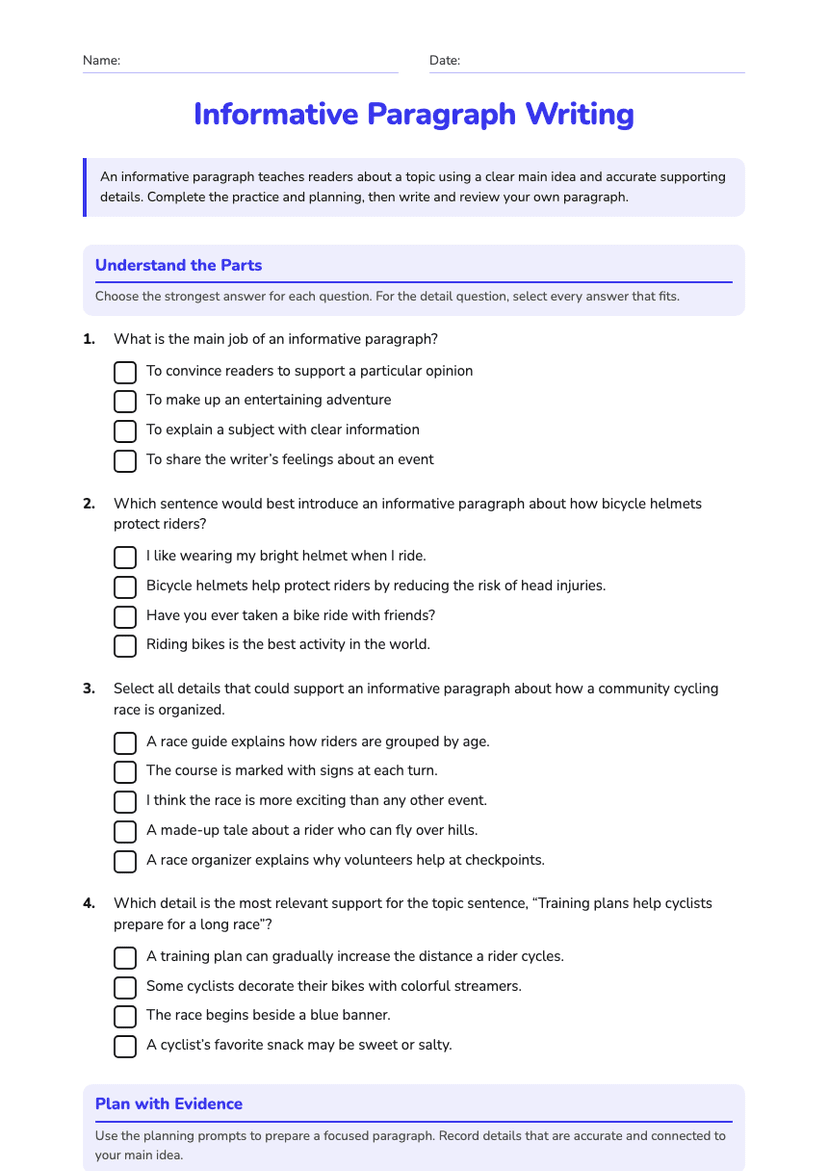
Informative Paragraph Writing
Free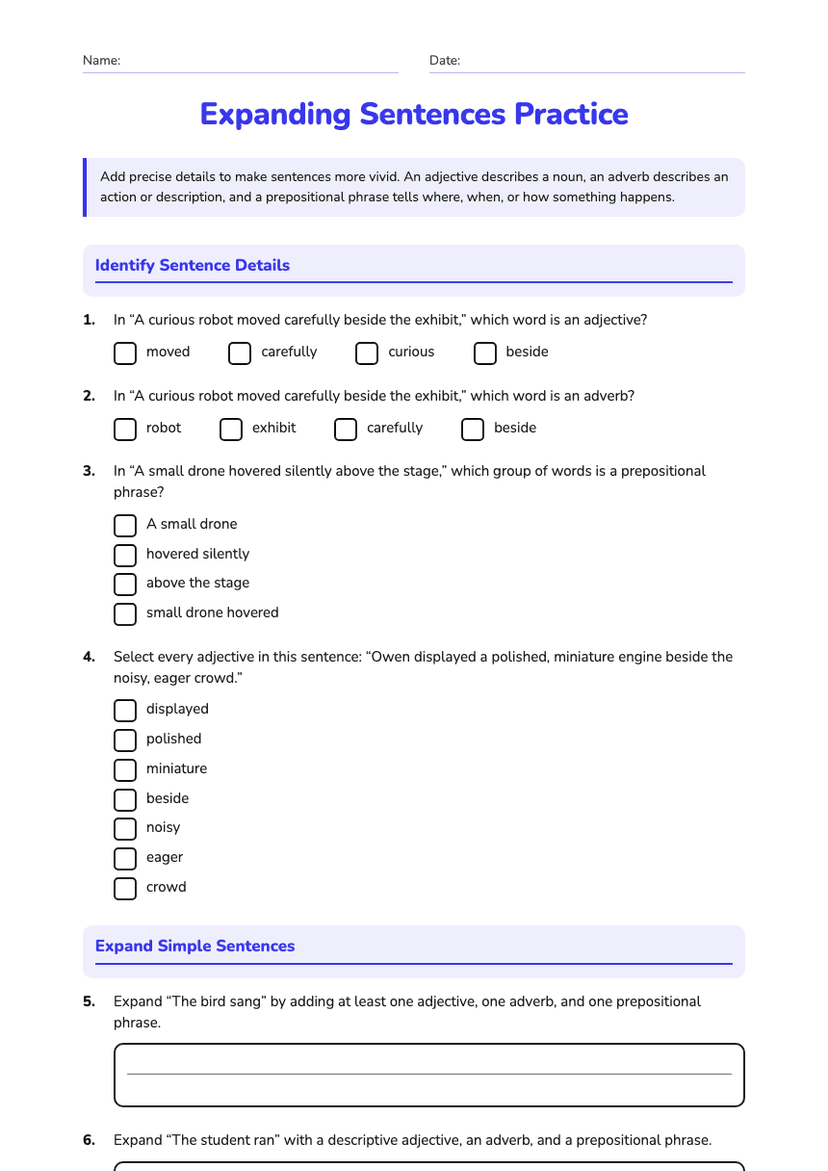
Expanding Sentences Practice
Free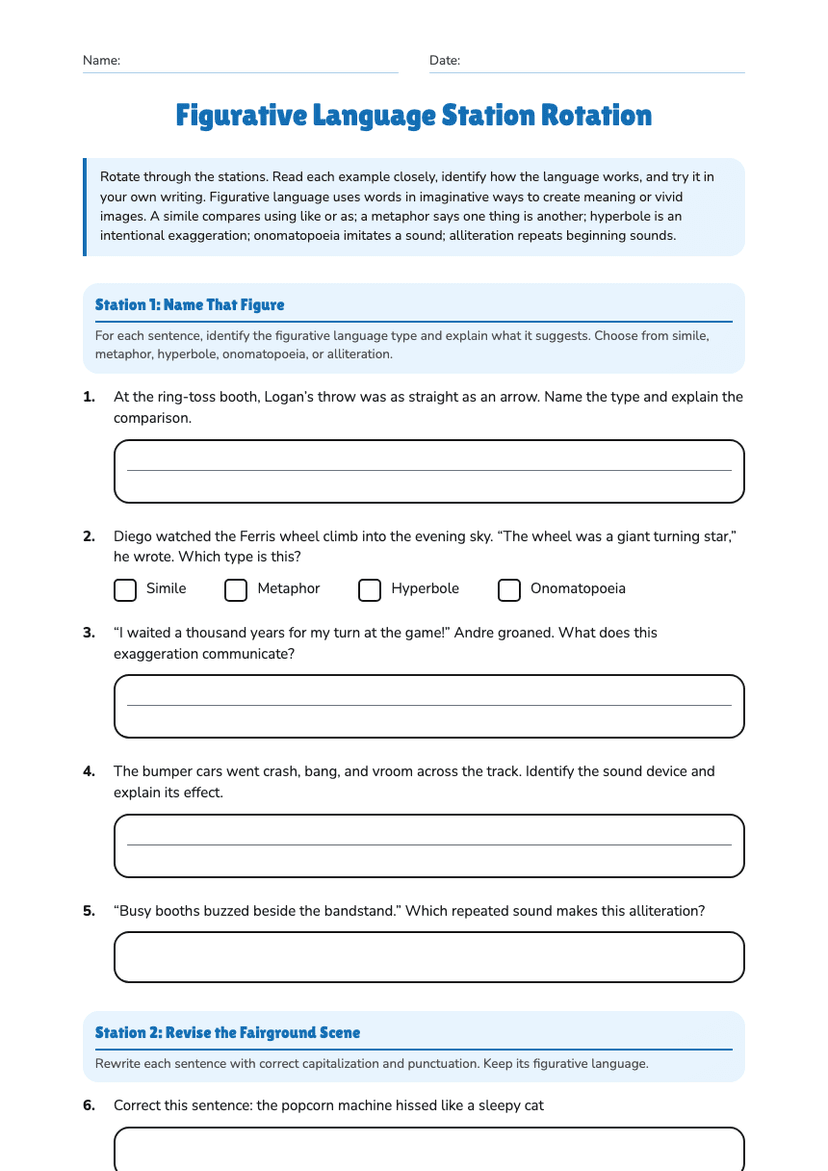
Figurative Language Station Rotation
Free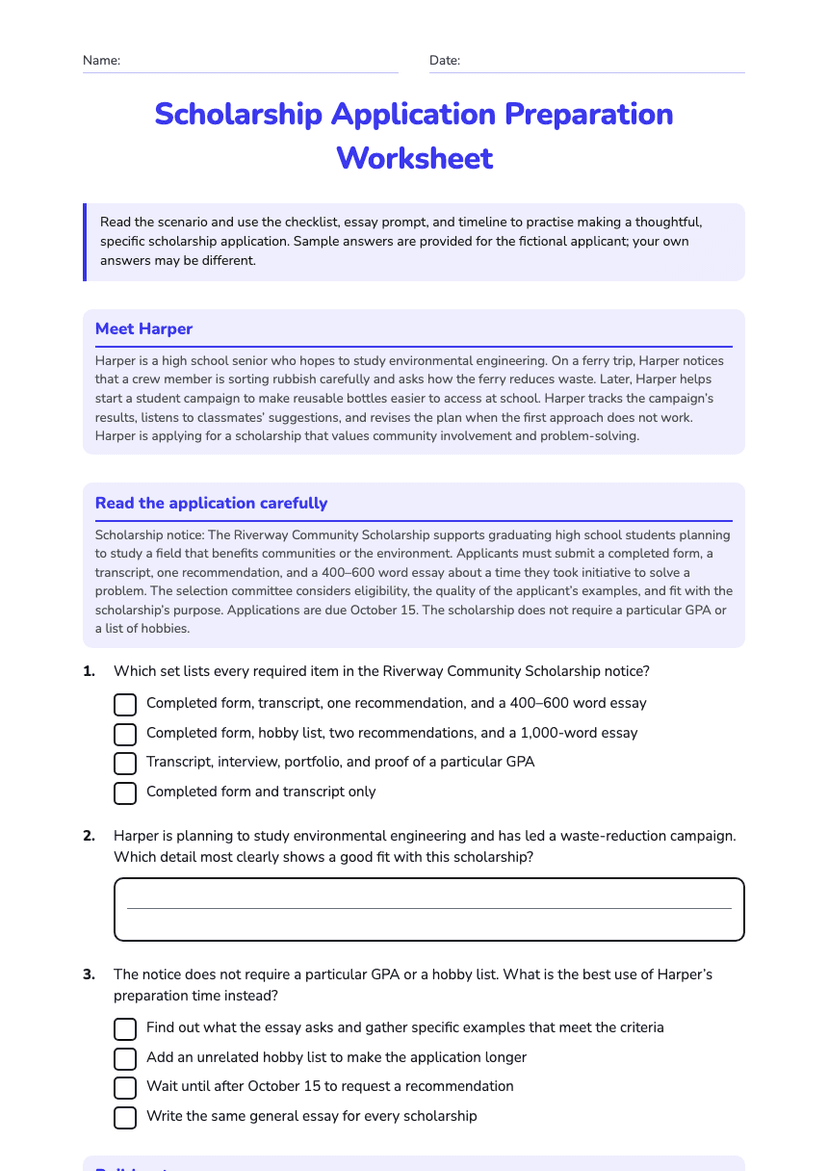
Scholarship Application Preparation Worksheet
Free
Stronger Stories Revision Workshop
Free
Grade 5 Opinion Writing
Free