English (ELA)FreePrintable

Stronger Stories Revision Workshop

A free english (ela) worksheet ready for your classroom. Open in Kuraplan to grab the print-ready PDF, customize it for your students, or generate a fresh version in seconds.
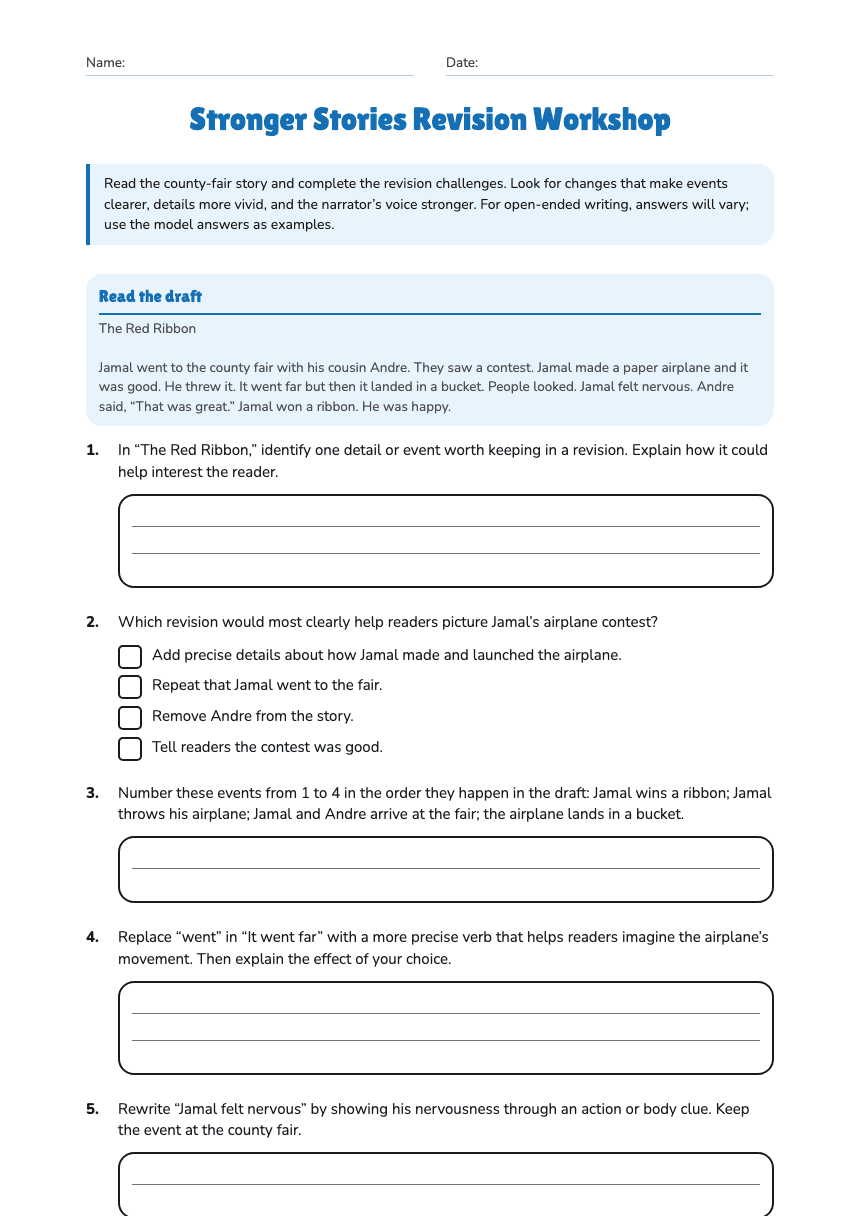
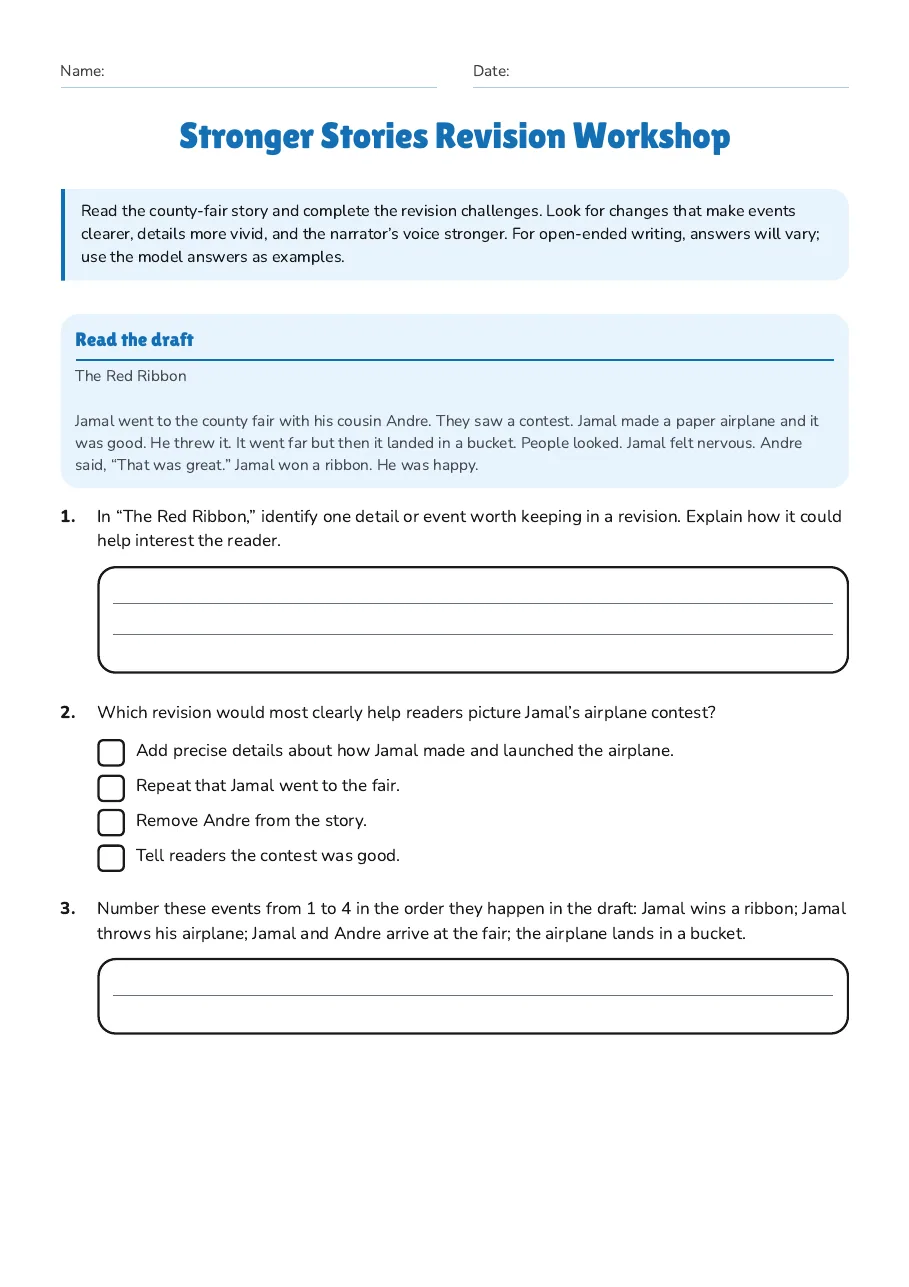
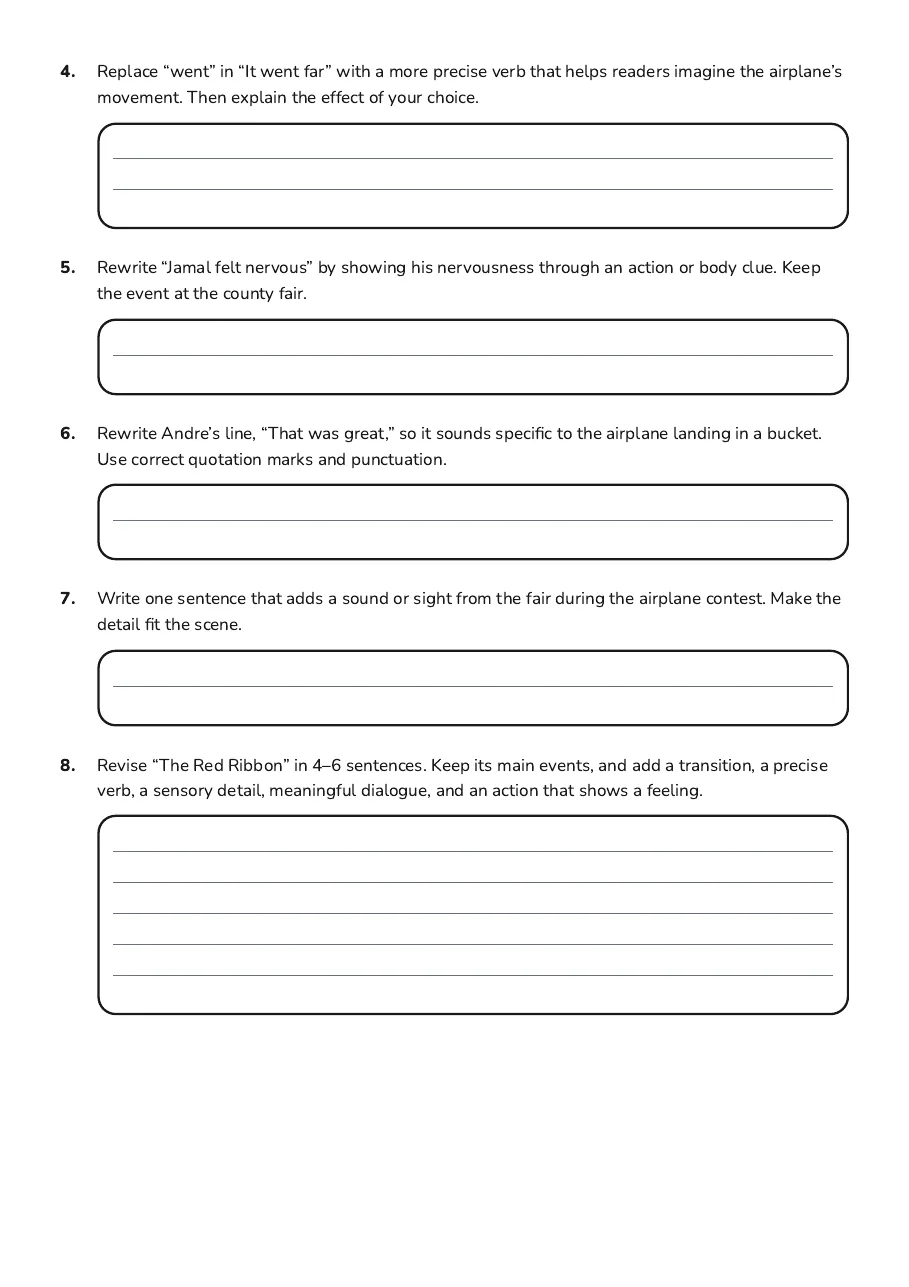
Stronger Stories Revision Workshop worksheet preview

Stronger Stories Revision Workshop

Worksheet illustration

Part 1: Notice What Makes a Story Stronger

Learning goal: I can revise my narrative so the events are clear, the details are vivid, and my voice is strong.

Success criteria: I can identify a strength and a next step. I can make at least two meaningful revisions. I can explain how my changes help my reader.

Before

Maya went to the field. It was nice. She saw the kite and ran. “Give it to me” she said and she was happy because it went up and then it fell.

After

When Maya reached the windy field, a red kite tugged against its string. She sprinted across the damp grass and called, “Please, let me try!” Her brother handed it over, and the kite climbed higher until the string suddenly snapped. Maya’s stomach dropped, but she chased the flashing red tail. Later, she realized that losing the kite had turned an ordinary afternoon into an adventure.

1. Identify three improvements in the “After” paragraph. For each one, explain how it helps the reader.
2. Revision checklist: Check each feature you can find in the “After” paragraph.

Events are in a logical order.

Sensory or descriptive details help me picture the scene.

Precise verbs replace weak verbs.

Dialogue is meaningful and punctuated correctly.

Feelings are shown through actions or body clues.

The ending includes reflection or a lesson learned.

3. Use the peer-review language below to write one helpful comment for a writer.

I noticed... ________________________________

You could... __________________________________

I wonder... ___________________________________

Part 2: Practice and Plan Your Revisions

4. Revise this bland paragraph. Add a transition, two sensory details, one precise verb, meaningful dialogue, and a feeling shown through action.

I opened the old box. I found a letter. I felt weird. I read it. Then I showed my brother.

Sentence starters: When I ________, ____________________. The box felt/smelt/sounded ________. “________________,” I said. My ________ ____________, showing that I felt ________.

5. Plan two meaningful revisions for your own narrative.

Revision 1—original idea or sentence:

My change:

Why this improves the story for my reader:

Revision 2—original idea or sentence:

My change:

Why this improves the story for my reader:

Word Bank

Transitions: suddenly, meanwhile, after that, a moment later, because, although, finally

Precise verbs: hurried, dashed, wandered, glanced, grabbed, whispered, shouted, trembled, stumbled

Feelings and actions: nervous—fidgeted; excited—grinned; worried—bit my lip; relieved—exhaled; angry—clenched my fists; surprised—stared

Sensory details: rough, icy, warm, dusty, bright, echoing, sharp, sweet, smoky, thunderous

Optional Challenge

Vary the pacing by slowing down an important moment or speeding through an unimportant one. Add one sentence of reflection that shows what the character learned or understood.

Support for All Writers

Read your draft aloud, use a ruler to track each line, or explain your revision to a partner before writing it. Focus on one or two priorities at a time. A partner may give advice, but the author decides which suggestions to use. You may use a dictionary, speech-to-text, or text-to-speech tool if approved.

Part 3: Exit Ticket and Teacher Guide

6. Which success criteria did you meet today? Check all that apply.

I identified a specific strength and next step.

I made at least two meaningful revisions.

I checked capitalization, punctuation, spelling, and grammar.

I explained why my revisions help my audience.

7. Name one revision you made and explain its effect on the reader.
8. What is one next step before you complete your final draft?

Brief Teacher Answer Guide

Question 1: Accept evidence-based responses such as logical sequencing, sensory details, stronger verbs, correctly punctuated dialogue, actions showing feelings, and reflection. Students should explain the effect on the reader.

Question 2: All six features appear in the “After” paragraph. “Windy,” “red,” and “damp” provide description; “sprint,” “tugged,” “climbed,” and “snapped” are precise verbs; the dialogue is meaningful and correctly punctuated.

Question 3: Look for kind, specific feedback using “I noticed,” “You could,” or “I wonder.” Discourage comments such as “Make it better” without evidence or a clear suggestion.

Question 4: Responses will vary. Strong revisions should improve sequence, description, verbs, dialogue, and shown feelings without changing the writer’s main idea.

Questions 5–8: Look for two documented, meaningful changes and a clear explanation of how each change improves clarity, voice, conventions, or audience awareness.

Standards connection: This workshop supports CCSS.ELA-LITERACY.W.5.3, W.6.3, W.7.3, W.8.3, and W.8.3b through narrative organization, description, dialogue, pacing, precise language, and reflection.

About This Worksheet

Free in Kuraplan

Sign up free, grab the PDF, and customize it for your class.

Print-Ready

Formatted for standard paper. Clean layout, easy to read.

AI-Generated

Created with Kuraplan's AI, designed for real classroom use.

For Teachers & Parents

Use in classrooms, for homework, tutoring, or homeschool.

Need a custom version of this worksheet?

Kuraplan's AI generates custom worksheets in seconds — differentiated for every learner, aligned to your curriculum.

Generate Custom Worksheets — Free
No credit card Curriculum-aligned Under 60 seconds