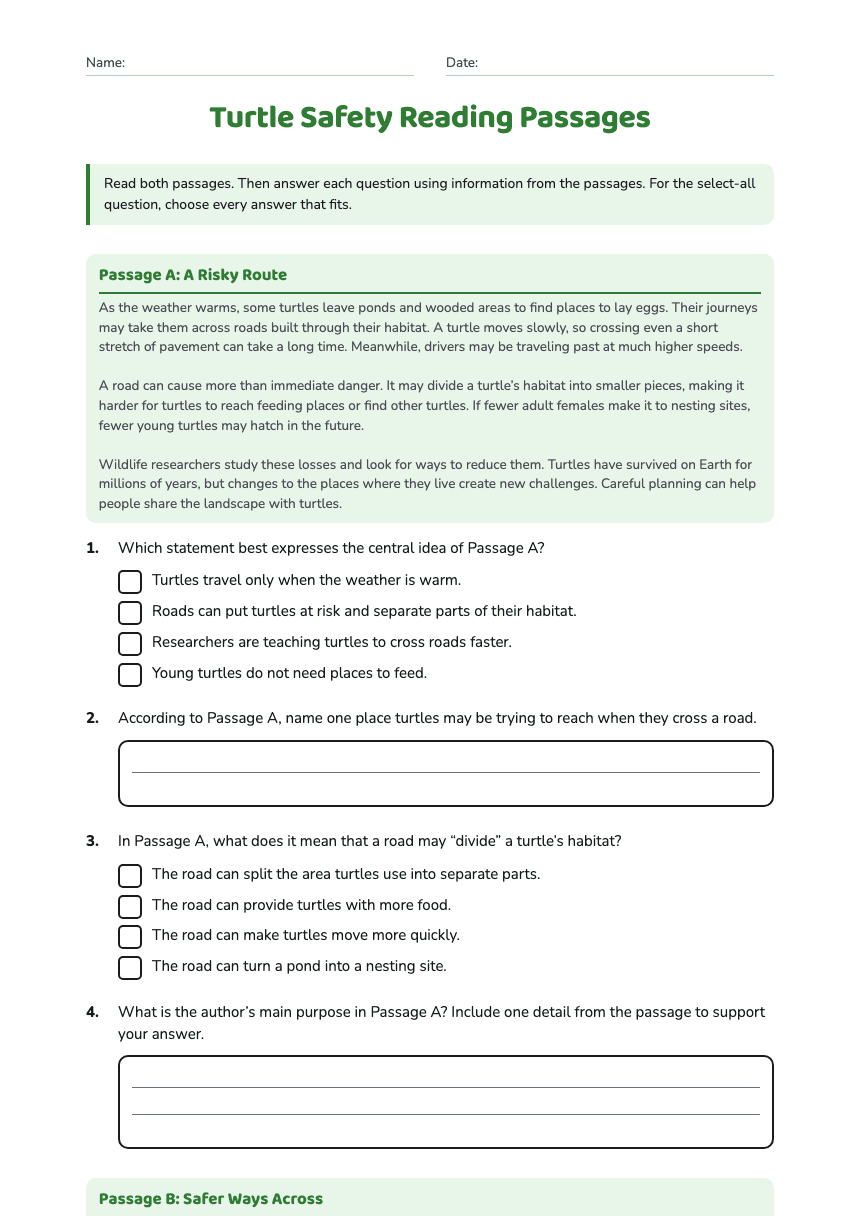
Turtle Safety Reading Passages
A free english (ela) worksheet ready for your classroom. Open in Kuraplan to grab the print-ready PDF, customize it for your students, or generate a fresh version in seconds.
Turtle Safety Reading Passages
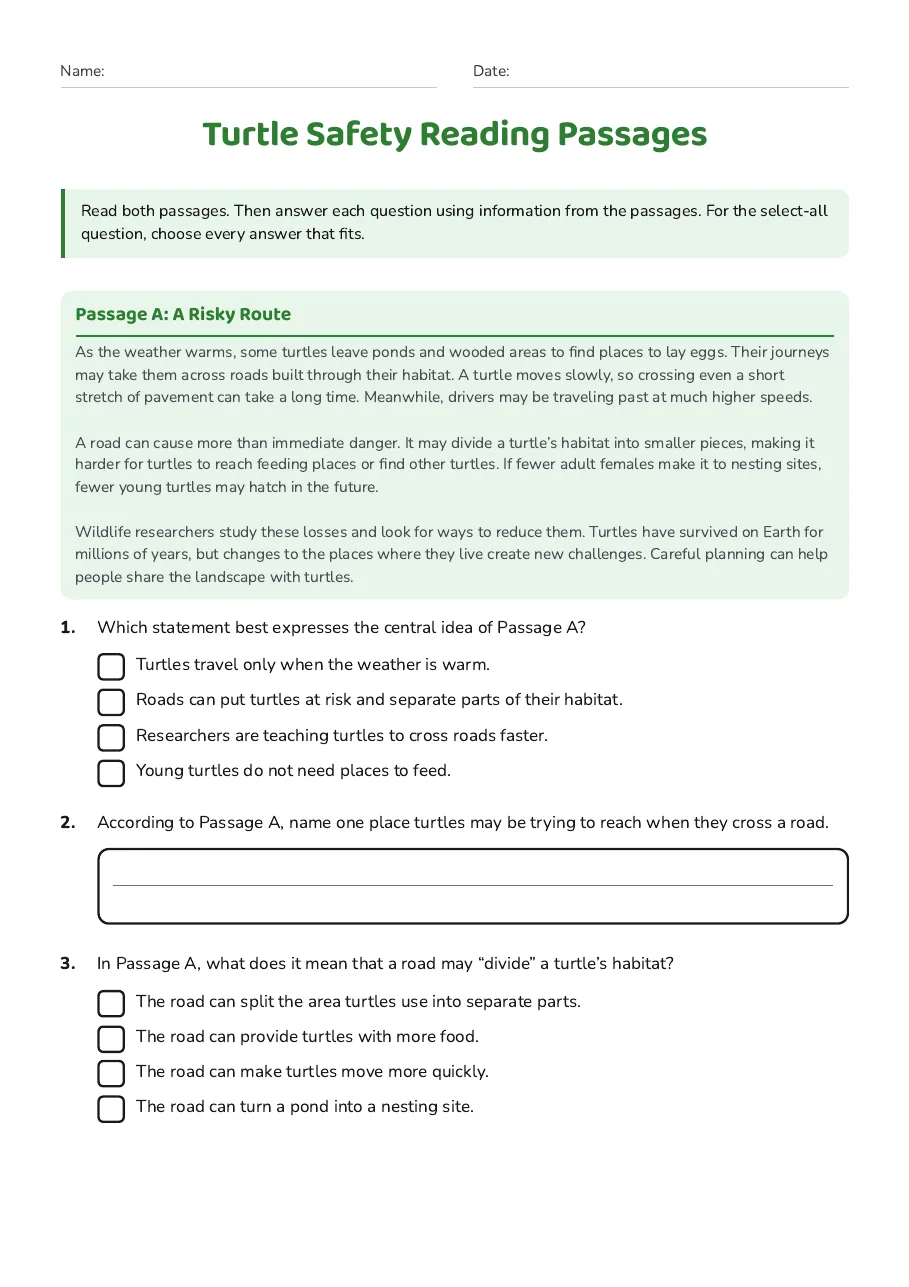
Passage A: A Risky Route
As the weather warms, some turtles leave ponds and wooded areas to find places to lay eggs. Their journeys may take them across roads built through their habitat. A turtle moves slowly, so crossing even a short stretch of pavement can take a long time. Meanwhile, drivers may be traveling past at much higher speeds. A road can cause more than immediate danger. It may divide a turtle’s habitat into smaller pieces, making it harder for turtles to reach feeding places or find other turtles. If fewer adult females make it to nesting sites, fewer young turtles may hatch in the future. Wildlife researchers study these losses and look for ways to reduce them. Turtles have survived on Earth for millions of years, but changes to the places where they live create new challenges. Careful planning can help people share the landscape with turtles.
- Turtles travel only when the weather is warm.
- Roads can put turtles at risk and separate parts of their habitat.
- Researchers are teaching turtles to cross roads faster.
- Young turtles do not need places to feed.
- The road can split the area turtles use into separate parts.
- The road can provide turtles with more food.
- The road can make turtles move more quickly.
- The road can turn a pond into a nesting site.
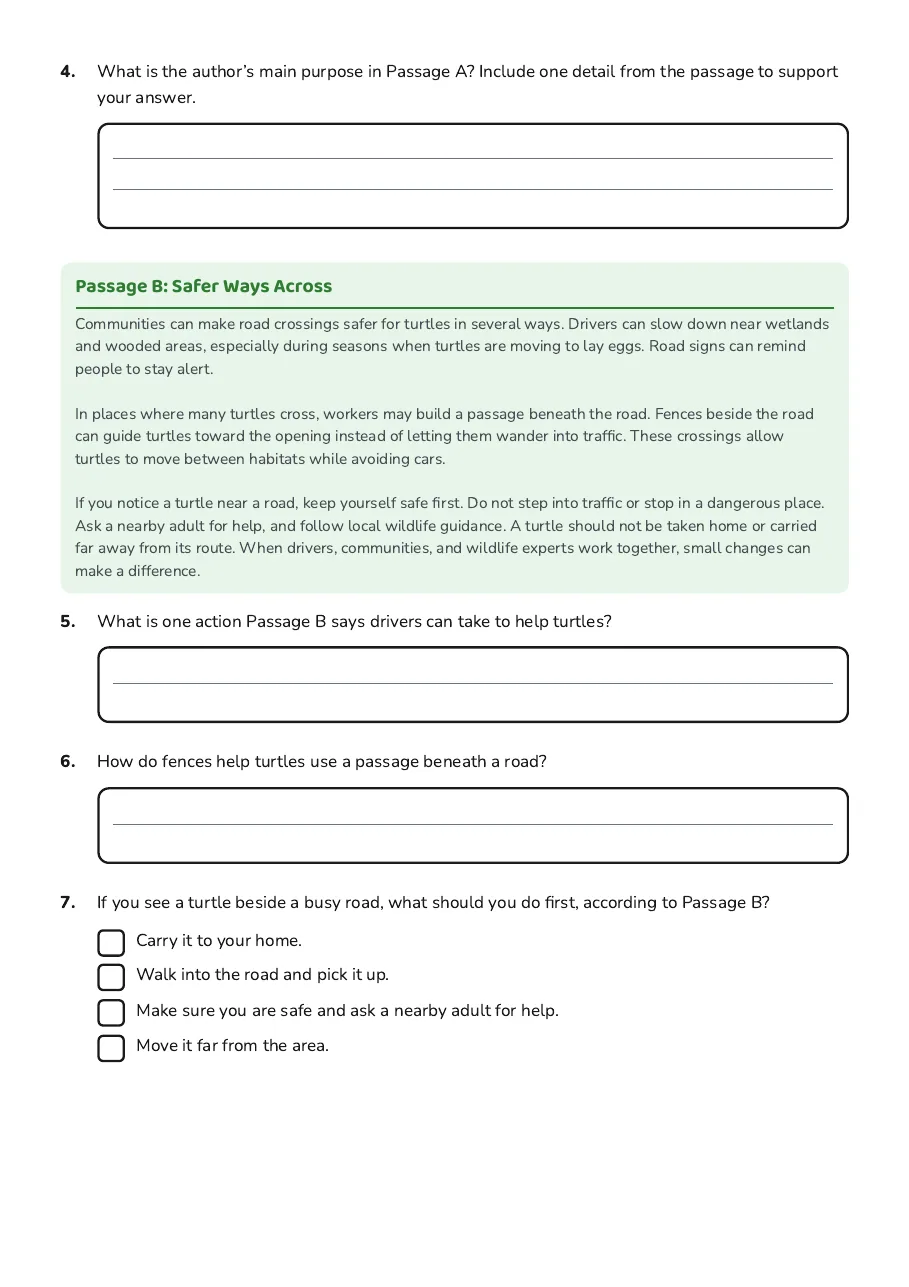
Passage B: Safer Ways Across
Communities can make road crossings safer for turtles in several ways. Drivers can slow down near wetlands and wooded areas, especially during seasons when turtles are moving to lay eggs. Road signs can remind people to stay alert. In places where many turtles cross, workers may build a passage beneath the road. Fences beside the road can guide turtles toward the opening instead of letting them wander into traffic. These crossings allow turtles to move between habitats while avoiding cars. If you notice a turtle near a road, keep yourself safe first. Do not step into traffic or stop in a dangerous place. Ask a nearby adult for help, and follow local wildlife guidance. A turtle should not be taken home or carried far away from its route. When drivers, communities, and wildlife experts work together, small changes can make a difference.
- Carry it to your home.
- Walk into the road and pick it up.
- Make sure you are safe and ask a nearby adult for help.
- Move it far from the area.
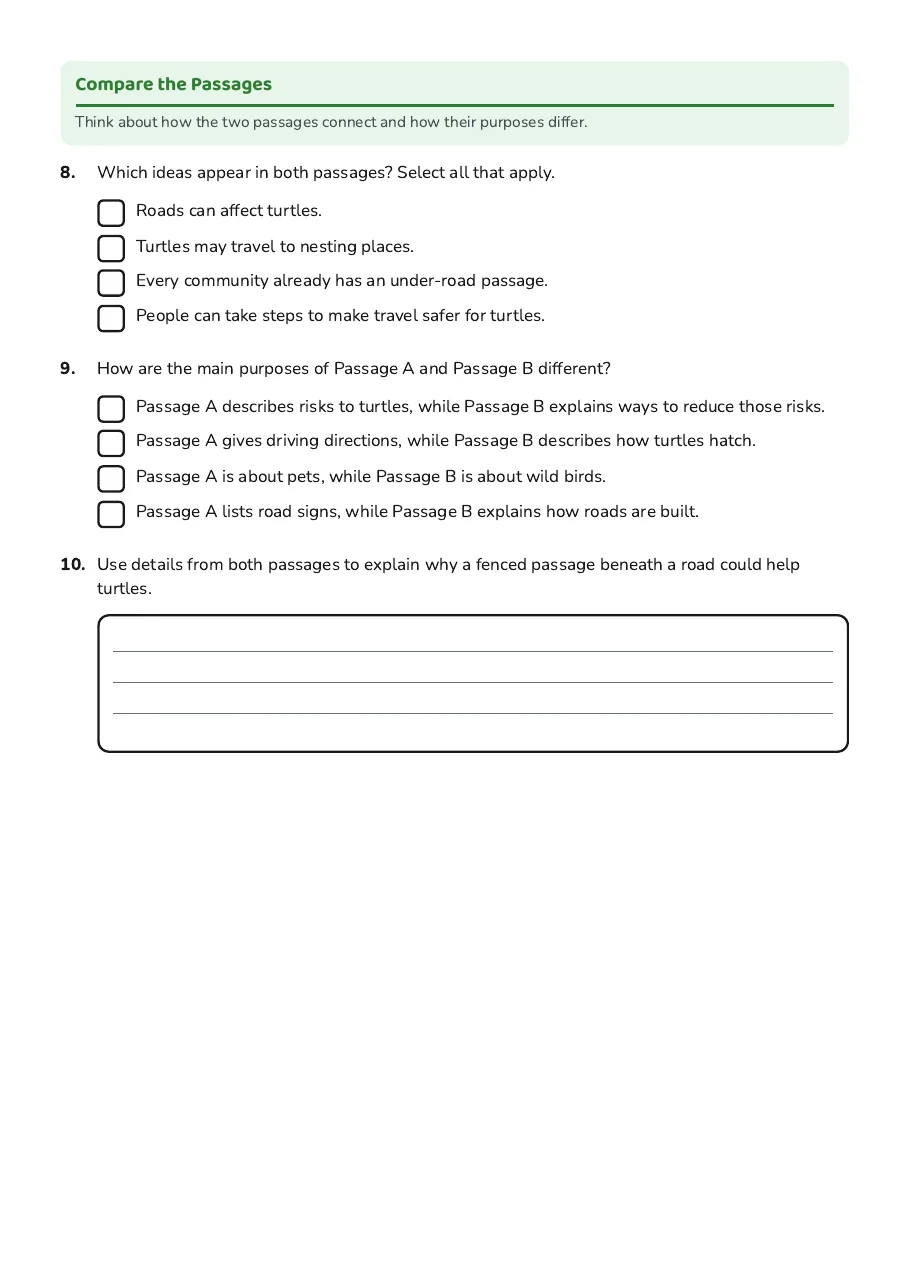
Compare the Passages
Think about how the two passages connect and how their purposes differ.
- Roads can affect turtles.
- Turtles may travel to nesting places.
- Every community already has an under-road passage.
- People can take steps to make travel safer for turtles.
- Passage A describes risks to turtles, while Passage B explains ways to reduce those risks.
- Passage A gives driving directions, while Passage B describes how turtles hatch.
- Passage A is about pets, while Passage B is about wild birds.
- Passage A lists road signs, while Passage B explains how roads are built.
3 printable pages
Page 1
Page 2
Page 3
About This Worksheet
Free in Kuraplan
Sign up free, grab the PDF, and customize it for your class.
Print-Ready
Formatted for standard paper. Clean layout, easy to read.
AI-Generated
Created with Kuraplan's AI, designed for real classroom use.
For Teachers & Parents
Use in classrooms, for homework, tutoring, or homeschool.
Need a custom version of this worksheet?
Kuraplan's AI generates custom worksheets in seconds — differentiated for every learner, aligned to your curriculum.
Generate Custom Worksheets — Free