Understanding Electric Circuits
A free science worksheet ready for your classroom. Open in Kuraplan to grab the print-ready PDF, customize it for your students, or generate a fresh version in seconds.
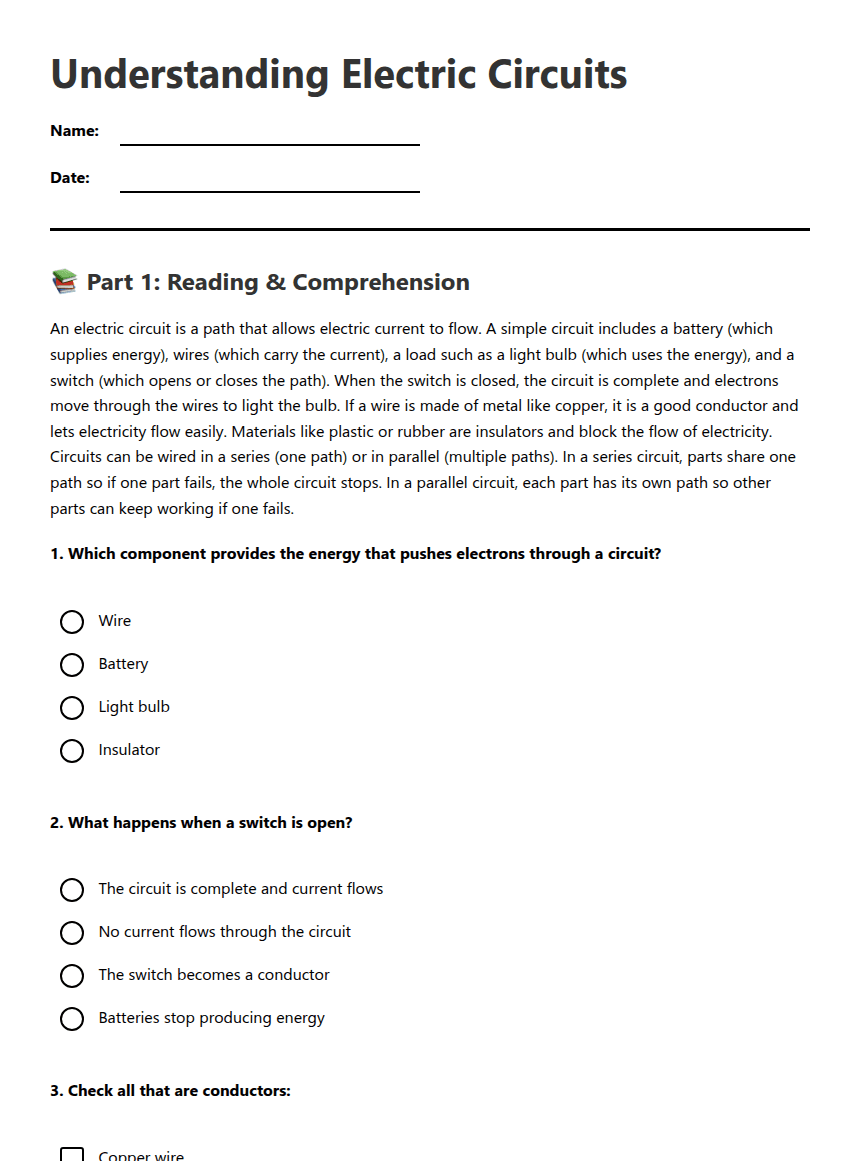
Understanding Electric Circuits
📚 Part 1: Reading & Comprehension
An electric circuit is a path that allows electric current to flow. A simple circuit includes a battery (which supplies energy), wires (which carry the current), a load such as a light bulb (which uses the energy), and a switch (which opens or closes the path). When the switch is closed, the circuit is complete and electrons move through the wires to light the bulb. If a wire is made of metal like copper, it is a good conductor and lets electricity flow easily. Materials like plastic or rubber are insulators and block the flow of electricity. Circuits can be wired in a series (one path) or in parallel (multiple paths). In a series circuit, parts share one path so if one part fails, the whole circuit stops. In a parallel circuit, each part has its own path so other parts can keep working if one fails.
✏️ Part 2: Experiment Plan
You will build a simple circuit with a battery, a bulb, wires, and a switch. Fill in the plan below before you begin the experiment.
Independent variable: ________________________
Dependent variable: ________________________
Controlled variables: ________________________
🔗 Part 3: Matching — Key Terms
Draw a line to match each term on the left with the correct definition or illustration on the right.
About This Worksheet
Free in Kuraplan
Sign up free, grab the PDF, and customize it for your class.
Print-Ready
Formatted for standard paper. Clean layout, easy to read.
AI-Generated
Created with Kuraplan's AI, designed for real classroom use.
For Teachers & Parents
Use in classrooms, for homework, tutoring, or homeschool.
Need a custom version of this worksheet?
Kuraplan's AI generates custom worksheets in seconds — differentiated for every learner, aligned to your curriculum.
Generate Custom Worksheets — FreeMore Science Worksheets
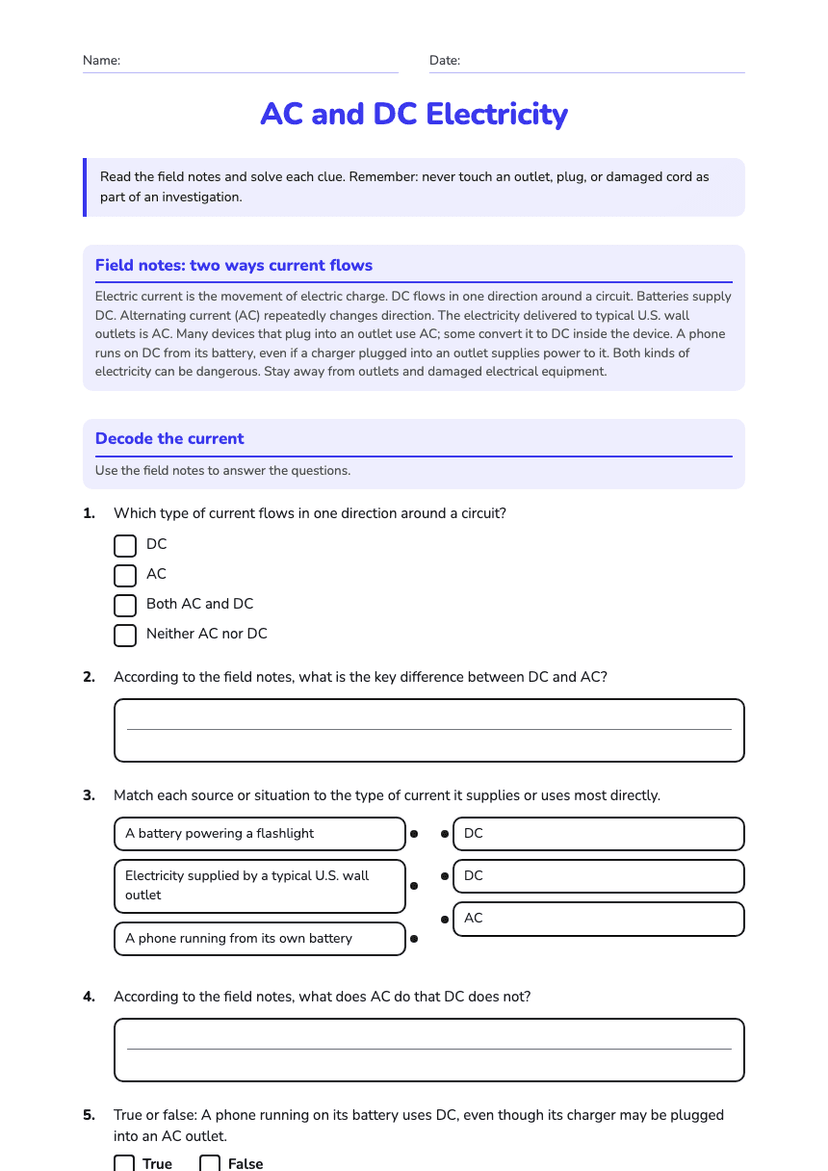
AC and DC Electricity
Free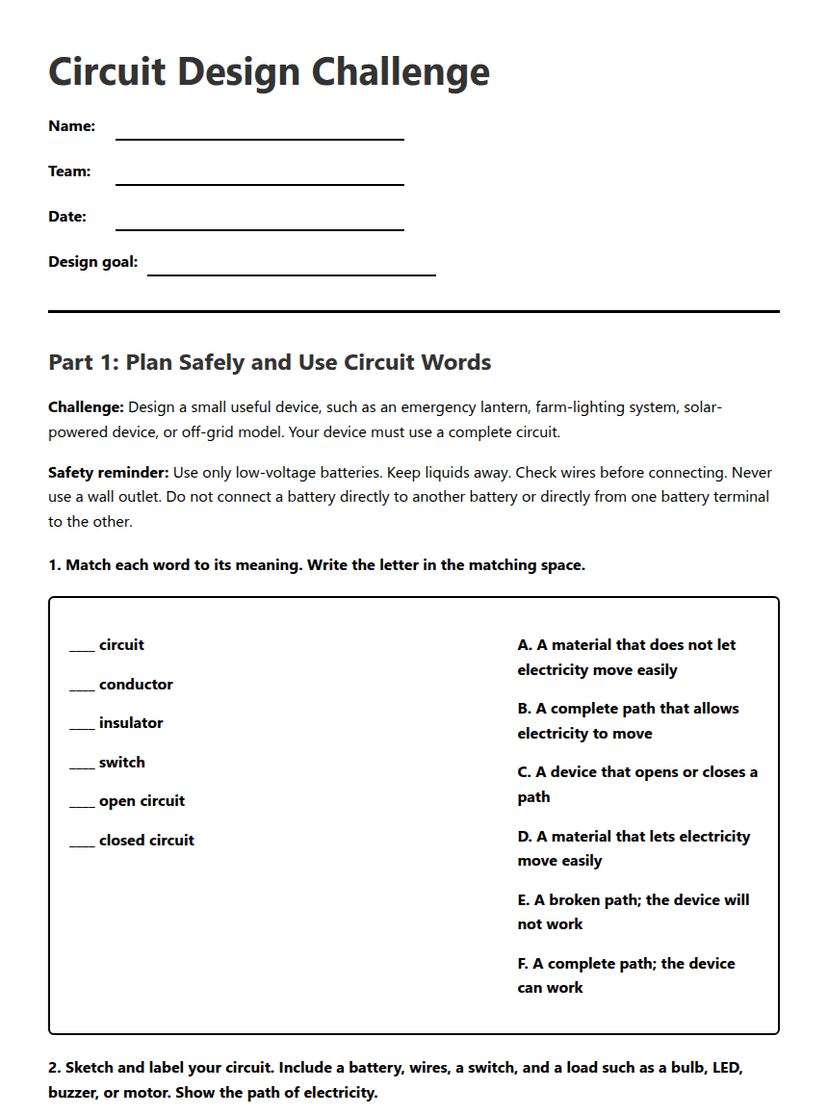
Circuit Design Challenge
Free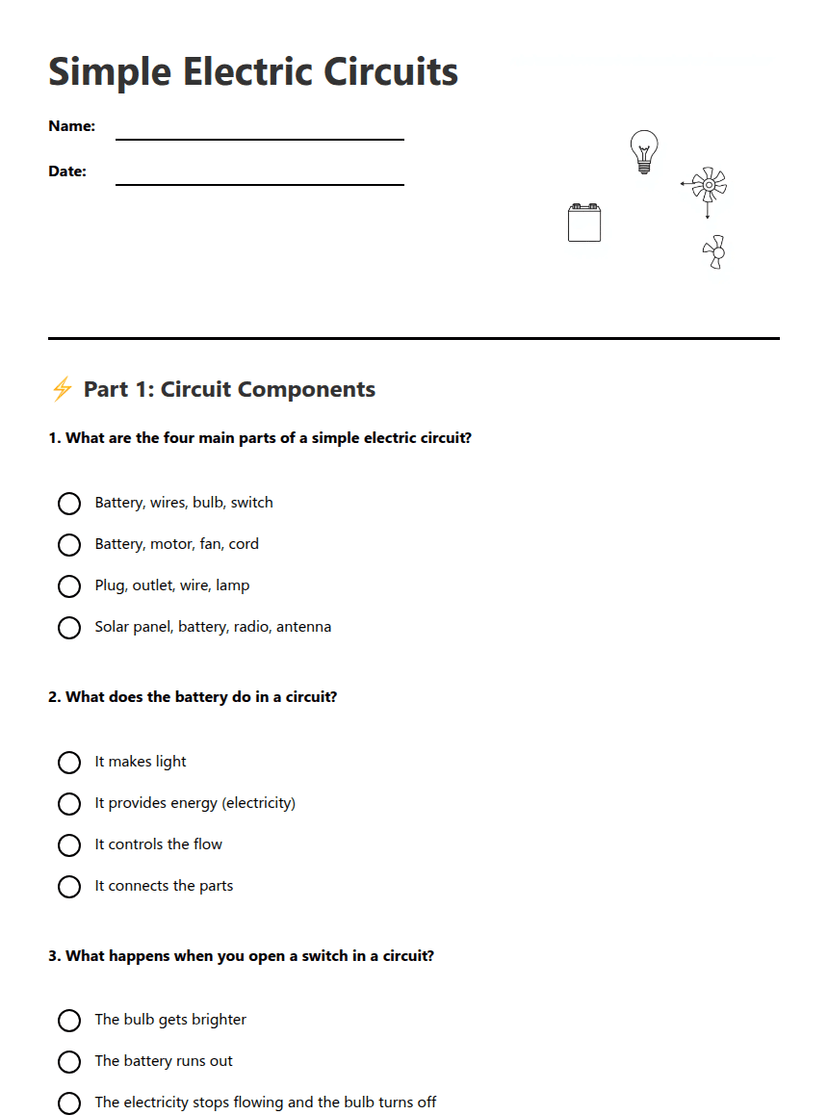
Simple Electric Circuits
Free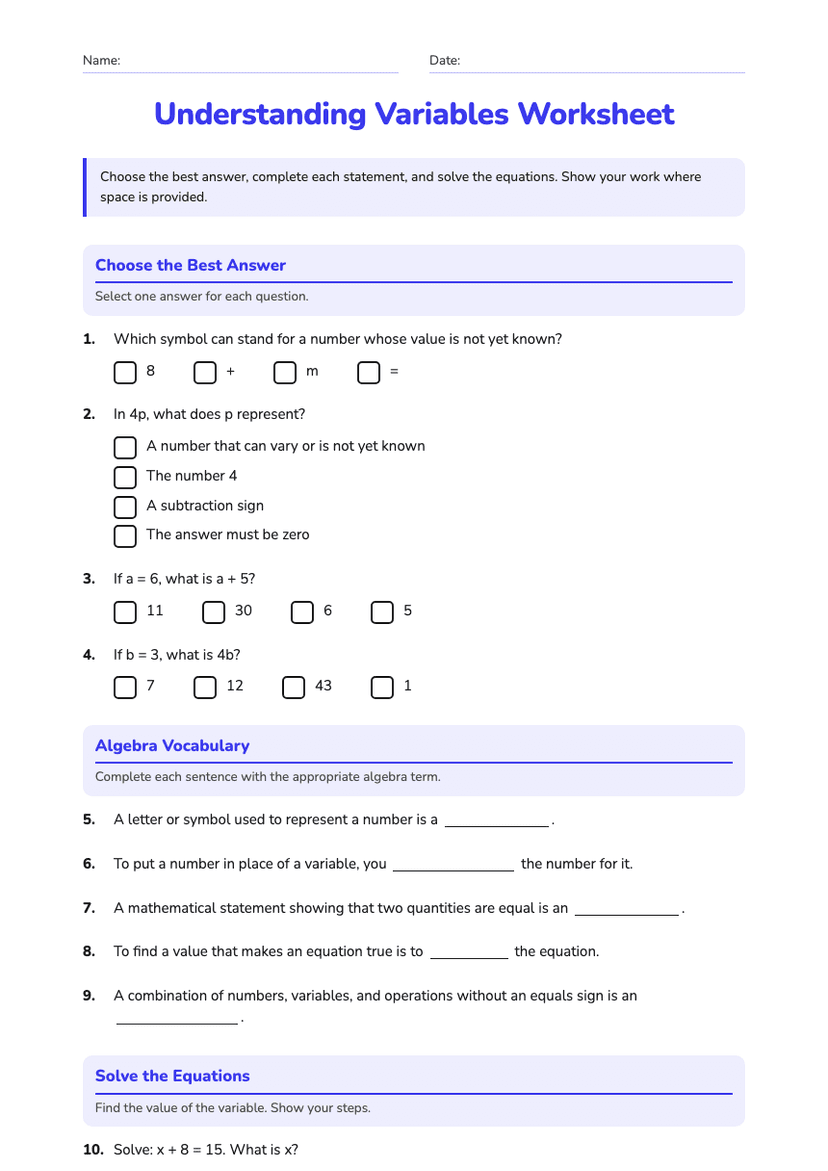
Understanding Variables Worksheet
Free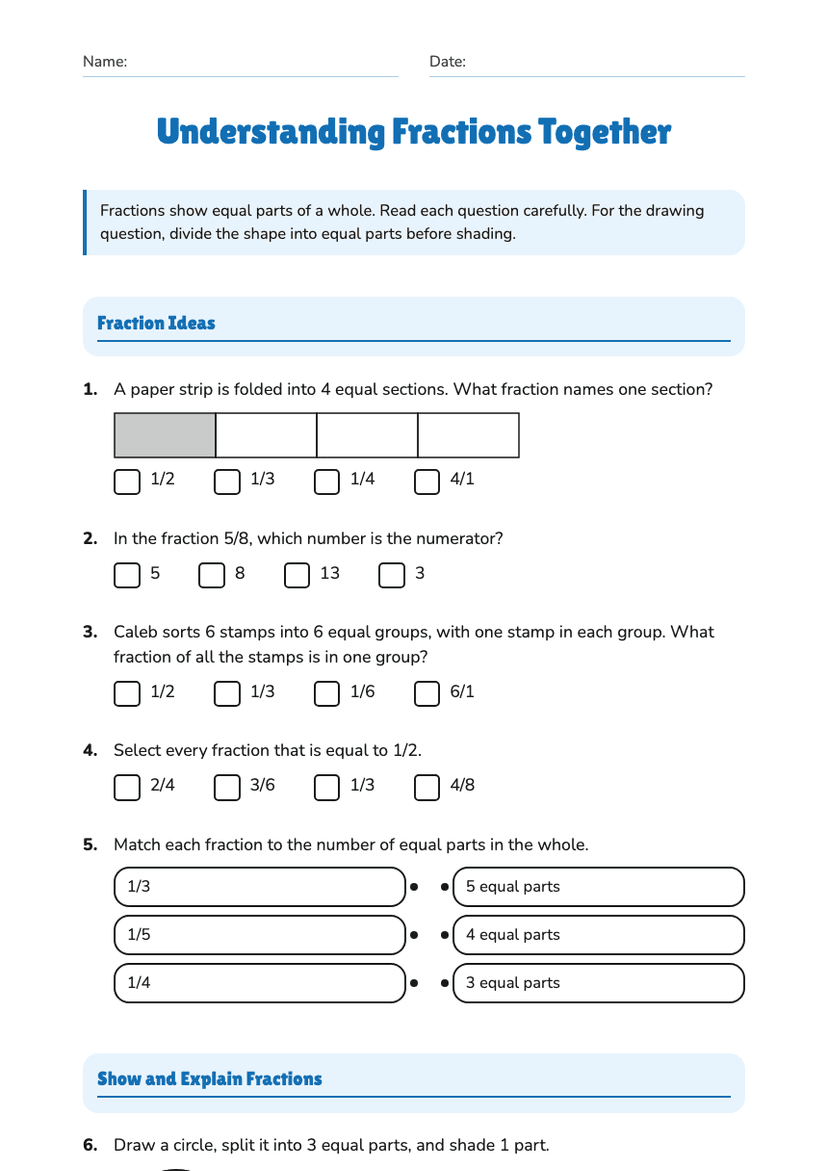
Understanding Fractions Together
Free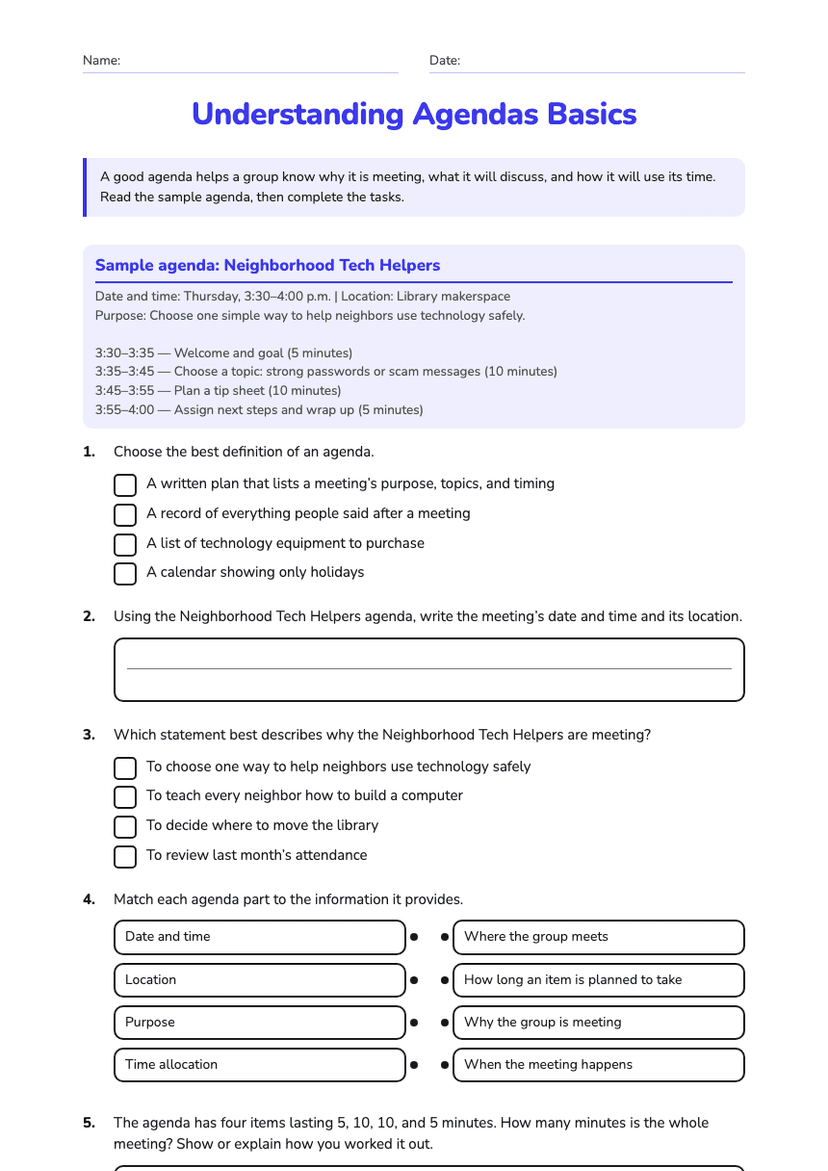
Understanding Agendas Basics
Free
Understanding Ratio Concepts
Free