Ancient Egyptian Religion
A free social sciences worksheet ready for your classroom. Open in Kuraplan to grab the print-ready PDF, customize it for your students, or generate a fresh version in seconds.
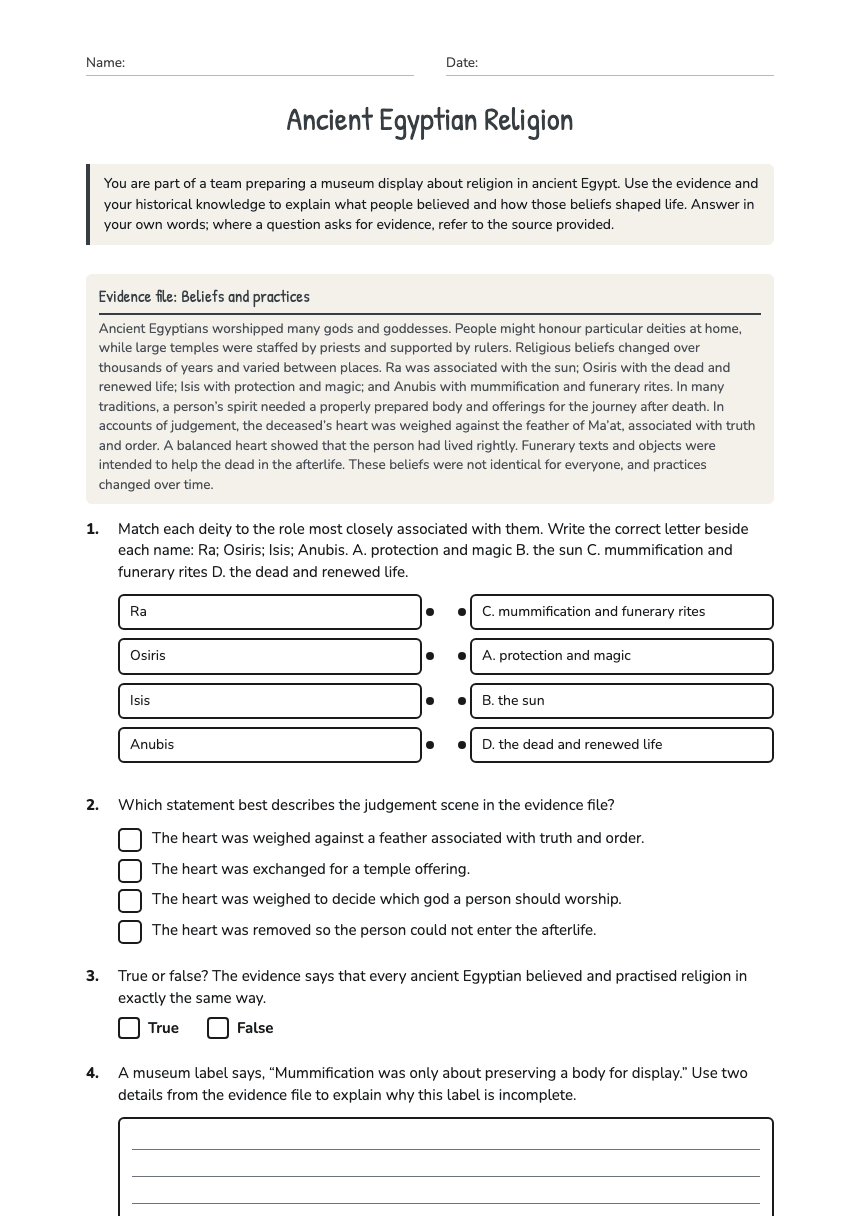
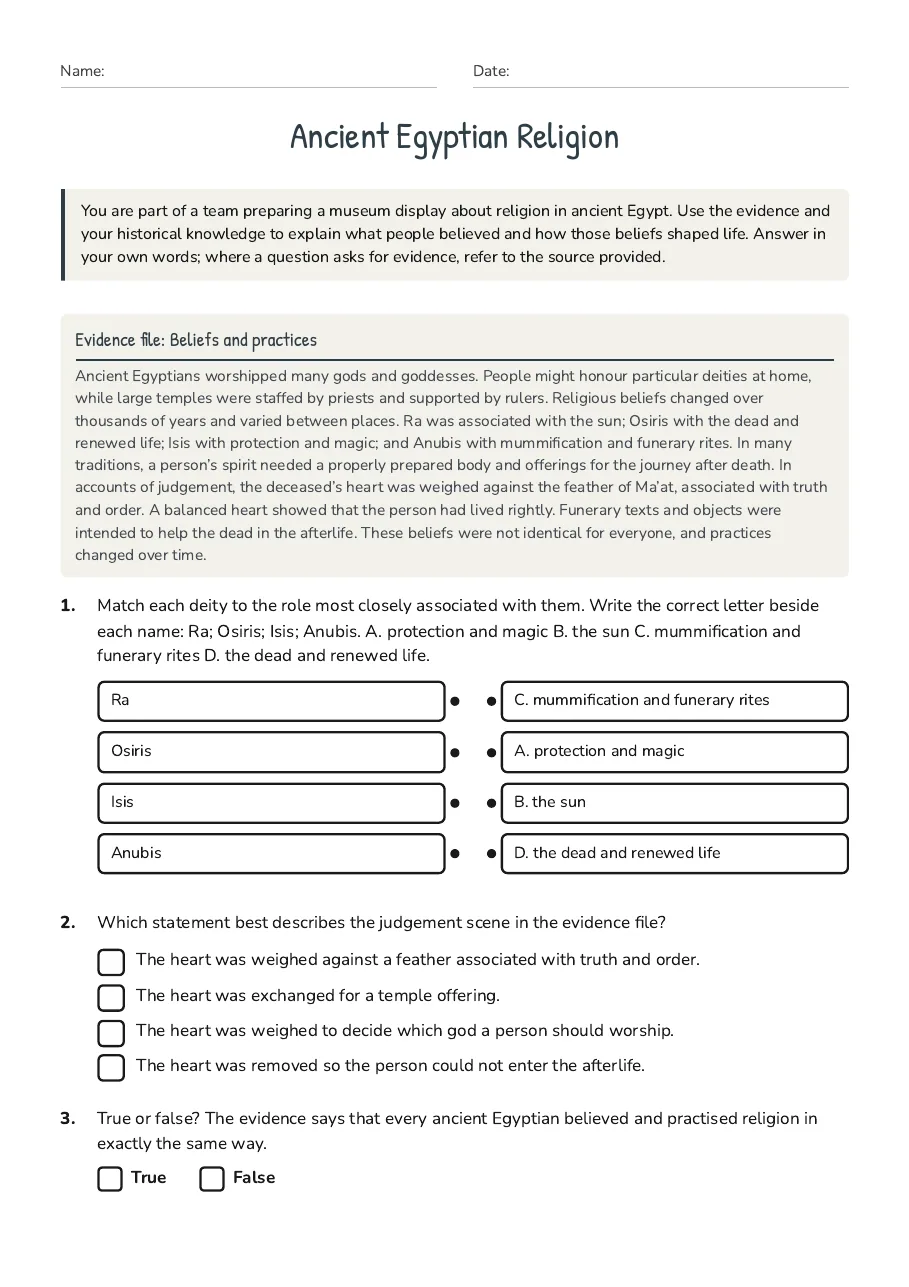
Ancient Egyptian Religion
Evidence file: Beliefs and practices
Ancient Egyptians worshipped many gods and goddesses. People might honour particular deities at home, while large temples were staffed by priests and supported by rulers. Religious beliefs changed over thousands of years and varied between places. Ra was associated with the sun; Osiris with the dead and renewed life; Isis with protection and magic; and Anubis with mummification and funerary rites. In many traditions, a person’s spirit needed a properly prepared body and offerings for the journey after death. In accounts of judgement, the deceased’s heart was weighed against the feather of Ma’at, associated with truth and order. A balanced heart showed that the person had lived rightly. Funerary texts and objects were intended to help the dead in the afterlife. These beliefs were not identical for everyone, and practices changed over time.
- Ra
- Osiris
- Isis
- Anubis
- C. mummification and funerary rites
- A. protection and magic
- B. the sun
- D. the dead and renewed life
- The heart was weighed against a feather associated with truth and order.
- The heart was exchanged for a temple offering.
- The heart was weighed to decide which god a person should worship.
- The heart was removed so the person could not enter the afterlife.
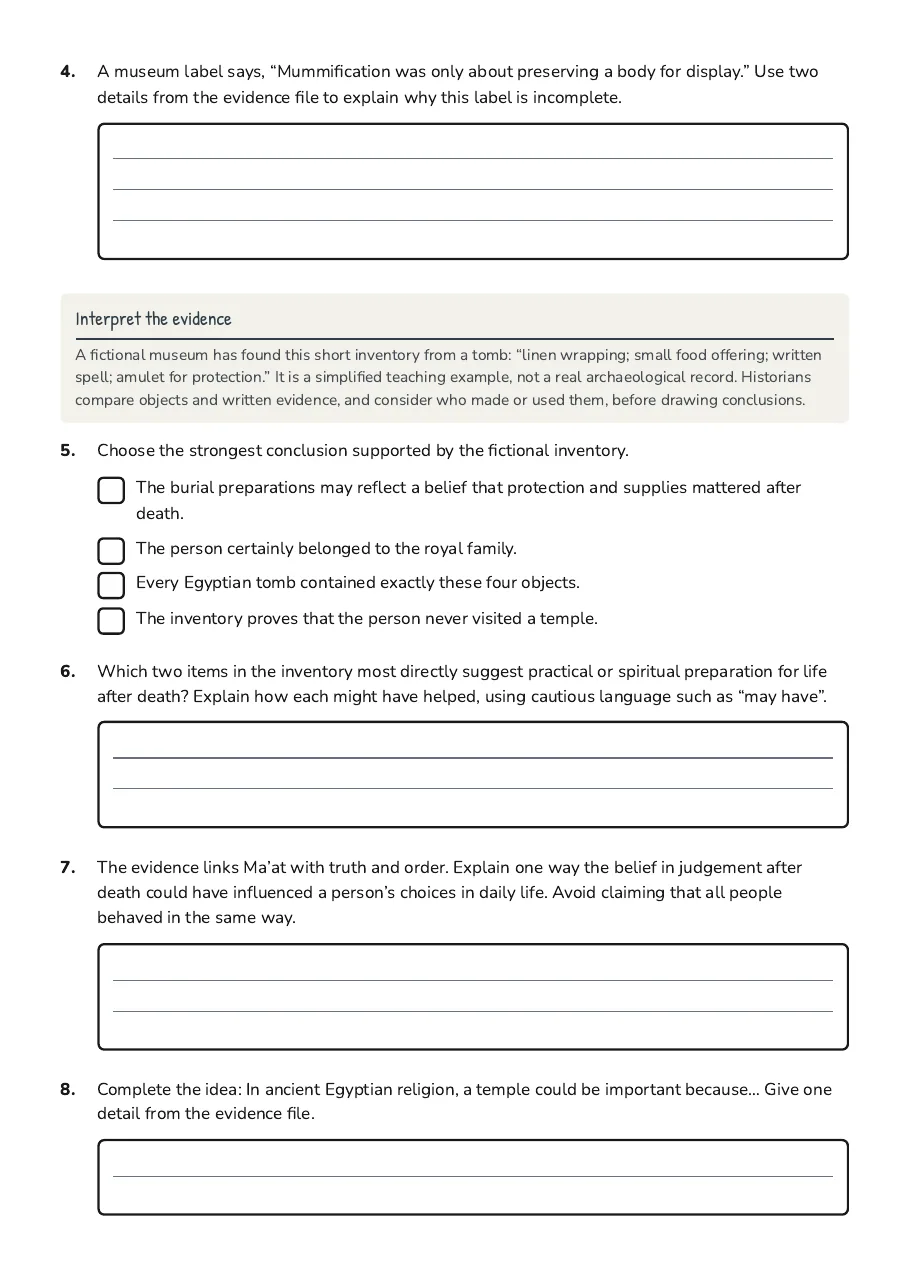
Interpret the evidence
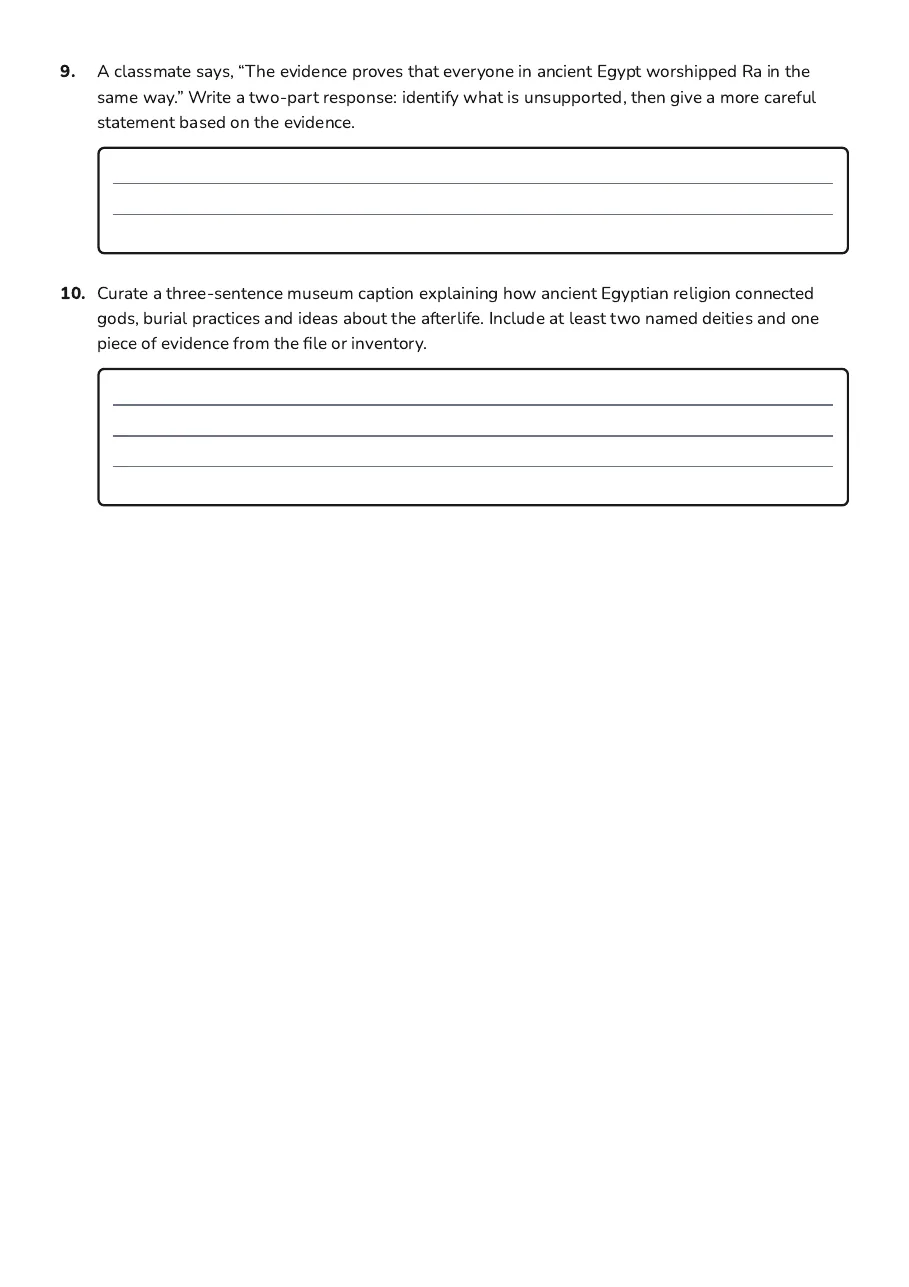
A fictional museum has found this short inventory from a tomb: “linen wrapping; small food offering; written spell; amulet for protection.” It is a simplified teaching example, not a real archaeological record. Historians compare objects and written evidence, and consider who made or used them, before drawing conclusions.
- The burial preparations may reflect a belief that protection and supplies mattered after death.
- The person certainly belonged to the royal family.
- Every Egyptian tomb contained exactly these four objects.
- The inventory proves that the person never visited a temple.
3 printable pages
Page 1
Page 2
Page 3
About This Worksheet
Free in Kuraplan
Sign up free, grab the PDF, and customize it for your class.
Print-Ready
Formatted for standard paper. Clean layout, easy to read.
AI-Generated
Created with Kuraplan's AI, designed for real classroom use.
For Teachers & Parents
Use in classrooms, for homework, tutoring, or homeschool.
Need a custom version of this worksheet?
Kuraplan's AI generates custom worksheets in seconds — differentiated for every learner, aligned to your curriculum.
Generate Custom Worksheets — FreeMore Social Sciences Worksheets
Parihaka: Historical Perspectives Worksheet
Free
Ancient Egyptian Burial Practices
Free
Russell Church Research
Free
New Zealand's Shaping History
Free
Te Aute Historical Insights
Free
World War II: Causes
Free
Traditional and Modern Voyaging
Free