ScienceFreePrintable
Atomic Theory Scientist Cards
A free science worksheet ready for your classroom. Open in Kuraplan to grab the print-ready PDF, customize it for your students, or generate a fresh version in seconds.

Name:Date:
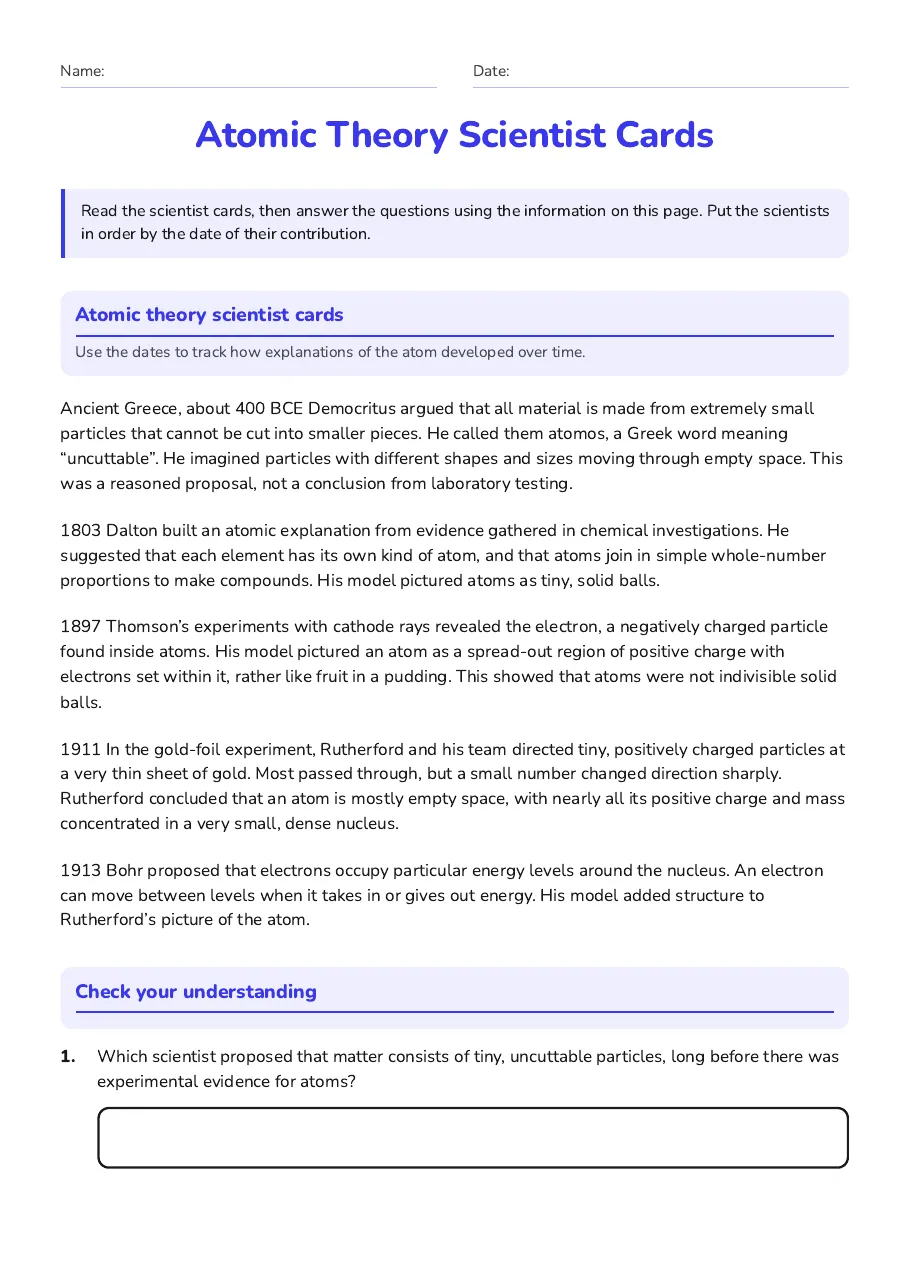
Atomic Theory Scientist Cards
Read the scientist cards, then answer the questions using the information on this page. Put the scientists in order by the date of their contribution.
Atomic theory scientist cards
Use the dates to track how explanations of the atom developed over time.
Ancient Greece, about 400 BCE
Democritus argued that all material is made from extremely small particles that cannot be cut into smaller pieces. He called them atomos, a Greek word meaning “uncuttable”. He imagined particles with different shapes and sizes moving through empty space. This was a reasoned proposal, not a conclusion from laboratory testing.
1803
Dalton built an atomic explanation from evidence gathered in chemical investigations. He suggested that each element has its own kind of atom, and that atoms join in simple whole-number proportions to make compounds. His model pictured atoms as tiny, solid balls.
1897
Thomson’s experiments with cathode rays revealed the electron, a negatively charged particle found inside atoms. His model pictured an atom as a spread-out region of positive charge with electrons set within it, rather like fruit in a pudding. This showed that atoms were not indivisible solid balls.
1911
In the gold-foil experiment, Rutherford and his team directed tiny, positively charged particles at a very thin sheet of gold. Most passed through, but a small number changed direction sharply. Rutherford concluded that an atom is mostly empty space, with nearly all its positive charge and mass concentrated in a very small, dense nucleus.
1913
Bohr proposed that electrons occupy particular energy levels around the nucleus. An electron can move between levels when it takes in or gives out energy. His model added structure to Rutherford’s picture of the atom.
Check your understanding
1.Which scientist proposed that matter consists of tiny, uncuttable particles, long before there was experimental evidence for atoms?
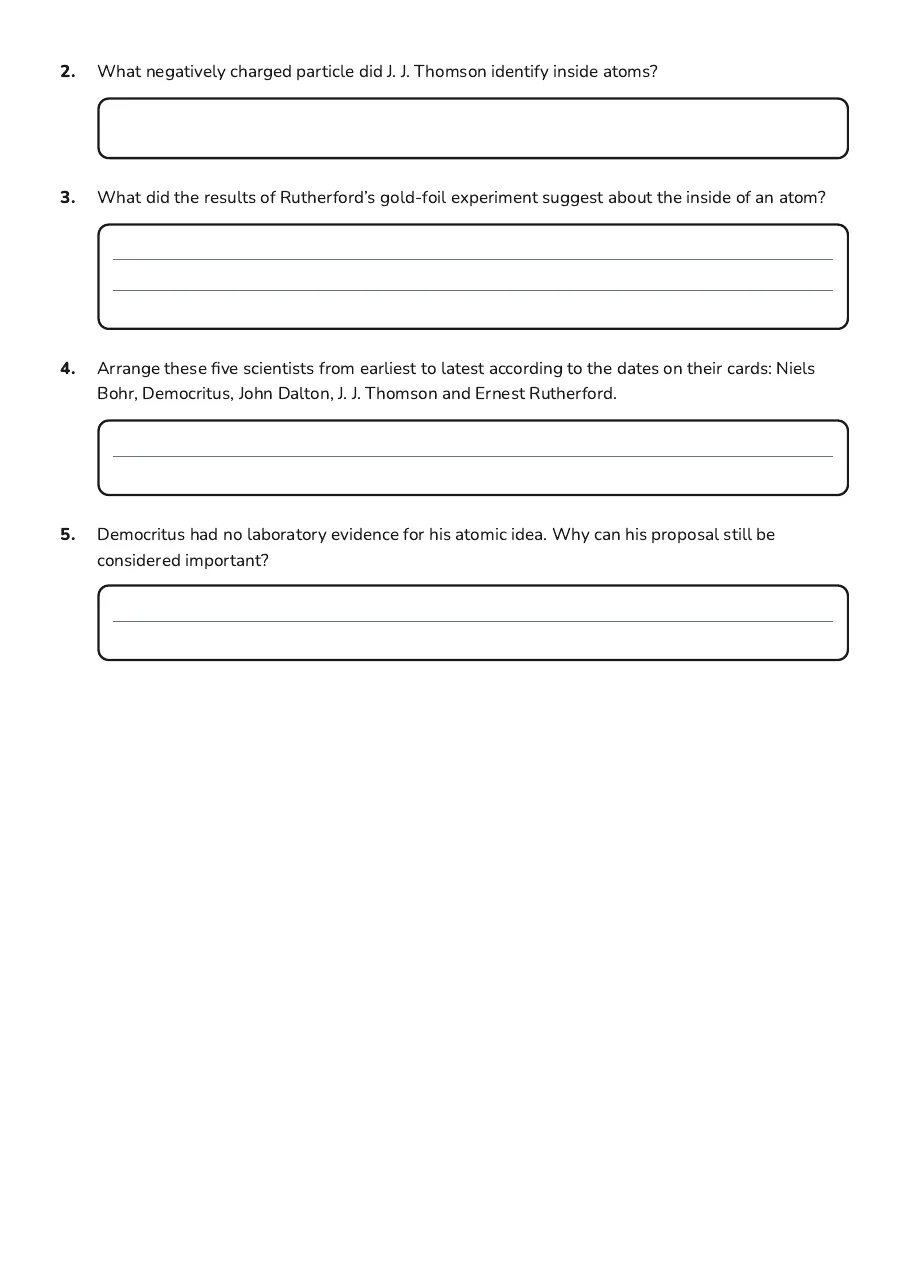
2.What negatively charged particle did J. J. Thomson identify inside atoms?
3.What did the results of Rutherford’s gold-foil experiment suggest about the inside of an atom?
4.Arrange these five scientists from earliest to latest according to the dates on their cards: Niels Bohr, Democritus, John Dalton, J. J. Thomson and Ernest Rutherford.
5.Democritus had no laboratory evidence for his atomic idea. Why can his proposal still be considered important?
2 printable pages
Page 1
Page 2
About This Worksheet
Free in Kuraplan
Sign up free, grab the PDF, and customize it for your class.
Print-Ready
Formatted for standard paper. Clean layout, easy to read.
AI-Generated
Created with Kuraplan's AI, designed for real classroom use.
For Teachers & Parents
Use in classrooms, for homework, tutoring, or homeschool.
Need a custom version of this worksheet?
Kuraplan's AI generates custom worksheets in seconds — differentiated for every learner, aligned to your curriculum.
Generate Custom Worksheets — Free No credit card Curriculum-aligned Under 60 seconds
More Science Worksheets
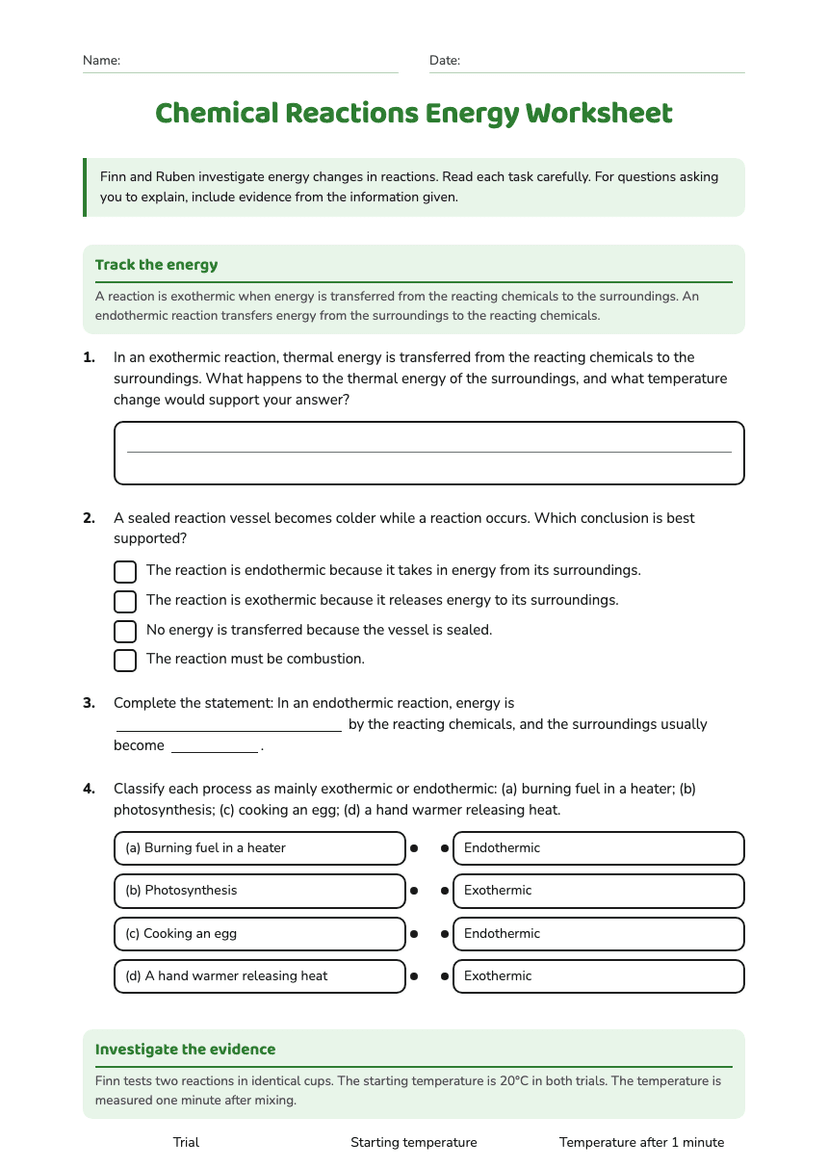
Chemical Reactions Energy Worksheet
Free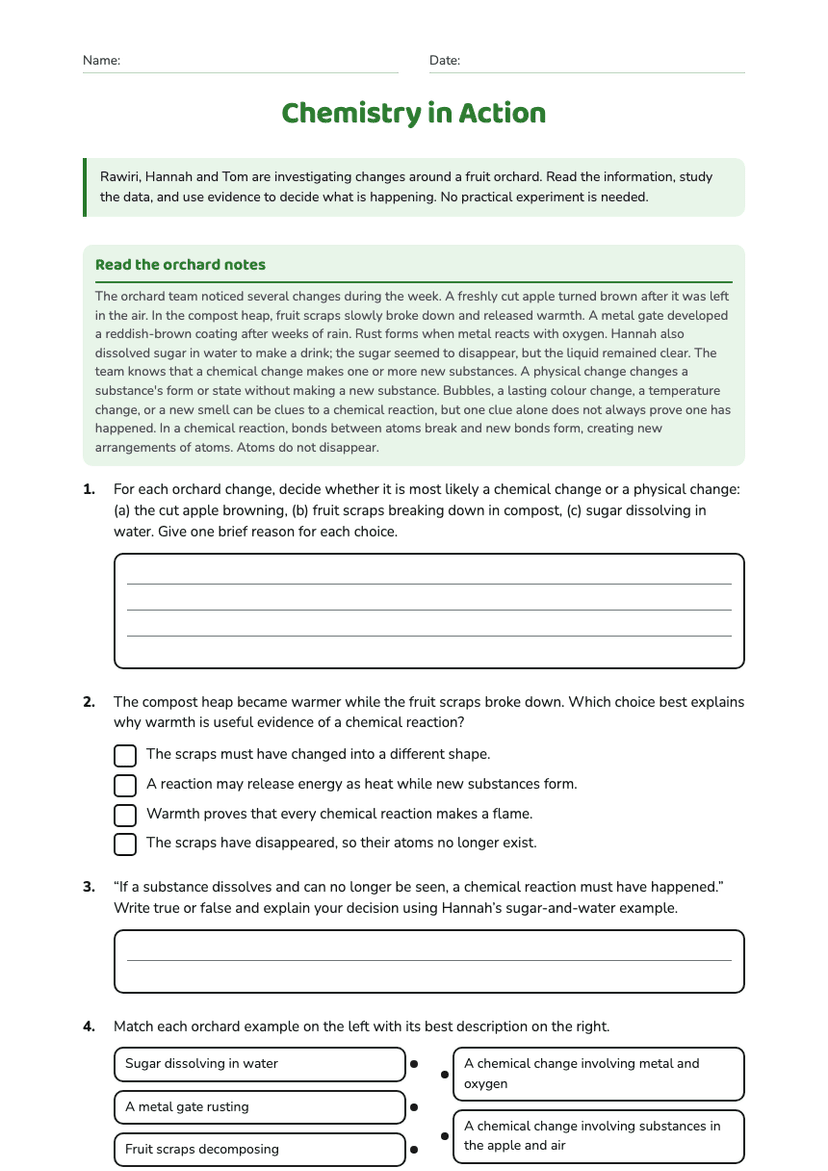
Year 7
Chemistry in Action
Free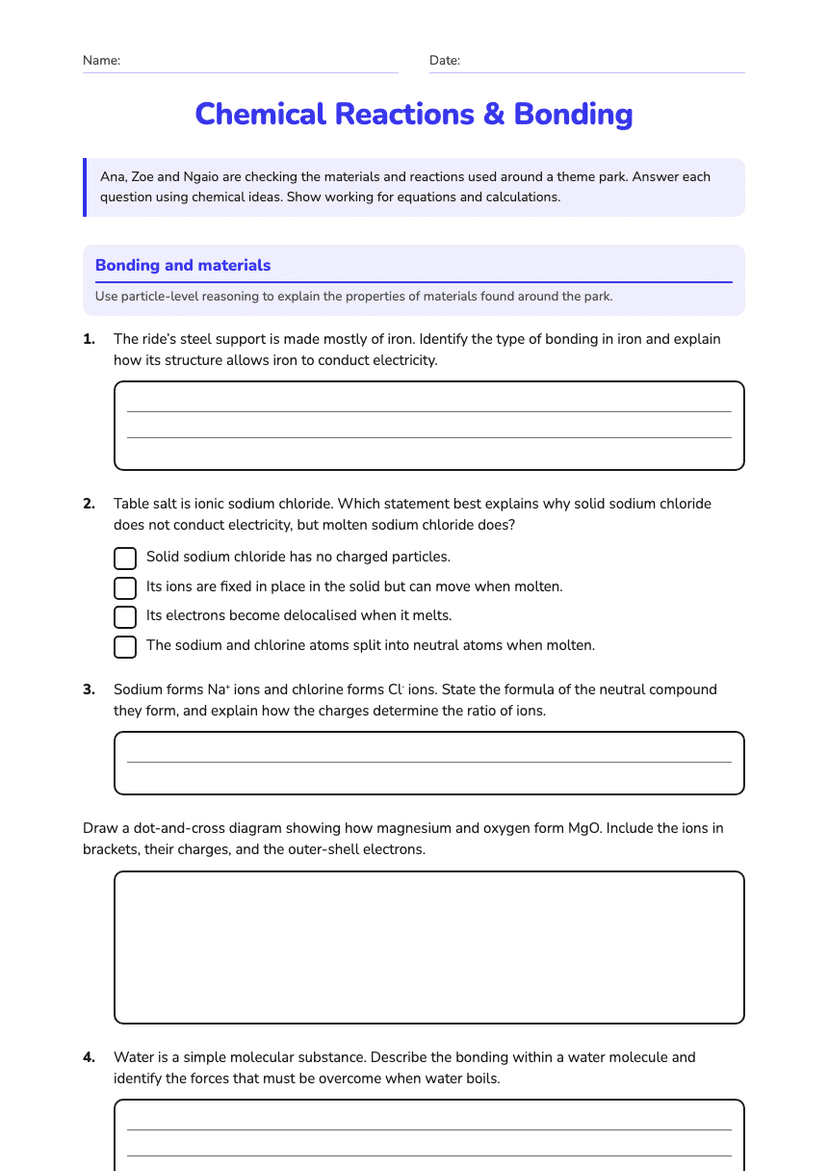
Year 11
Chemical Reactions & Bonding
Free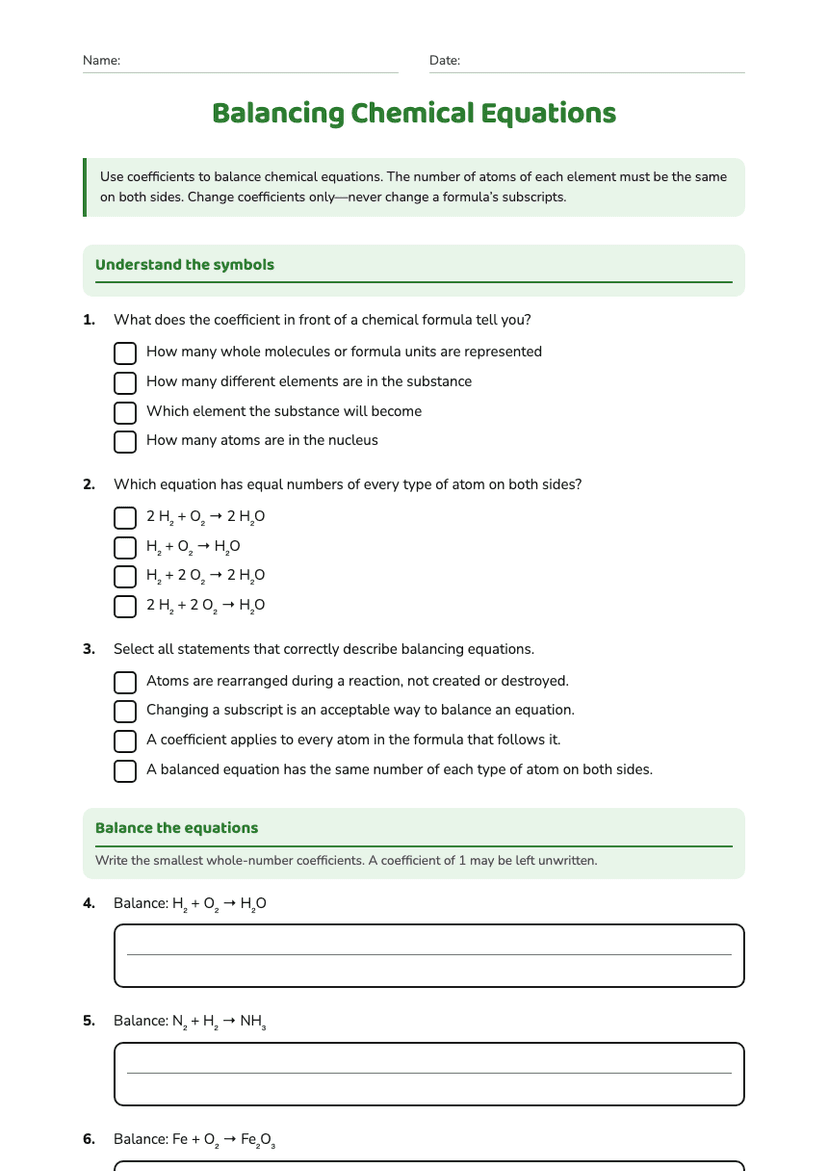
Year 7–8
Balancing Chemical Equations
Free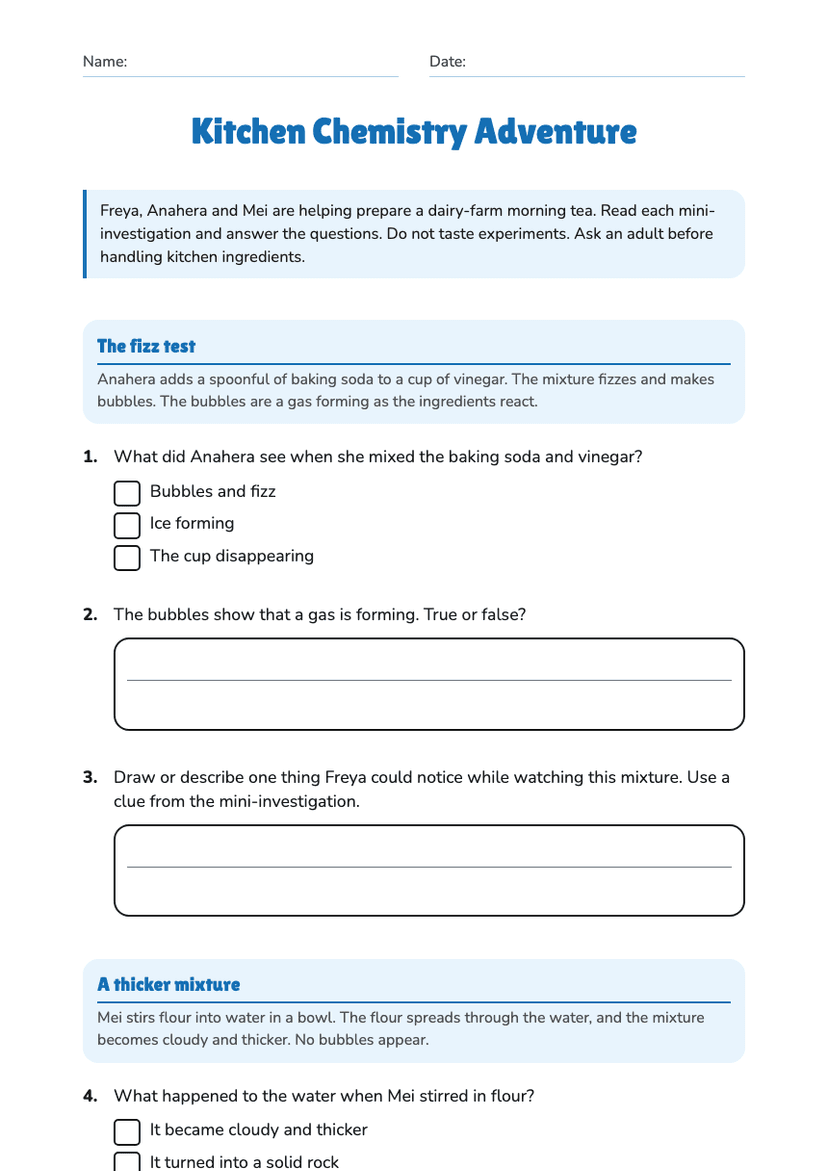
Year 2
Kitchen Chemistry Adventure
Free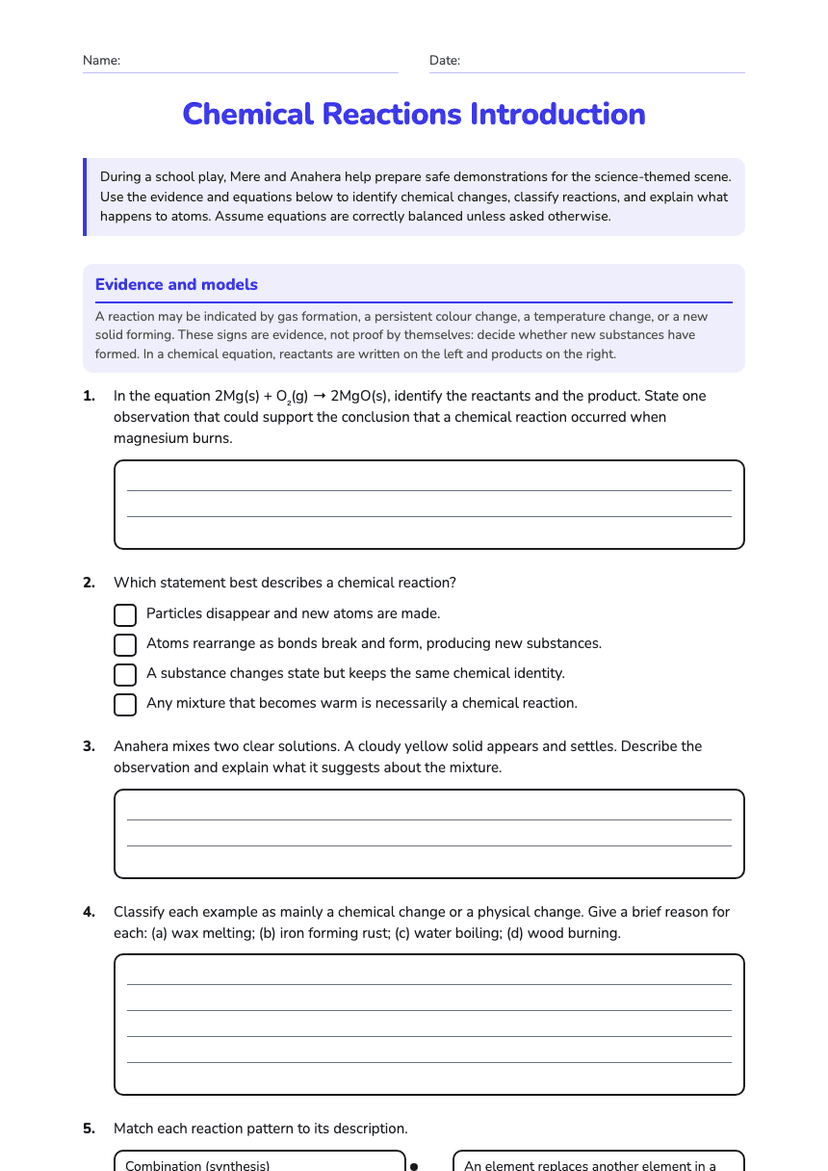
Year 11
Chemical Reactions Introduction
Free
Year 9
Element Flashcards Worksheet
Free
Year 7–8