Social SciencesFreePrintable

Australian Law Reform Fact Sheets

A free social sciences worksheet ready for your classroom. Open in Kuraplan to grab the print-ready PDF, customize it for your students, or generate a fresh version in seconds.
Australian Law Reform Fact Sheets worksheet preview
Name:Date:

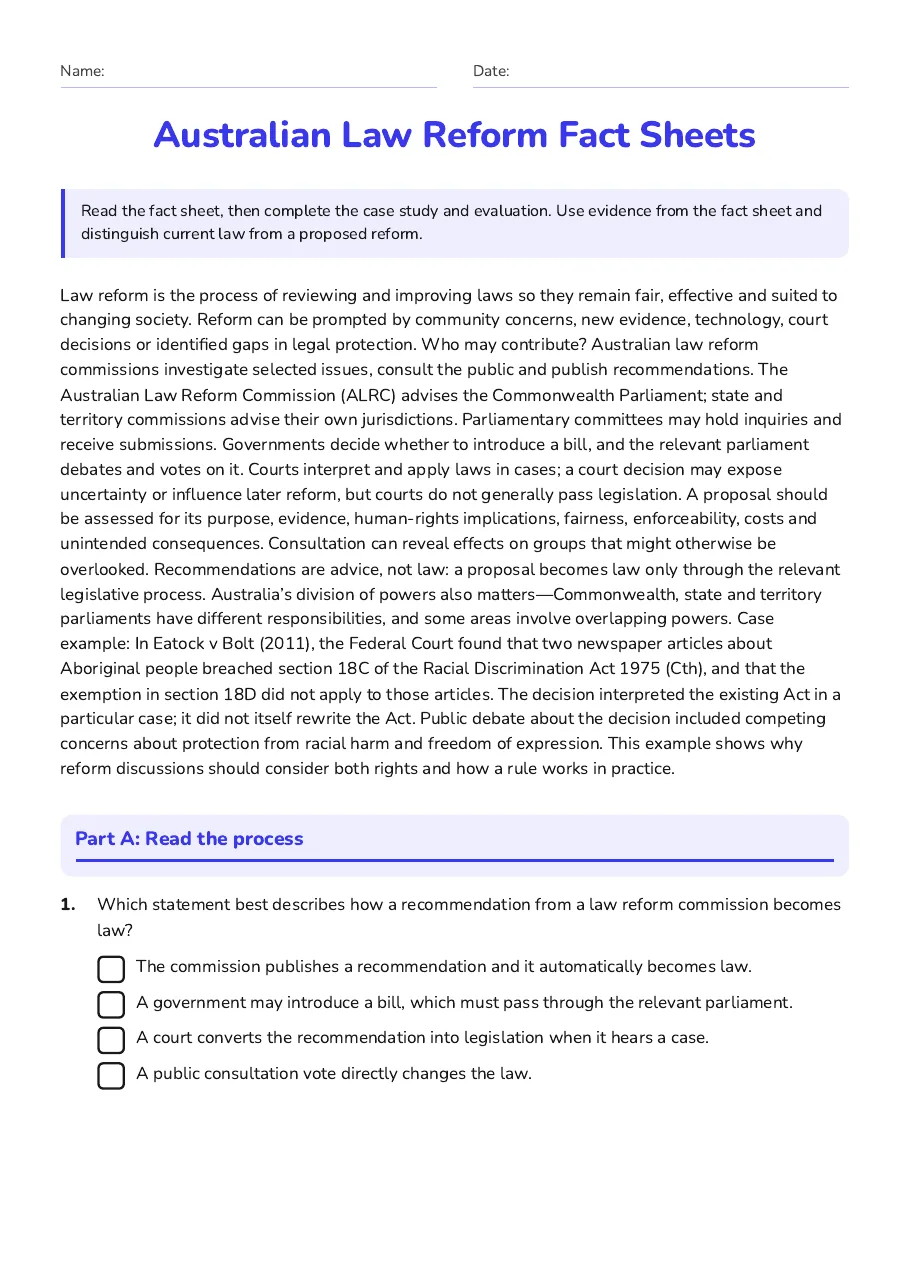
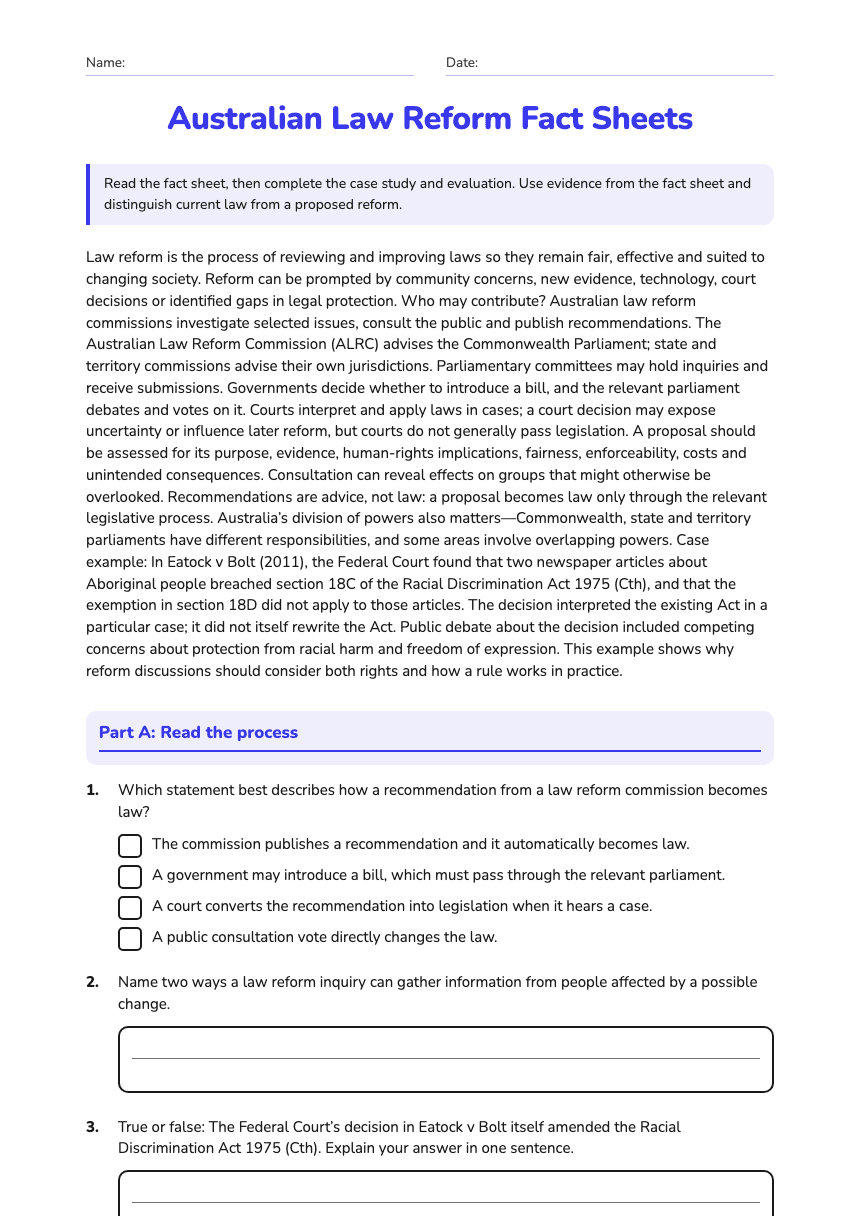
Australian Law Reform Fact Sheets

Read the fact sheet, then complete the case study and evaluation. Use evidence from the fact sheet and distinguish current law from a proposed reform.
Law reform is the process of reviewing and improving laws so they remain fair, effective and suited to changing society. Reform can be prompted by community concerns, new evidence, technology, court decisions or identified gaps in legal protection. Who may contribute? Australian law reform commissions investigate selected issues, consult the public and publish recommendations. The Australian Law Reform Commission (ALRC) advises the Commonwealth Parliament; state and territory commissions advise their own jurisdictions. Parliamentary committees may hold inquiries and receive submissions. Governments decide whether to introduce a bill, and the relevant parliament debates and votes on it. Courts interpret and apply laws in cases; a court decision may expose uncertainty or influence later reform, but courts do not generally pass legislation. A proposal should be assessed for its purpose, evidence, human-rights implications, fairness, enforceability, costs and unintended consequences. Consultation can reveal effects on groups that might otherwise be overlooked. Recommendations are advice, not law: a proposal becomes law only through the relevant legislative process. Australia’s division of powers also matters—Commonwealth, state and territory parliaments have different responsibilities, and some areas involve overlapping powers. Case example: In Eatock v Bolt (2011), the Federal Court found that two newspaper articles about Aboriginal people breached section 18C of the Racial Discrimination Act 1975 (Cth), and that the exemption in section 18D did not apply to those articles. The decision interpreted the existing Act in a particular case; it did not itself rewrite the Act. Public debate about the decision included competing concerns about protection from racial harm and freedom of expression. This example shows why reform discussions should consider both rights and how a rule works in practice.

Part A: Read the process

1.Which statement best describes how a recommendation from a law reform commission becomes law?
  • The commission publishes a recommendation and it automatically becomes law.
  • A government may introduce a bill, which must pass through the relevant parliament.
  • A court converts the recommendation into legislation when it hears a case.
  • A public consultation vote directly changes the law.
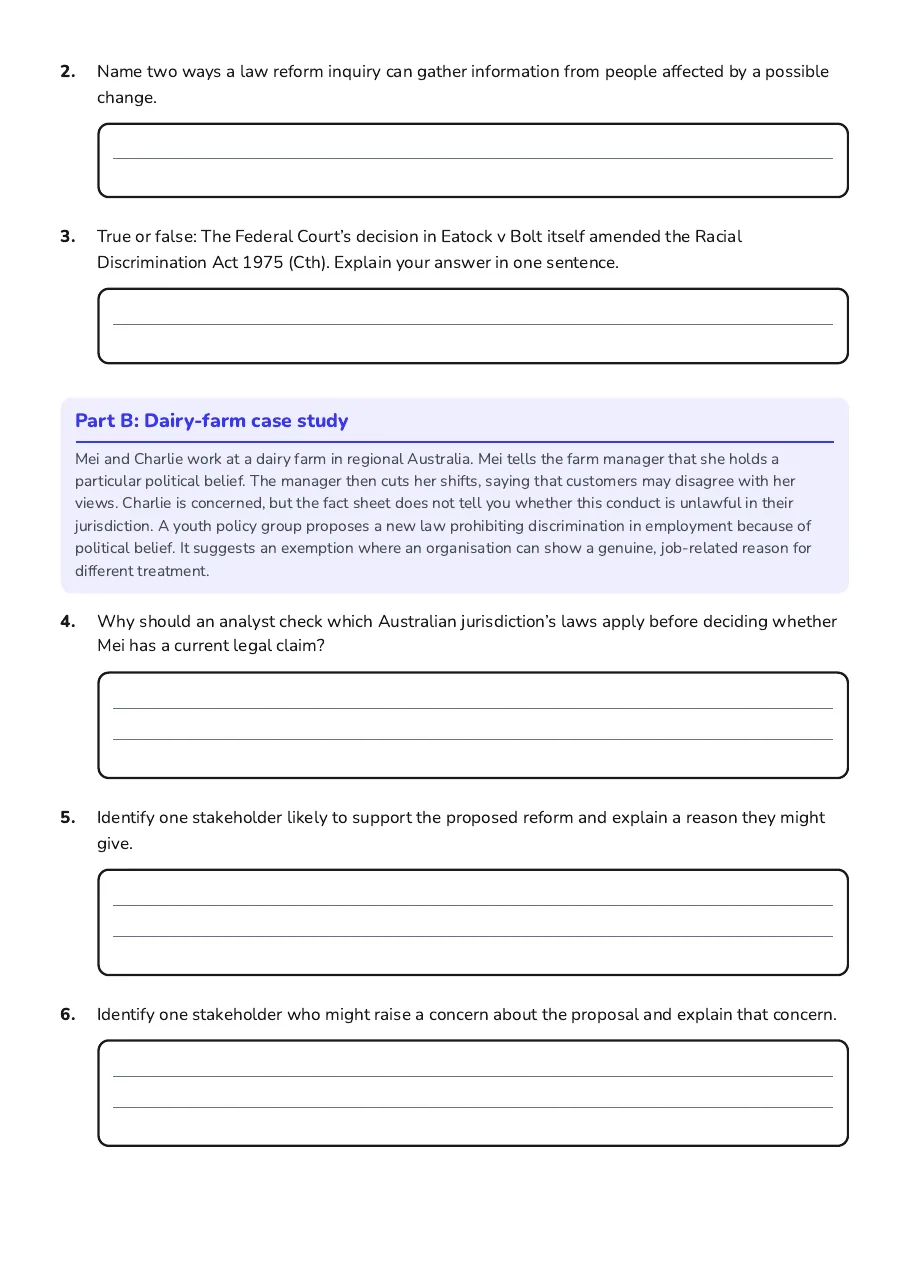
2.Name two ways a law reform inquiry can gather information from people affected by a possible change.
3.True or false: The Federal Court’s decision in Eatock v Bolt itself amended the Racial Discrimination Act 1975 (Cth). Explain your answer in one sentence.

Part B: Dairy-farm case study

Mei and Charlie work at a dairy farm in regional Australia. Mei tells the farm manager that she holds a particular political belief. The manager then cuts her shifts, saying that customers may disagree with her views. Charlie is concerned, but the fact sheet does not tell you whether this conduct is unlawful in their jurisdiction. A youth policy group proposes a new law prohibiting discrimination in employment because of political belief. It suggests an exemption where an organisation can show a genuine, job-related reason for different treatment.

4.Why should an analyst check which Australian jurisdiction’s laws apply before deciding whether Mei has a current legal claim?
5.Identify one stakeholder likely to support the proposed reform and explain a reason they might give.
6.Identify one stakeholder who might raise a concern about the proposal and explain that concern.
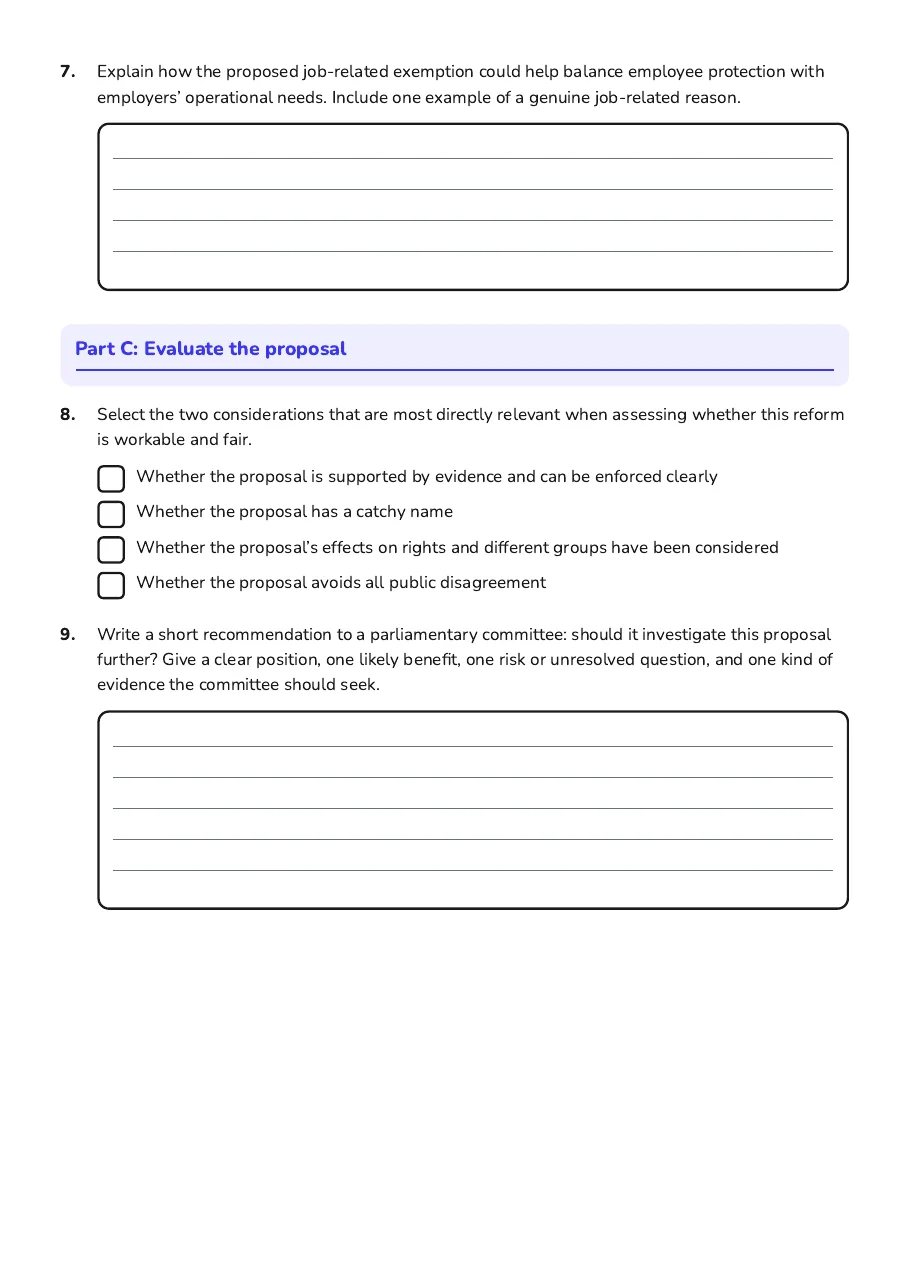
7.Explain how the proposed job-related exemption could help balance employee protection with employers’ operational needs. Include one example of a genuine job-related reason.

Part C: Evaluate the proposal

8.Select the two considerations that are most directly relevant when assessing whether this reform is workable and fair.
  • Whether the proposal is supported by evidence and can be enforced clearly
  • Whether the proposal has a catchy name
  • Whether the proposal’s effects on rights and different groups have been considered
  • Whether the proposal avoids all public disagreement
9.Write a short recommendation to a parliamentary committee: should it investigate this proposal further? Give a clear position, one likely benefit, one risk or unresolved question, and one kind of evidence the committee should seek.

3 printable pages

  • Australian Law Reform Fact Sheets, page 1 of 3: Part A: Read the process

    Page 1

  • Australian Law Reform Fact Sheets, page 2 of 3: Part B: Dairy-farm case study

    Page 2

  • Australian Law Reform Fact Sheets, page 3 of 3: Part C: Evaluate the proposal

    Page 3

About This Worksheet

Free in Kuraplan

Sign up free, grab the PDF, and customize it for your class.

Print-Ready

Formatted for standard paper. Clean layout, easy to read.

AI-Generated

Created with Kuraplan's AI, designed for real classroom use.

For Teachers & Parents

Use in classrooms, for homework, tutoring, or homeschool.

Need a custom version of this worksheet?

Kuraplan's AI generates custom worksheets in seconds — differentiated for every learner, aligned to your curriculum.

Generate Custom Worksheets — Free
No credit card Curriculum-aligned Under 60 seconds