ScienceFreePrintable
Chemical Reactions & Bonding
A free science worksheet ready for your classroom. Open in Kuraplan to grab the print-ready PDF, customize it for your students, or generate a fresh version in seconds.
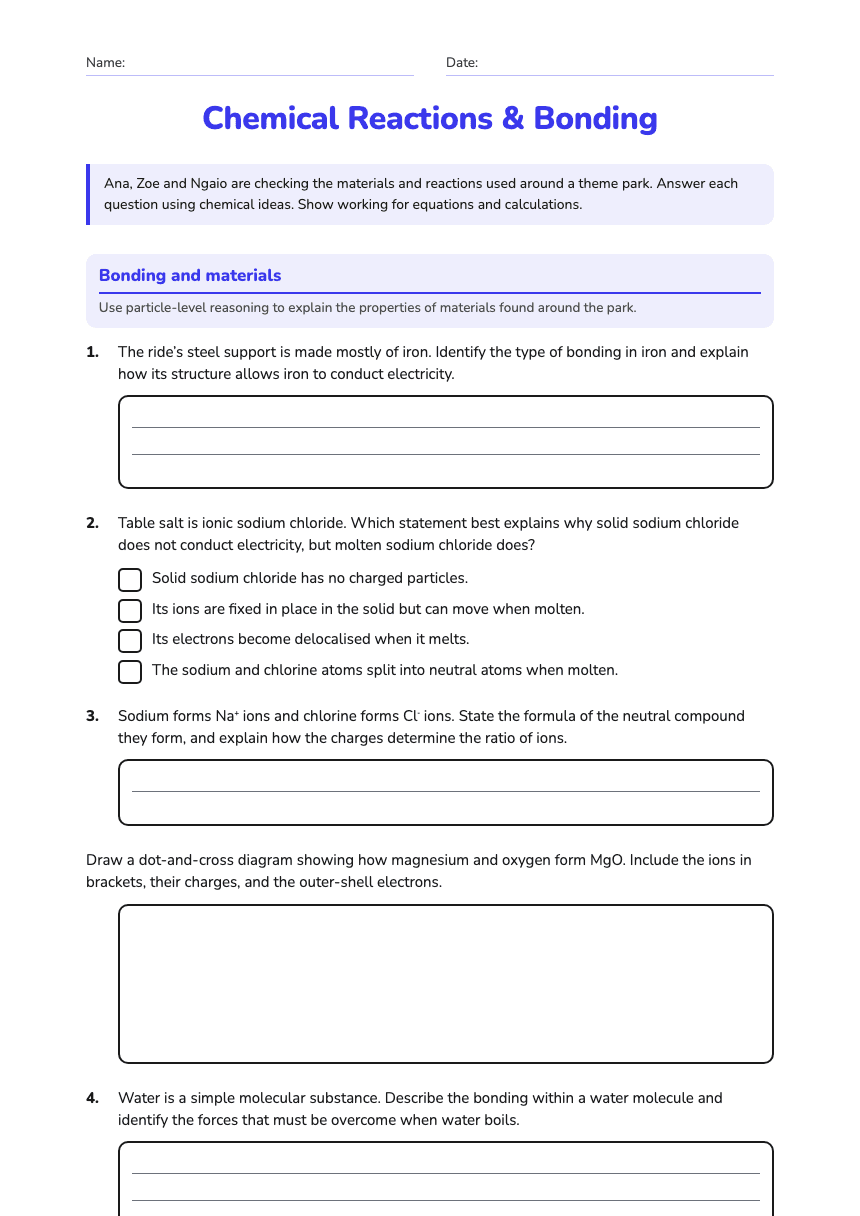
Name:Date:
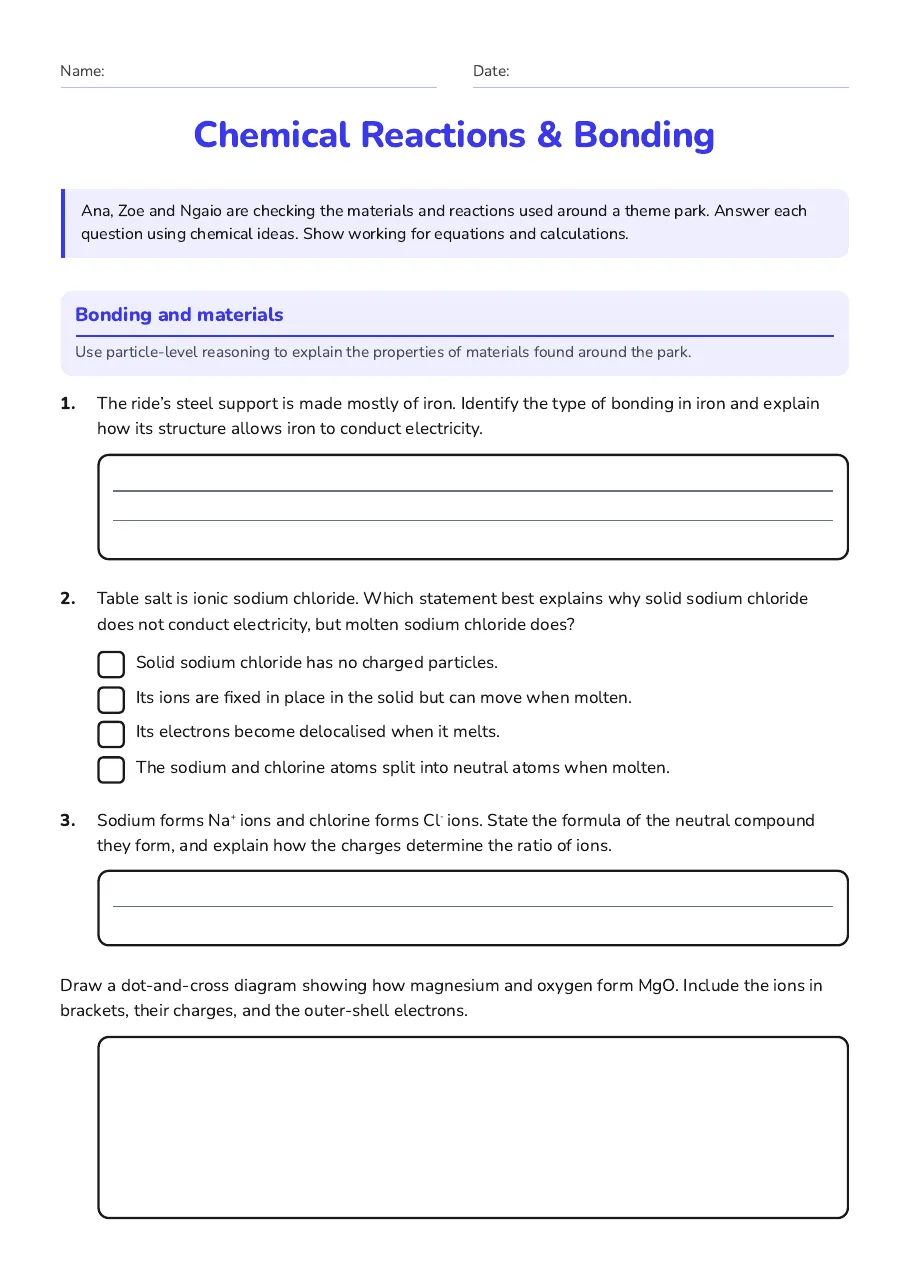
Chemical Reactions & Bonding
Ana, Zoe and Ngaio are checking the materials and reactions used around a theme park. Answer each question using chemical ideas. Show working for equations and calculations.
Bonding and materials
Use particle-level reasoning to explain the properties of materials found around the park.
1.The ride’s steel support is made mostly of iron. Identify the type of bonding in iron and explain how its structure allows iron to conduct electricity.
2.Table salt is ionic sodium chloride. Which statement best explains why solid sodium chloride does not conduct electricity, but molten sodium chloride does?
- Solid sodium chloride has no charged particles.
- Its ions are fixed in place in the solid but can move when molten.
- Its electrons become delocalised when it melts.
- The sodium and chlorine atoms split into neutral atoms when molten.
3.Sodium forms Na⁺ ions and chlorine forms Cl⁻ ions. State the formula of the neutral compound they form, and explain how the charges determine the ratio of ions.
Draw a dot-and-cross diagram showing how magnesium and oxygen form MgO. Include the ions in brackets, their charges, and the outer-shell electrons.
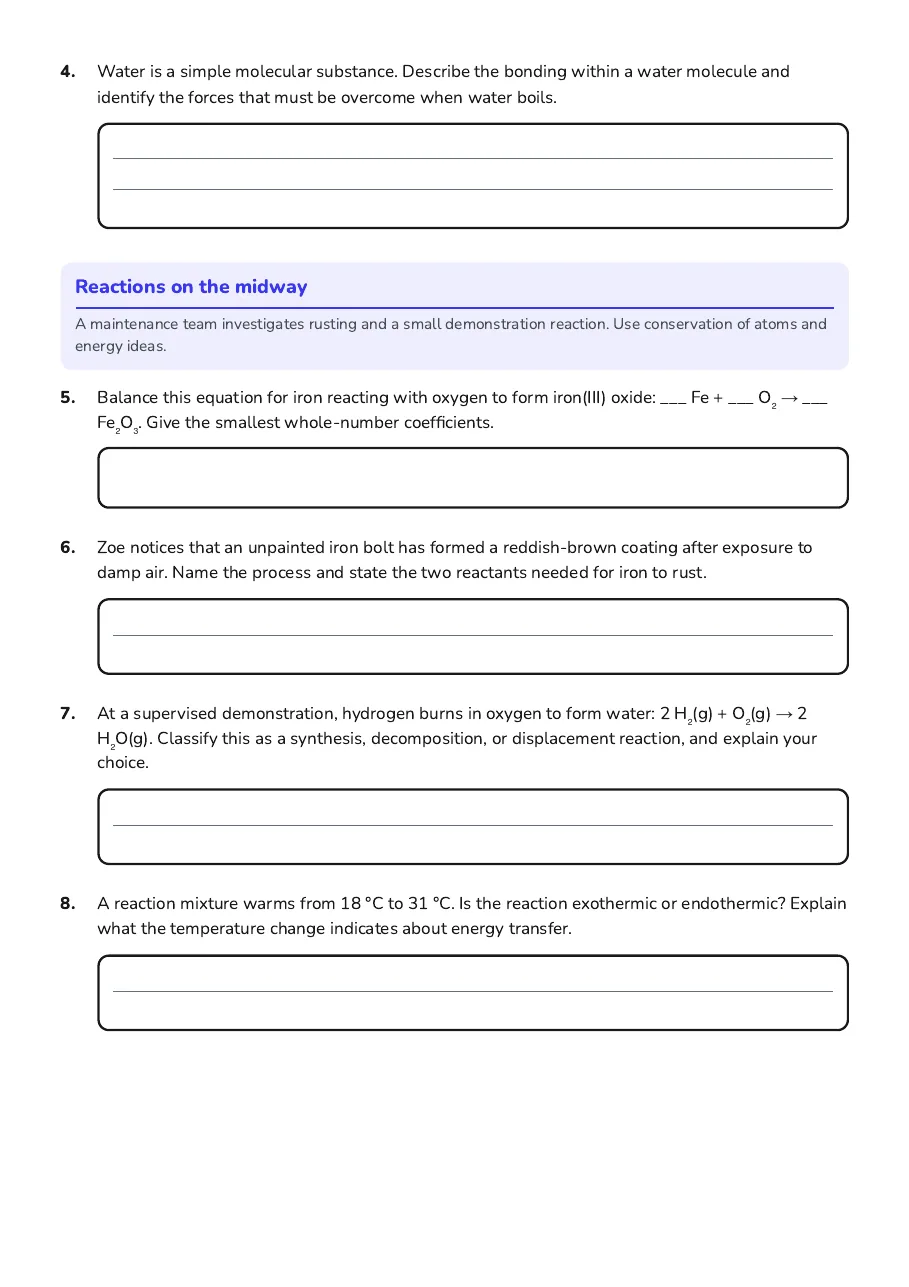
4.Water is a simple molecular substance. Describe the bonding within a water molecule and identify the forces that must be overcome when water boils.
Reactions on the midway
A maintenance team investigates rusting and a small demonstration reaction. Use conservation of atoms and energy ideas.
5.Balance this equation for iron reacting with oxygen to form iron(III) oxide: ___ Fe + ___ O₂ → ___ Fe₂O₃. Give the smallest whole-number coefficients.
6.Zoe notices that an unpainted iron bolt has formed a reddish-brown coating after exposure to damp air. Name the process and state the two reactants needed for iron to rust.
7.At a supervised demonstration, hydrogen burns in oxygen to form water: 2 H₂(g) + O₂(g) → 2 H₂O(g). Classify this as a synthesis, decomposition, or displacement reaction, and explain your choice.
8.A reaction mixture warms from 18 °C to 31 °C. Is the reaction exothermic or endothermic? Explain what the temperature change indicates about energy transfer.
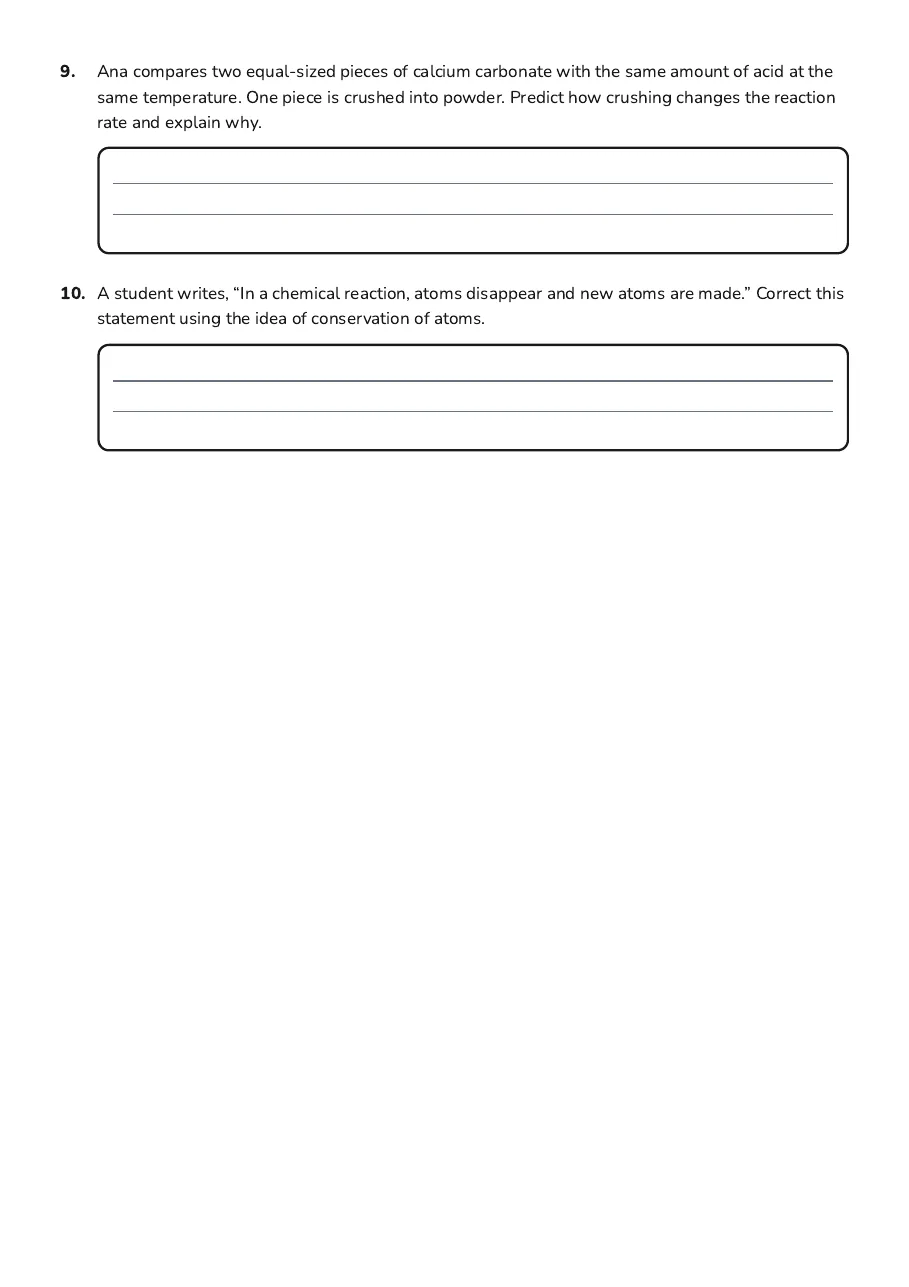
9.Ana compares two equal-sized pieces of calcium carbonate with the same amount of acid at the same temperature. One piece is crushed into powder. Predict how crushing changes the reaction rate and explain why.
10.A student writes, “In a chemical reaction, atoms disappear and new atoms are made.” Correct this statement using the idea of conservation of atoms.
3 printable pages
Page 1
Page 2
Page 3
About This Worksheet
Free in Kuraplan
Sign up free, grab the PDF, and customize it for your class.
Print-Ready
Formatted for standard paper. Clean layout, easy to read.
AI-Generated
Created with Kuraplan's AI, designed for real classroom use.
For Teachers & Parents
Use in classrooms, for homework, tutoring, or homeschool.
Need a custom version of this worksheet?
Kuraplan's AI generates custom worksheets in seconds — differentiated for every learner, aligned to your curriculum.
Generate Custom Worksheets — Free No credit card Curriculum-aligned Under 60 seconds
More Science Worksheets
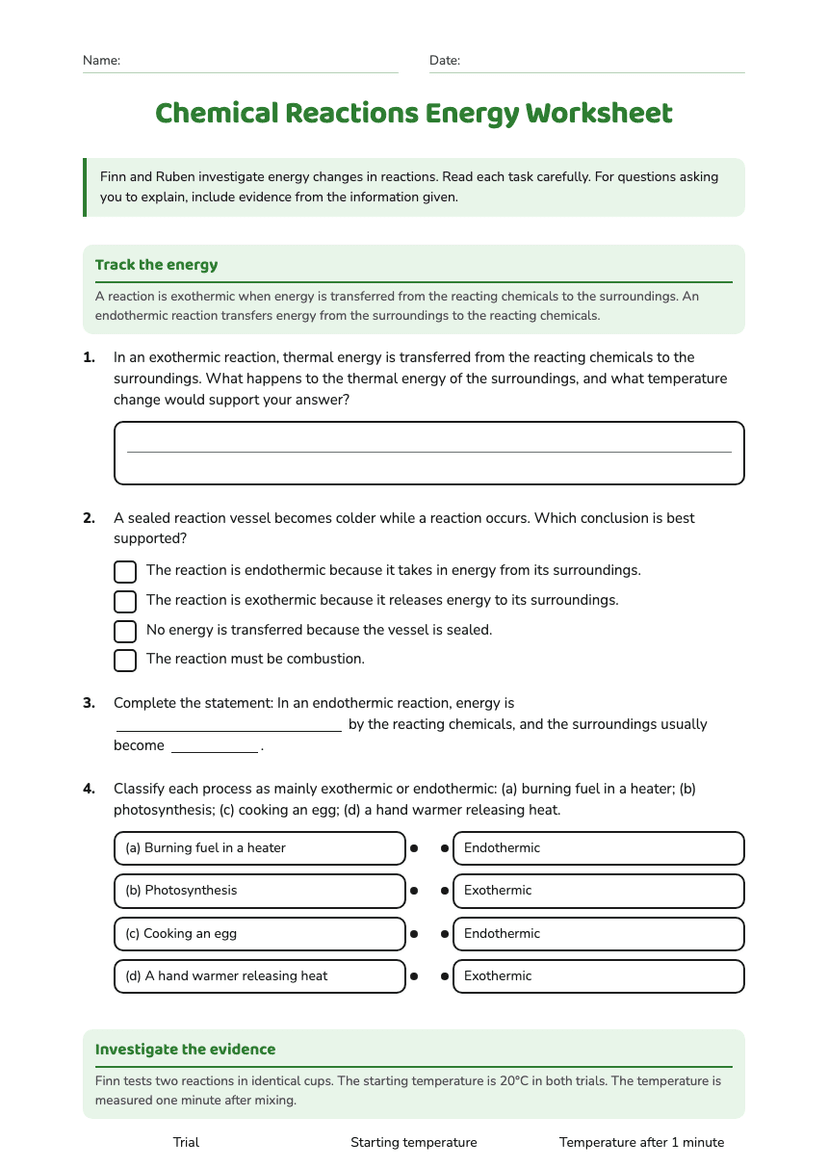
Chemical Reactions Energy Worksheet
Free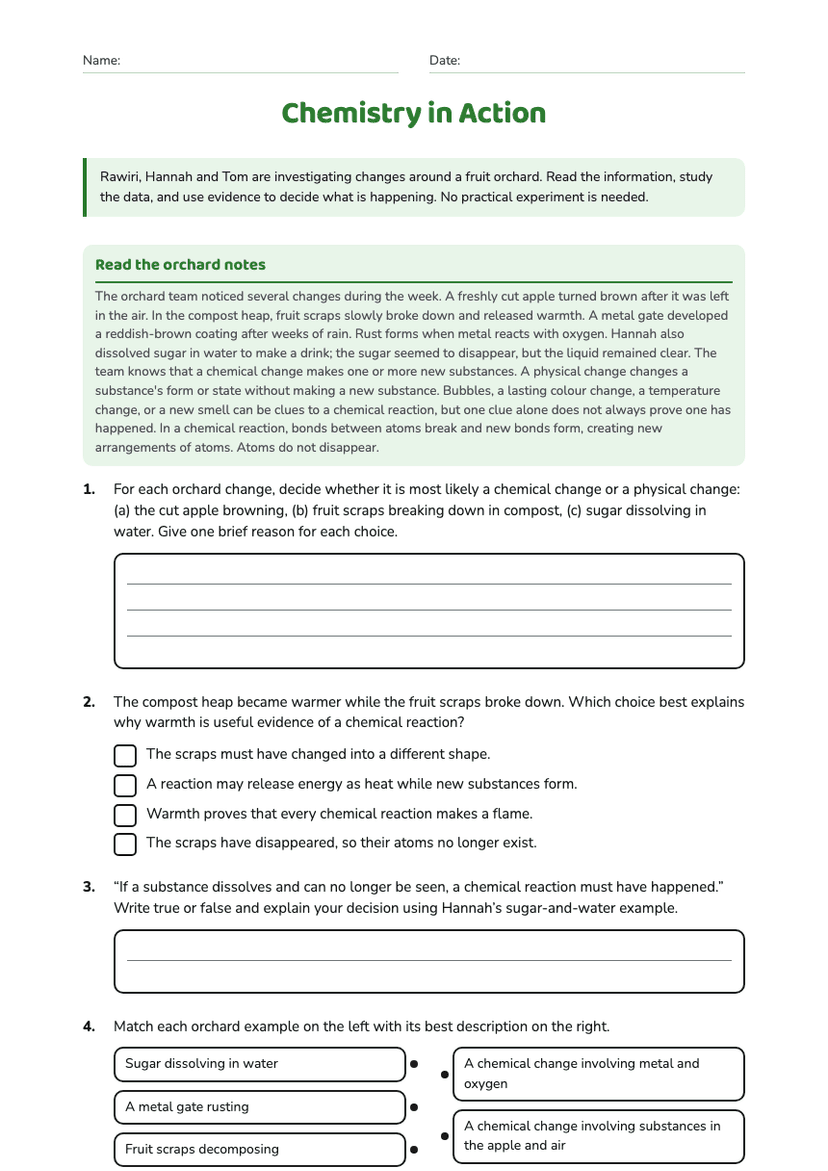
Year 7
Chemistry in Action
Free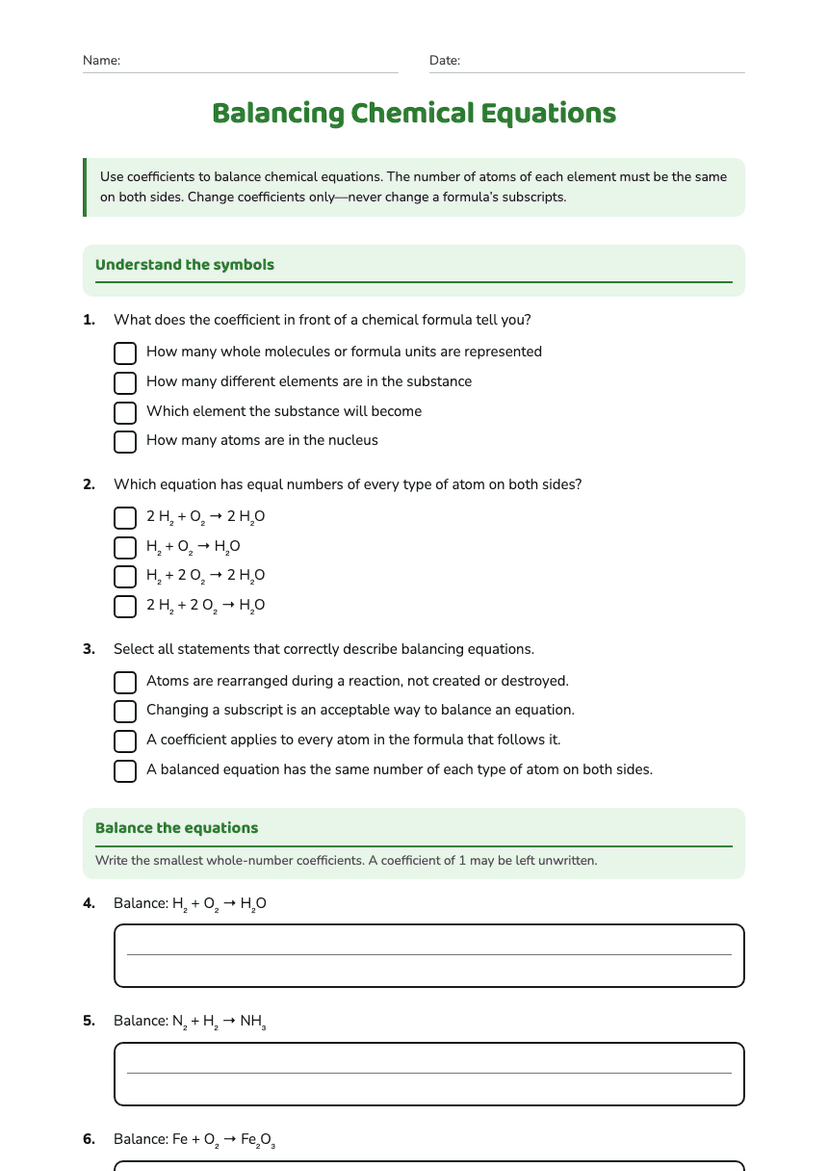
Year 7–8
Balancing Chemical Equations
Free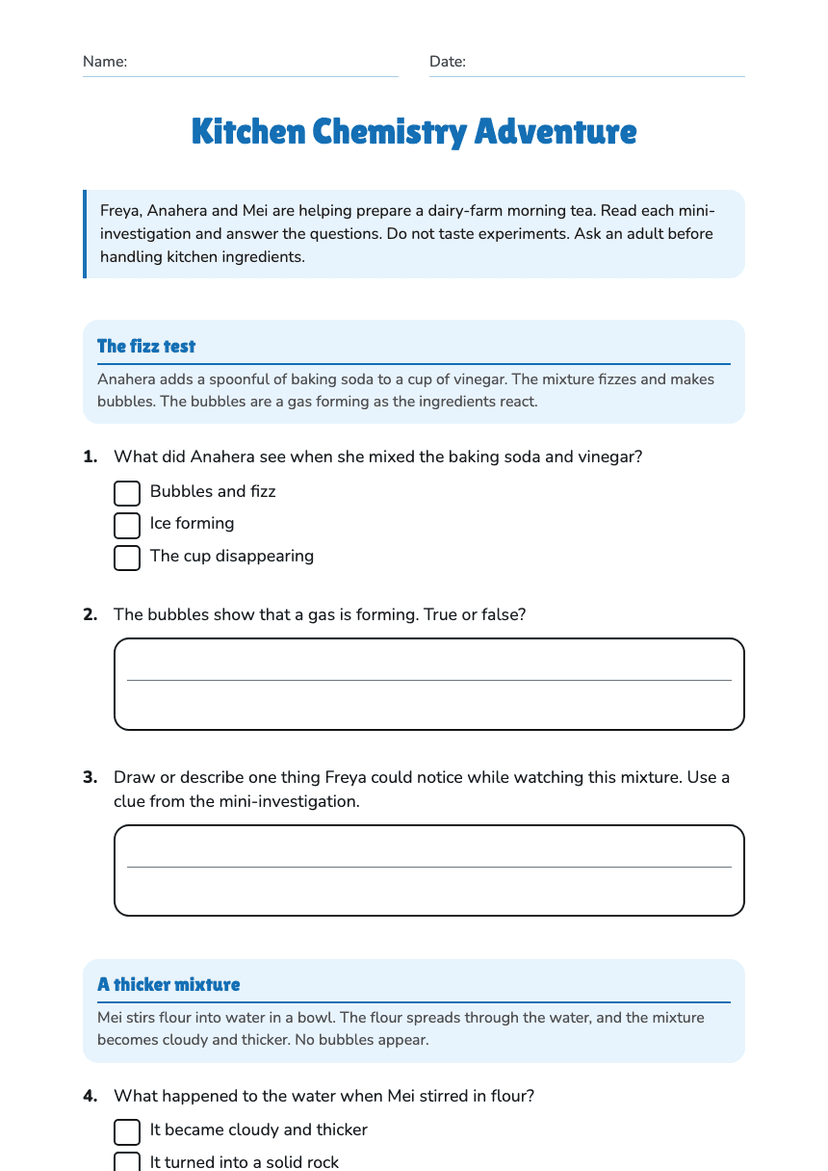
Year 2
Kitchen Chemistry Adventure
Free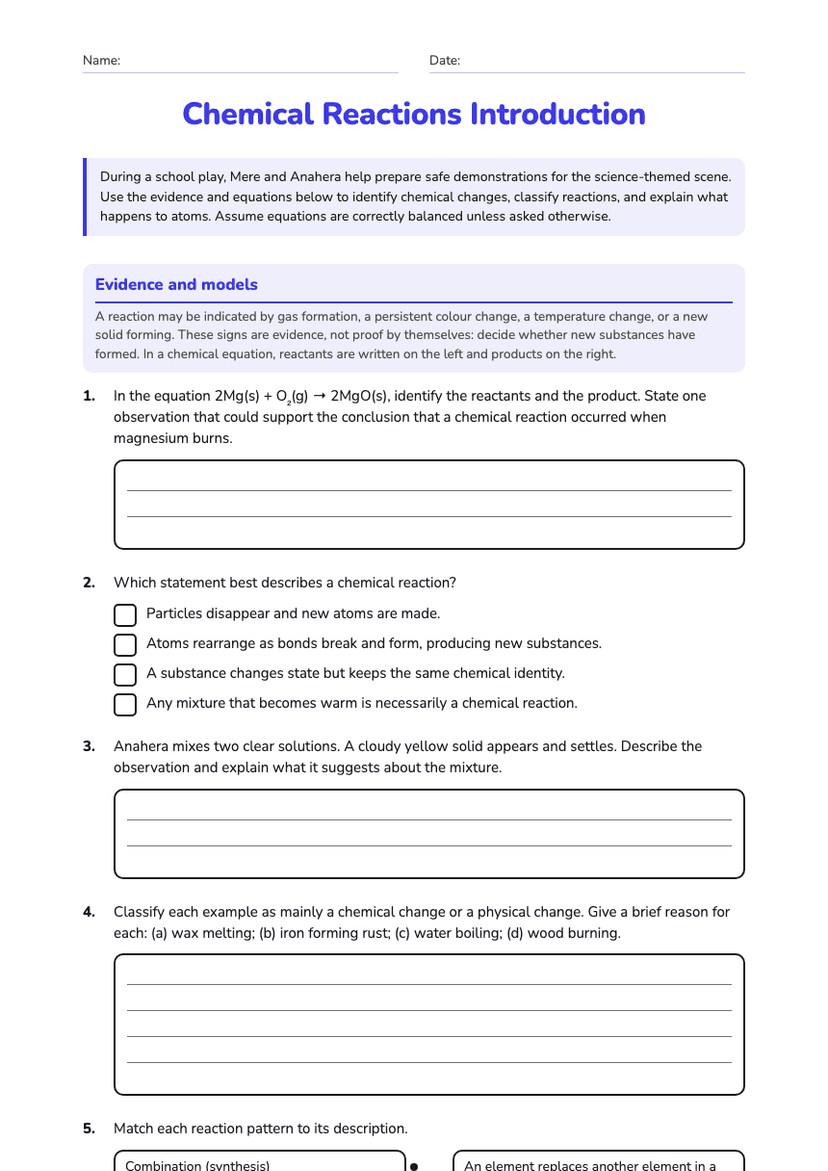
Year 11
Chemical Reactions Introduction
Free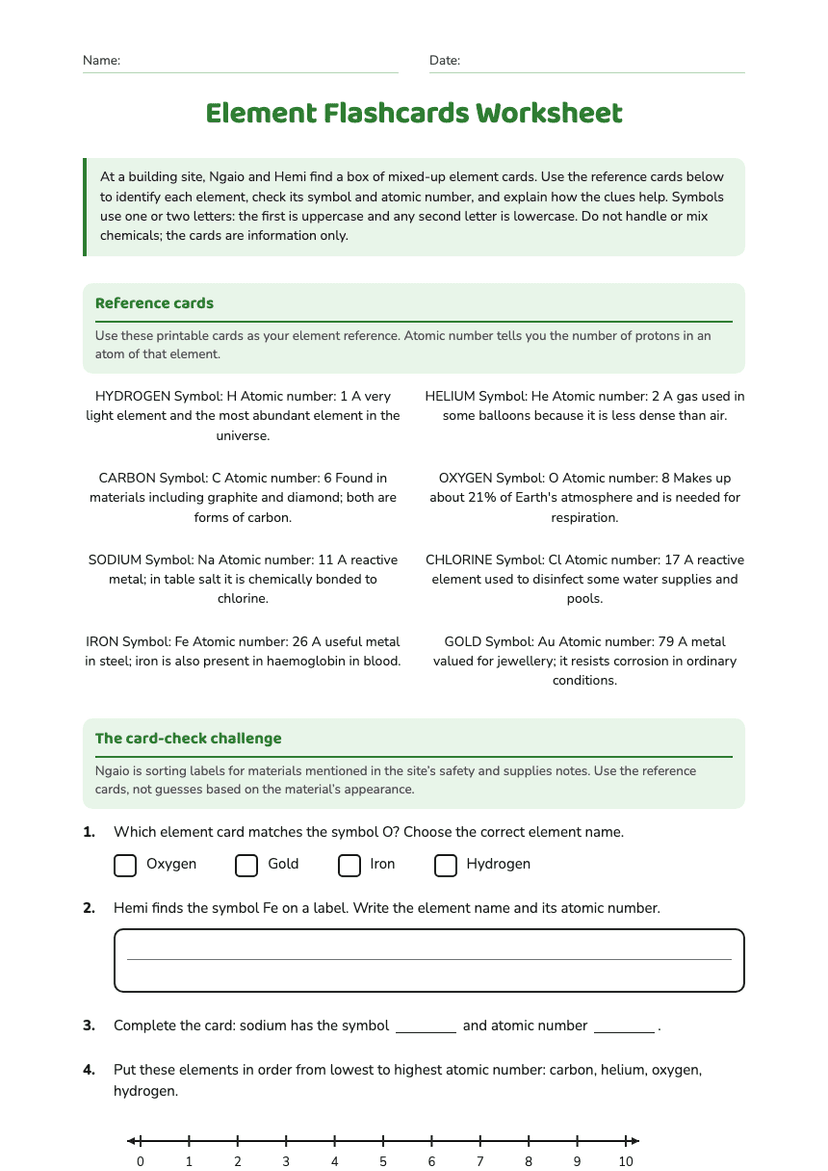
Year 9
Element Flashcards Worksheet
Free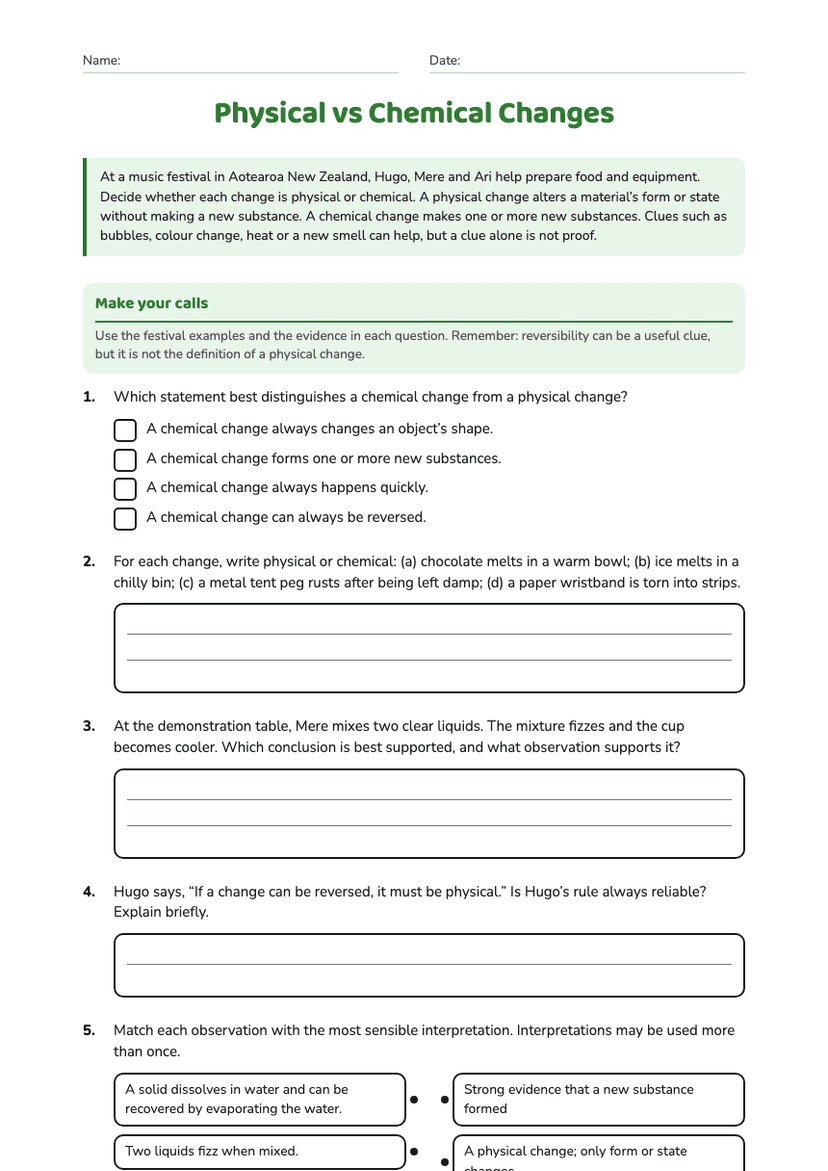
Year 7–8
Physical vs Chemical Changes
Free