ScienceFreePrintable

Chemical Reactions Introduction

A free science worksheet ready for your classroom. Open in Kuraplan to grab the print-ready PDF, customize it for your students, or generate a fresh version in seconds.
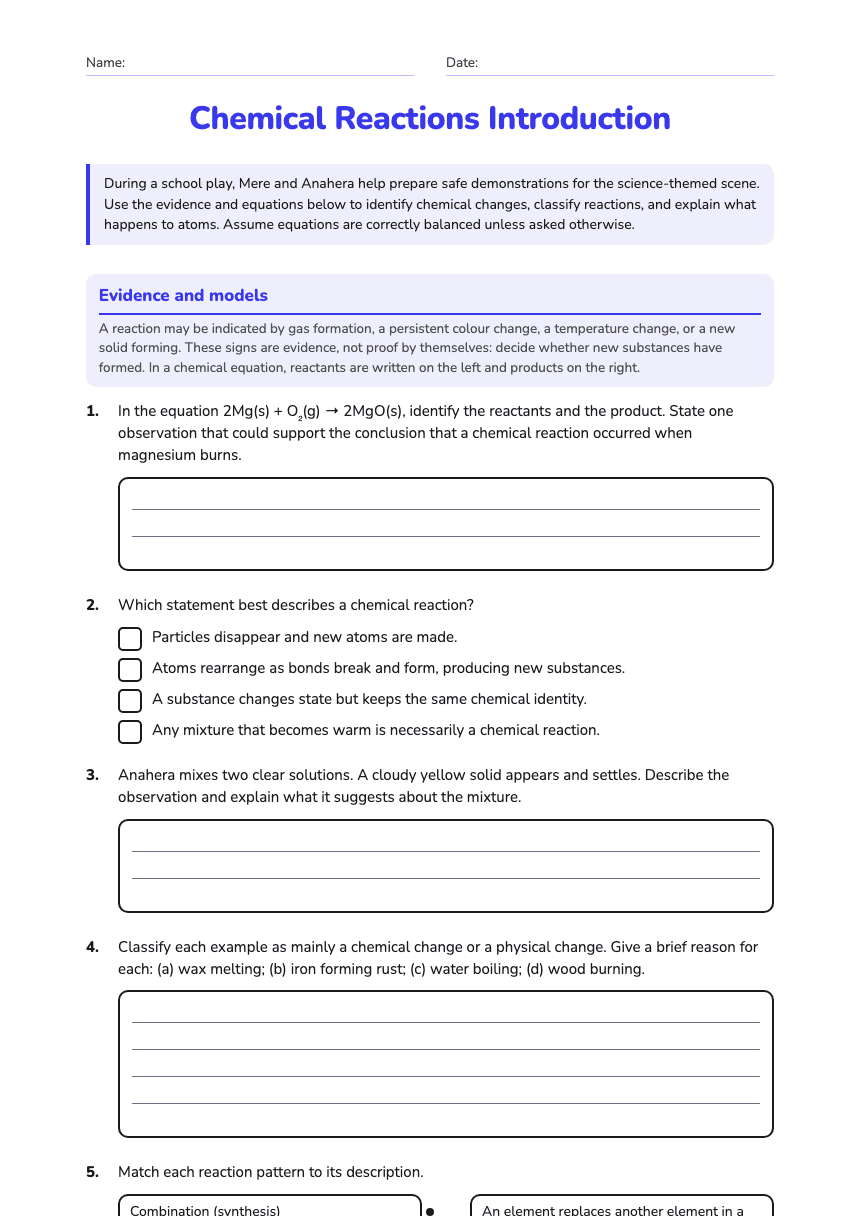
Chemical Reactions Introduction worksheet preview
Name:Date:

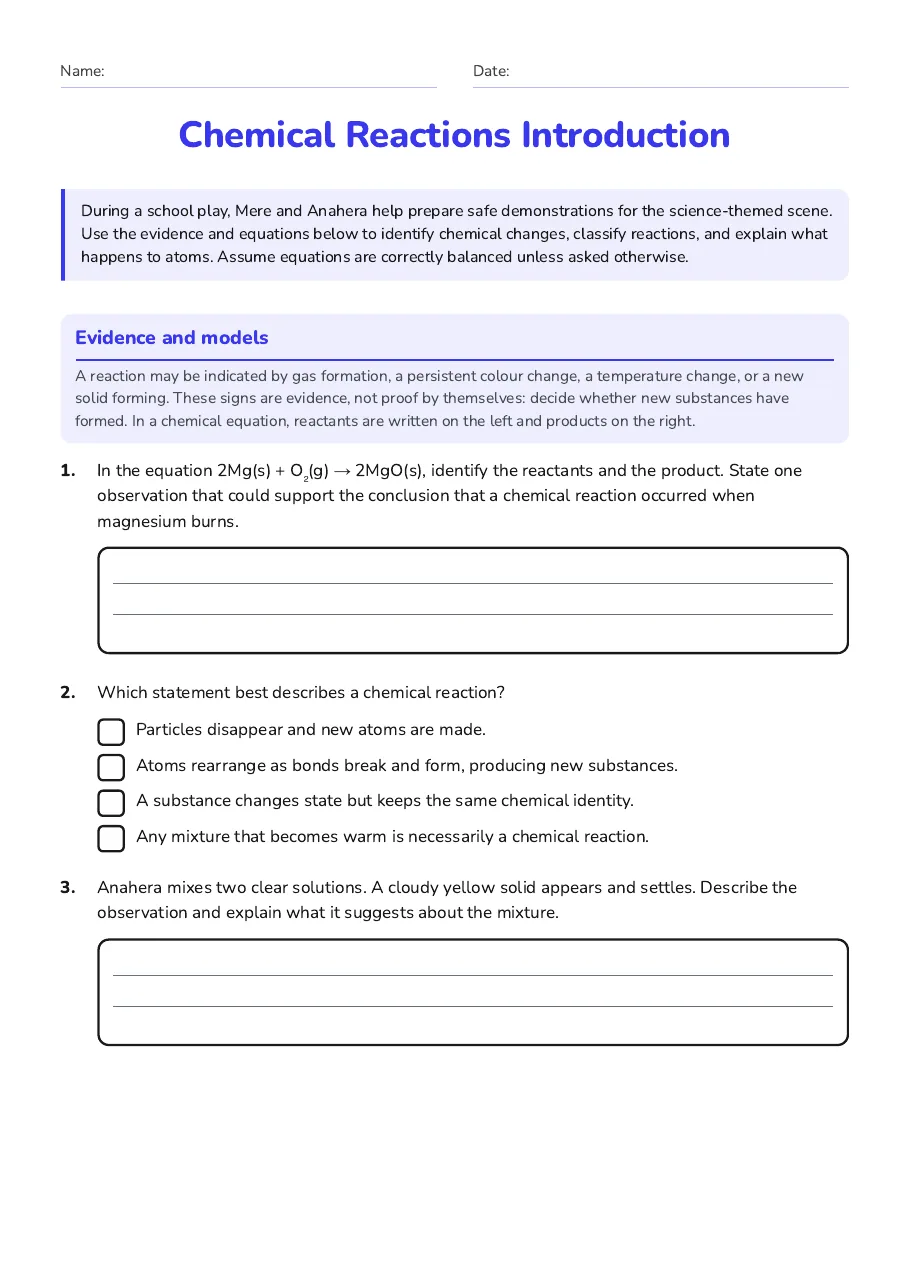
Chemical Reactions Introduction

During a school play, Mere and Anahera help prepare safe demonstrations for the science-themed scene. Use the evidence and equations below to identify chemical changes, classify reactions, and explain what happens to atoms. Assume equations are correctly balanced unless asked otherwise.

Evidence and models

A reaction may be indicated by gas formation, a persistent colour change, a temperature change, or a new solid forming. These signs are evidence, not proof by themselves: decide whether new substances have formed. In a chemical equation, reactants are written on the left and products on the right.

1.In the equation 2Mg(s) + O₂(g) → 2MgO(s), identify the reactants and the product. State one observation that could support the conclusion that a chemical reaction occurred when magnesium burns.
2.Which statement best describes a chemical reaction?
  • Particles disappear and new atoms are made.
  • Atoms rearrange as bonds break and form, producing new substances.
  • A substance changes state but keeps the same chemical identity.
  • Any mixture that becomes warm is necessarily a chemical reaction.
3.Anahera mixes two clear solutions. A cloudy yellow solid appears and settles. Describe the observation and explain what it suggests about the mixture.
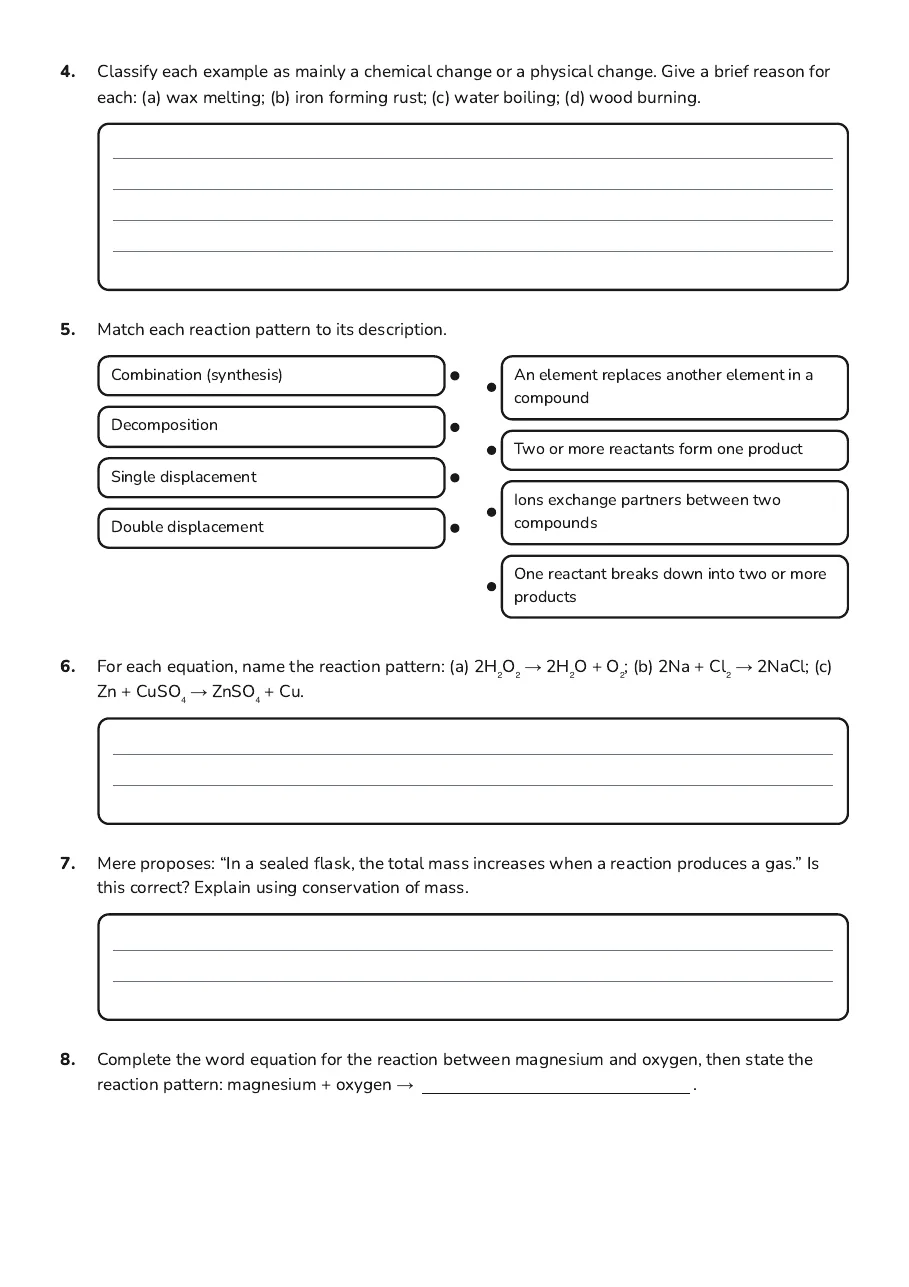
4.Classify each example as mainly a chemical change or a physical change. Give a brief reason for each: (a) wax melting; (b) iron forming rust; (c) water boiling; (d) wood burning.
5.Match each reaction pattern to its description.
  • Combination (synthesis)
  • Decomposition
  • Single displacement
  • Double displacement
  • An element replaces another element in a compound
  • Two or more reactants form one product
  • Ions exchange partners between two compounds
  • One reactant breaks down into two or more products
6.For each equation, name the reaction pattern: (a) 2H₂O₂ → 2H₂O + O₂; (b) 2Na + Cl₂ → 2NaCl; (c) Zn + CuSO₄ → ZnSO₄ + Cu.
7.Mere proposes: “In a sealed flask, the total mass increases when a reaction produces a gas.” Is this correct? Explain using conservation of mass.
8.Complete the word equation for the reaction between magnesium and oxygen, then state the reaction pattern: magnesium + oxygen → .
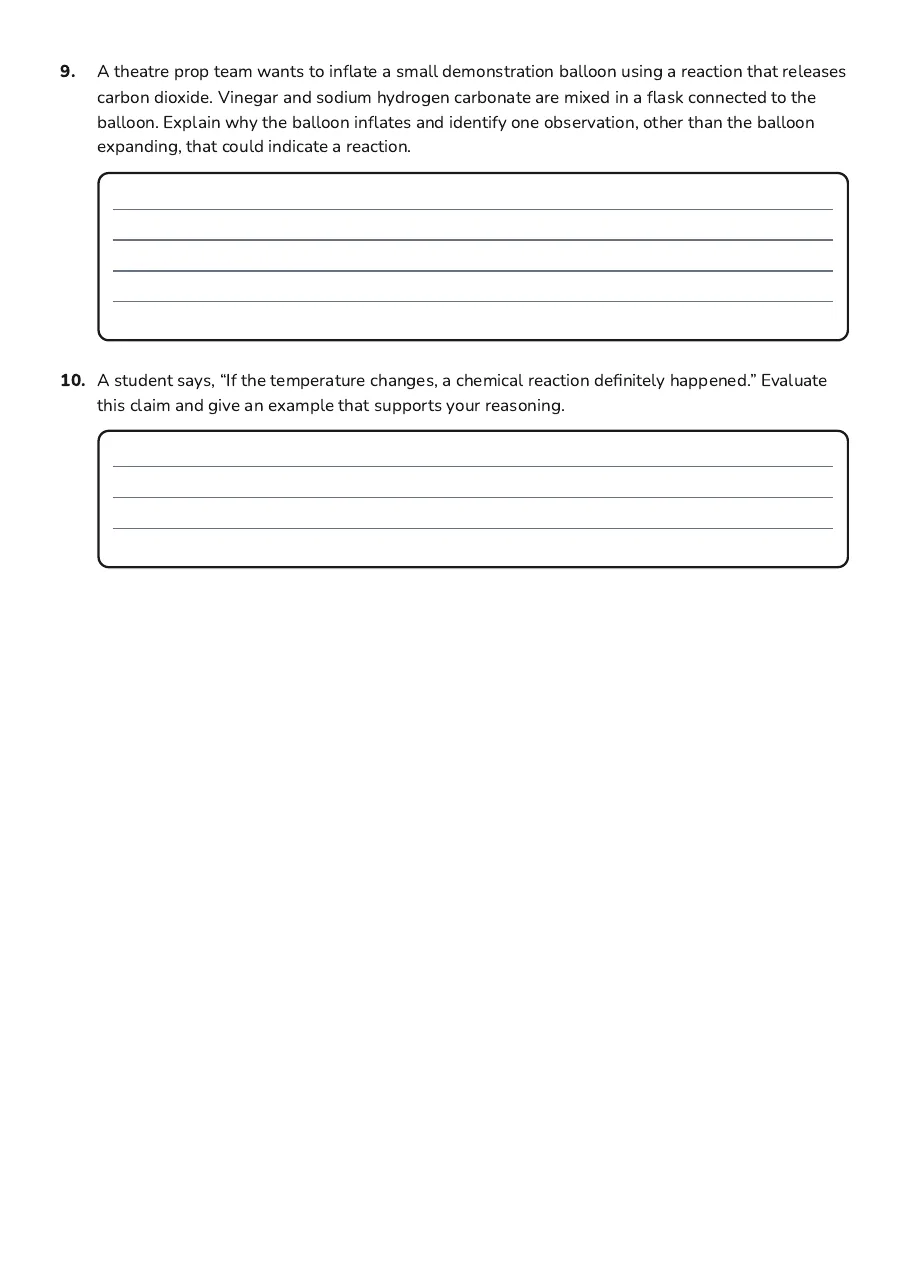
9.A theatre prop team wants to inflate a small demonstration balloon using a reaction that releases carbon dioxide. Vinegar and sodium hydrogen carbonate are mixed in a flask connected to the balloon. Explain why the balloon inflates and identify one observation, other than the balloon expanding, that could indicate a reaction.
10.A student says, “If the temperature changes, a chemical reaction definitely happened.” Evaluate this claim and give an example that supports your reasoning.

3 printable pages

  • Chemical Reactions Introduction, page 1 of 3: Evidence and models

    Page 1

  • Chemical Reactions Introduction, page 2 of 3: 4. Classify each example as mainly a chemical change or a physical change. Give a brief…

    Page 2

  • Chemical Reactions Introduction, page 3 of 3: 9. A theatre prop team wants to inflate a small demonstration balloon using a reaction…

    Page 3

About This Worksheet

Free in Kuraplan

Sign up free, grab the PDF, and customize it for your class.

Print-Ready

Formatted for standard paper. Clean layout, easy to read.

AI-Generated

Created with Kuraplan's AI, designed for real classroom use.

For Teachers & Parents

Use in classrooms, for homework, tutoring, or homeschool.

Need a custom version of this worksheet?

Kuraplan's AI generates custom worksheets in seconds — differentiated for every learner, aligned to your curriculum.

Generate Custom Worksheets — Free
No credit card Curriculum-aligned Under 60 seconds