EnglishFreePrintable
Childhood Memory Story Planning
A free english worksheet ready for your classroom. Open in Kuraplan to grab the print-ready PDF, customize it for your students, or generate a fresh version in seconds.
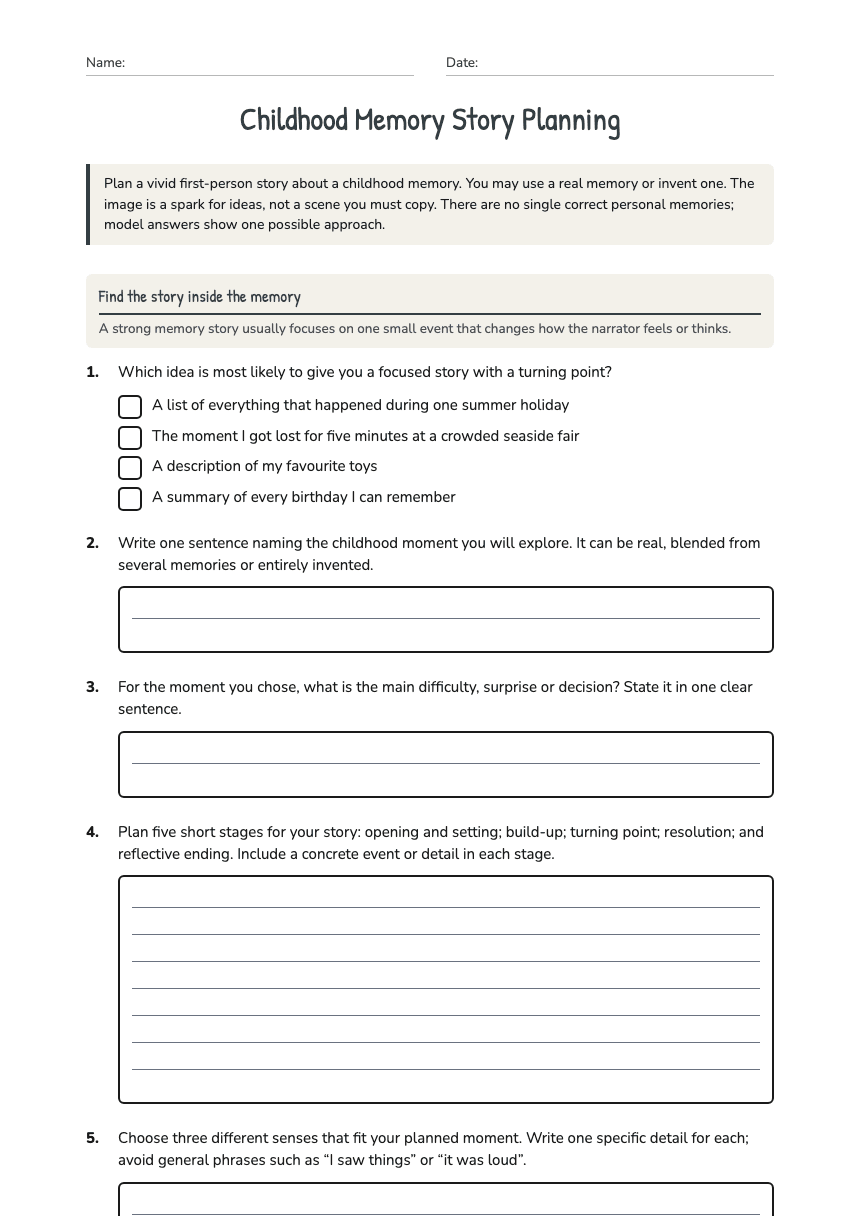
Name:Date:
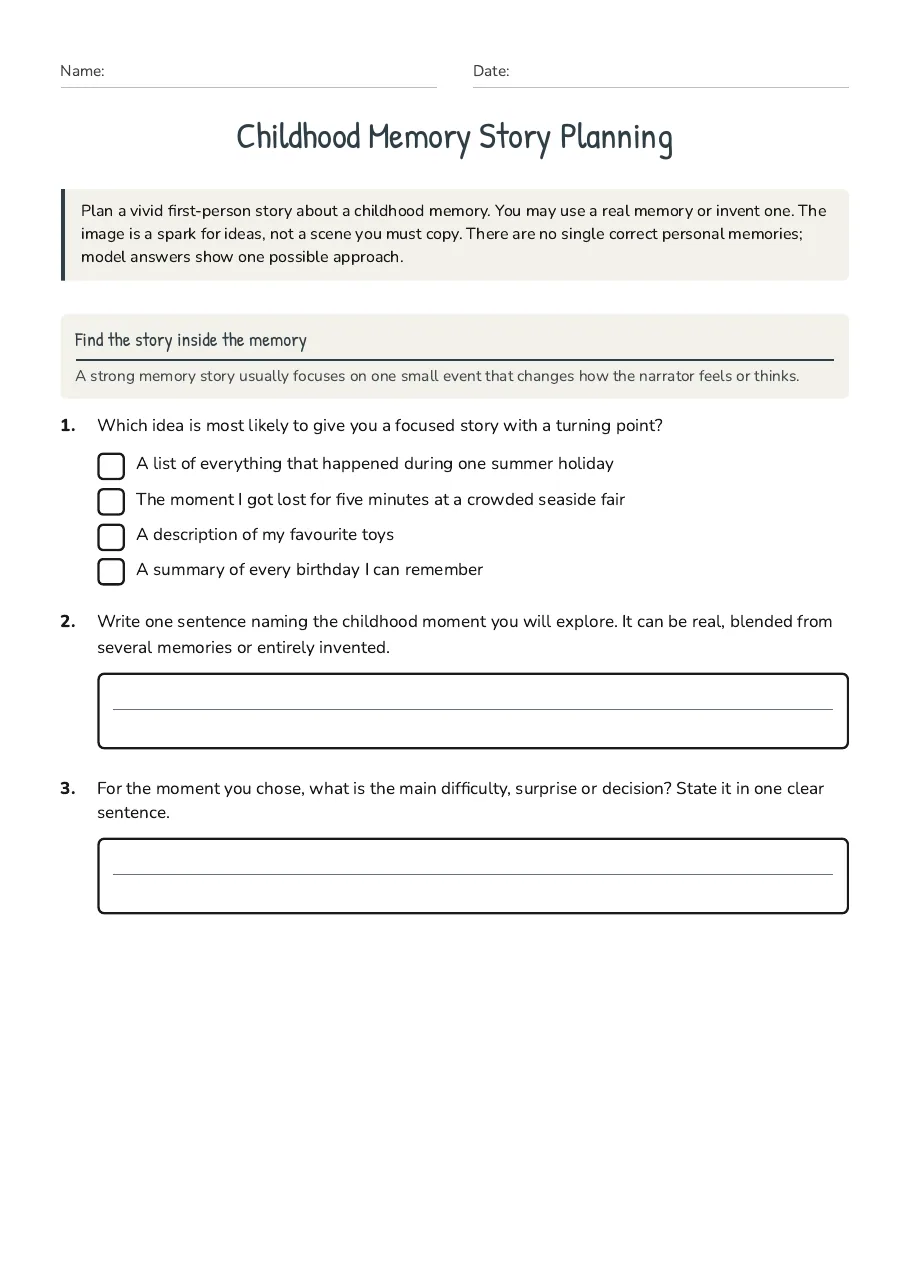
Childhood Memory Story Planning
Plan a vivid first-person story about a childhood memory. You may use a real memory or invent one. The image is a spark for ideas, not a scene you must copy. There are no single correct personal memories; model answers show one possible approach.
Find the story inside the memory
A strong memory story usually focuses on one small event that changes how the narrator feels or thinks.
1.Which idea is most likely to give you a focused story with a turning point?
- A list of everything that happened during one summer holiday
- The moment I got lost for five minutes at a crowded seaside fair
- A description of my favourite toys
- A summary of every birthday I can remember
2.Write one sentence naming the childhood moment you will explore. It can be real, blended from several memories or entirely invented.
3.For the moment you chose, what is the main difficulty, surprise or decision? State it in one clear sentence.
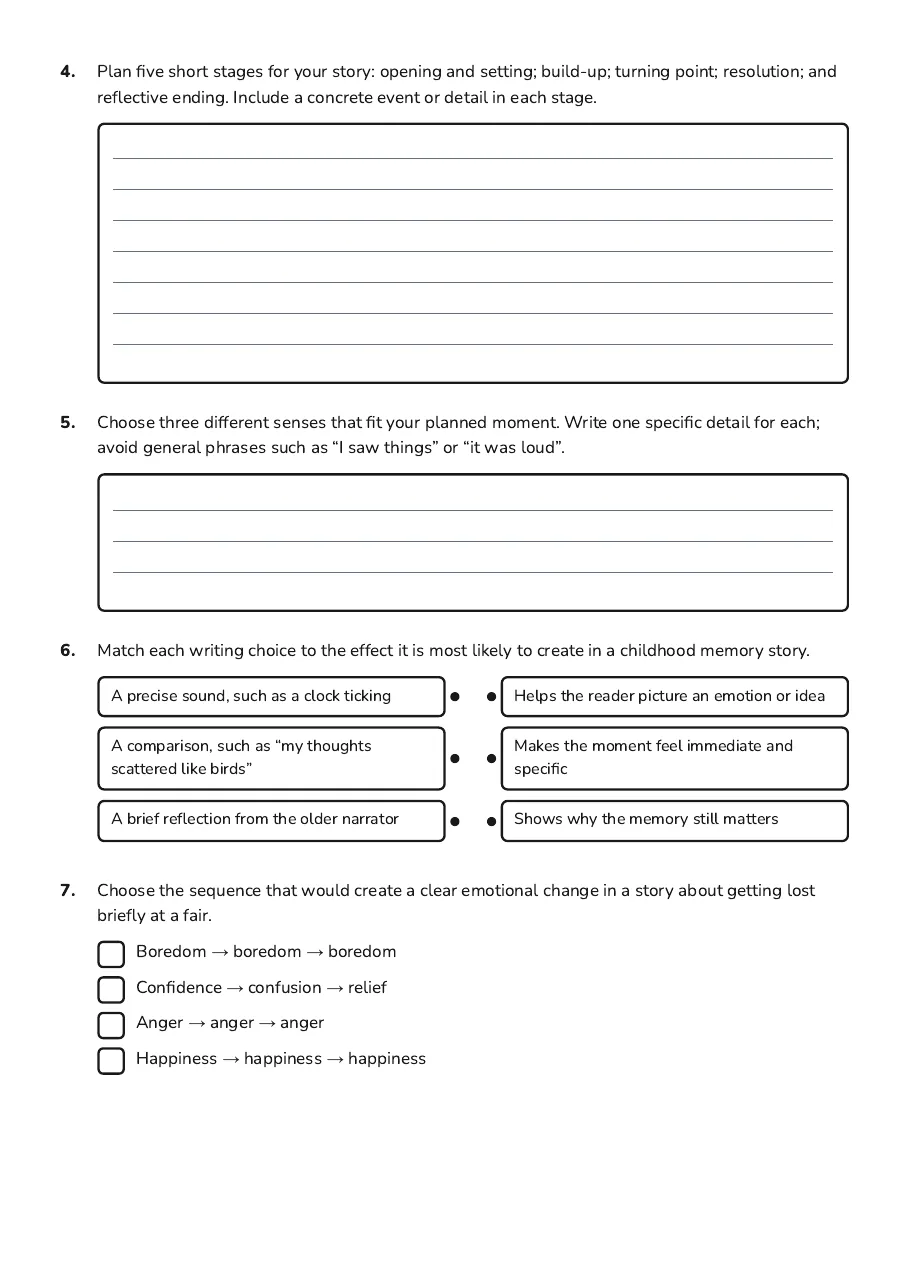
4.Plan five short stages for your story: opening and setting; build-up; turning point; resolution; and reflective ending. Include a concrete event or detail in each stage.
5.Choose three different senses that fit your planned moment. Write one specific detail for each; avoid general phrases such as “I saw things” or “it was loud”.
6.Match each writing choice to the effect it is most likely to create in a childhood memory story.
- A precise sound, such as a clock ticking
- A comparison, such as “my thoughts scattered like birds”
- A brief reflection from the older narrator
- Helps the reader picture an emotion or idea
- Makes the moment feel immediate and specific
- Shows why the memory still matters
7.Choose the sequence that would create a clear emotional change in a story about getting lost briefly at a fair.
- Boredom → boredom → boredom
- Confidence → confusion → relief
- Anger → anger → anger
- Happiness → happiness → happiness
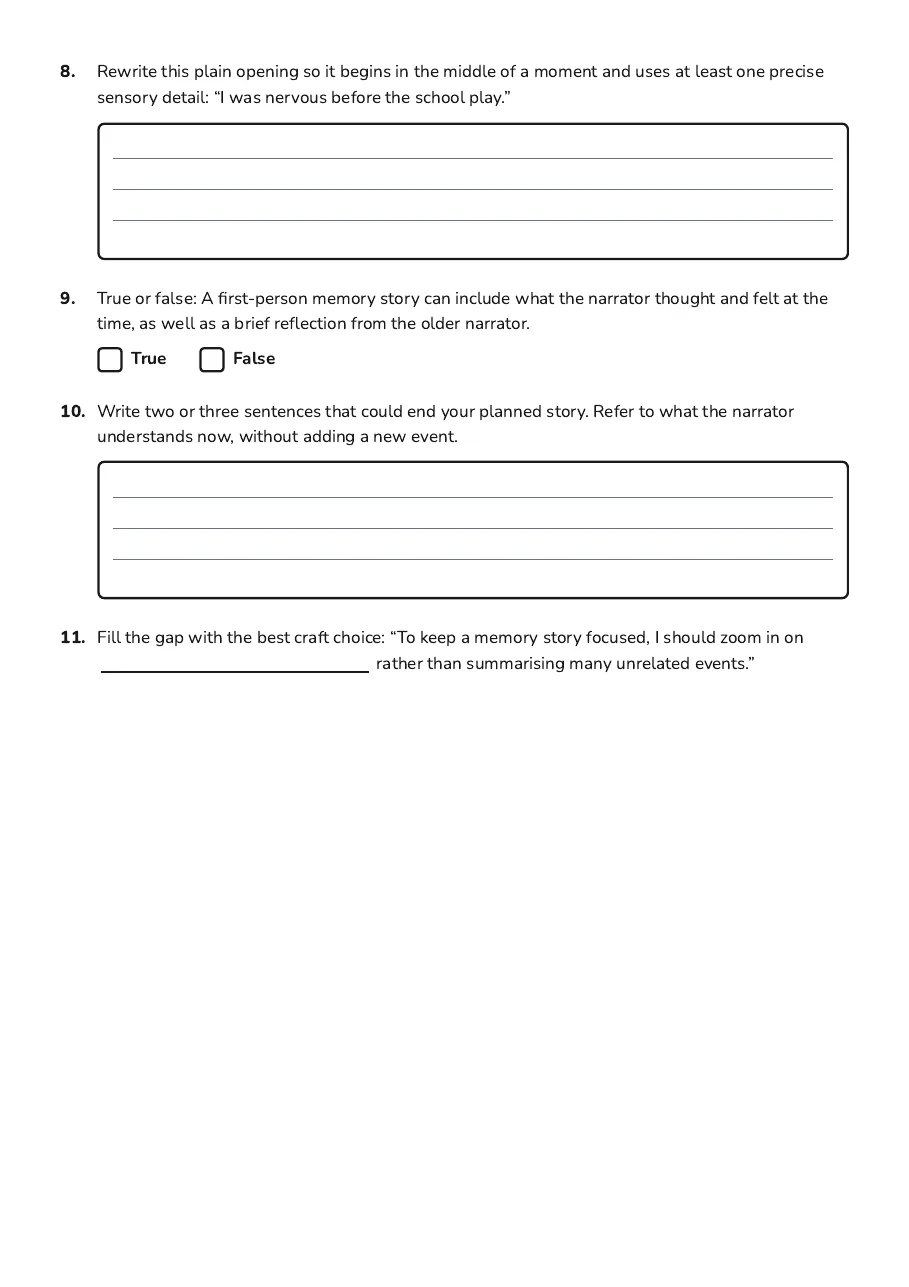
8.Rewrite this plain opening so it begins in the middle of a moment and uses at least one precise sensory detail: “I was nervous before the school play.”
9.True or false: A first-person memory story can include what the narrator thought and felt at the time, as well as a brief reflection from the older narrator.
TrueFalse
10.Write two or three sentences that could end your planned story. Refer to what the narrator understands now, without adding a new event.
11.Fill the gap with the best craft choice: “To keep a memory story focused, I should zoom in on rather than summarising many unrelated events.”
3 printable pages
Page 1
Page 2
Page 3
About This Worksheet
Free in Kuraplan
Sign up free, grab the PDF, and customize it for your class.
Print-Ready
Formatted for standard paper. Clean layout, easy to read.
AI-Generated
Created with Kuraplan's AI, designed for real classroom use.
For Teachers & Parents
Use in classrooms, for homework, tutoring, or homeschool.
Need a custom version of this worksheet?
Kuraplan's AI generates custom worksheets in seconds — differentiated for every learner, aligned to your curriculum.
Generate Custom Worksheets — Free No credit card Curriculum-aligned Under 60 seconds