Cicada Shells and Lifecycle
A free science worksheet ready for your classroom. Open in Kuraplan to grab the print-ready PDF, customize it for your students, or generate a fresh version in seconds.

Cicada Shells and Lifecycle
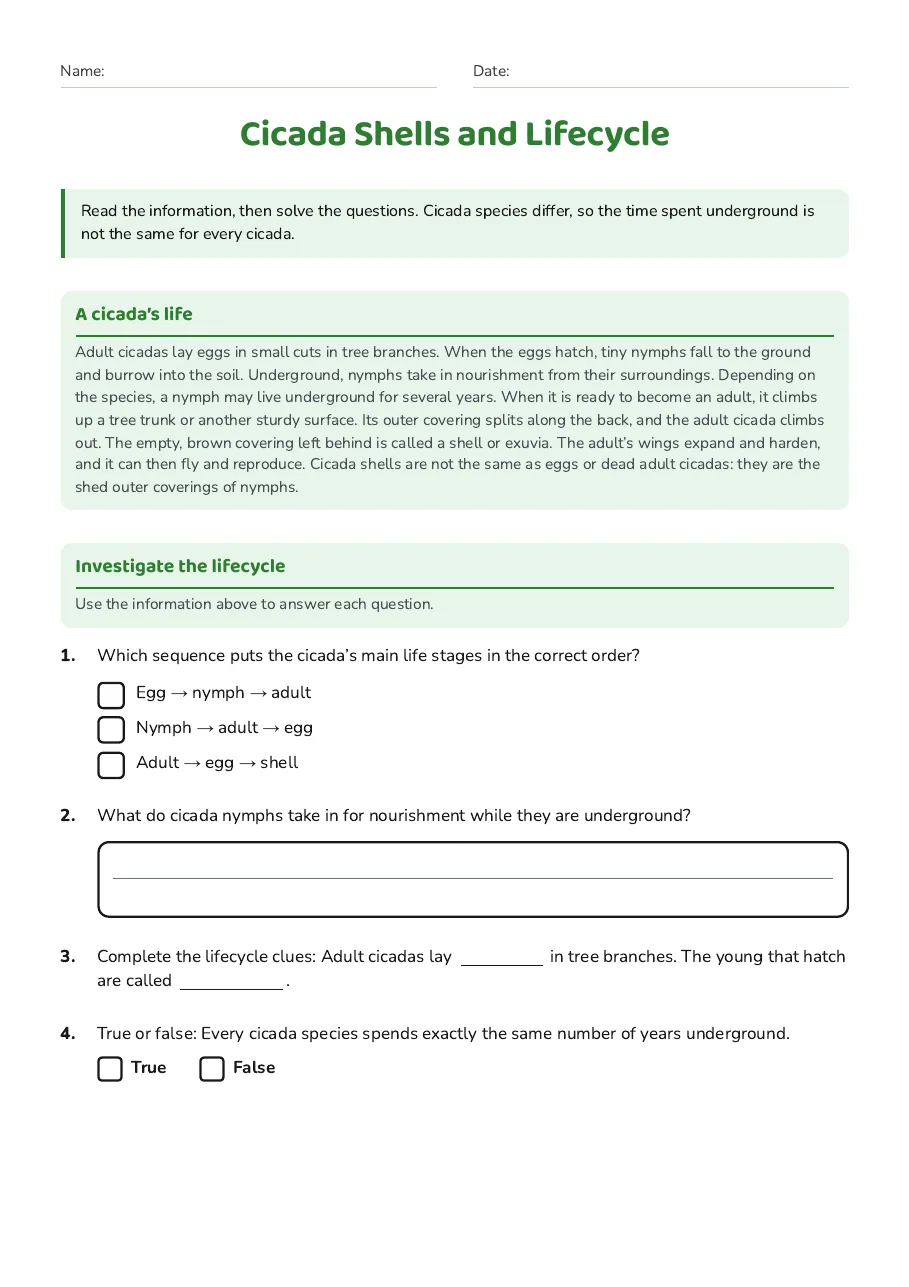
A cicada’s life
Adult cicadas lay eggs in small cuts in tree branches. When the eggs hatch, tiny nymphs fall to the ground and burrow into the soil. Underground, nymphs take in nourishment from their surroundings. Depending on the species, a nymph may live underground for several years. When it is ready to become an adult, it climbs up a tree trunk or another sturdy surface. Its outer covering splits along the back, and the adult cicada climbs out. The empty, brown covering left behind is called a shell or exuvia. The adult’s wings expand and harden, and it can then fly and reproduce. Cicada shells are not the same as eggs or dead adult cicadas: they are the shed outer coverings of nymphs.
Investigate the lifecycle
Use the information above to answer each question.
- Egg → nymph → adult
- Nymph → adult → egg
- Adult → egg → shell
2 printable pages
Page 1
Page 2
About This Worksheet
Free in Kuraplan
Sign up free, grab the PDF, and customize it for your class.
Print-Ready
Formatted for standard paper. Clean layout, easy to read.
AI-Generated
Created with Kuraplan's AI, designed for real classroom use.
For Teachers & Parents
Use in classrooms, for homework, tutoring, or homeschool.
Need a custom version of this worksheet?
Kuraplan's AI generates custom worksheets in seconds — differentiated for every learner, aligned to your curriculum.
Generate Custom Worksheets — Free