ScienceFreePrintable
Contact Forces Spring Scale
A free science worksheet ready for your classroom. Open in Kuraplan to grab the print-ready PDF, customize it for your students, or generate a fresh version in seconds.
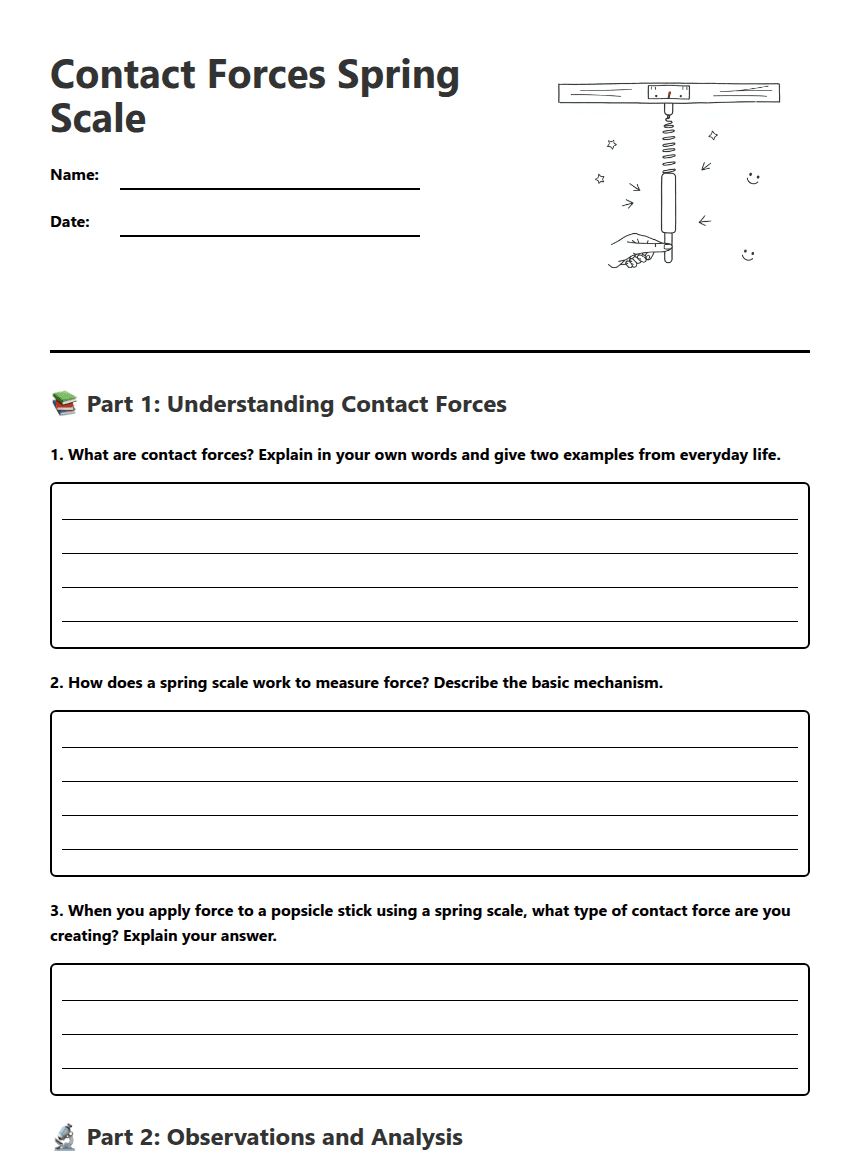
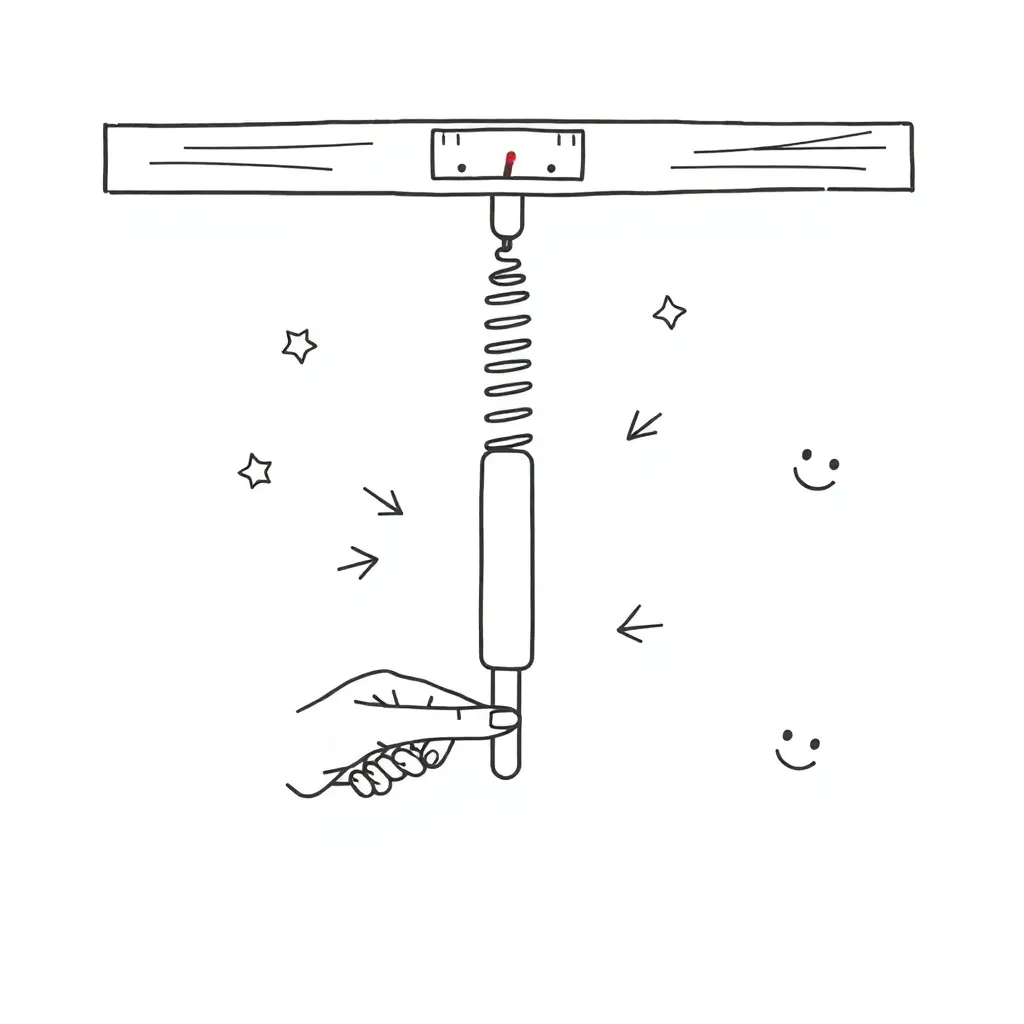
Contact Forces Spring Scale
📚 Part 1: Understanding Contact Forces
1. What are contact forces? Explain in your own words and give two examples from everyday life.
2. How does a spring scale work to measure force? Describe the basic mechanism.
3. When you apply force to a popsicle stick using a spring scale, what type of contact force are you creating? Explain your answer.
4. Describe what happens to the popsicle stick as you gradually increase the force applied by the spring scale. Be specific about the deformation you observe.
5. Explain how the spring scale's mechanism allows it to accurately measure the force being applied to the popsicle stick. What physical principles are involved?
🔬 Part 2: Multiple Choice Questions
6. Which of the following is NOT a contact force?
A) Friction
B) Gravity
C) Normal force
D) Applied force
7. What unit is typically used to measure force on a spring scale?
A) Meters
B) Newtons
C) Kilograms
D) Seconds
8. When a popsicle stick begins to bend under force, this is called:
A) Compression
B) Deformation
C) Acceleration
D) Friction
9. As you increase the force on a spring scale, the spring inside:
A) Gets shorter
B) Gets longer
C) Stays the same length
D) Breaks immediately
10. Which material would likely require the MOST force to break using a spring scale?
A) Popsicle stick
B) Paper clip
C) Steel rod
D) Plastic straw
11. The point at which a material breaks under force is called its:
A) Elastic limit
B) Breaking point
C) Force limit
D) Contact point
12. When using a spring scale to measure force, you should:
A) Pull as fast as possible
B) Apply force gradually and steadily
C) Shake the scale while pulling
D) Only use maximum force
13. If you apply the same force to a popsicle stick in different directions, the results will likely be:
A) Exactly the same
B) Completely different
C) Similar but may vary
D) Impossible to predict
14. The spring in a spring scale follows which scientific law when measuring force?
A) Newton's First Law
B) Hooke's Law
C) Law of Conservation of Energy
D) Pascal's Principle
15. When a popsicle stick is under tension from a spring scale, the molecules inside the stick are:
A) Being pulled apart
B) Being pushed together
C) Rotating rapidly
D) Remaining unchanged
16. What happens to the reading on a spring scale if you slowly increase force on a popsicle stick until it breaks?
A) It stays constant throughout
B) It increases then suddenly drops to zero
C) It decreases gradually
D) It fluctuates randomly
17. The elastic region of a popsicle stick refers to the range where:
A) The stick will break immediately
B) The stick returns to its original shape when force is removed
C) The stick becomes permanently deformed
D) No force can be applied
18. Which factor would NOT affect the force required to break a popsicle stick as measured by a spring scale?
A) The thickness of the stick
B) The material composition
C) The color of the stick
D) The temperature of the stick
19. When comparing two identical popsicle sticks tested with a spring scale, you would expect:
A) Exactly the same breaking force
B) Very similar but not identical breaking forces
C) Completely different results
D) One to be unbreakable
20. The maximum force a spring scale can measure is called its:
A) Breaking point
B) Capacity or range
C) Elastic limit
D) Contact force
About This Worksheet
Free in Kuraplan
Sign up free, grab the PDF, and customize it for your class.
Print-Ready
Formatted for standard paper. Clean layout, easy to read.
AI-Generated
Created with Kuraplan's AI, designed for real classroom use.
For Teachers & Parents
Use in classrooms, for homework, tutoring, or homeschool.
Need a custom version of this worksheet?
Kuraplan's AI generates custom worksheets in seconds — differentiated for every learner, aligned to your curriculum.
Generate Custom Worksheets — Free No credit card Curriculum-aligned Under 60 seconds
More Science Worksheets
8th Grade
Force and Motion Investigations
Free
Kindergarten
Pushes and Pulls Investigations
Free
5th Grade–8th Grade
Forces and Friction Investigation
Free
8th Grade
Forces and Motion Exploration
Free
8th Grade
Forces and Motion Experiments
Free
Forces: Cornell Notes Example
Free
Energy and Forces Worksheet
Free
5th Grade