Diffusion in Science
A free science worksheet ready for your classroom. Open in Kuraplan to grab the print-ready PDF, customize it for your students, or generate a fresh version in seconds.
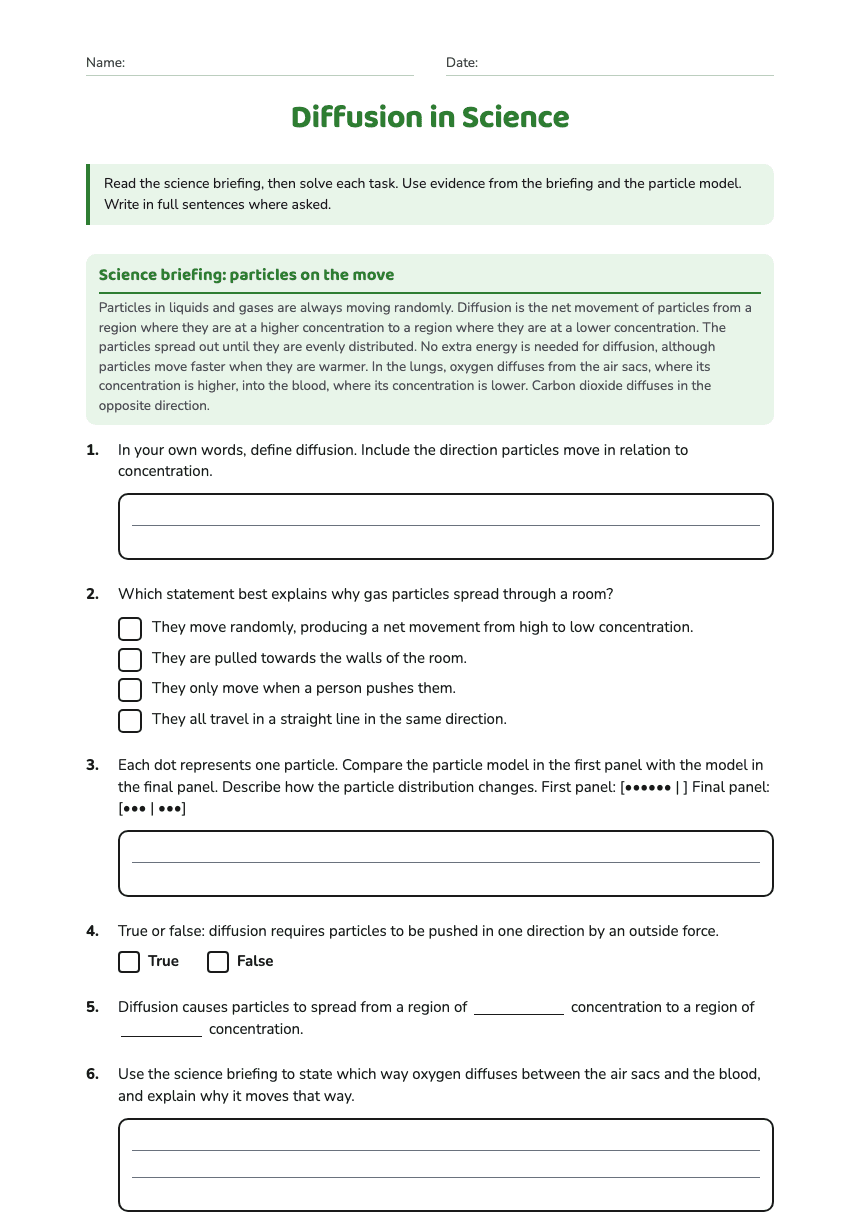
Diffusion in Science
Science briefing: particles on the move
Particles in liquids and gases are always moving randomly. Diffusion is the net movement of particles from a region where they are at a higher concentration to a region where they are at a lower concentration. The particles spread out until they are evenly distributed. No extra energy is needed for diffusion, although particles move faster when they are warmer. In the lungs, oxygen diffuses from the air sacs, where its concentration is higher, into the blood, where its concentration is lower. Carbon dioxide diffuses in the opposite direction.
- They move randomly, producing a net movement from high to low concentration.
- They are pulled towards the walls of the room.
- They only move when a person pushes them.
- They all travel in a straight line in the same direction.
- 1. A smell spreads from a scented candle across a room.
- 2. A gas moves from the air sacs into the blood.
- 3. A gas moves from the blood into the air sacs.
- B. Scent particles
- A. Oxygen
- C. Carbon dioxide
2 printable pages
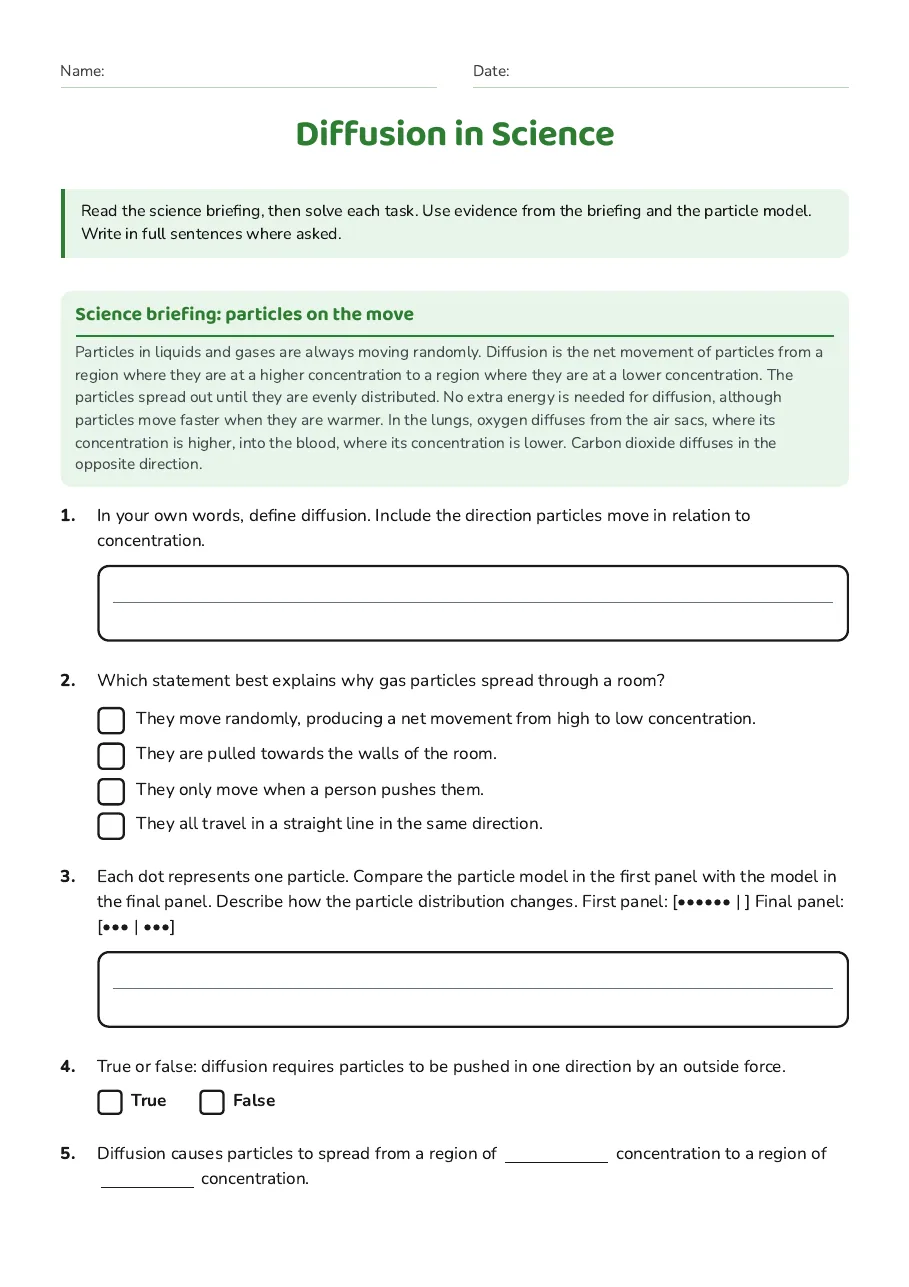
Page 1
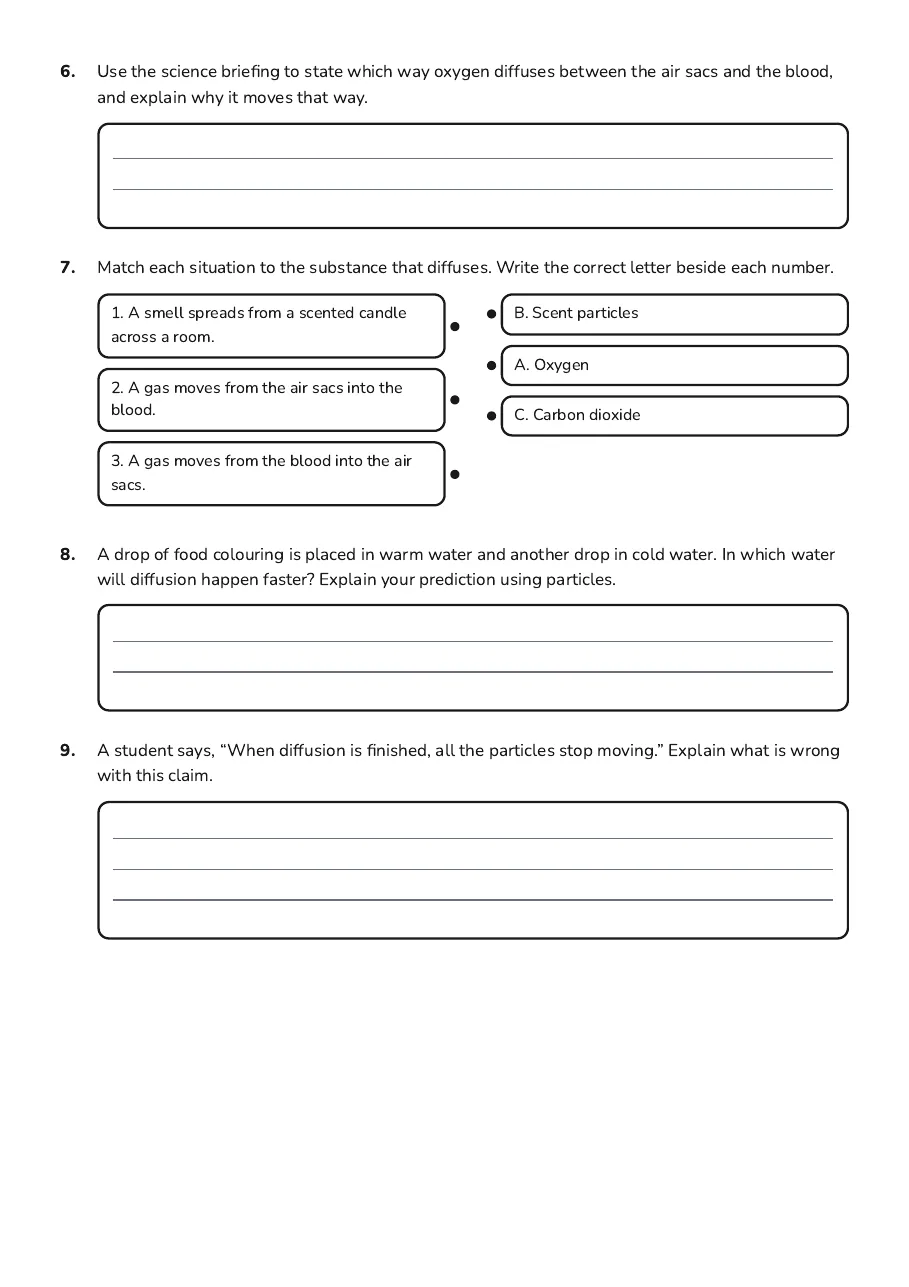
Page 2
About This Worksheet
Free in Kuraplan
Sign up free, grab the PDF, and customize it for your class.
Print-Ready
Formatted for standard paper. Clean layout, easy to read.
AI-Generated
Created with Kuraplan's AI, designed for real classroom use.
For Teachers & Parents
Use in classrooms, for homework, tutoring, or homeschool.
Need a custom version of this worksheet?
Kuraplan's AI generates custom worksheets in seconds — differentiated for every learner, aligned to your curriculum.
Generate Custom Worksheets — Free