ScienceFreePrintable
Electrical Circuits and Energy
A free science worksheet ready for your classroom. Open in Kuraplan to grab the print-ready PDF, customize it for your students, or generate a fresh version in seconds.
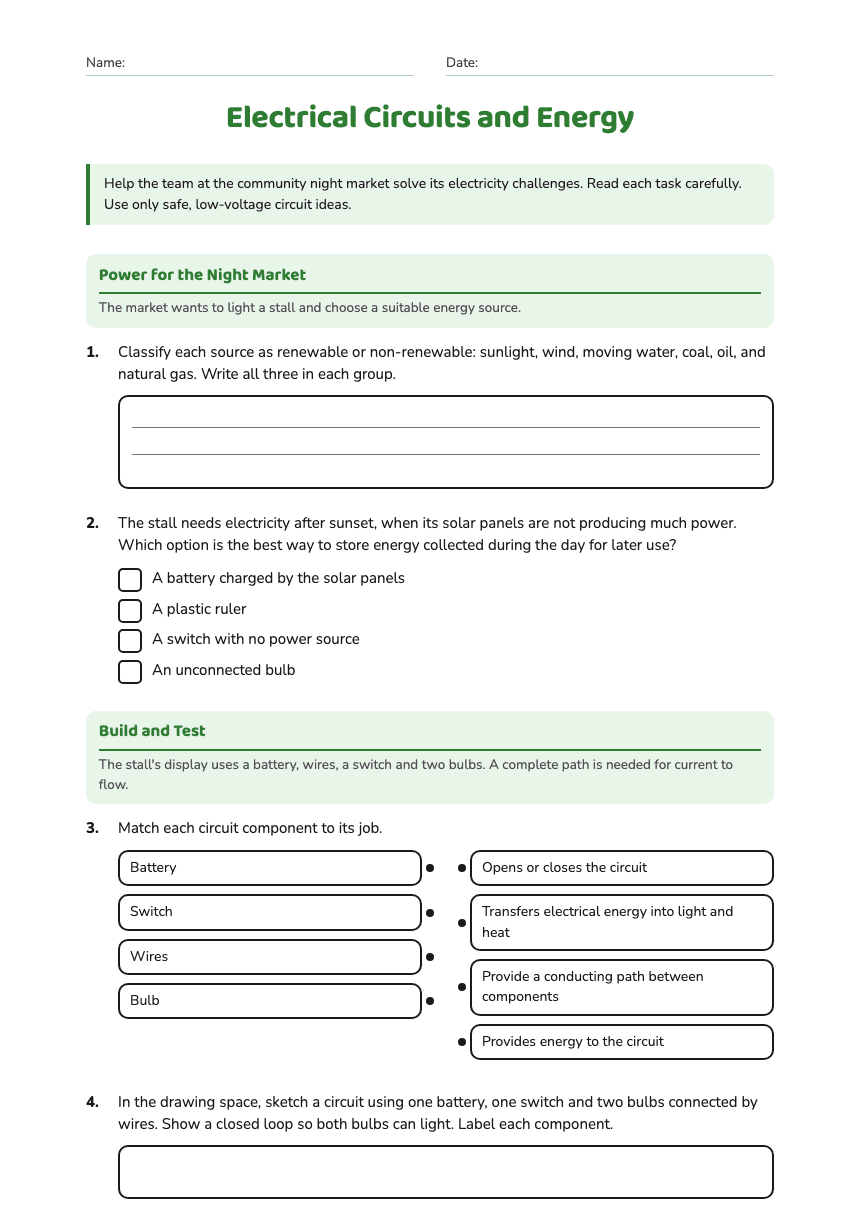
Name:Date:
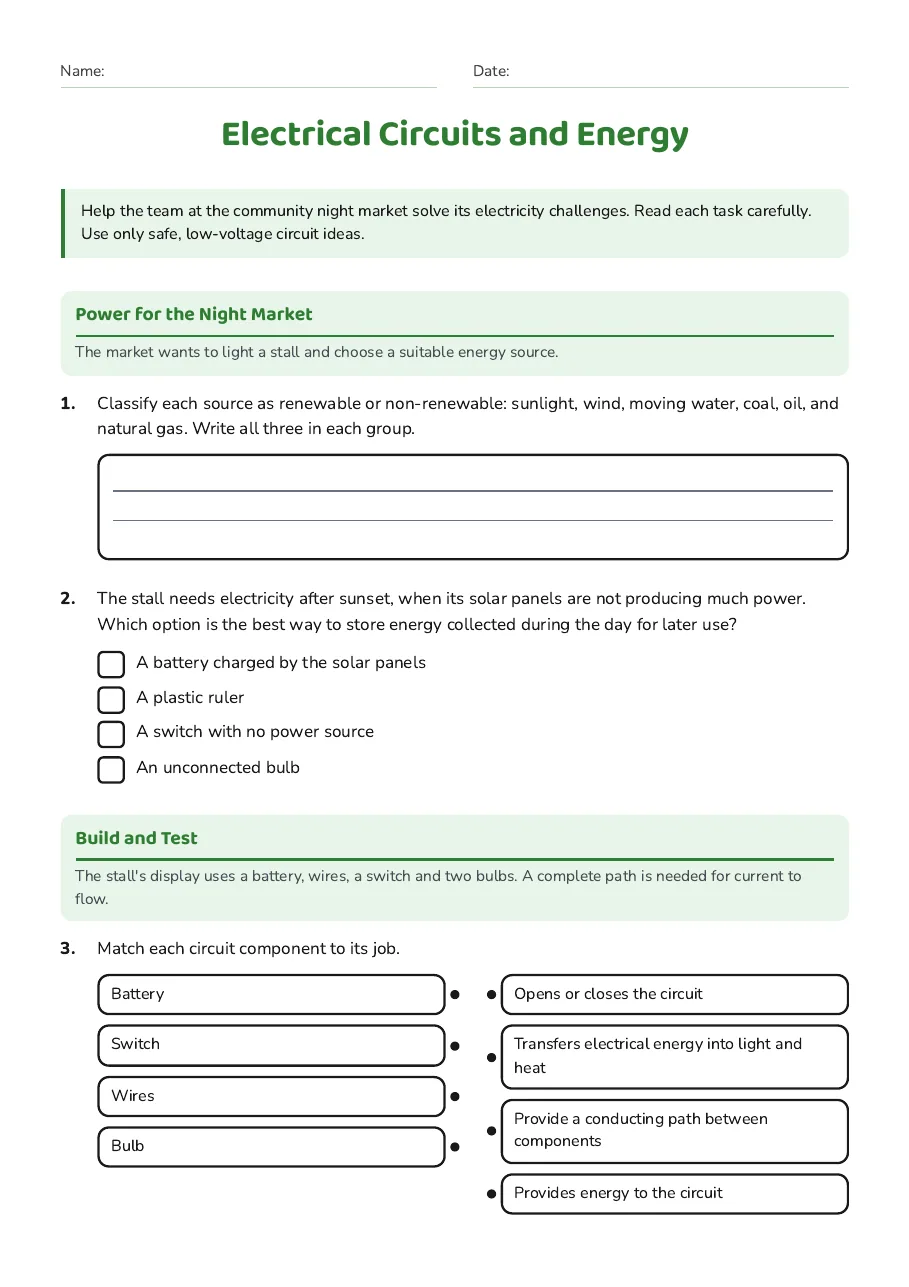
Electrical Circuits and Energy
Help the team at the community night market solve its electricity challenges. Read each task carefully. Use only safe, low-voltage circuit ideas.
Power for the Night Market
The market wants to light a stall and choose a suitable energy source.
1.Classify each source as renewable or non-renewable: sunlight, wind, moving water, coal, oil, and natural gas. Write all three in each group.
2.The stall needs electricity after sunset, when its solar panels are not producing much power. Which option is the best way to store energy collected during the day for later use?
- A battery charged by the solar panels
- A plastic ruler
- A switch with no power source
- An unconnected bulb
Build and Test
The stall's display uses a battery, wires, a switch and two bulbs. A complete path is needed for current to flow.
3.Match each circuit component to its job.
- Battery
- Switch
- Wires
- Bulb
- Opens or closes the circuit
- Transfers electrical energy into light and heat
- Provide a conducting path between components
- Provides energy to the circuit
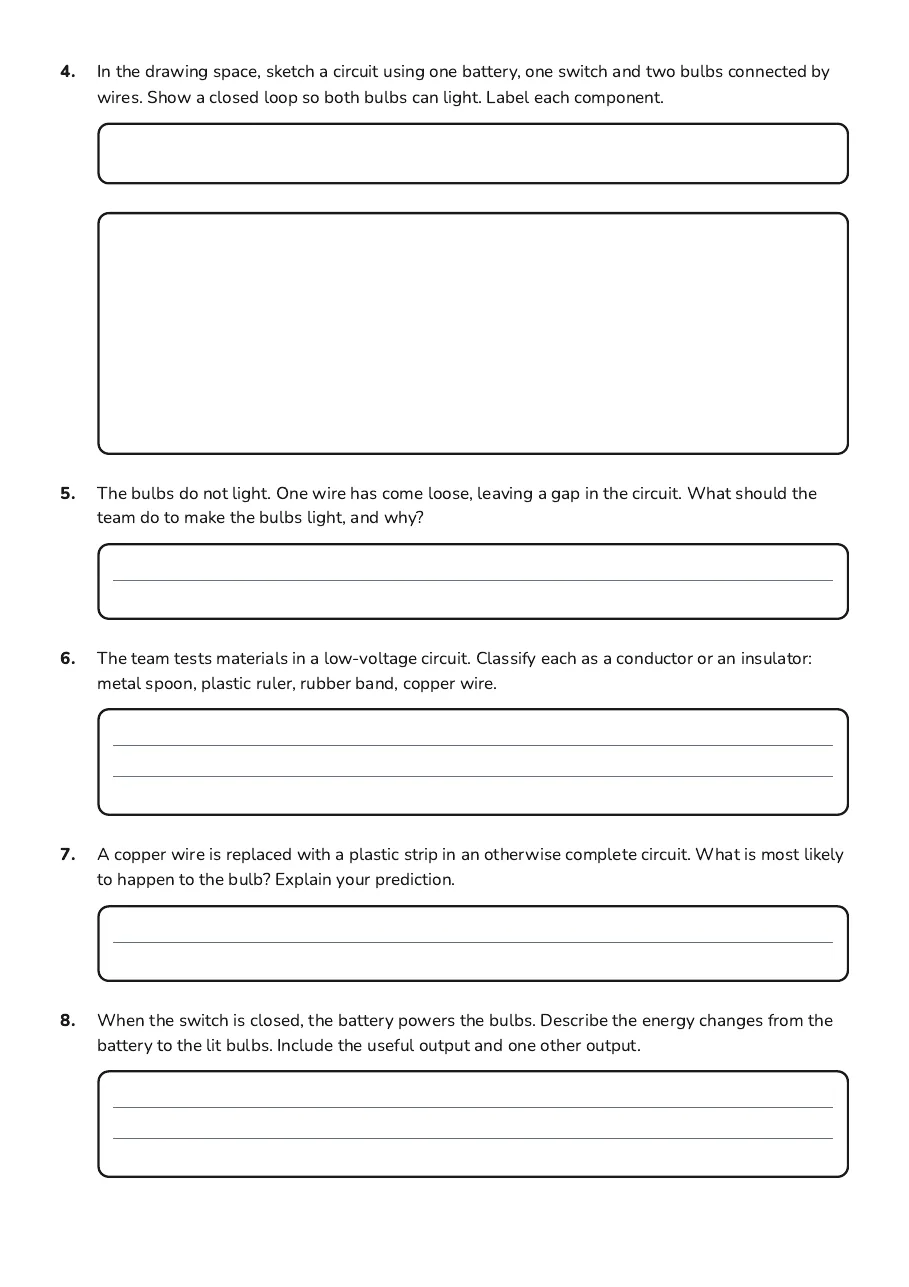
4.In the drawing space, sketch a circuit using one battery, one switch and two bulbs connected by wires. Show a closed loop so both bulbs can light. Label each component.
5.The bulbs do not light. One wire has come loose, leaving a gap in the circuit. What should the team do to make the bulbs light, and why?
6.The team tests materials in a low-voltage circuit. Classify each as a conductor or an insulator: metal spoon, plastic ruler, rubber band, copper wire.
7.A copper wire is replaced with a plastic strip in an otherwise complete circuit. What is most likely to happen to the bulb? Explain your prediction.
8.When the switch is closed, the battery powers the bulbs. Describe the energy changes from the battery to the lit bulbs. Include the useful output and one other output.
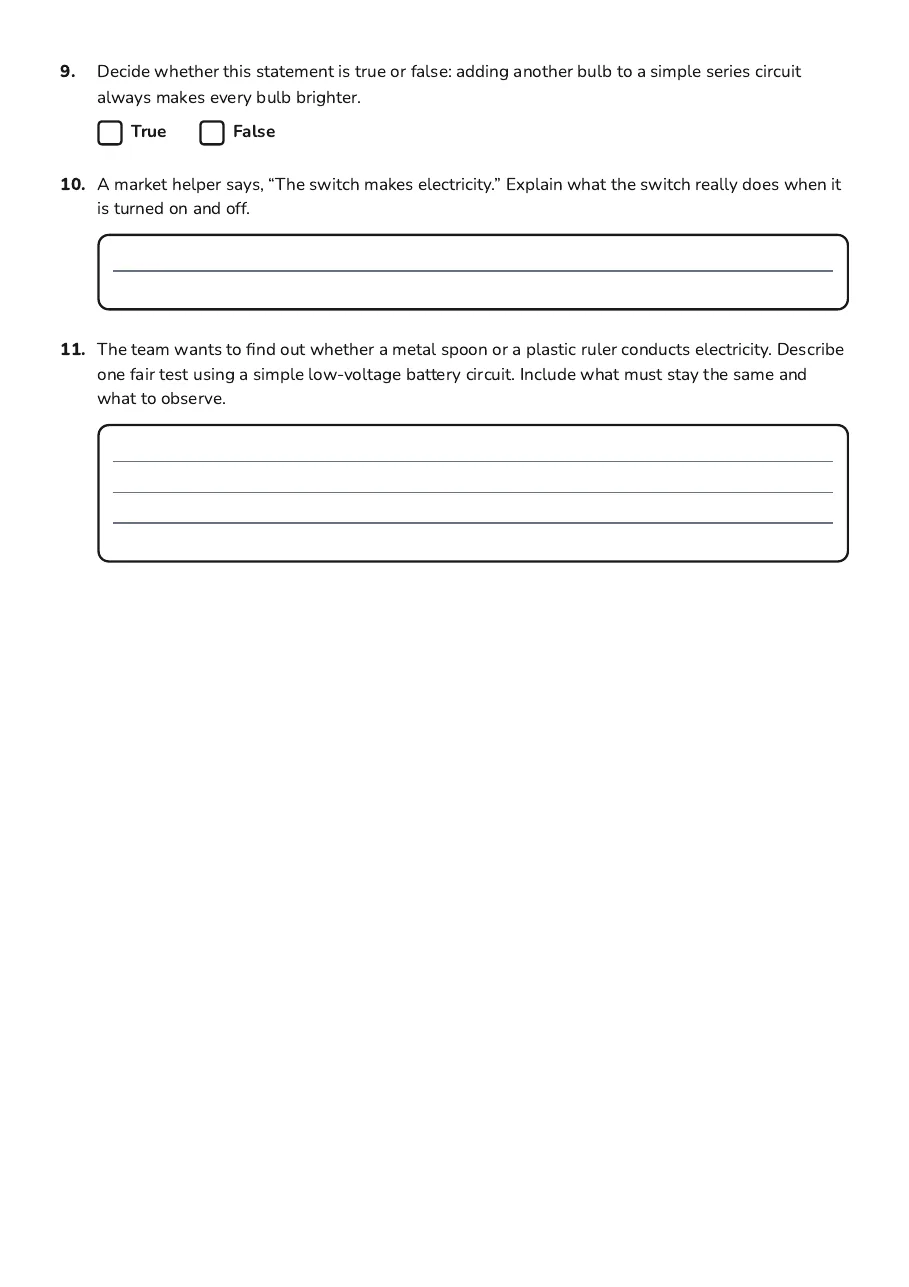
9.Decide whether this statement is true or false: adding another bulb to a simple series circuit always makes every bulb brighter.
TrueFalse
10.A market helper says, “The switch makes electricity.” Explain what the switch really does when it is turned on and off.
11.The team wants to find out whether a metal spoon or a plastic ruler conducts electricity. Describe one fair test using a simple low-voltage battery circuit. Include what must stay the same and what to observe.
3 printable pages
Page 1
Page 2
Page 3
About This Worksheet
Free in Kuraplan
Sign up free, grab the PDF, and customize it for your class.
Print-Ready
Formatted for standard paper. Clean layout, easy to read.
AI-Generated
Created with Kuraplan's AI, designed for real classroom use.
For Teachers & Parents
Use in classrooms, for homework, tutoring, or homeschool.
Need a custom version of this worksheet?
Kuraplan's AI generates custom worksheets in seconds — differentiated for every learner, aligned to your curriculum.
Generate Custom Worksheets — Free No credit card Curriculum-aligned Under 60 seconds
More Science Worksheets
Year 6
Electrical Circuits Investigation
Free
Year 6
Introduction to Electrical Circuits
Free
Year 6
Understanding Circuit Components
Free
Tesla's Electric Power Transmission
Free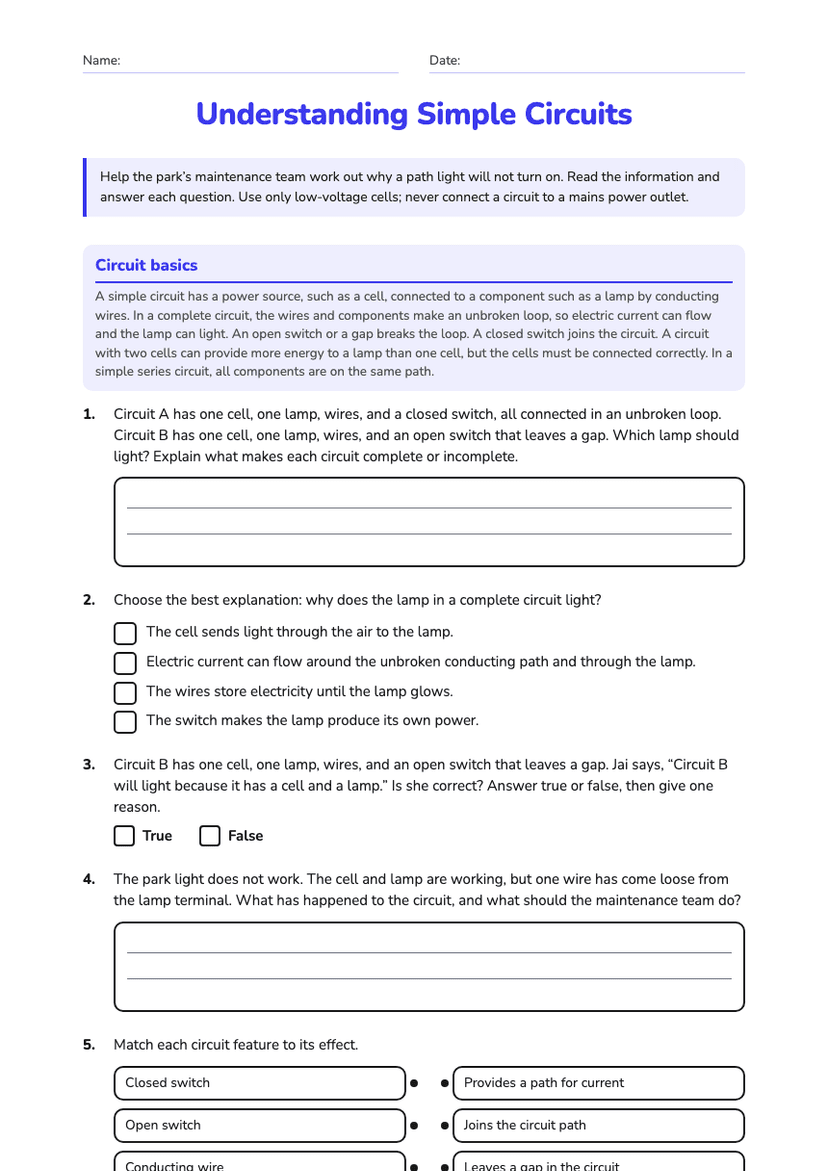
Year 6
Understanding Simple Circuits
Free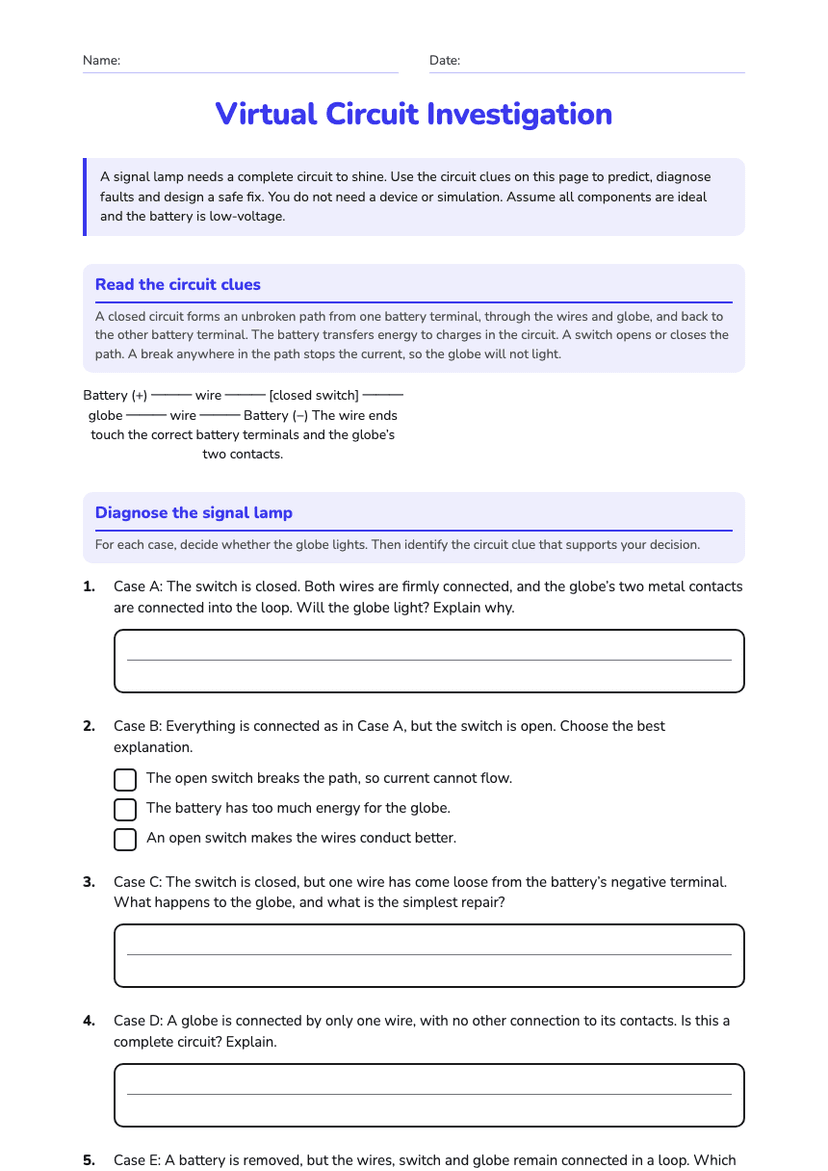
Year 6
Virtual Circuit Investigation
Free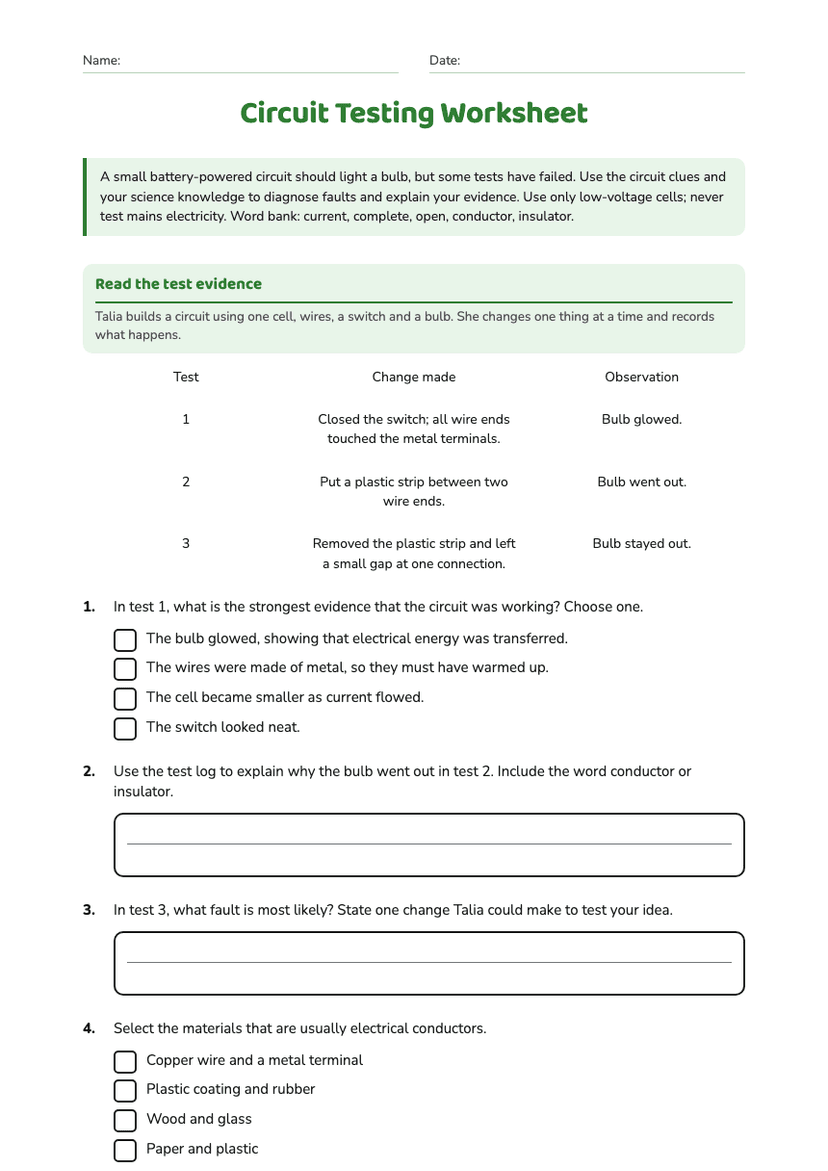
Year 6
Circuit Testing Worksheet
Free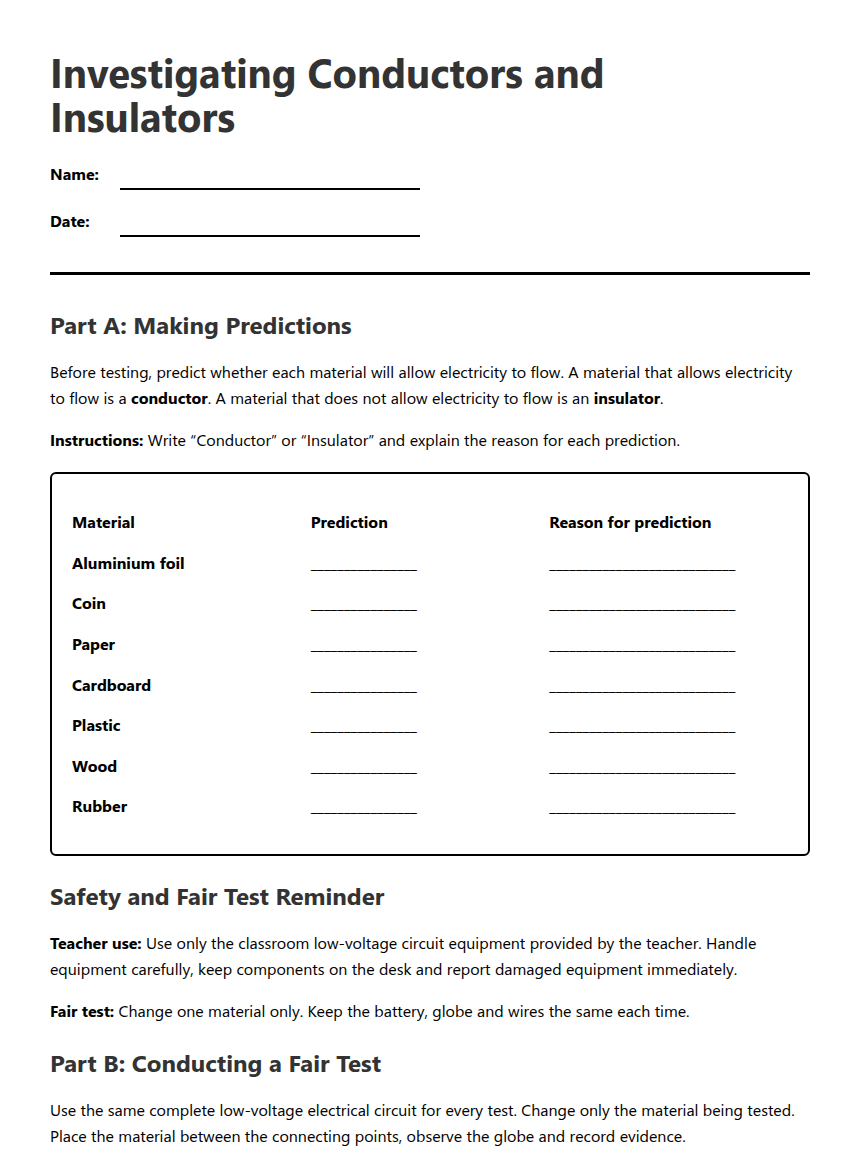
Year 6