Famous Gladiators and Stories
A free social sciences worksheet ready for your classroom. Open in Kuraplan to grab the print-ready PDF, customize it for your students, or generate a fresh version in seconds.
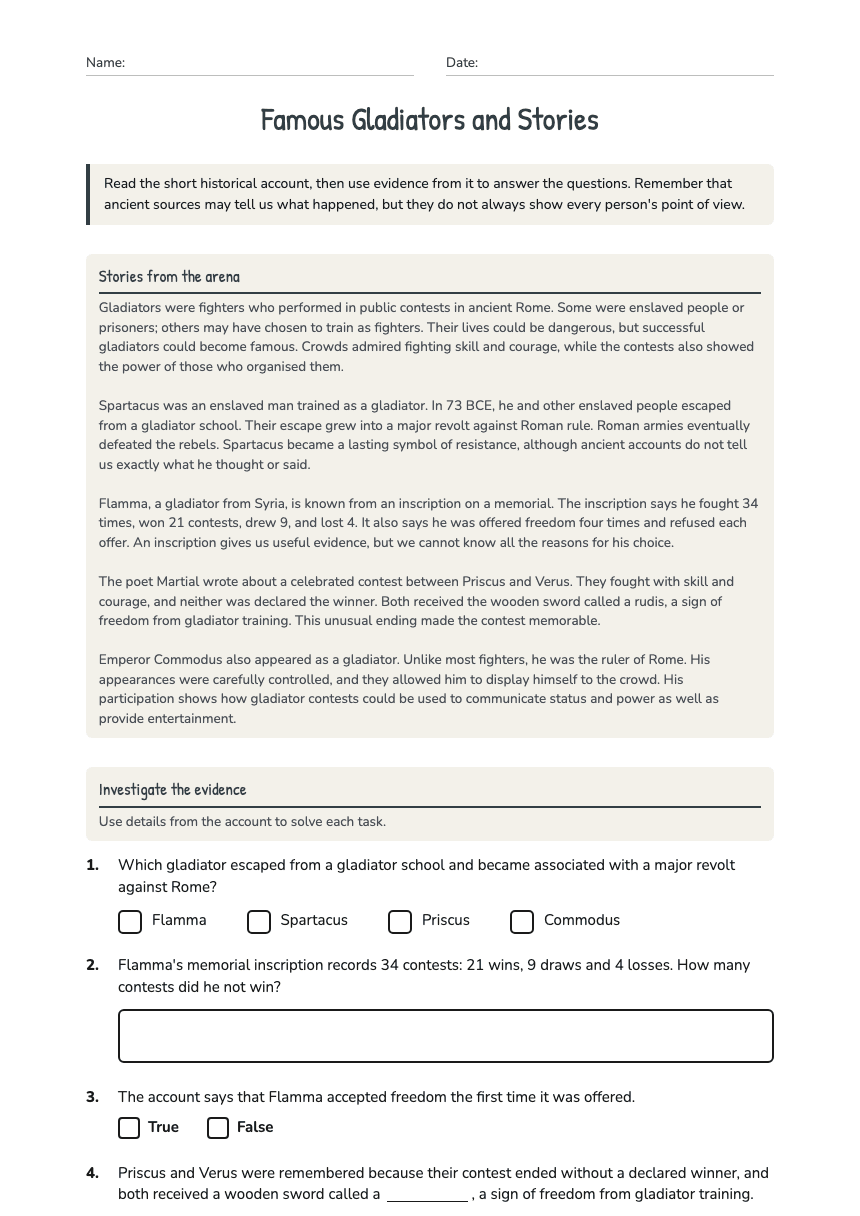
Famous Gladiators and Stories
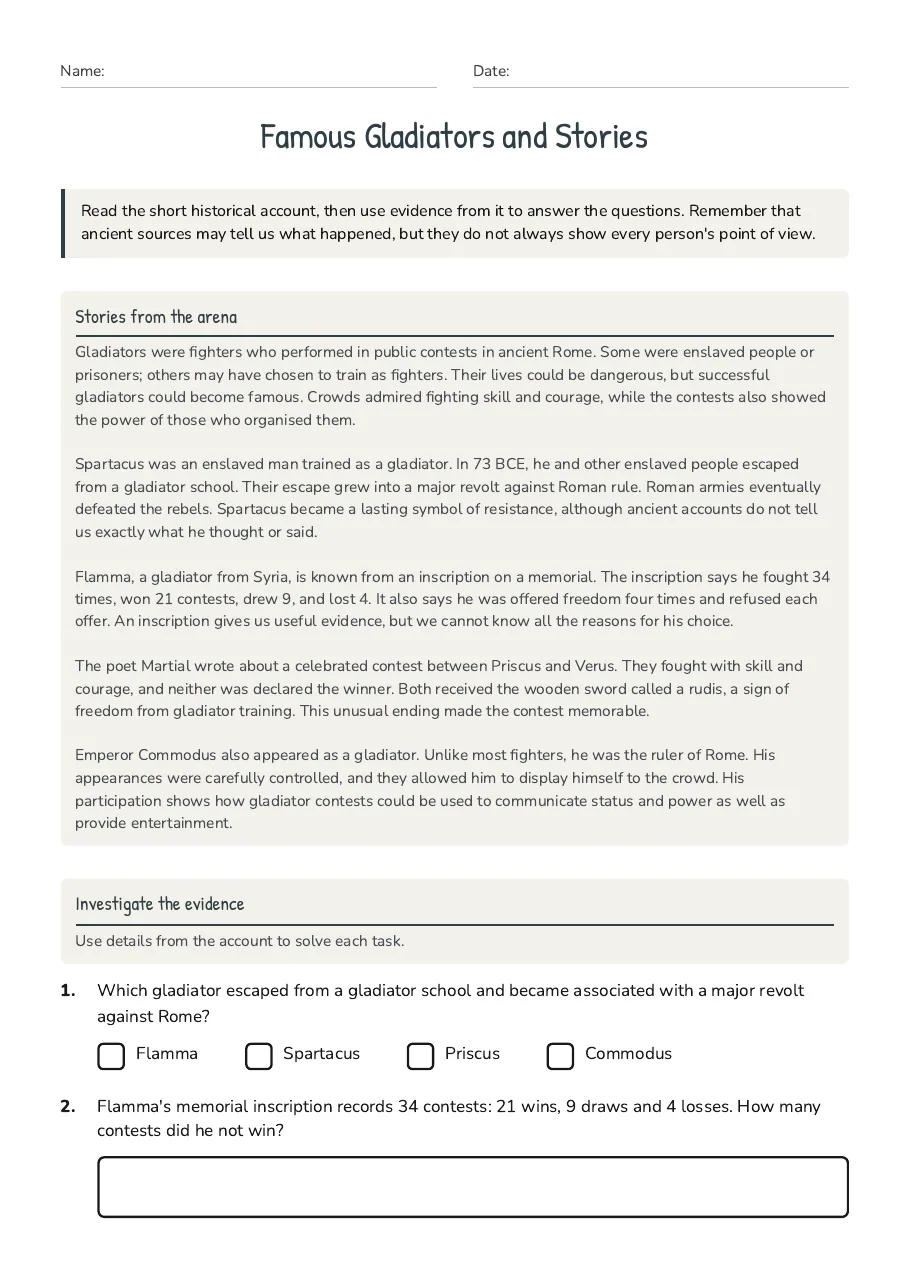
Stories from the arena
Gladiators were fighters who performed in public contests in ancient Rome. Some were enslaved people or prisoners; others may have chosen to train as fighters. Their lives could be dangerous, but successful gladiators could become famous. Crowds admired fighting skill and courage, while the contests also showed the power of those who organised them. Spartacus was an enslaved man trained as a gladiator. In 73 BCE, he and other enslaved people escaped from a gladiator school. Their escape grew into a major revolt against Roman rule. Roman armies eventually defeated the rebels. Spartacus became a lasting symbol of resistance, although ancient accounts do not tell us exactly what he thought or said. Flamma, a gladiator from Syria, is known from an inscription on a memorial. The inscription says he fought 34 times, won 21 contests, drew 9, and lost 4. It also says he was offered freedom four times and refused each offer. An inscription gives us useful evidence, but we cannot know all the reasons for his choice. The poet Martial wrote about a celebrated contest between Priscus and Verus. They fought with skill and courage, and neither was declared the winner. Both received the wooden sword called a rudis, a sign of freedom from gladiator training. This unusual ending made the contest memorable. Emperor Commodus also appeared as a gladiator. Unlike most fighters, he was the ruler of Rome. His appearances were carefully controlled, and they allowed him to display himself to the crowd. His participation shows how gladiator contests could be used to communicate status and power as well as provide entertainment.
Investigate the evidence
Use details from the account to solve each task.
- Flamma
- Spartacus
- Priscus
- Commodus
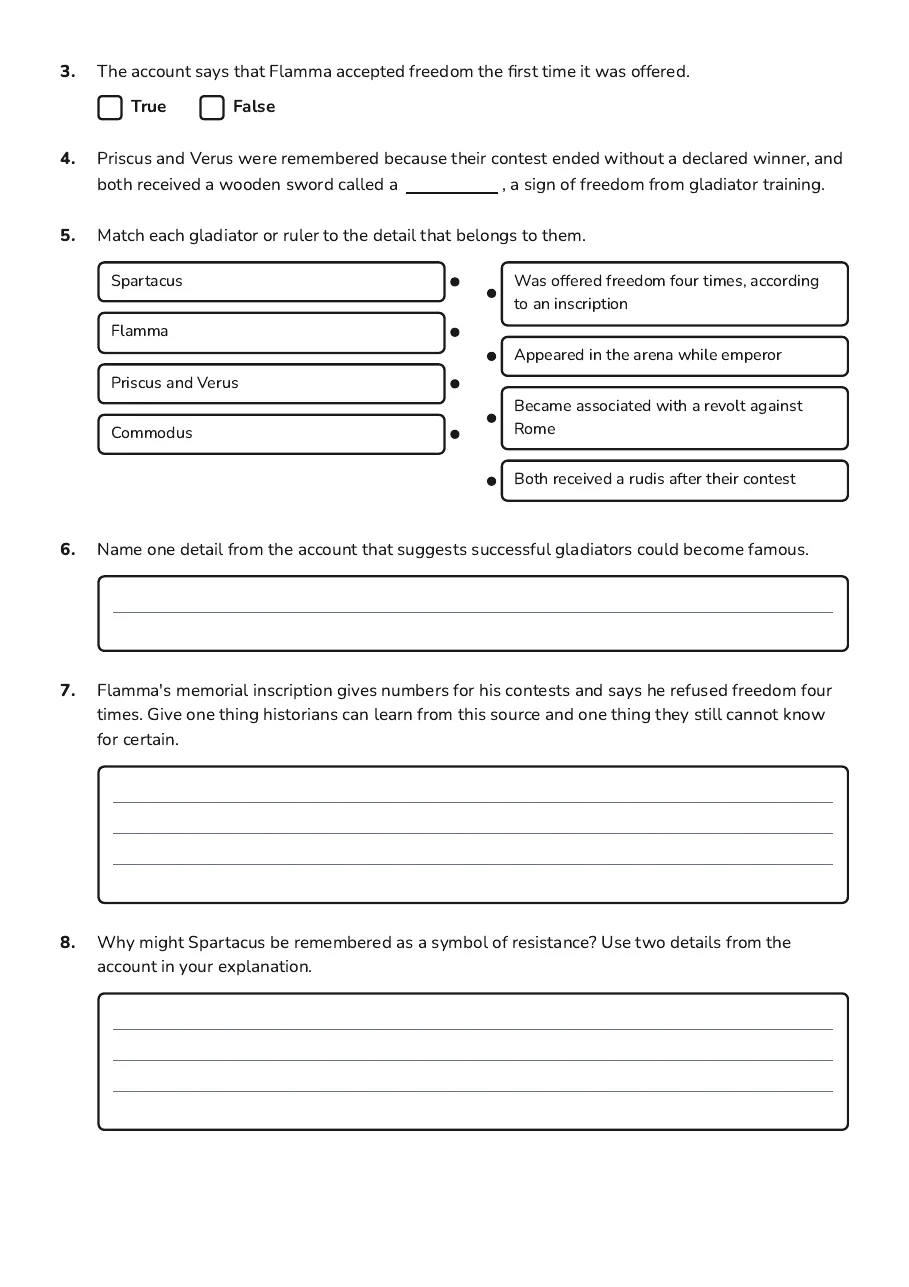
- Spartacus
- Flamma
- Priscus and Verus
- Commodus
- Was offered freedom four times, according to an inscription
- Appeared in the arena while emperor
- Became associated with a revolt against Rome
- Both received a rudis after their contest
3 printable pages
Page 1
Page 2

Page 3
About This Worksheet
Free in Kuraplan
Sign up free, grab the PDF, and customize it for your class.
Print-Ready
Formatted for standard paper. Clean layout, easy to read.
AI-Generated
Created with Kuraplan's AI, designed for real classroom use.
For Teachers & Parents
Use in classrooms, for homework, tutoring, or homeschool.
Need a custom version of this worksheet?
Kuraplan's AI generates custom worksheets in seconds — differentiated for every learner, aligned to your curriculum.
Generate Custom Worksheets — Free