Forces: Contact vs. Non-Contact
A free science worksheet ready for your classroom. Open in Kuraplan to grab the print-ready PDF, customize it for your students, or generate a fresh version in seconds.

Forces: Contact vs. Non-Contact

🎯 WALT (We Are Learning To)
We are learning to analyse and evaluate the nature of contact and non-contact forces and their applications in real-world scenarios.
Success Criteria:
✓ I can explain the fundamental differences between contact and non-contact forces
✓ I can analyse the mechanisms behind friction, tension, gravity, and electromagnetic forces
✓ I can apply force concepts to solve problems and explain phenomena
✓ I can evaluate the relative strengths and effects of different forces
📚 Key Concepts
Contact Forces: Forces that require physical contact between objects. They arise from electromagnetic interactions at the atomic level between surface atoms.
Non-Contact Forces: Forces that act through fields (gravitational, electric, or magnetic) without direct physical contact between objects.
Examples of Contact Forces:
• Friction: Opposition to motion caused by surface irregularities and molecular interactions
• Tension: Force transmitted through strings, ropes, or cables when pulled tight
• Normal Force: Support force perpendicular to a surface
• Applied Force: Direct push or pull exerted by one object on another
Examples of Non-Contact Forces:
• Gravitational Force: Attractive force between masses (F = mg near Earth's surface)
• Electromagnetic Force: Forces between charged particles or magnetic materials
• Nuclear Forces: Strong and weak forces acting within atomic nuclei
a) A satellite orbiting Earth: ________________________________
Mechanism: _____________________________________________
b) Brakes stopping a car: ___________________________________
Mechanism: _____________________________________________
c) A crane lifting steel beams: ________________________________
Mechanism: _____________________________________________
🔬 Part 2: Force Analysis and Applications
a) Weight of the book: W = mg = _______ × _______ = _______N
b) Normal force from desk: _______N (direction: _________)
c) Why are these forces equal? _________________________________
a) Normal force: N = _______ × _______ = _______N
b) Friction force: f = μN = _______ × _______ = _______N
c) Is this friction helpful or harmful? Explain: ____________________
🌟 Extension Activities
• Hypothesis: ____________________________________________
• Variables (independent, dependent, controlled): ________________
• Method (3-4 steps): ____________________________________
• How you would ensure accuracy: ____________________________
🎯 Differentiation Support
Visual Learners: Draw force diagrams for questions 3 and 5
Kinesthetic Learners: Demonstrate the forces using classroom objects
Advanced Learners: Research how quantum mechanics explains contact forces
💡 Dyslexia-Friendly Reading Tips
• Use a ruler under each line when reading
• Cover text below the line you're reading
• Take breaks between sections
• Ask for help if words are unclear
• Use colored overlays if helpful
About This Worksheet
Free in Kuraplan
Sign up free, grab the PDF, and customize it for your class.
Print-Ready
Formatted for standard paper. Clean layout, easy to read.
AI-Generated
Created with Kuraplan's AI, designed for real classroom use.
For Teachers & Parents
Use in classrooms, for homework, tutoring, or homeschool.
Need a custom version of this worksheet?
Kuraplan's AI generates custom worksheets in seconds — differentiated for every learner, aligned to your curriculum.
Generate Custom Worksheets — FreeMore Science Worksheets
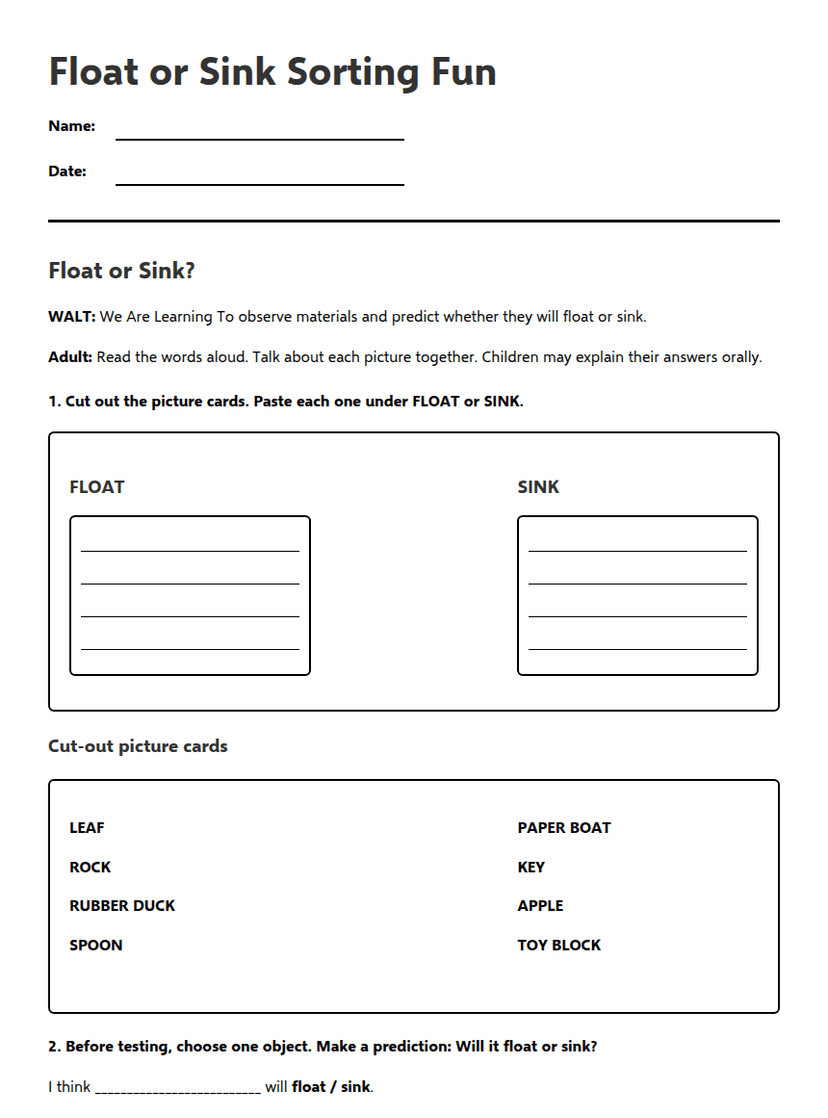
Float or Sink Sorting Fun
Free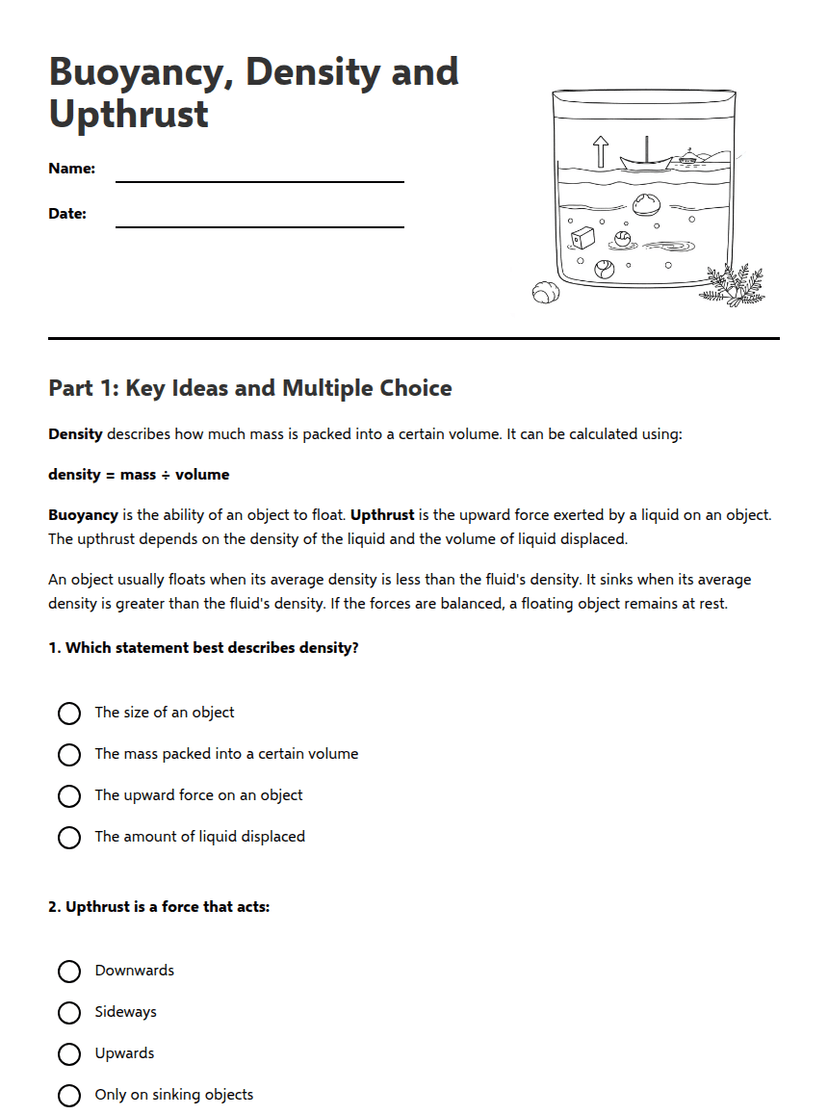
Buoyancy, Density and Upthrust
Free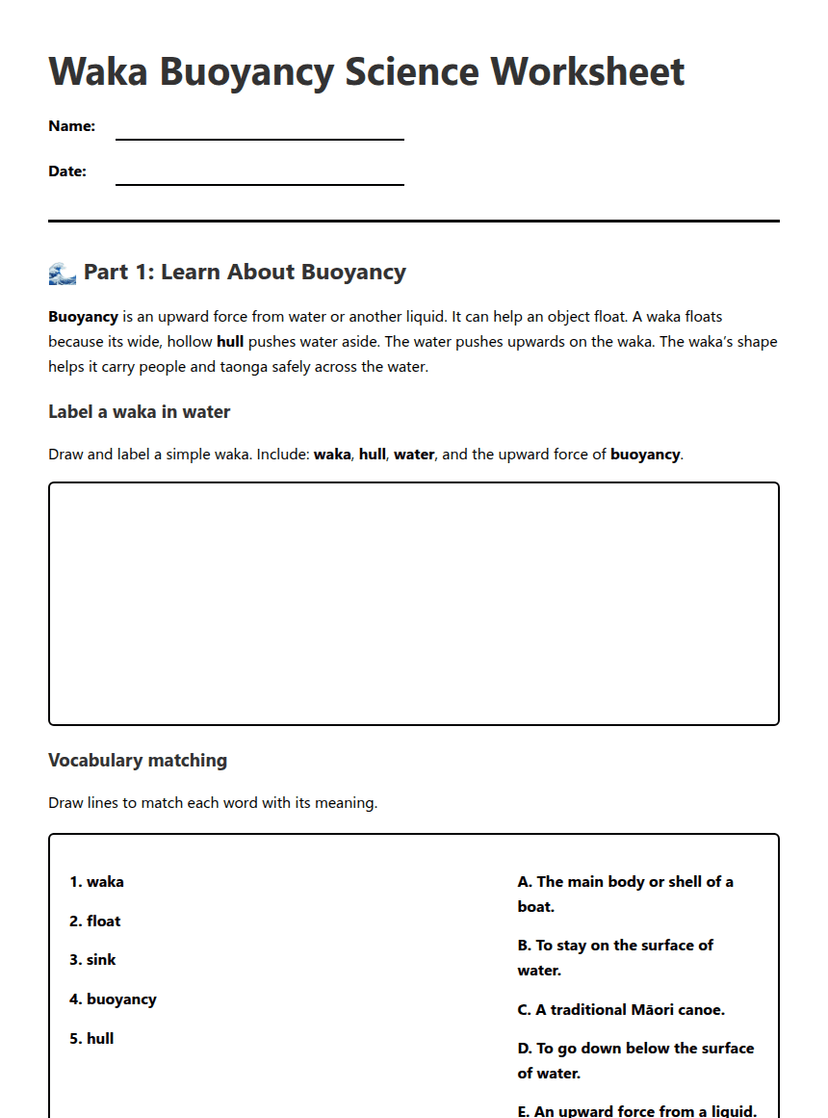
Waka Buoyancy Science Worksheet
Free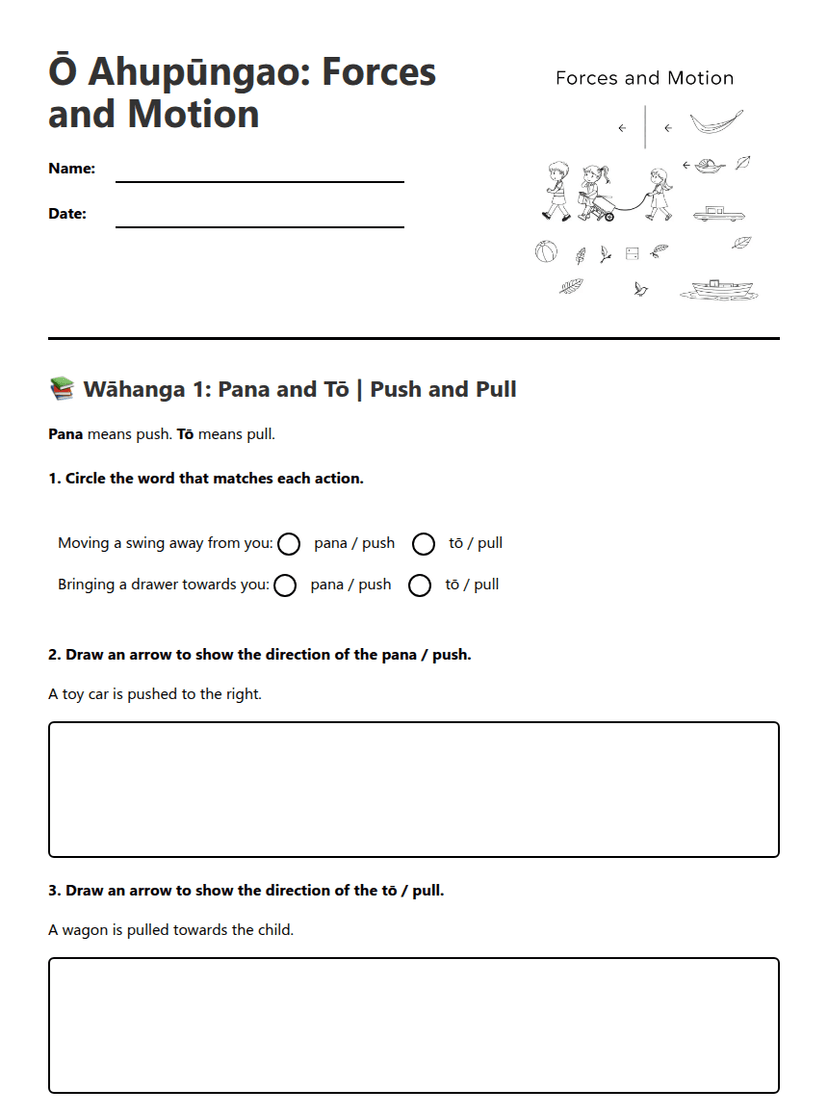
Ō Ahupūngao: Forces and Motion
Free
Aircraft Design and Aerodynamics
Free
Circular Motion Physics
Free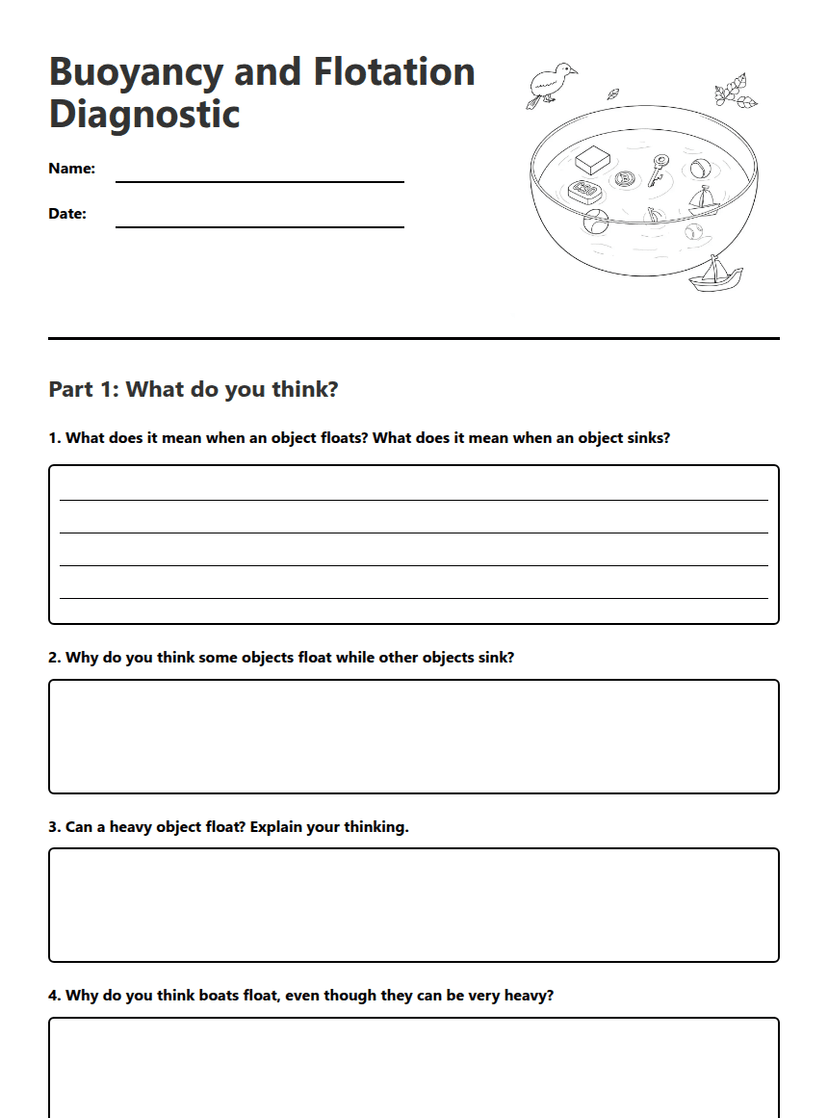
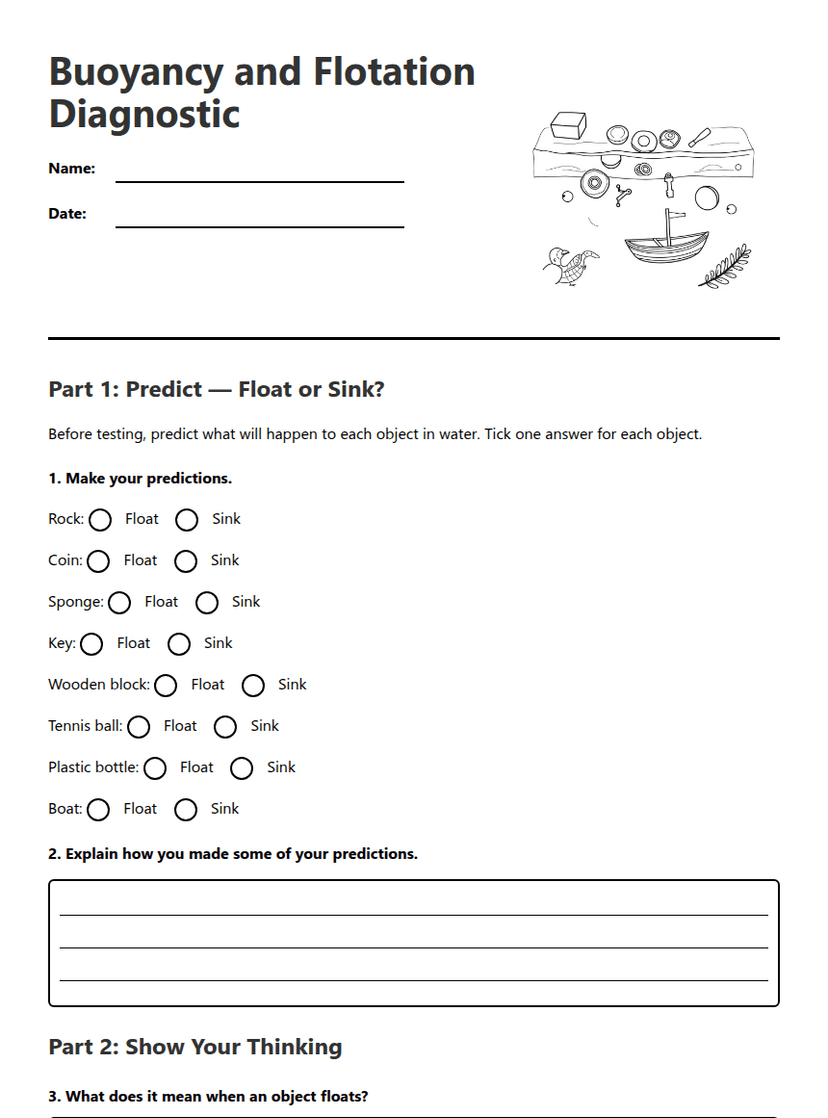
Buoyancy and Flotation Diagnostic
Free