Friction: Friend or Foe?
A free science worksheet ready for your classroom. Open in Kuraplan to grab the print-ready PDF, customize it for your students, or generate a fresh version in seconds.
Friction: Friend or Foe?
🔬 Part 1: Understanding Friction
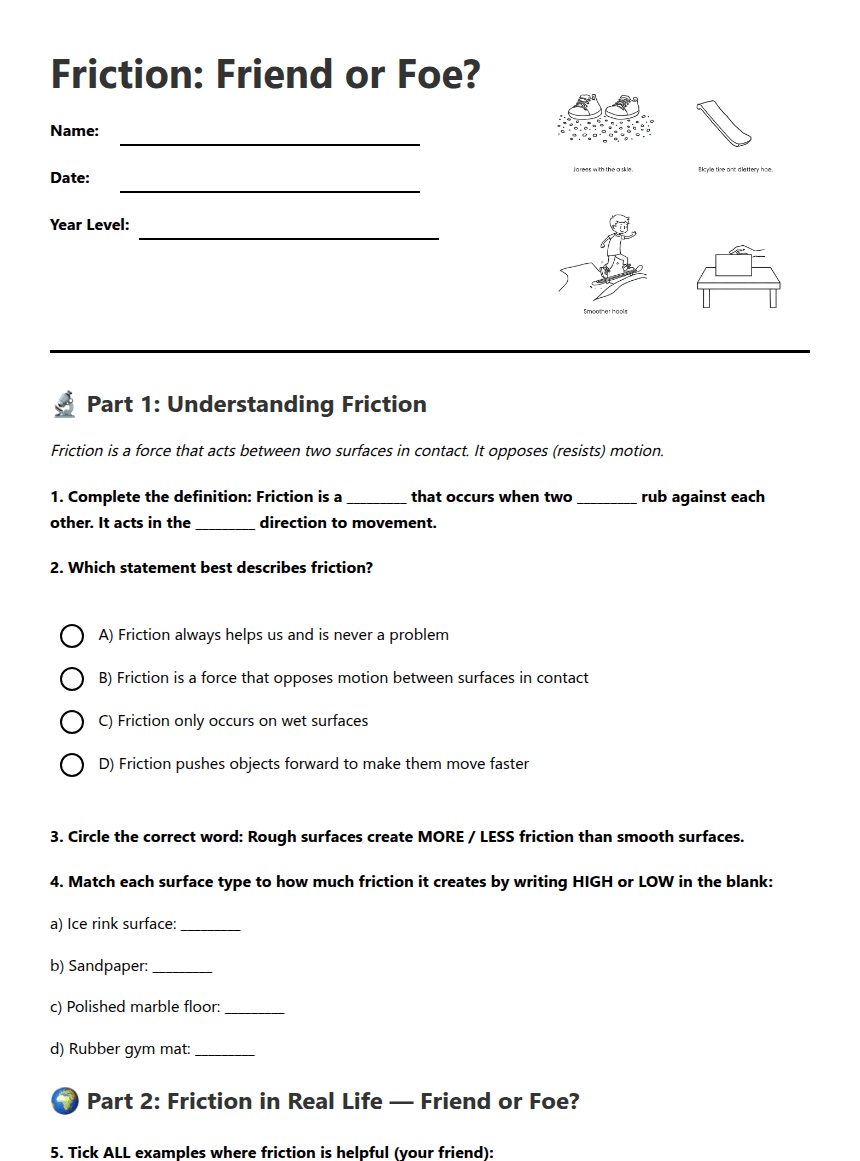
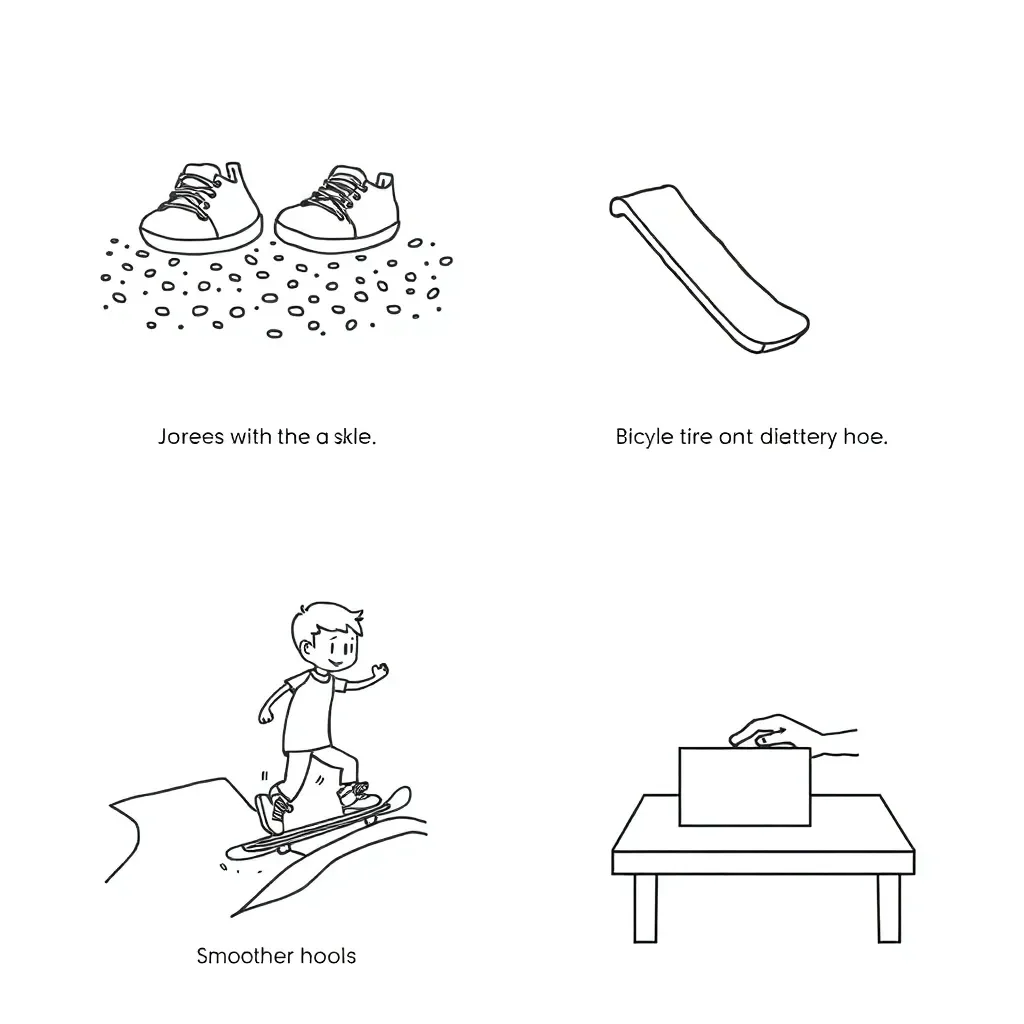
Friction is a force that acts between two surfaces in contact. It opposes (resists) motion.
a) Ice rink surface: _________
b) Sandpaper: _________
c) Polished marble floor: _________
d) Rubber gym mat: _________
🌍 Part 2: Friction in Real Life — Friend or Foe?
🧪 Part 3: Predict and Observe
Imagine you push the same book across three different surfaces: a carpet, a wooden desk, and a plastic tray with a few drops of water on it.
_____ Carpet _____ Wooden desk _____ Wet plastic tray
a) _______________________________
b) _______________________________
✅ Answer Guide (Teacher / Self-Check)
Q1: force / surfaces / opposite
Q2: B
Q3: MORE
Q4: a) LOW b) HIGH c) LOW d) HIGH
Q5: ✔ Car brakes ✔ Shoes gripping the floor ✔ Writing with a pencil ✔ Striking a match
Q6: Accept any reasonable answer, e.g. friction in a bike chain causes wear and slows the bike down; rubbing causes heat and damage in engines.
Q7: Tread grooves channel water away and increase grip on the road surface, creating more friction and preventing the car from skidding.
Q8: 1 = Carpet 2 = Wooden desk 3 = Wet plastic tray
Q9: Accept any two: oil/lubricant, water, grease, wax, ball bearings, smooth coating.
Q10: Disagree — without friction we could not walk, hold objects, write, brake vehicles, or grip anything. Accept well-reasoned responses either way.
About This Worksheet
Free in Kuraplan
Sign up free, grab the PDF, and customize it for your class.
Print-Ready
Formatted for standard paper. Clean layout, easy to read.
AI-Generated
Created with Kuraplan's AI, designed for real classroom use.
For Teachers & Parents
Use in classrooms, for homework, tutoring, or homeschool.
Need a custom version of this worksheet?
Kuraplan's AI generates custom worksheets in seconds — differentiated for every learner, aligned to your curriculum.
Generate Custom Worksheets — FreeMore Science Worksheets
Science Skills Review Worksheet
Free
Year 3 Science Comprehension
Free
Year 6 Science Exploration
Free
Homeschool Science Worksheet
Free
Earth Science Exploration Worksheet
Free
Earth Science Question Worksheet
Free
Soil Science Through Drama
Free