EnglishFreePrintable

Future Pathways Narrative Writing

A free english worksheet ready for your classroom. Open in Kuraplan to grab the print-ready PDF, customize it for your students, or generate a fresh version in seconds.
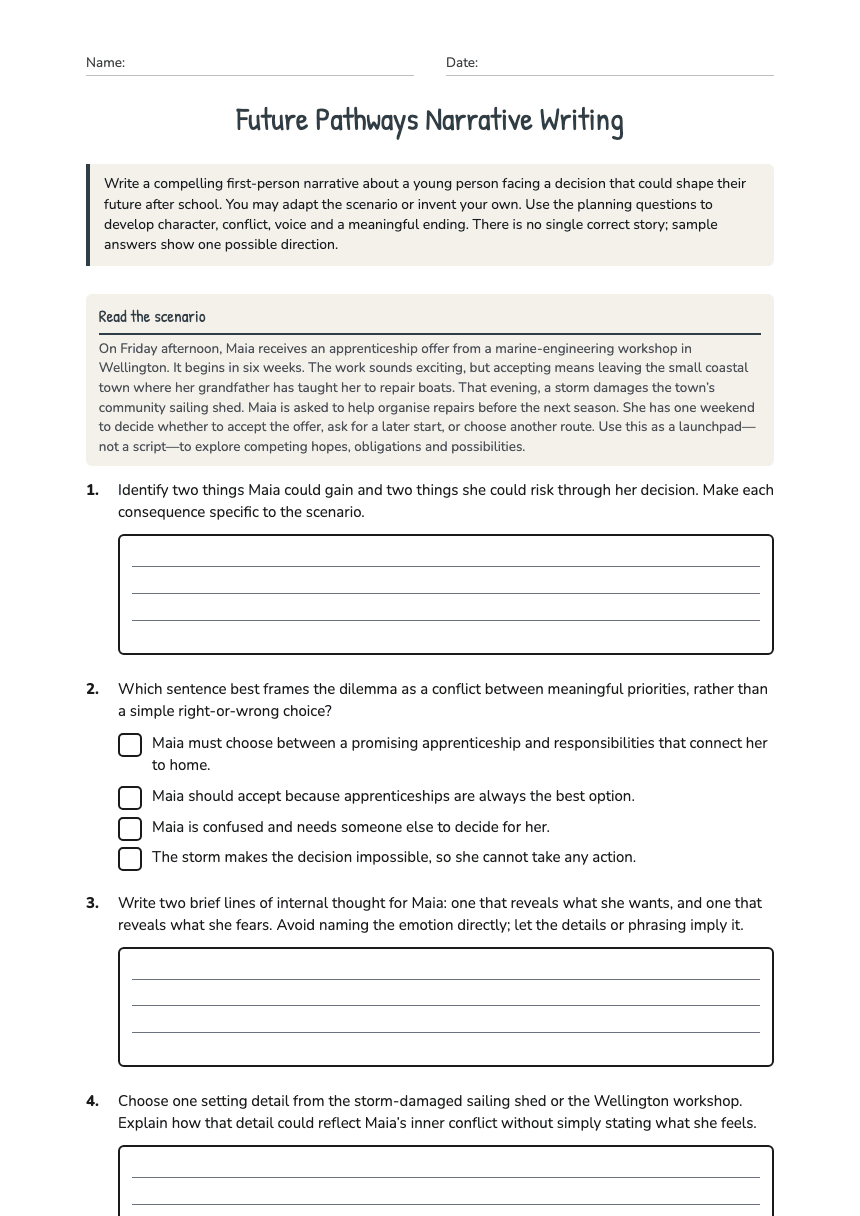
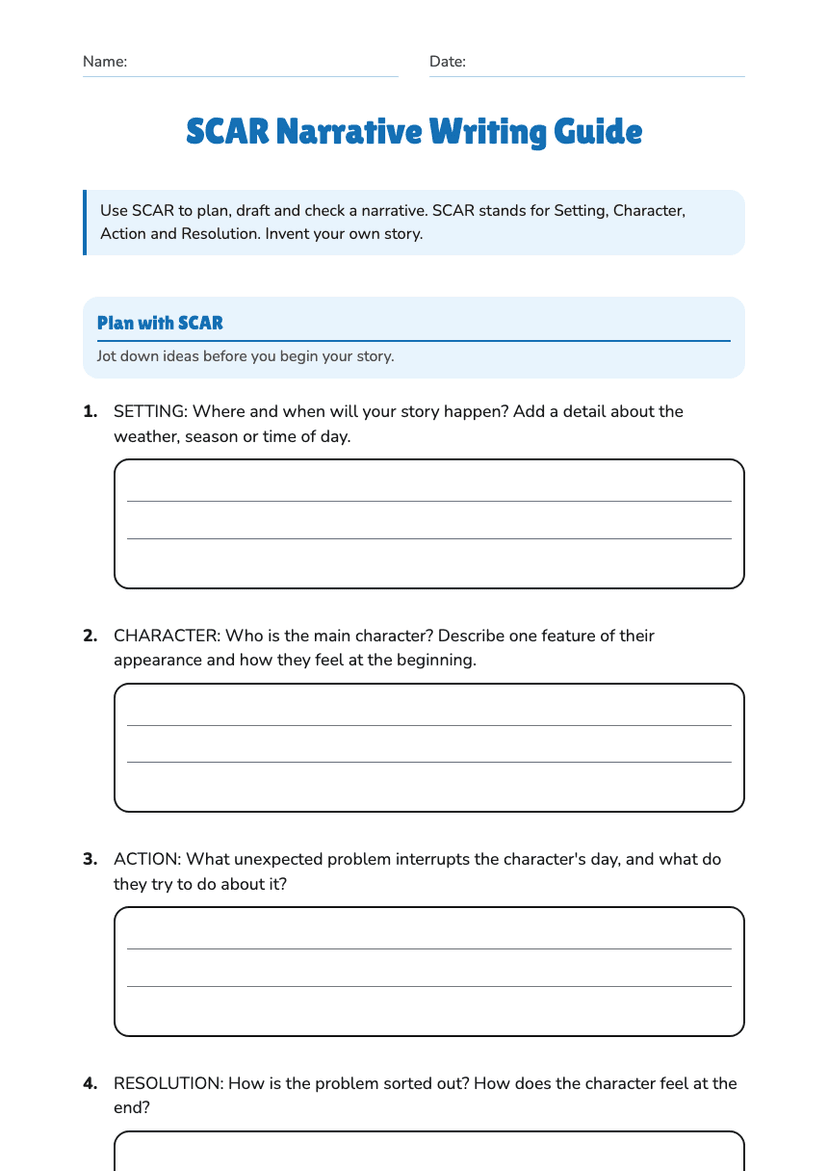
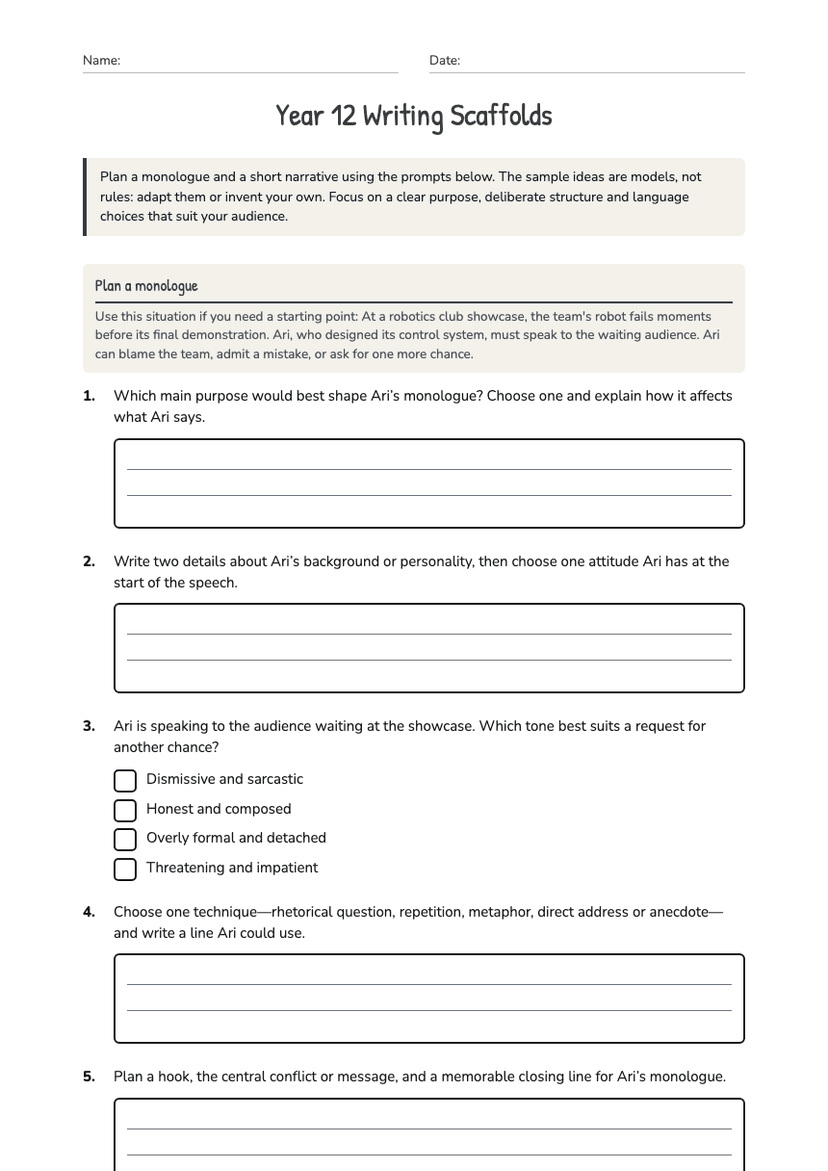
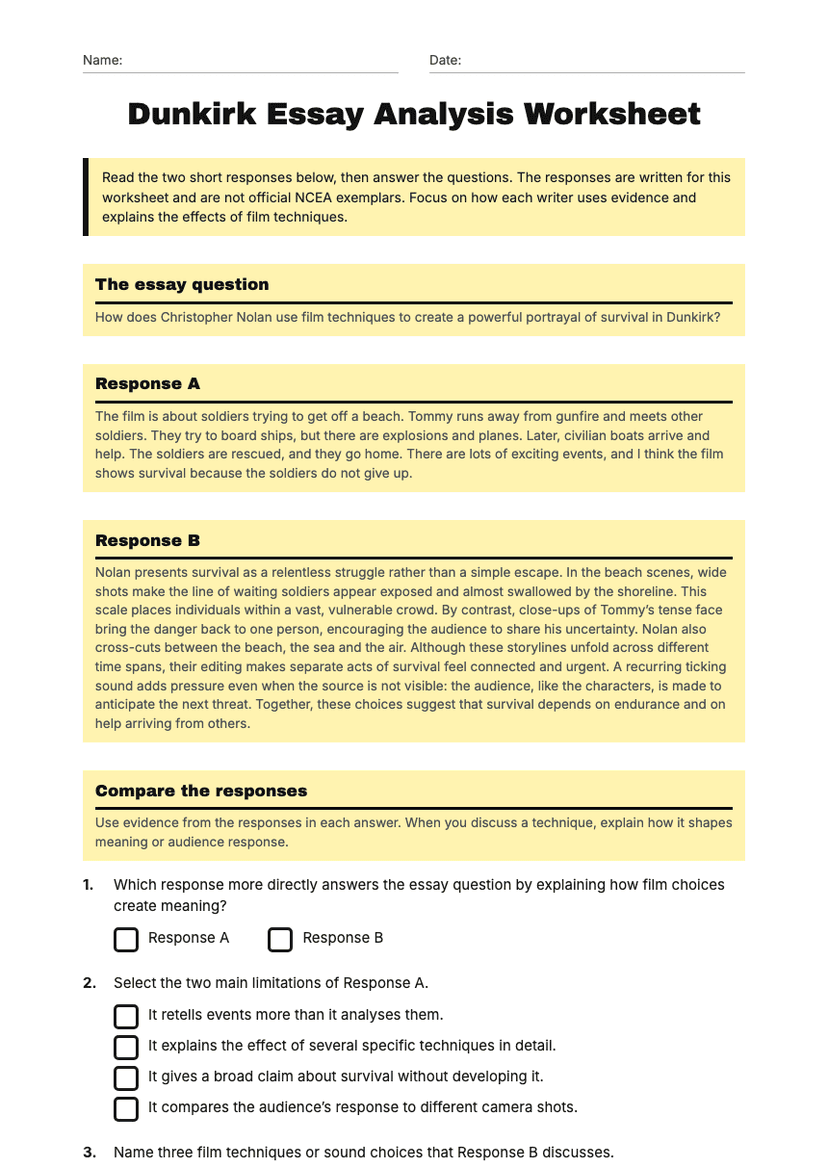
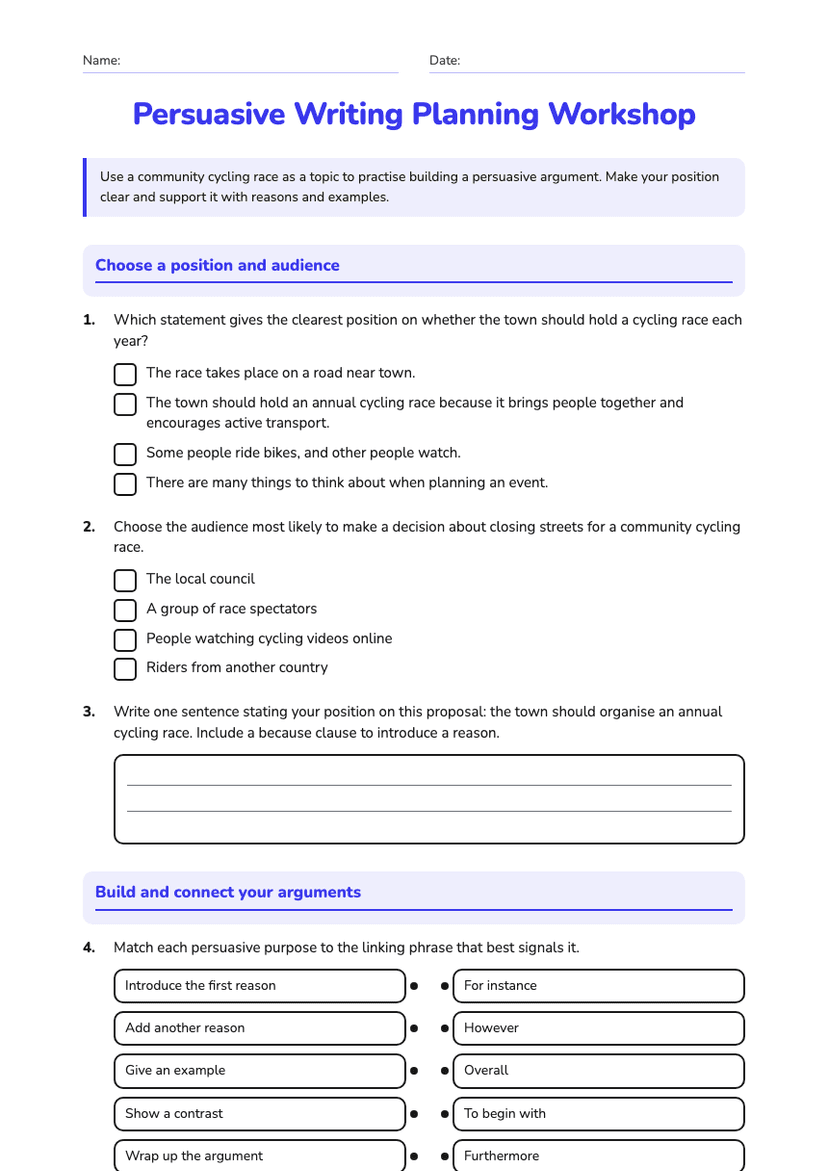
Future Pathways Narrative Writing worksheet preview
Name:Date:

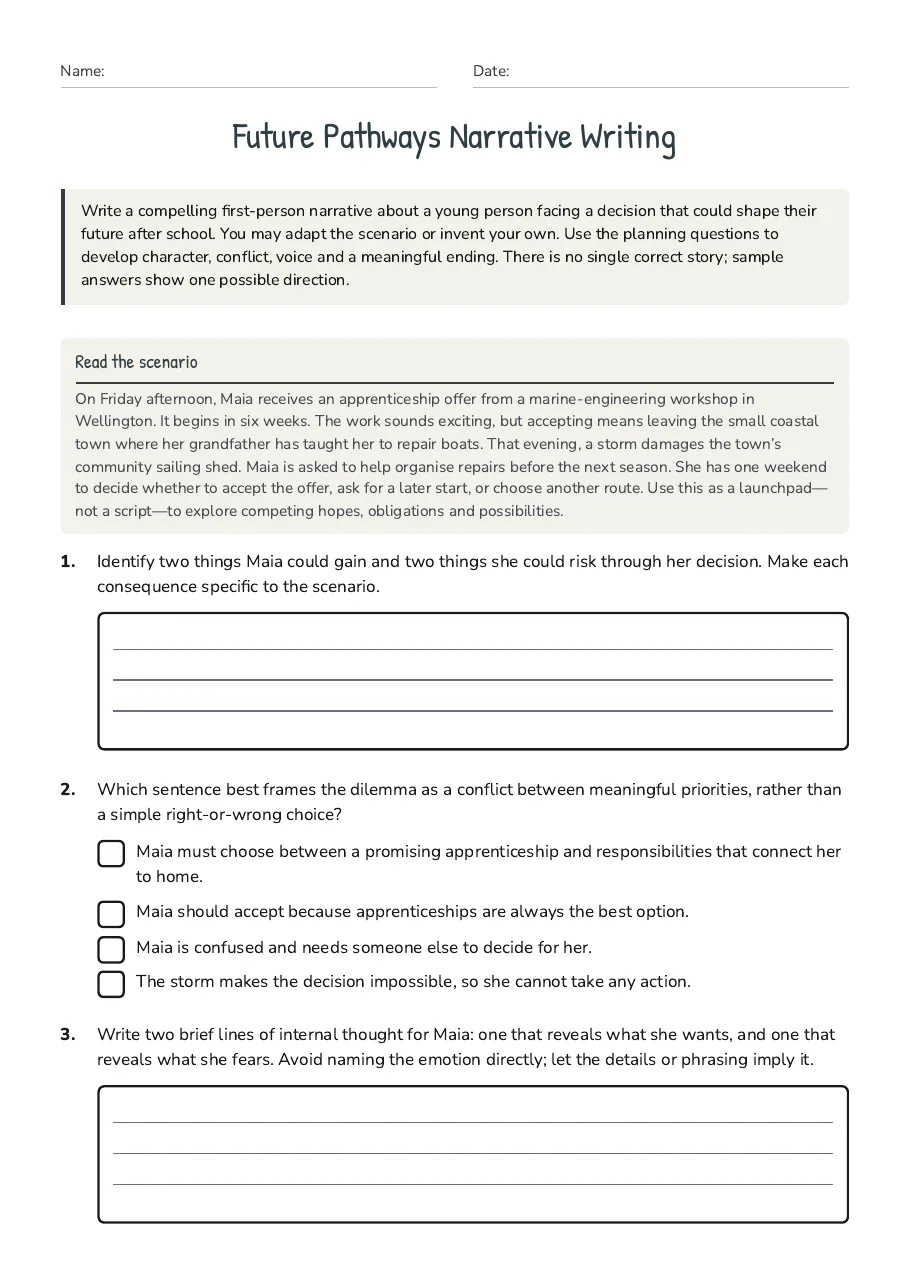
Future Pathways Narrative Writing

Write a compelling first-person narrative about a young person facing a decision that could shape their future after school. You may adapt the scenario or invent your own. Use the planning questions to develop character, conflict, voice and a meaningful ending. There is no single correct story; sample answers show one possible direction.

Read the scenario

On Friday afternoon, Maia receives an apprenticeship offer from a marine-engineering workshop in Wellington. It begins in six weeks. The work sounds exciting, but accepting means leaving the small coastal town where her grandfather has taught her to repair boats. That evening, a storm damages the town’s community sailing shed. Maia is asked to help organise repairs before the next season. She has one weekend to decide whether to accept the offer, ask for a later start, or choose another route. Use this as a launchpad—not a script—to explore competing hopes, obligations and possibilities.

1.Identify two things Maia could gain and two things she could risk through her decision. Make each consequence specific to the scenario.
2.Which sentence best frames the dilemma as a conflict between meaningful priorities, rather than a simple right-or-wrong choice?
  • Maia must choose between a promising apprenticeship and responsibilities that connect her to home.
  • Maia should accept because apprenticeships are always the best option.
  • Maia is confused and needs someone else to decide for her.
  • The storm makes the decision impossible, so she cannot take any action.
3.Write two brief lines of internal thought for Maia: one that reveals what she wants, and one that reveals what she fears. Avoid naming the emotion directly; let the details or phrasing imply it.
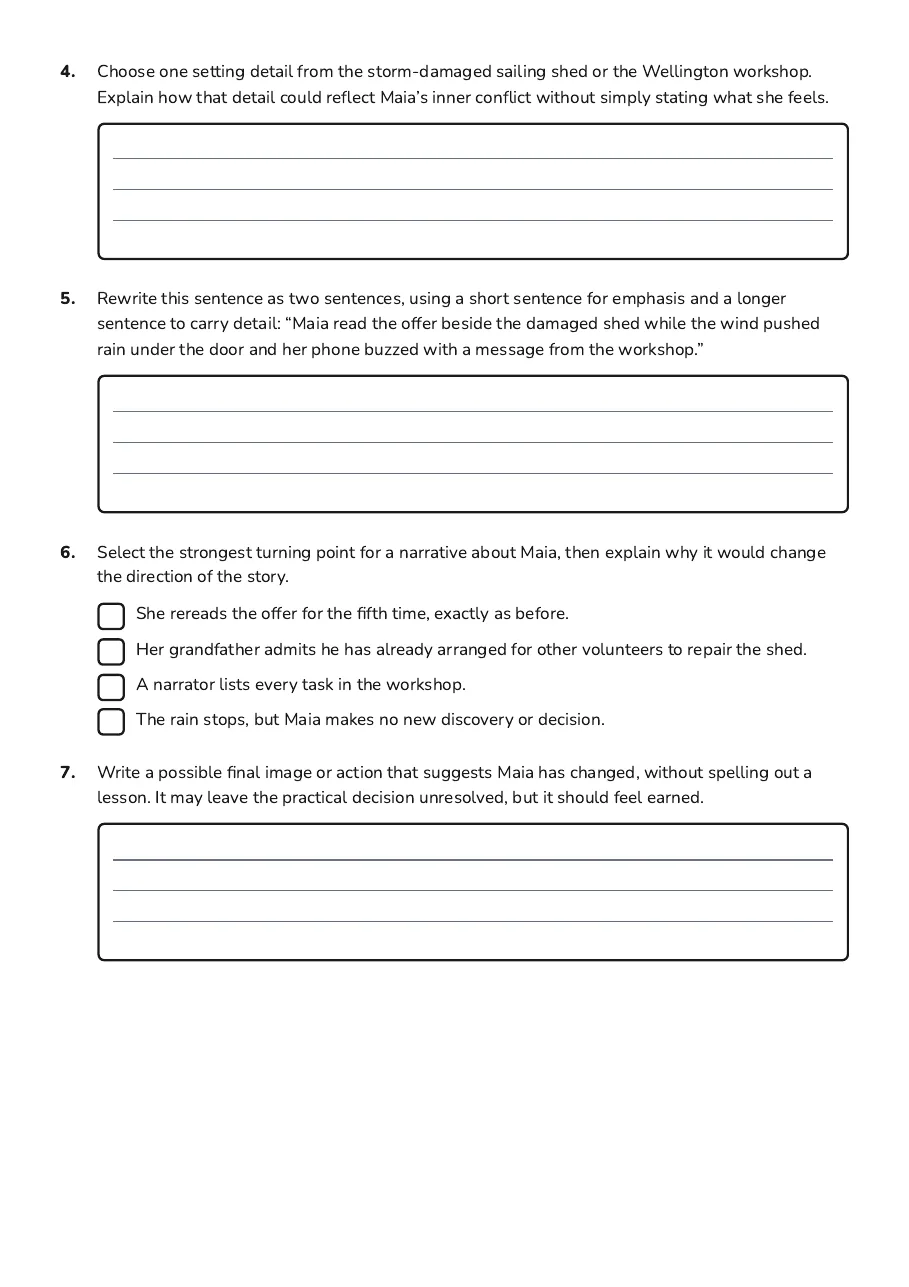
4.Choose one setting detail from the storm-damaged sailing shed or the Wellington workshop. Explain how that detail could reflect Maia’s inner conflict without simply stating what she feels.
5.Rewrite this sentence as two sentences, using a short sentence for emphasis and a longer sentence to carry detail: “Maia read the offer beside the damaged shed while the wind pushed rain under the door and her phone buzzed with a message from the workshop.”
6.Select the strongest turning point for a narrative about Maia, then explain why it would change the direction of the story.
  • She rereads the offer for the fifth time, exactly as before.
  • Her grandfather admits he has already arranged for other volunteers to repair the shed.
  • A narrator lists every task in the workshop.
  • The rain stops, but Maia makes no new discovery or decision.
7.Write a possible final image or action that suggests Maia has changed, without spelling out a lesson. It may leave the practical decision unresolved, but it should feel earned.
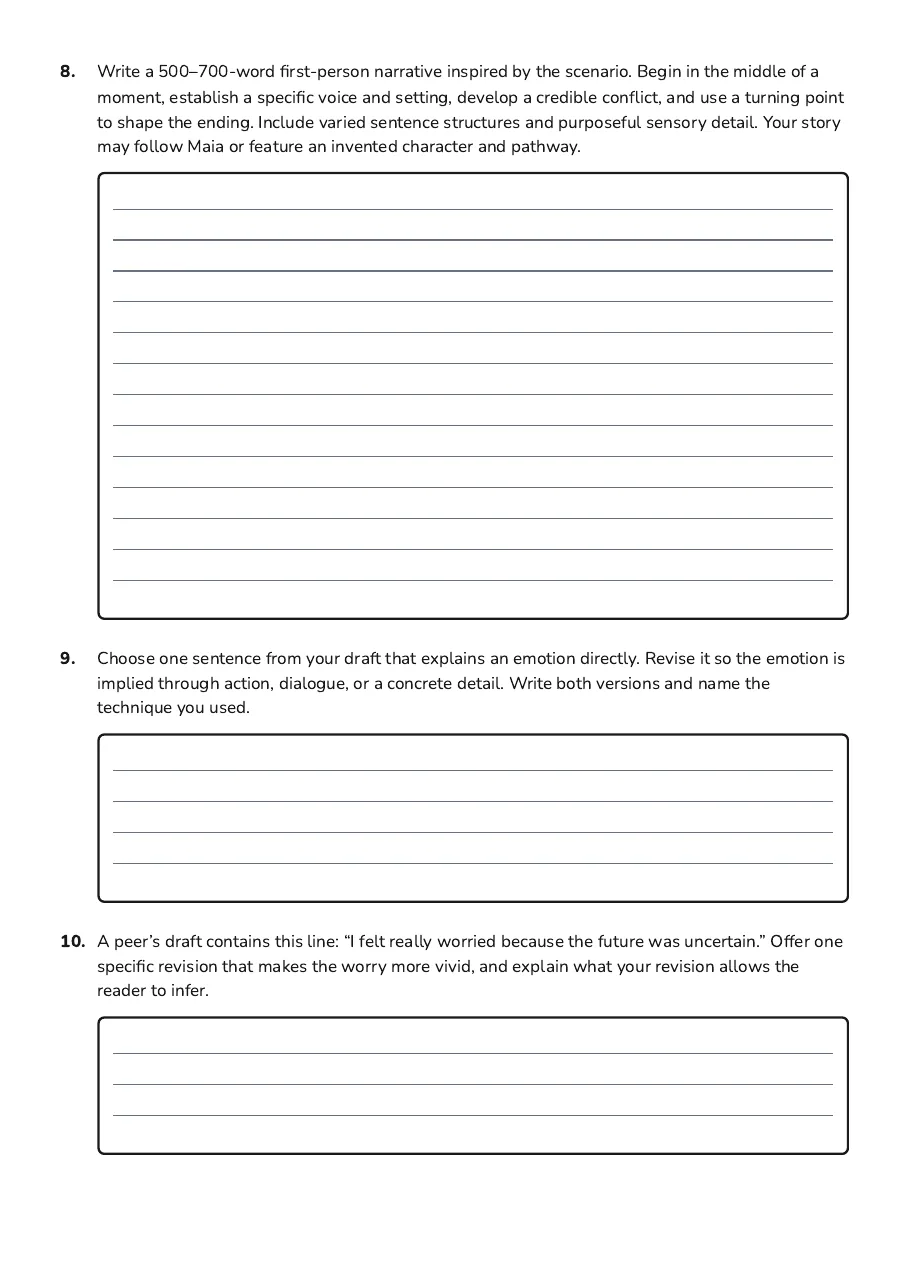
8.Write a 500–700-word first-person narrative inspired by the scenario. Begin in the middle of a moment, establish a specific voice and setting, develop a credible conflict, and use a turning point to shape the ending. Include varied sentence structures and purposeful sensory detail. Your story may follow Maia or feature an invented character and pathway.
9.Choose one sentence from your draft that explains an emotion directly. Revise it so the emotion is implied through action, dialogue, or a concrete detail. Write both versions and name the technique you used.
10.A peer’s draft contains this line: “I felt really worried because the future was uncertain.” Offer one specific revision that makes the worry more vivid, and explain what your revision allows the reader to infer.

3 printable pages

  • Future Pathways Narrative Writing, page 1 of 3: Read the scenario

    Page 1

  • Future Pathways Narrative Writing, page 2 of 3: 4. Choose one setting detail from the storm-damaged sailing shed or the Wellington…

    Page 2

  • Future Pathways Narrative Writing, page 3 of 3: 8. Write a 500–700-word first-person narrative inspired by the scenario. Begin in the…

    Page 3

About This Worksheet

Free in Kuraplan

Sign up free, grab the PDF, and customize it for your class.

Print-Ready

Formatted for standard paper. Clean layout, easy to read.

AI-Generated

Created with Kuraplan's AI, designed for real classroom use.

For Teachers & Parents

Use in classrooms, for homework, tutoring, or homeschool.

Need a custom version of this worksheet?

Kuraplan's AI generates custom worksheets in seconds — differentiated for every learner, aligned to your curriculum.

Generate Custom Worksheets — Free
No credit card Curriculum-aligned Under 60 seconds