EnglishFreePrintable

Narrative Structure Planning Worksheet

A free english worksheet ready for your classroom. Open in Kuraplan to grab the print-ready PDF, customize it for your students, or generate a fresh version in seconds.
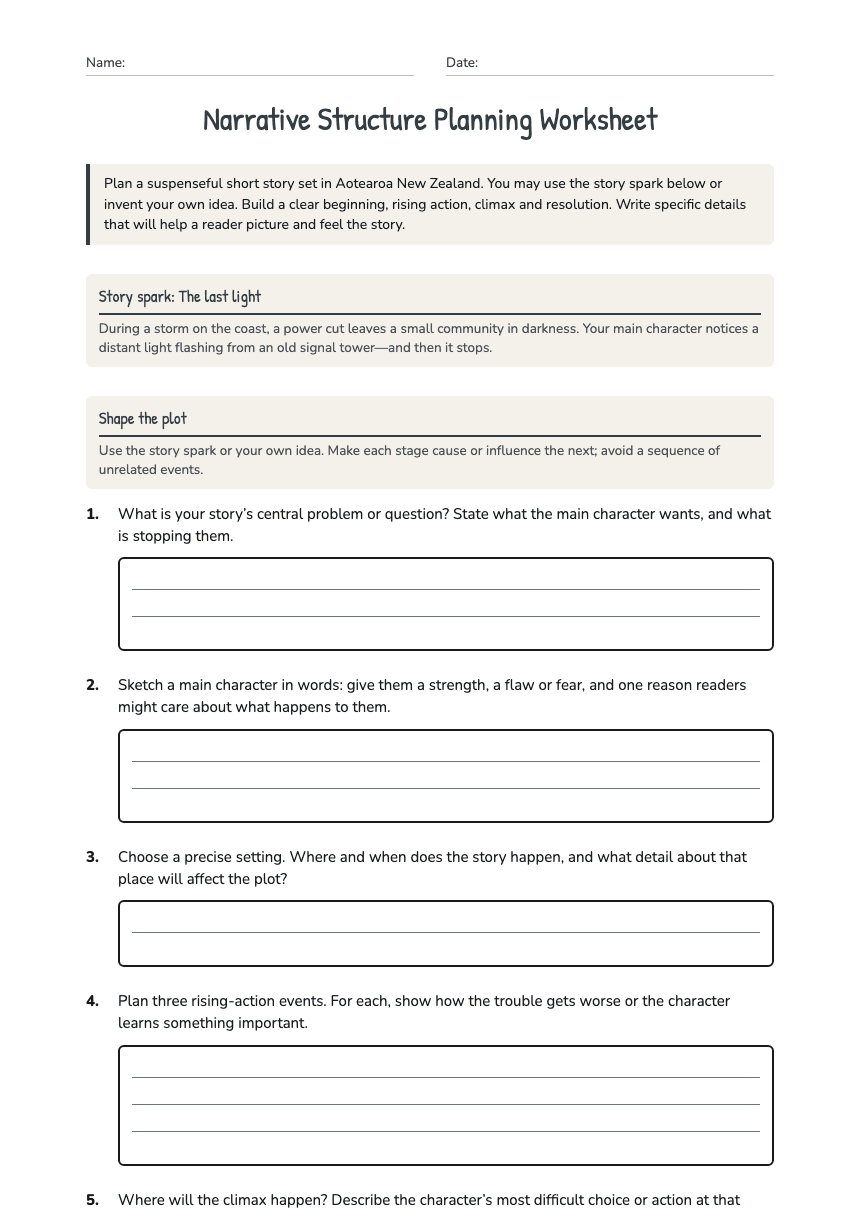
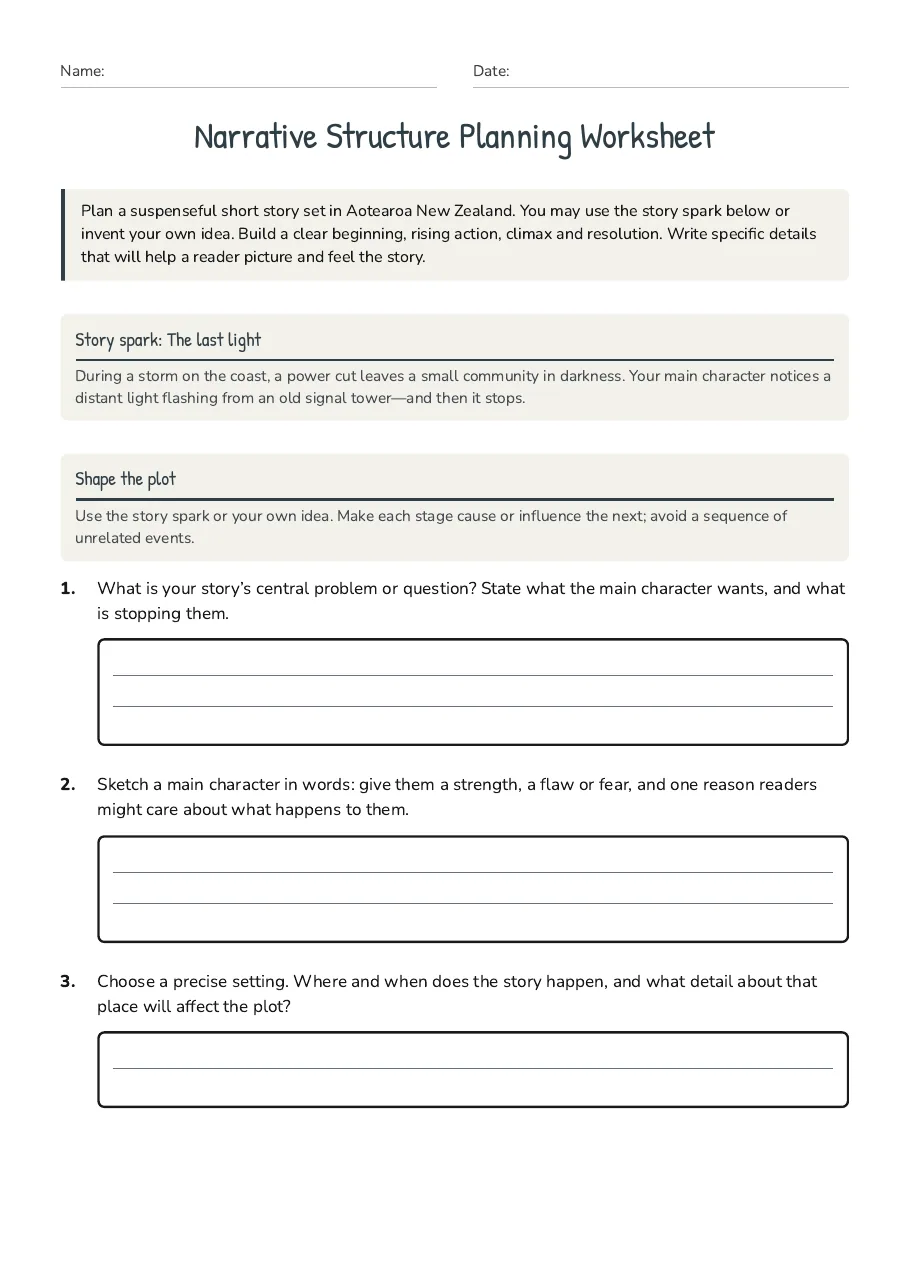
Narrative Structure Planning Worksheet worksheet preview
Name:Date:

Narrative Structure Planning Worksheet

Plan a suspenseful short story set in Aotearoa New Zealand. You may use the story spark below or invent your own idea. Build a clear beginning, rising action, climax and resolution. Write specific details that will help a reader picture and feel the story.

Story spark: The last light

During a storm on the coast, a power cut leaves a small community in darkness. Your main character notices a distant light flashing from an old signal tower—and then it stops.

Shape the plot

Use the story spark or your own idea. Make each stage cause or influence the next; avoid a sequence of unrelated events.

1.What is your story’s central problem or question? State what the main character wants, and what is stopping them.
2.Sketch a main character in words: give them a strength, a flaw or fear, and one reason readers might care about what happens to them.
3.Choose a precise setting. Where and when does the story happen, and what detail about that place will affect the plot?
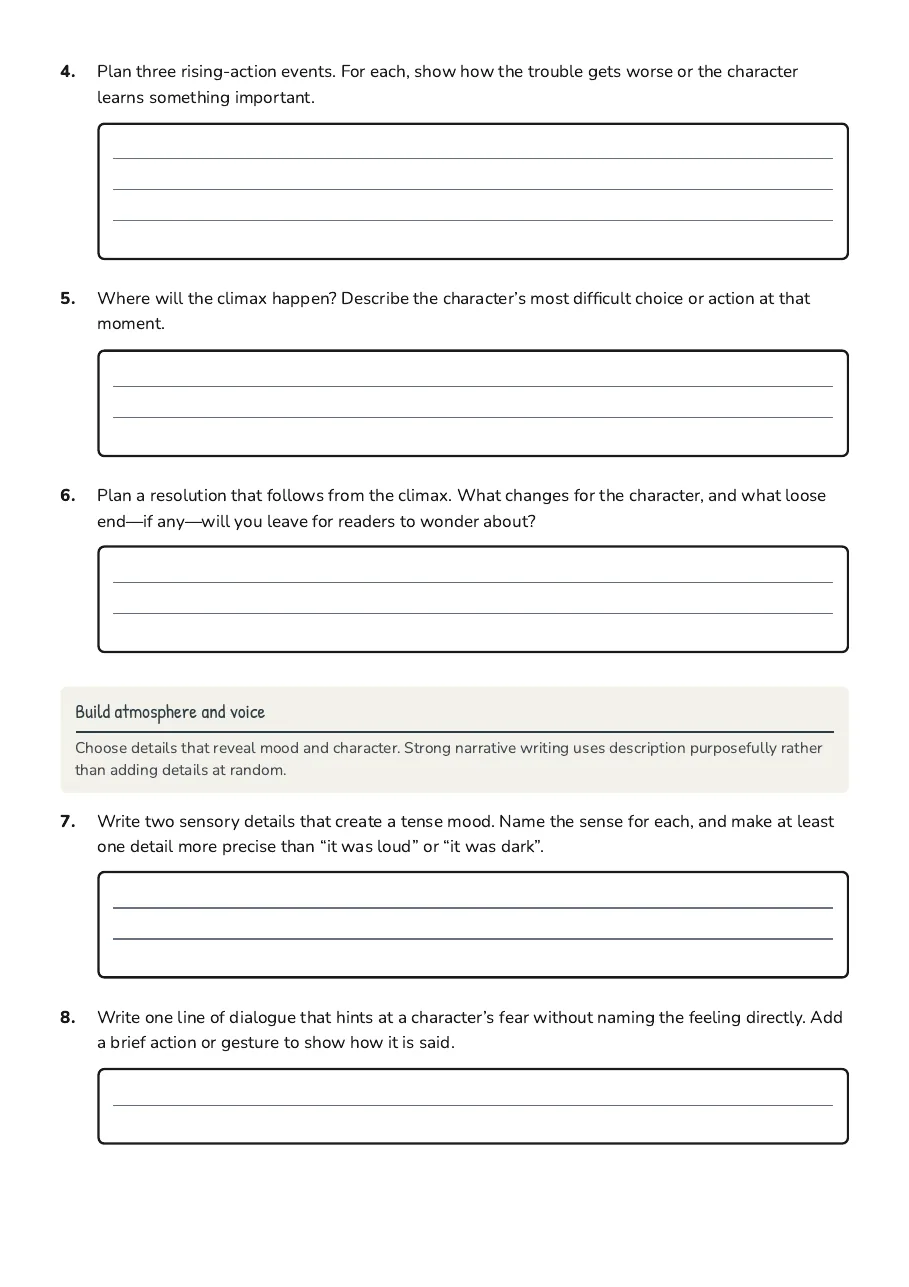
4.Plan three rising-action events. For each, show how the trouble gets worse or the character learns something important.
5.Where will the climax happen? Describe the character’s most difficult choice or action at that moment.
6.Plan a resolution that follows from the climax. What changes for the character, and what loose end—if any—will you leave for readers to wonder about?

Build atmosphere and voice

Choose details that reveal mood and character. Strong narrative writing uses description purposefully rather than adding details at random.

7.Write two sensory details that create a tense mood. Name the sense for each, and make at least one detail more precise than “it was loud” or “it was dark”.
8.Write one line of dialogue that hints at a character’s fear without naming the feeling directly. Add a brief action or gesture to show how it is said.
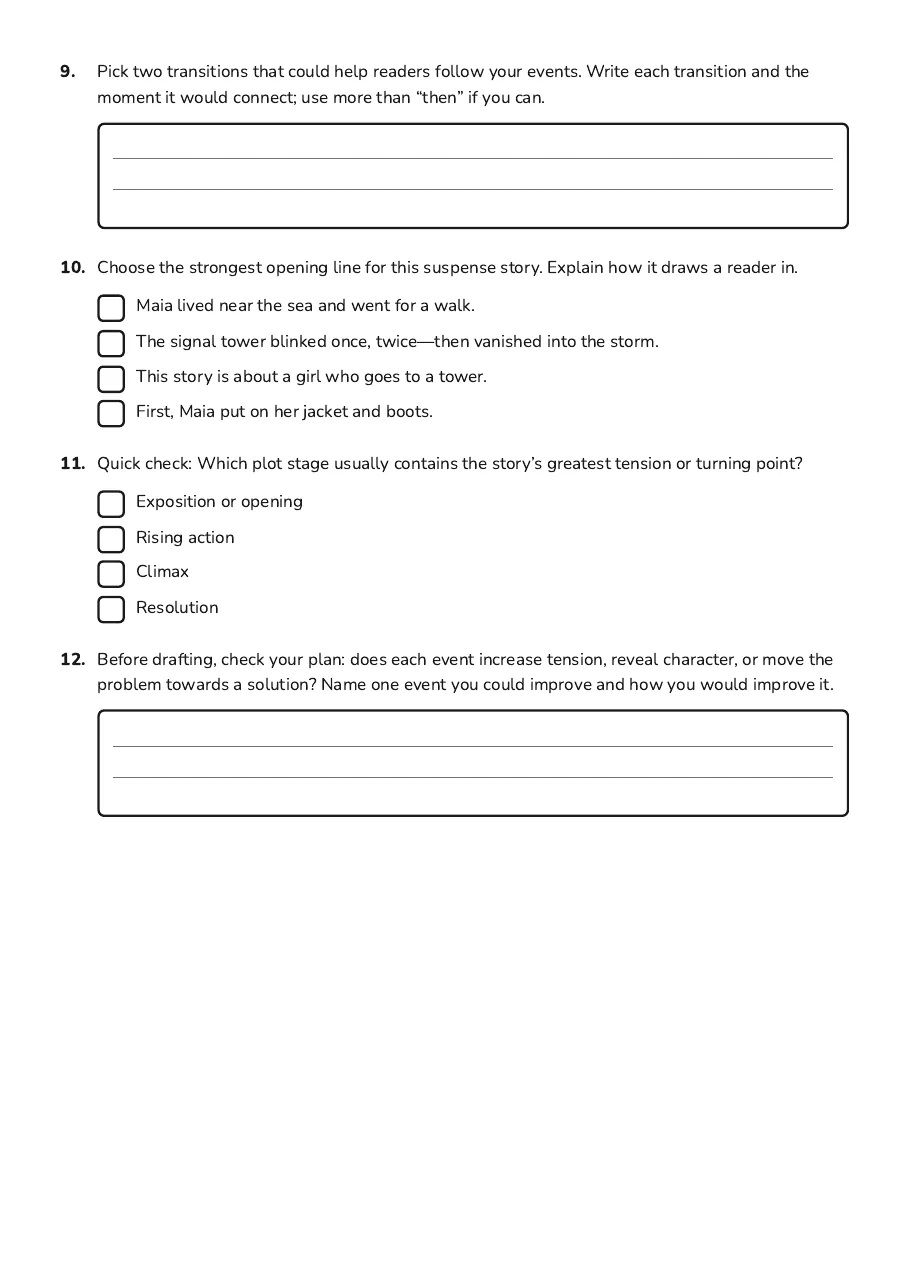
9.Pick two transitions that could help readers follow your events. Write each transition and the moment it would connect; use more than “then” if you can.
10.Choose the strongest opening line for this suspense story. Explain how it draws a reader in.
  • Maia lived near the sea and went for a walk.
  • The signal tower blinked once, twice—then vanished into the storm.
  • This story is about a girl who goes to a tower.
  • First, Maia put on her jacket and boots.
11.Quick check: Which plot stage usually contains the story’s greatest tension or turning point?
  • Exposition or opening
  • Rising action
  • Climax
  • Resolution
12.Before drafting, check your plan: does each event increase tension, reveal character, or move the problem towards a solution? Name one event you could improve and how you would improve it.

3 printable pages

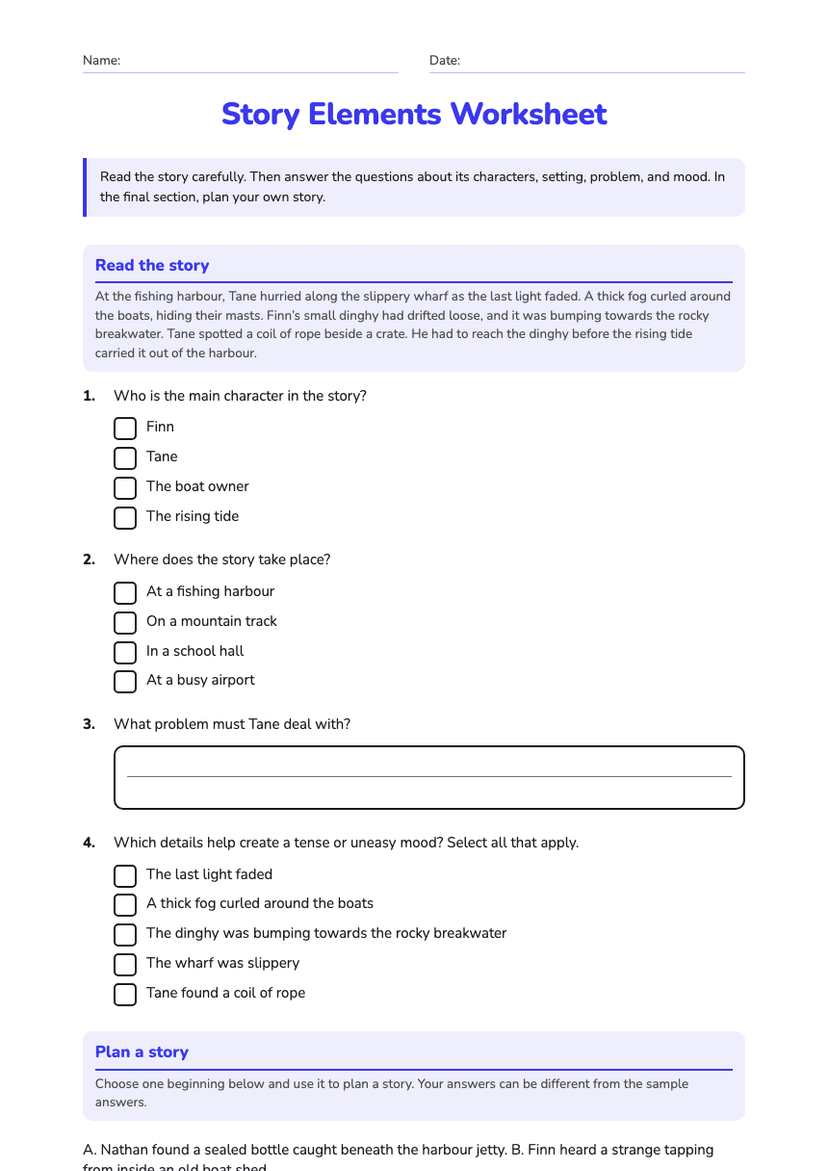
  • Narrative Structure Planning Worksheet, page 1 of 3: Story spark: The last light, Shape the plot

    Page 1

  • Narrative Structure Planning Worksheet, page 2 of 3: Build atmosphere and voice

    Page 2

  • Narrative Structure Planning Worksheet, page 3 of 3: 9. Pick two transitions that could help readers follow your events. Write each transition…

    Page 3

About This Worksheet

Free in Kuraplan

Sign up free, grab the PDF, and customize it for your class.

Print-Ready

Formatted for standard paper. Clean layout, easy to read.

AI-Generated

Created with Kuraplan's AI, designed for real classroom use.

For Teachers & Parents

Use in classrooms, for homework, tutoring, or homeschool.

Need a custom version of this worksheet?

Kuraplan's AI generates custom worksheets in seconds — differentiated for every learner, aligned to your curriculum.

Generate Custom Worksheets — Free
No credit card Curriculum-aligned Under 60 seconds