MathsFreePrintable

Geometry Communication Presentations

A free maths worksheet ready for your classroom. Open in Kuraplan to grab the print-ready PDF, customize it for your students, or generate a fresh version in seconds.
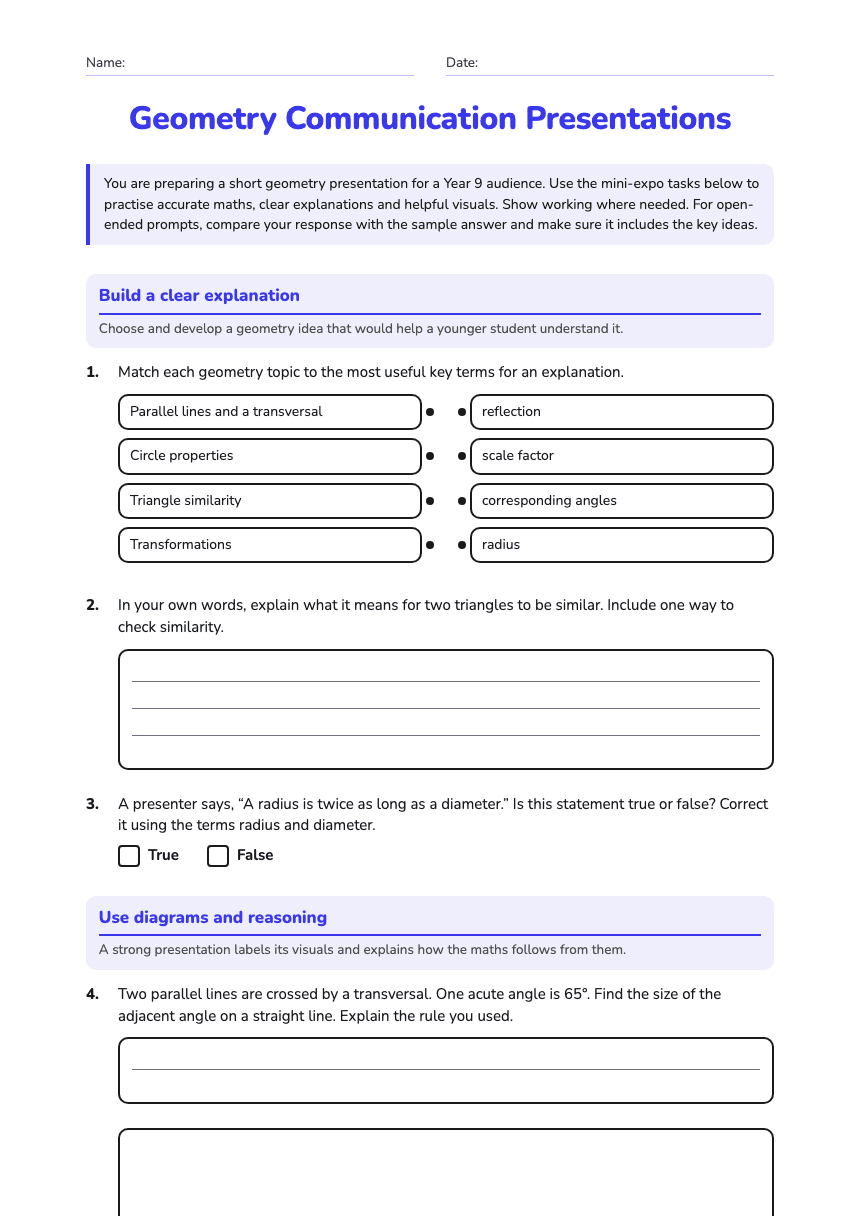
Geometry Communication Presentations worksheet preview
Name:Date:

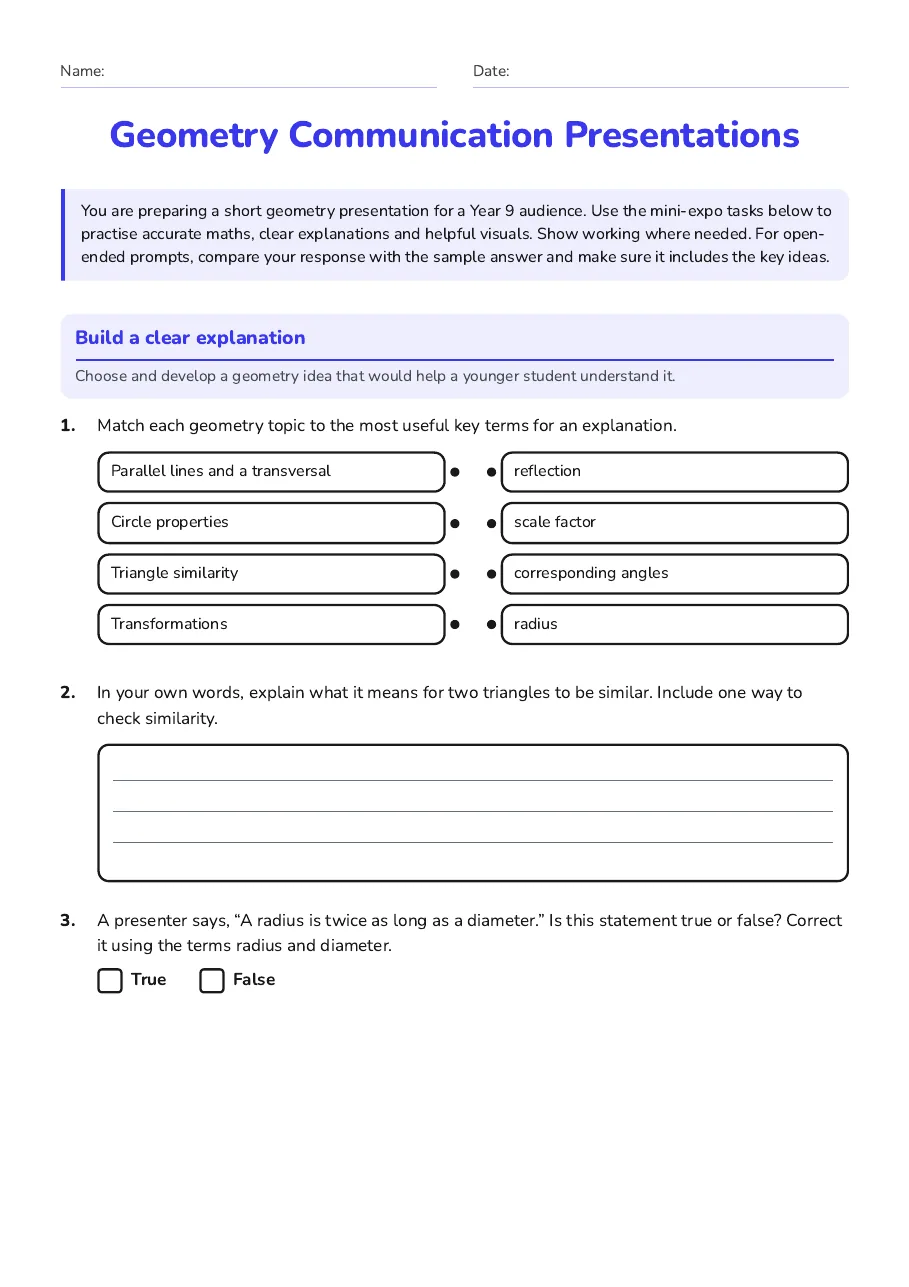
Geometry Communication Presentations

You are preparing a short geometry presentation for a Year 9 audience. Use the mini-expo tasks below to practise accurate maths, clear explanations and helpful visuals. Show working where needed. For open-ended prompts, compare your response with the sample answer and make sure it includes the key ideas.

Build a clear explanation

Choose and develop a geometry idea that would help a younger student understand it.

1.Match each geometry topic to the most useful key terms for an explanation.
  • Parallel lines and a transversal
  • Circle properties
  • Triangle similarity
  • Transformations
  • reflection
  • scale factor
  • corresponding angles
  • radius
2.In your own words, explain what it means for two triangles to be similar. Include one way to check similarity.
3.A presenter says, “A radius is twice as long as a diameter.” Is this statement true or false? Correct it using the terms radius and diameter.
TrueFalse

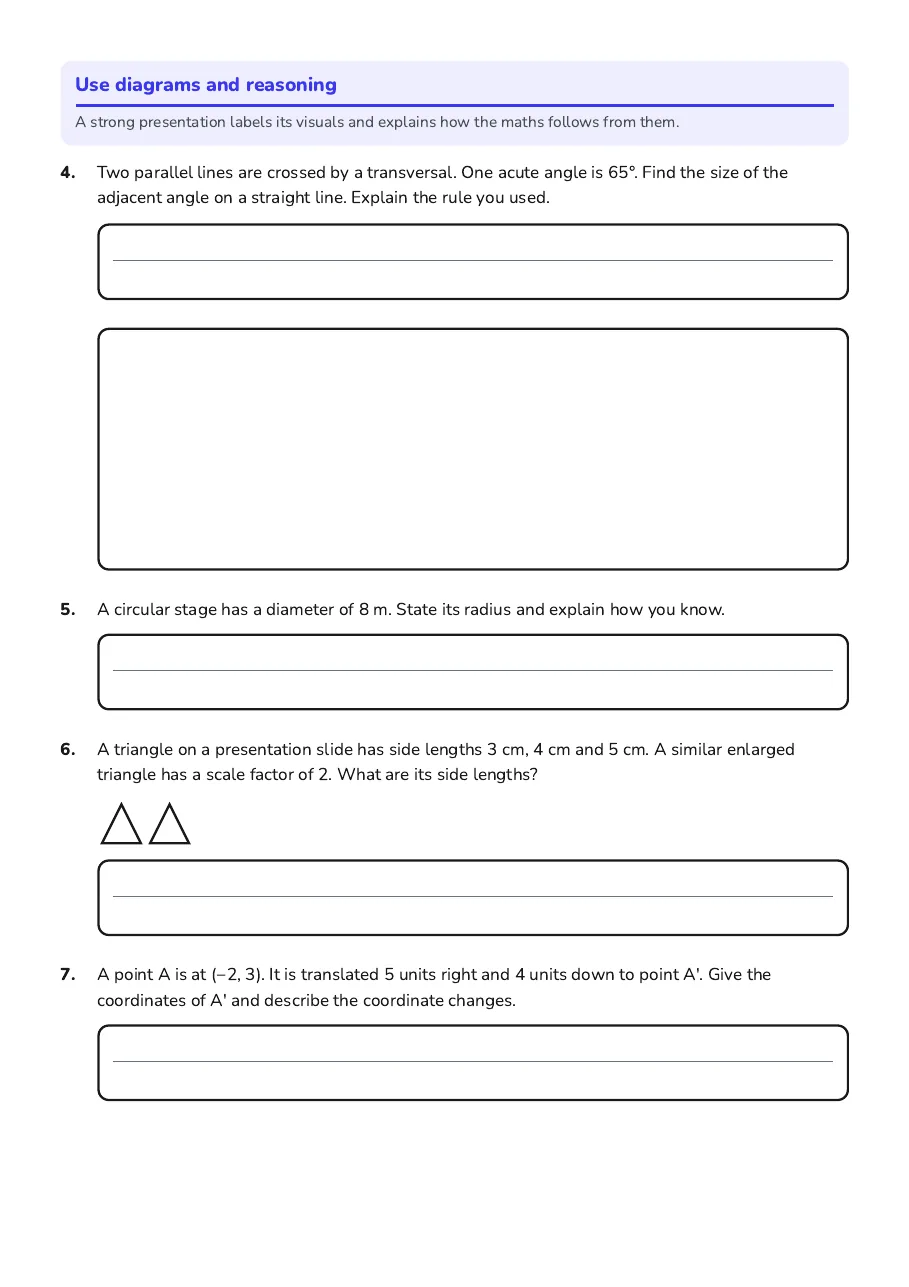
Use diagrams and reasoning

A strong presentation labels its visuals and explains how the maths follows from them.

4.Two parallel lines are crossed by a transversal. One acute angle is 65°. Find the size of the adjacent angle on a straight line. Explain the rule you used.
5.A circular stage has a diameter of 8 m. State its radius and explain how you know.
6.A triangle on a presentation slide has side lengths 3 cm, 4 cm and 5 cm. A similar enlarged triangle has a scale factor of 2. What are its side lengths?
7.A point A is at (−2, 3). It is translated 5 units right and 4 units down to point A′. Give the coordinates of A′ and describe the coordinate changes.

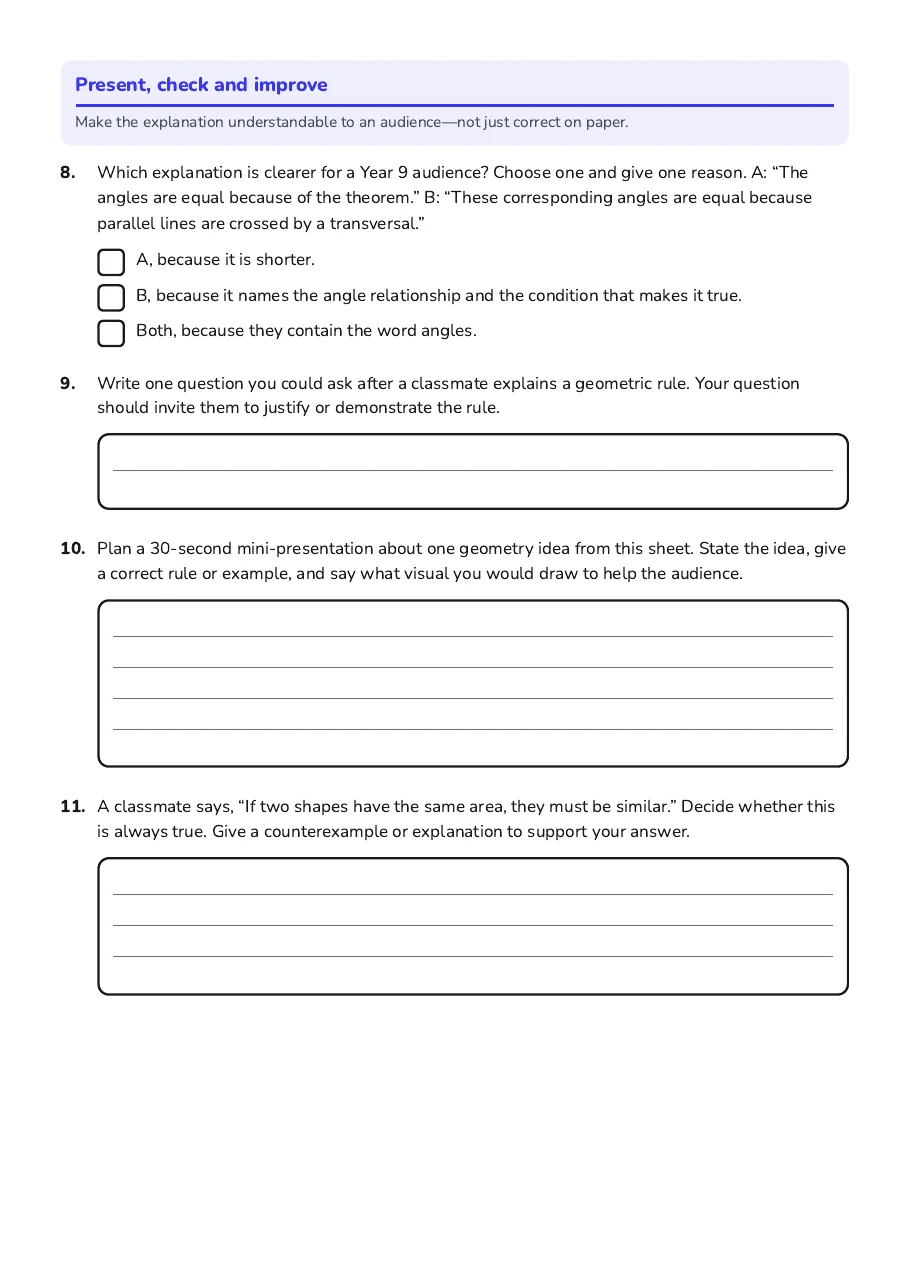
Present, check and improve

Make the explanation understandable to an audience—not just correct on paper.

8.Which explanation is clearer for a Year 9 audience? Choose one and give one reason. A: “The angles are equal because of the theorem.” B: “These corresponding angles are equal because parallel lines are crossed by a transversal.”
  • A, because it is shorter.
  • B, because it names the angle relationship and the condition that makes it true.
  • Both, because they contain the word angles.
9.Write one question you could ask after a classmate explains a geometric rule. Your question should invite them to justify or demonstrate the rule.
10.Plan a 30-second mini-presentation about one geometry idea from this sheet. State the idea, give a correct rule or example, and say what visual you would draw to help the audience.
11.A classmate says, “If two shapes have the same area, they must be similar.” Decide whether this is always true. Give a counterexample or explanation to support your answer.

3 printable pages

  • Geometry Communication Presentations, page 1 of 3: Build a clear explanation

    Page 1

  • Geometry Communication Presentations, page 2 of 3: Use diagrams and reasoning

    Page 2

  • Geometry Communication Presentations, page 3 of 3: Present, check and improve

    Page 3

About This Worksheet

Free in Kuraplan

Sign up free, grab the PDF, and customize it for your class.

Print-Ready

Formatted for standard paper. Clean layout, easy to read.

AI-Generated

Created with Kuraplan's AI, designed for real classroom use.

For Teachers & Parents

Use in classrooms, for homework, tutoring, or homeschool.

Need a custom version of this worksheet?

Kuraplan's AI generates custom worksheets in seconds — differentiated for every learner, aligned to your curriculum.

Generate Custom Worksheets — Free
No credit card Curriculum-aligned Under 60 seconds