Year 8 Geometry Unit
A free maths worksheet ready for your classroom. Open in Kuraplan to grab the print-ready PDF, customize it for your students, or generate a fresh version in seconds.
Year 8 Geometry Unit
📐 Part 1: Shape Classification and Properties
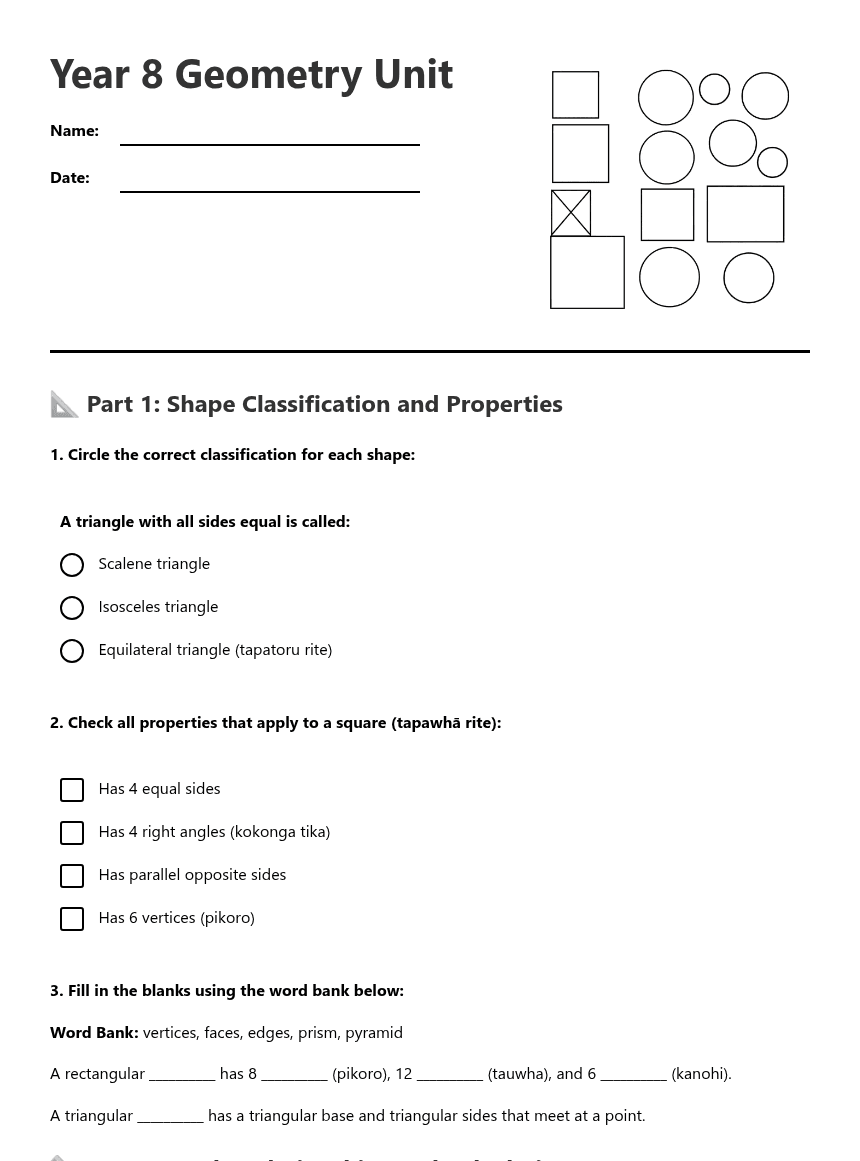
A triangle with all sides equal is called:
Scalene triangle Isosceles triangle Equilateral triangle (tapatoru rite)Word Bank: vertices, faces, edges, prism, pyramid
A rectangular __________ has 8 __________ (pikoro), 12 __________ (tauwha), and 6 __________ (kanohi).
A triangular __________ has a triangular base and triangular sides that meet at a point.
📏 Part 2: Angle Relationships and Calculations
a) Angles on a straight line: 65° + x = ___________
b) Angles at a point: 120° + 85° + y = ___________
c) Interior angles of a triangle: 45° + 60° + z = ___________
Vertically opposite angles are always equal:
True FalseThe sum of interior angles in any quadrilateral is 360°:
True FalseComplementary angles add up to 180°:
True False🎨 Part 3: Transformations and Cultural Patterns
Instructions: Start with triangle ABC at coordinates A(2,1), B(4,1), C(3,3)
a) Translate 3 units right and 2 units up (whakarereke)
b) Reflect across the y-axis (whakaata)
Which transformations create symmetrical patterns? (Check all that apply)
Reflection (whakaata) Rotation (hurihuri) Translation (whakarereke) Enlargement (whakarahi)📦 Part 4: 3D Visualisation and Nets
Rectangular prism: _____ faces, _____ edges, _____ vertices
Triangular pyramid: _____ faces, _____ edges, _____ vertices
🧭 Part 5: Coordinates and Navigation
A(1,2), B(4,2), C(4,5), D(1,5)
What shape have you created? _______________
From the school to the library: Walk 200m _______, then 150m _______
From the library to the park: Walk 100m _______, then 250m _______
If you face North and turn 90° clockwise, you are now facing:
South East West Northeast🔍 Part 6: Problem Solving and Real-World Applications
a) The perimeter of the floor: _______________
b) The area of the floor: _______________
c) If the roof makes a 45° angle with the walls, what type of angle is this? _______________
How do transformations help create beautiful patterns in Māori and Pacific art? Give at least two examples.
Design your own kōwhaiwhai pattern using at least two different transformations. Describe the transformations you used and explain how they create symmetry in your pattern.
About This Worksheet
Free in Kuraplan
Sign up free, grab the PDF, and customize it for your class.
Print-Ready
Formatted for standard paper. Clean layout, easy to read.
AI-Generated
Created with Kuraplan's AI, designed for real classroom use.
For Teachers & Parents
Use in classrooms, for homework, tutoring, or homeschool.
Need a custom version of this worksheet?
Kuraplan's AI generates custom worksheets in seconds — differentiated for every learner, aligned to your curriculum.
Generate Custom Worksheets — FreeMore Maths Worksheets
Compass Maps Worksheet
Free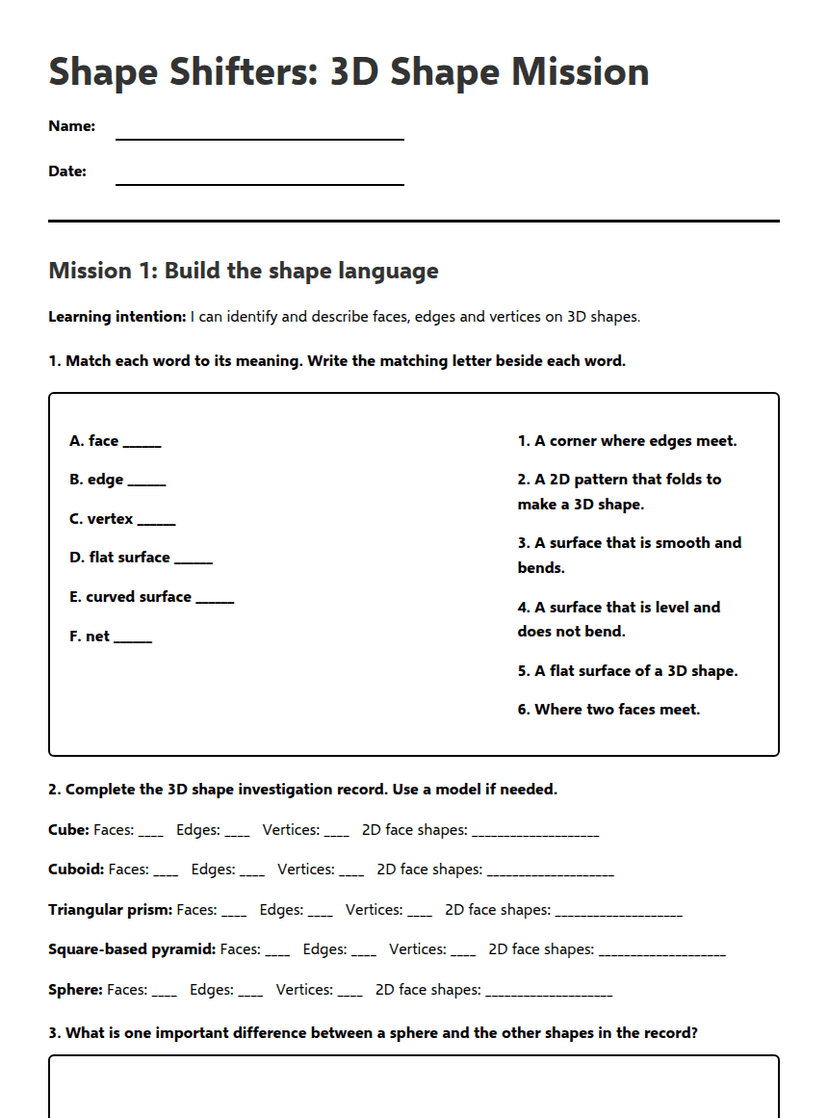
3D Shape Investigation Mission
Free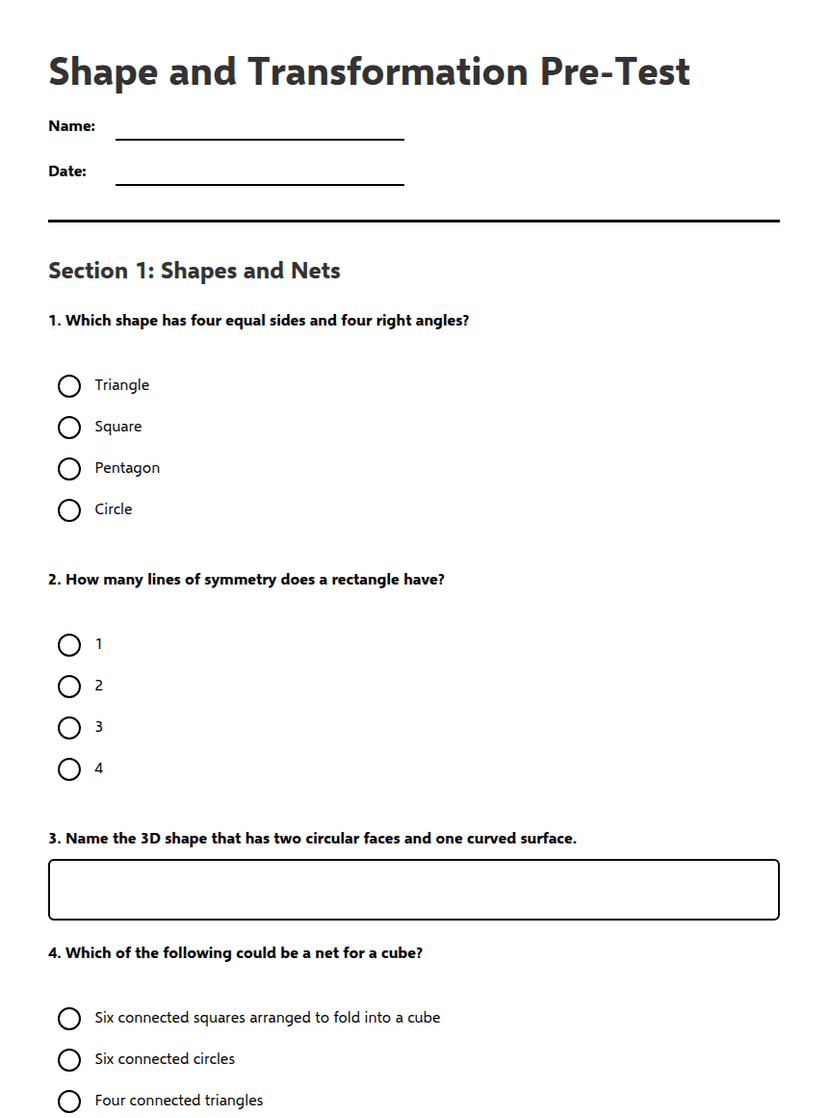
Shape and Transformation Pre-Test
Free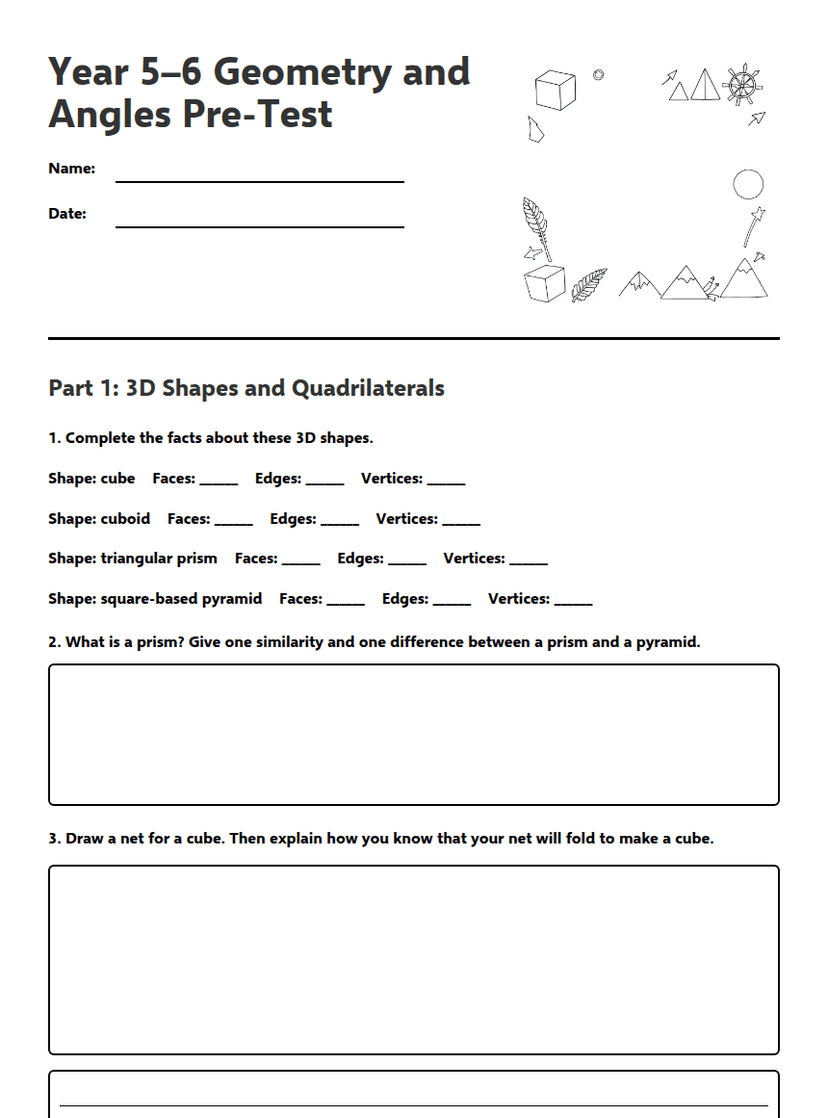
Geometry and Angles Pre-Test
Free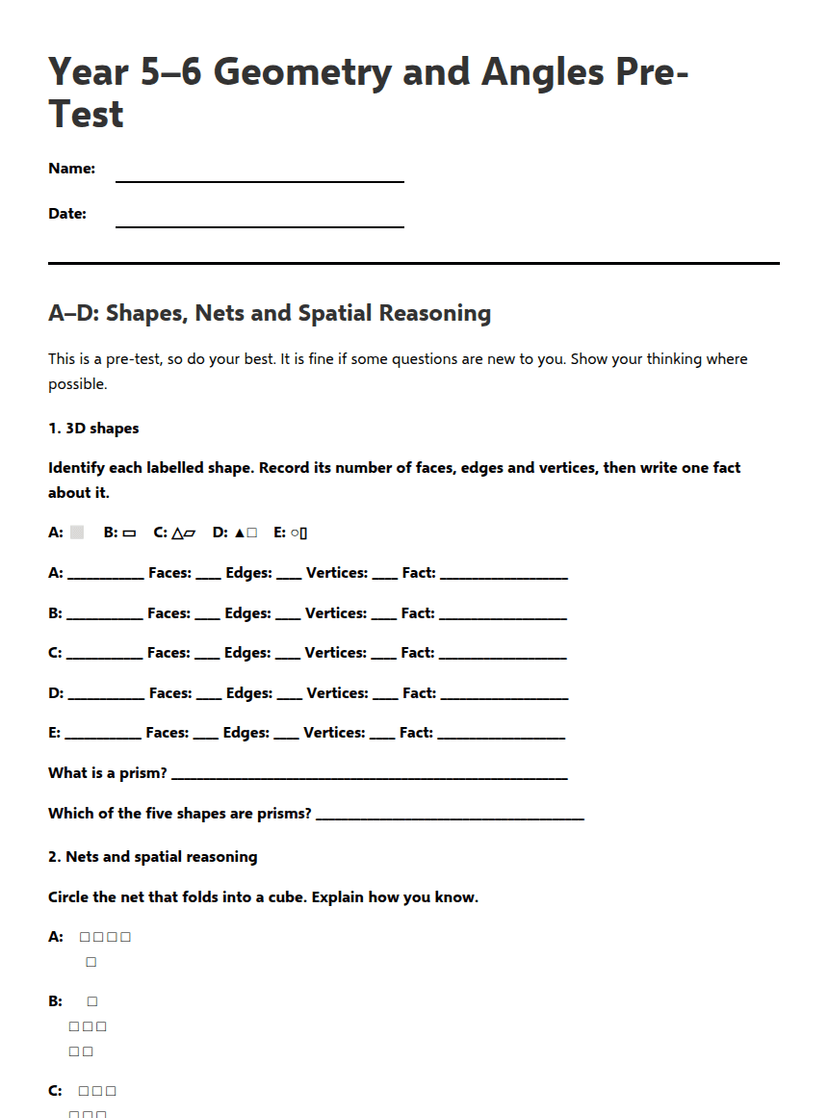
Year 5–6 Geometry Diagnostic Pre-Test
Free
Geometry and Angles Pre-Test
Free
Seeing 3D Shapes from Different Views
Free