ScienceFreePrintable

Grade 8 Earth Science Intro

A free science worksheet ready for your classroom. Open in Kuraplan to grab the print-ready PDF, customize it for your students, or generate a fresh version in seconds.
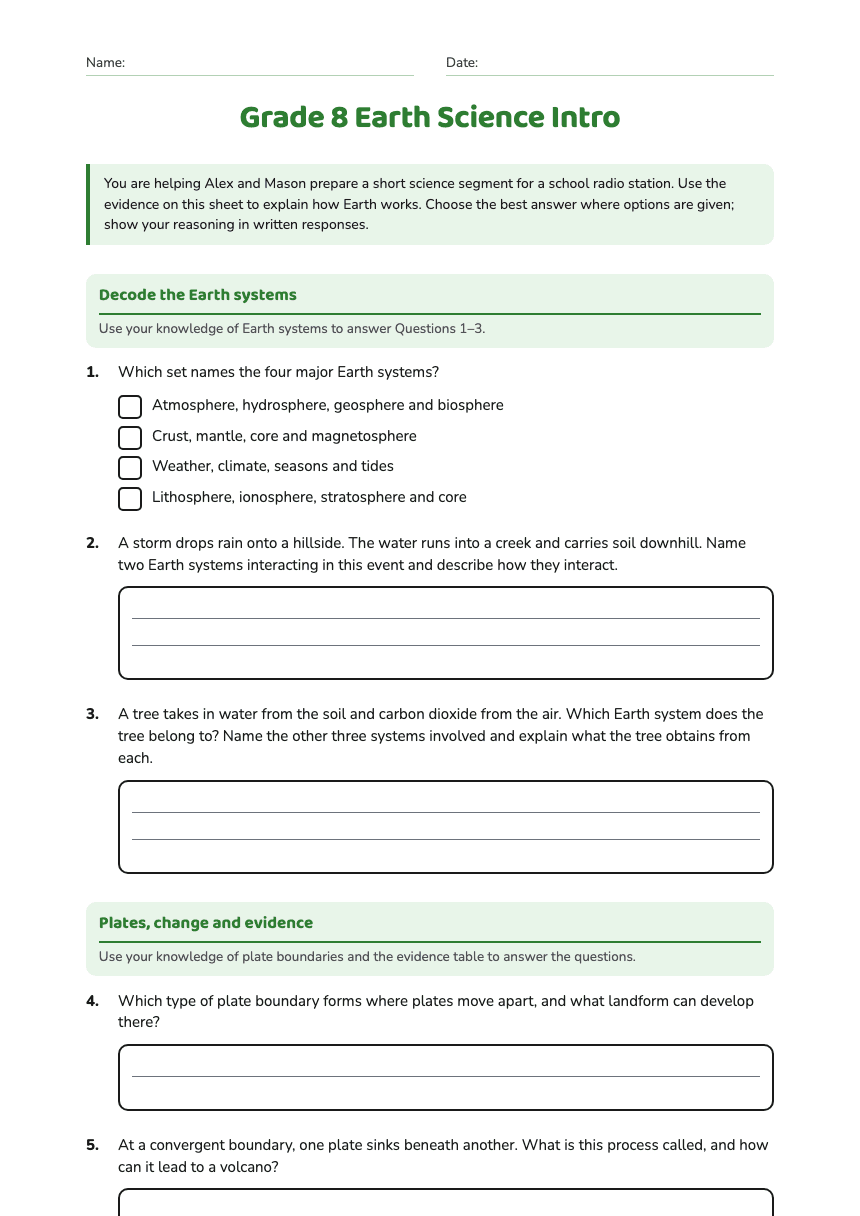
Grade 8 Earth Science Intro worksheet preview
Name:Date:

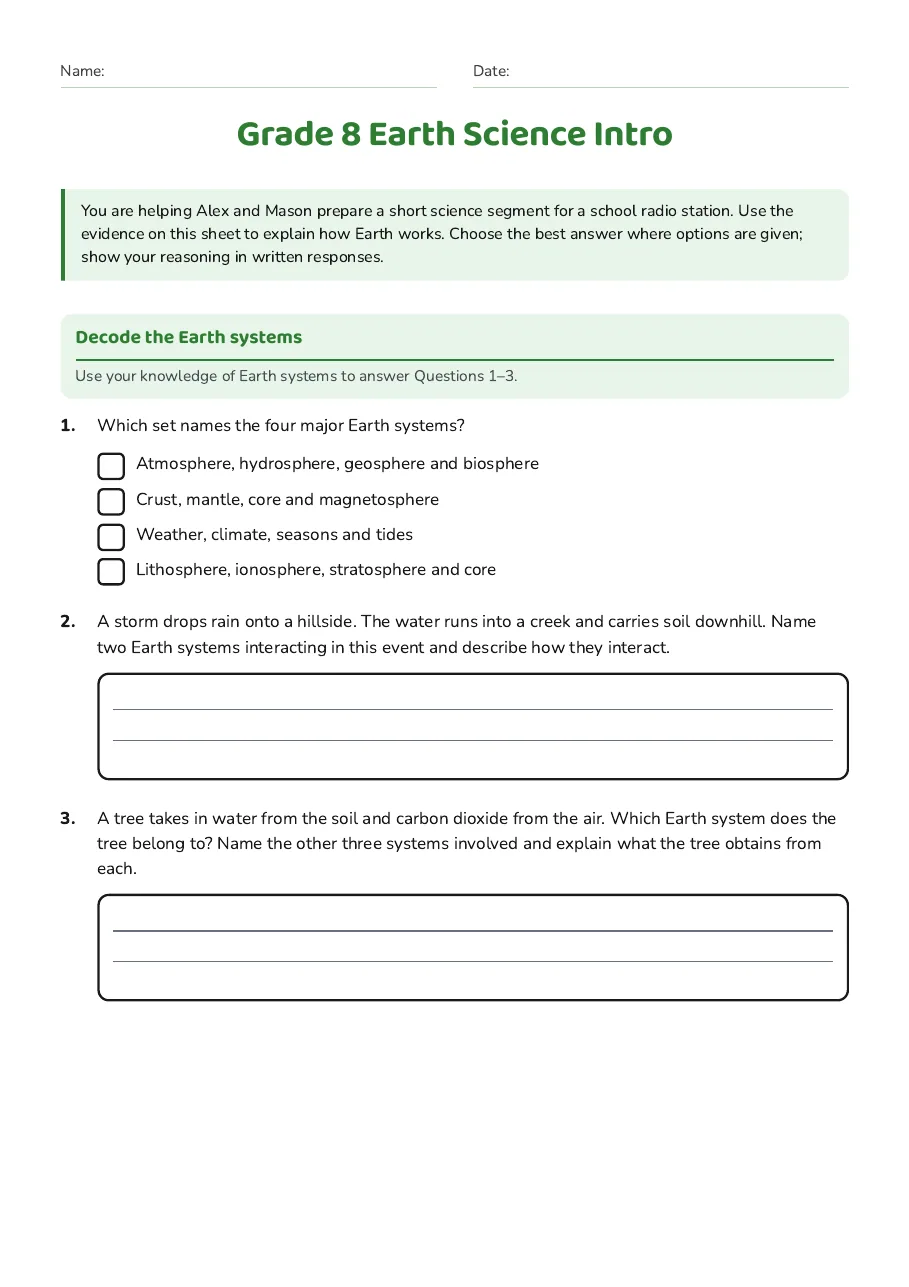
Grade 8 Earth Science Intro

You are helping Alex and Mason prepare a short science segment for a school radio station. Use the evidence on this sheet to explain how Earth works. Choose the best answer where options are given; show your reasoning in written responses.

Decode the Earth systems

Use your knowledge of Earth systems to answer Questions 1–3.

1.Which set names the four major Earth systems?
  • Atmosphere, hydrosphere, geosphere and biosphere
  • Crust, mantle, core and magnetosphere
  • Weather, climate, seasons and tides
  • Lithosphere, ionosphere, stratosphere and core
2.A storm drops rain onto a hillside. The water runs into a creek and carries soil downhill. Name two Earth systems interacting in this event and describe how they interact.
3.A tree takes in water from the soil and carbon dioxide from the air. Which Earth system does the tree belong to? Name the other three systems involved and explain what the tree obtains from each.

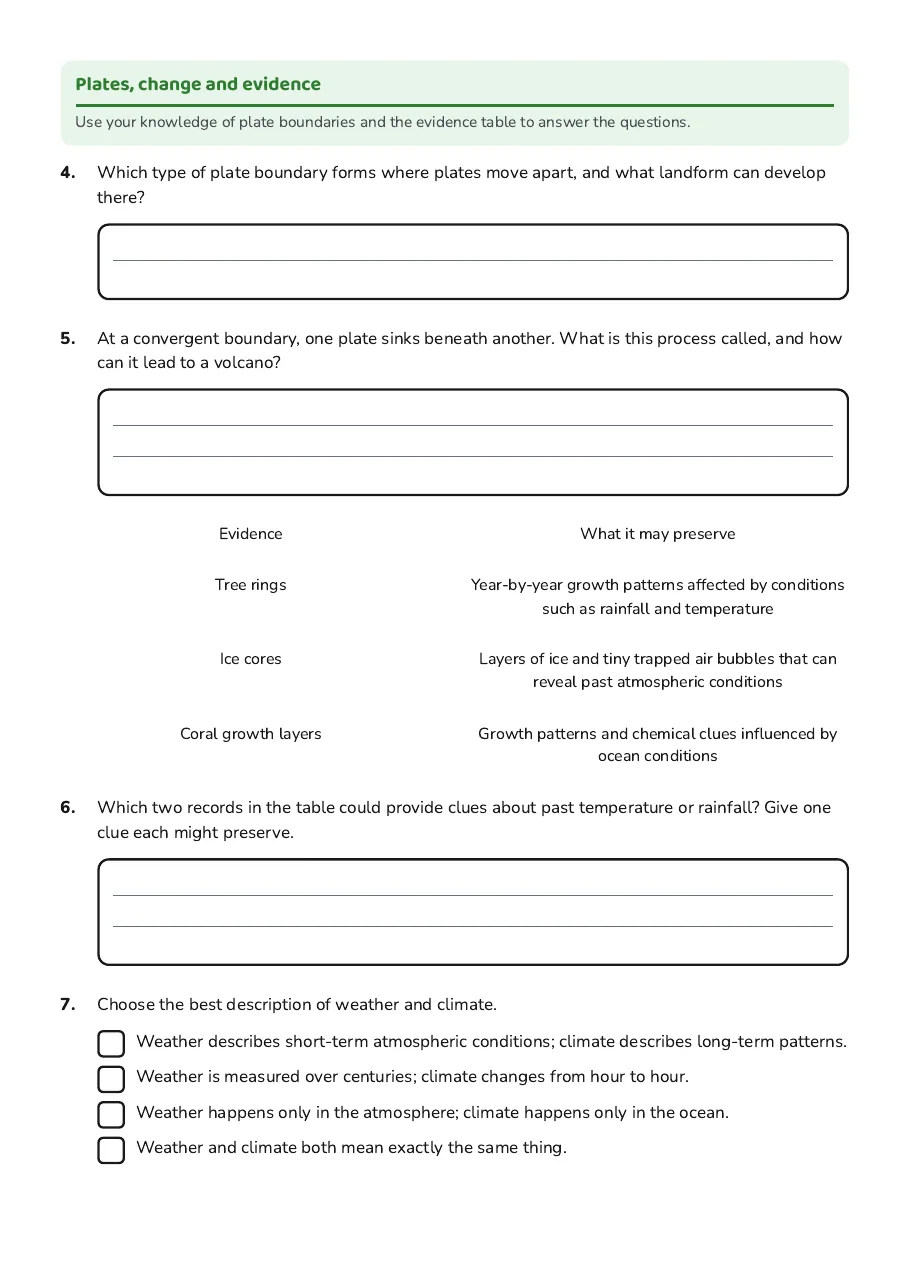
Plates, change and evidence

Use your knowledge of plate boundaries and the evidence table to answer the questions.

4.Which type of plate boundary forms where plates move apart, and what landform can develop there?
5.At a convergent boundary, one plate sinks beneath another. What is this process called, and how can it lead to a volcano?

Evidence

What it may preserve

Tree rings

Year-by-year growth patterns affected by conditions such as rainfall and temperature

Ice cores

Layers of ice and tiny trapped air bubbles that can reveal past atmospheric conditions

Coral growth layers

Growth patterns and chemical clues influenced by ocean conditions

6.Which two records in the table could provide clues about past temperature or rainfall? Give one clue each might preserve.
7.Choose the best description of weather and climate.
  • Weather describes short-term atmospheric conditions; climate describes long-term patterns.
  • Weather is measured over centuries; climate changes from hour to hour.
  • Weather happens only in the atmosphere; climate happens only in the ocean.
  • Weather and climate both mean exactly the same thing.
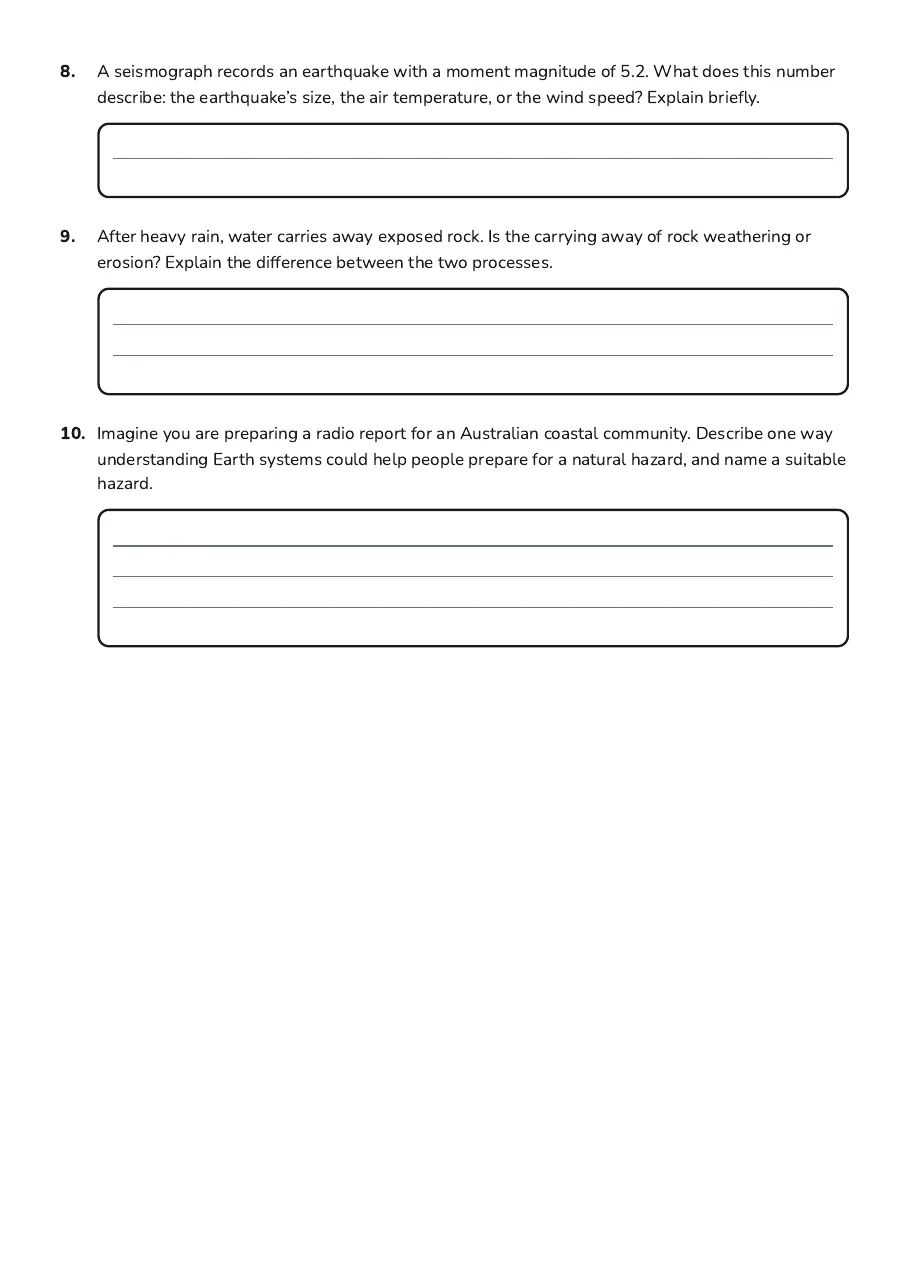
8.A seismograph records an earthquake with a moment magnitude of 5.2. What does this number describe: the earthquake’s size, the air temperature, or the wind speed? Explain briefly.
9.After heavy rain, water carries away exposed rock. Is the carrying away of rock weathering or erosion? Explain the difference between the two processes.
10.Imagine you are preparing a radio report for an Australian coastal community. Describe one way understanding Earth systems could help people prepare for a natural hazard, and name a suitable hazard.

3 printable pages

  • Grade 8 Earth Science Intro, page 1 of 3: Decode the Earth systems

    Page 1

  • Grade 8 Earth Science Intro, page 2 of 3: Plates, change and evidence

    Page 2

  • Grade 8 Earth Science Intro, page 3 of 3: 8. A seismograph records an earthquake with a moment magnitude of 5.2. What does this…

    Page 3

About This Worksheet

Free in Kuraplan

Sign up free, grab the PDF, and customize it for your class.

Print-Ready

Formatted for standard paper. Clean layout, easy to read.

AI-Generated

Created with Kuraplan's AI, designed for real classroom use.

For Teachers & Parents

Use in classrooms, for homework, tutoring, or homeschool.

Need a custom version of this worksheet?

Kuraplan's AI generates custom worksheets in seconds — differentiated for every learner, aligned to your curriculum.

Generate Custom Worksheets — Free
No credit card Curriculum-aligned Under 60 seconds