ScienceFreePrintable

Gravity and Black Holes

A free science worksheet ready for your classroom. Open in Kuraplan to grab the print-ready PDF, customize it for your students, or generate a fresh version in seconds.
Gravity and Black Holes worksheet preview
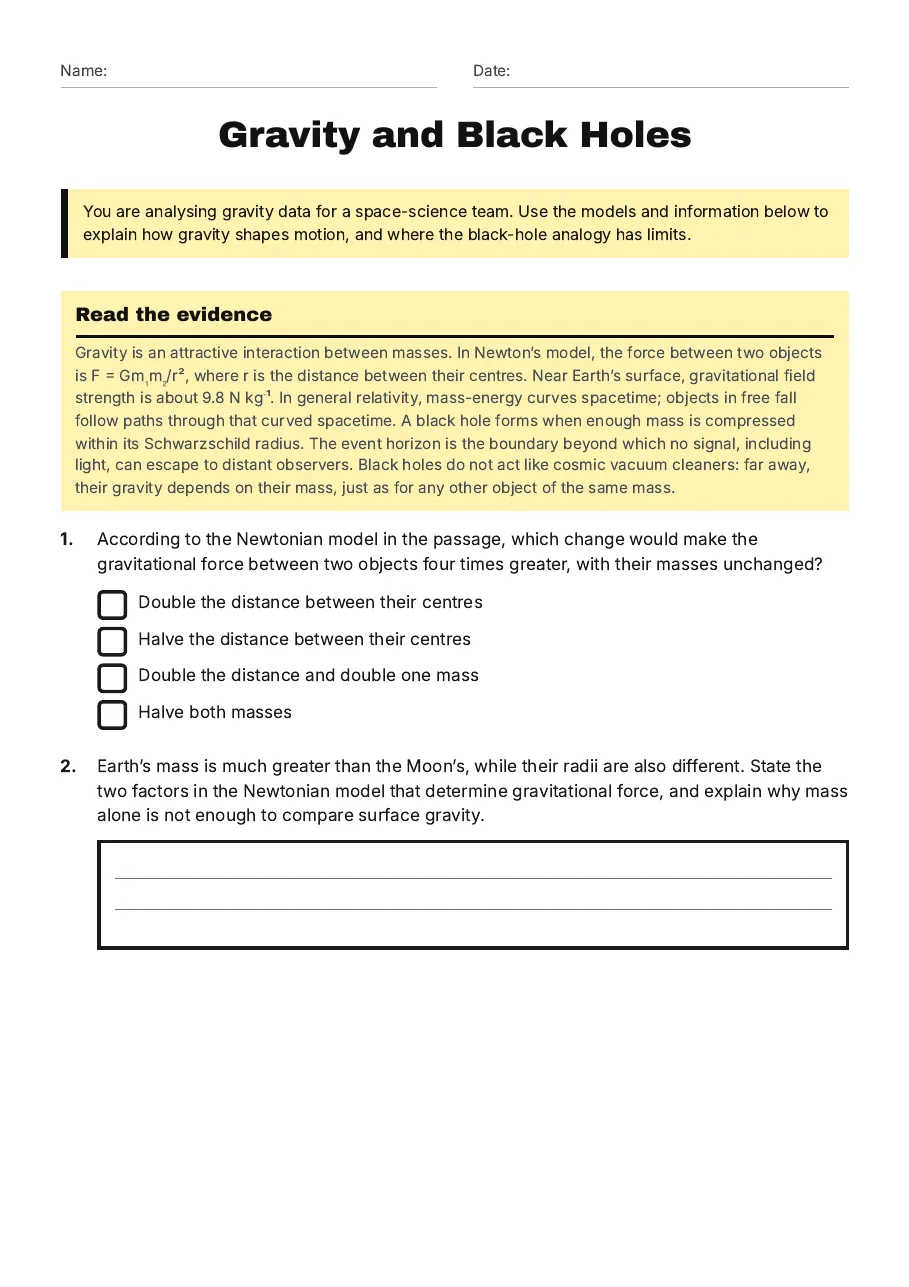
Name:Date:

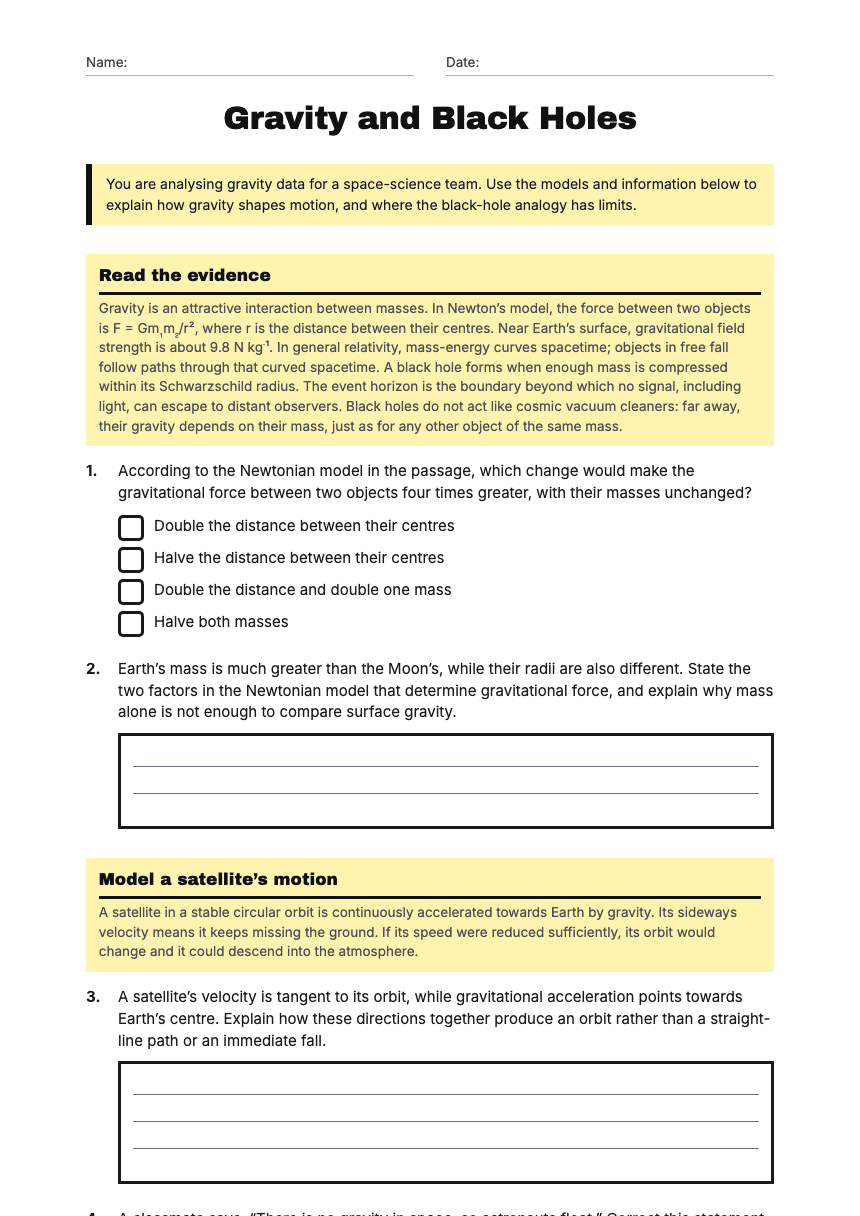
Gravity and Black Holes

You are analysing gravity data for a space-science team. Use the models and information below to explain how gravity shapes motion, and where the black-hole analogy has limits.

Read the evidence

Gravity is an attractive interaction between masses. In Newton’s model, the force between two objects is F = Gm₁m₂/r², where r is the distance between their centres. Near Earth’s surface, gravitational field strength is about 9.8 N kg⁻¹. In general relativity, mass-energy curves spacetime; objects in free fall follow paths through that curved spacetime. A black hole forms when enough mass is compressed within its Schwarzschild radius. The event horizon is the boundary beyond which no signal, including light, can escape to distant observers. Black holes do not act like cosmic vacuum cleaners: far away, their gravity depends on their mass, just as for any other object of the same mass.

1.According to the Newtonian model in the passage, which change would make the gravitational force between two objects four times greater, with their masses unchanged?
  • Double the distance between their centres
  • Halve the distance between their centres
  • Double the distance and double one mass
  • Halve both masses
2.Earth’s mass is much greater than the Moon’s, while their radii are also different. State the two factors in the Newtonian model that determine gravitational force, and explain why mass alone is not enough to compare surface gravity.

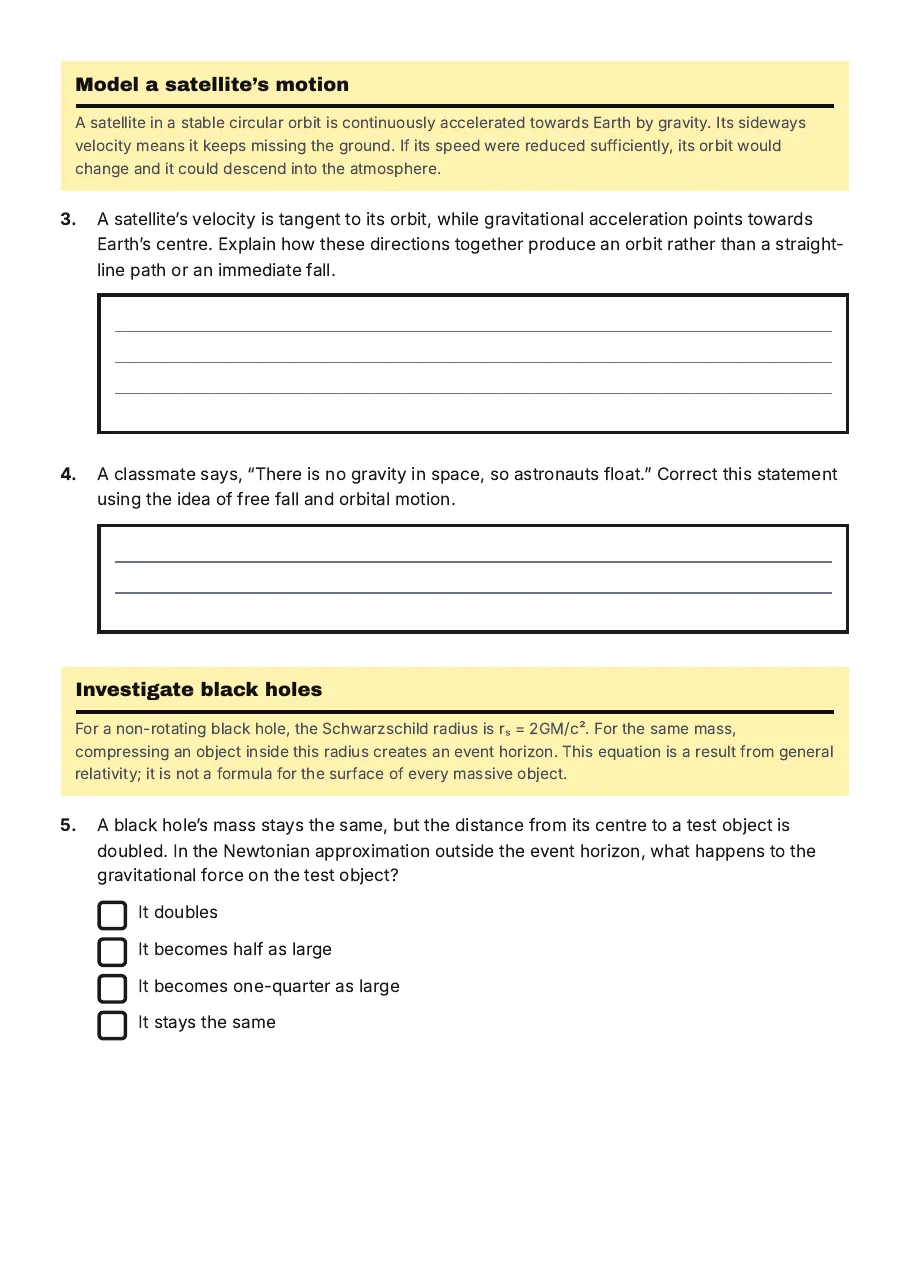
Model a satellite’s motion

A satellite in a stable circular orbit is continuously accelerated towards Earth by gravity. Its sideways velocity means it keeps missing the ground. If its speed were reduced sufficiently, its orbit would change and it could descend into the atmosphere.

3.A satellite’s velocity is tangent to its orbit, while gravitational acceleration points towards Earth’s centre. Explain how these directions together produce an orbit rather than a straight-line path or an immediate fall.
4.A classmate says, “There is no gravity in space, so astronauts float.” Correct this statement using the idea of free fall and orbital motion.

Investigate black holes

For a non-rotating black hole, the Schwarzschild radius is rₛ = 2GM/c². For the same mass, compressing an object inside this radius creates an event horizon. This equation is a result from general relativity; it is not a formula for the surface of every massive object.

5.A black hole’s mass stays the same, but the distance from its centre to a test object is doubled. In the Newtonian approximation outside the event horizon, what happens to the gravitational force on the test object?
  • It doubles
  • It becomes half as large
  • It becomes one-quarter as large
  • It stays the same
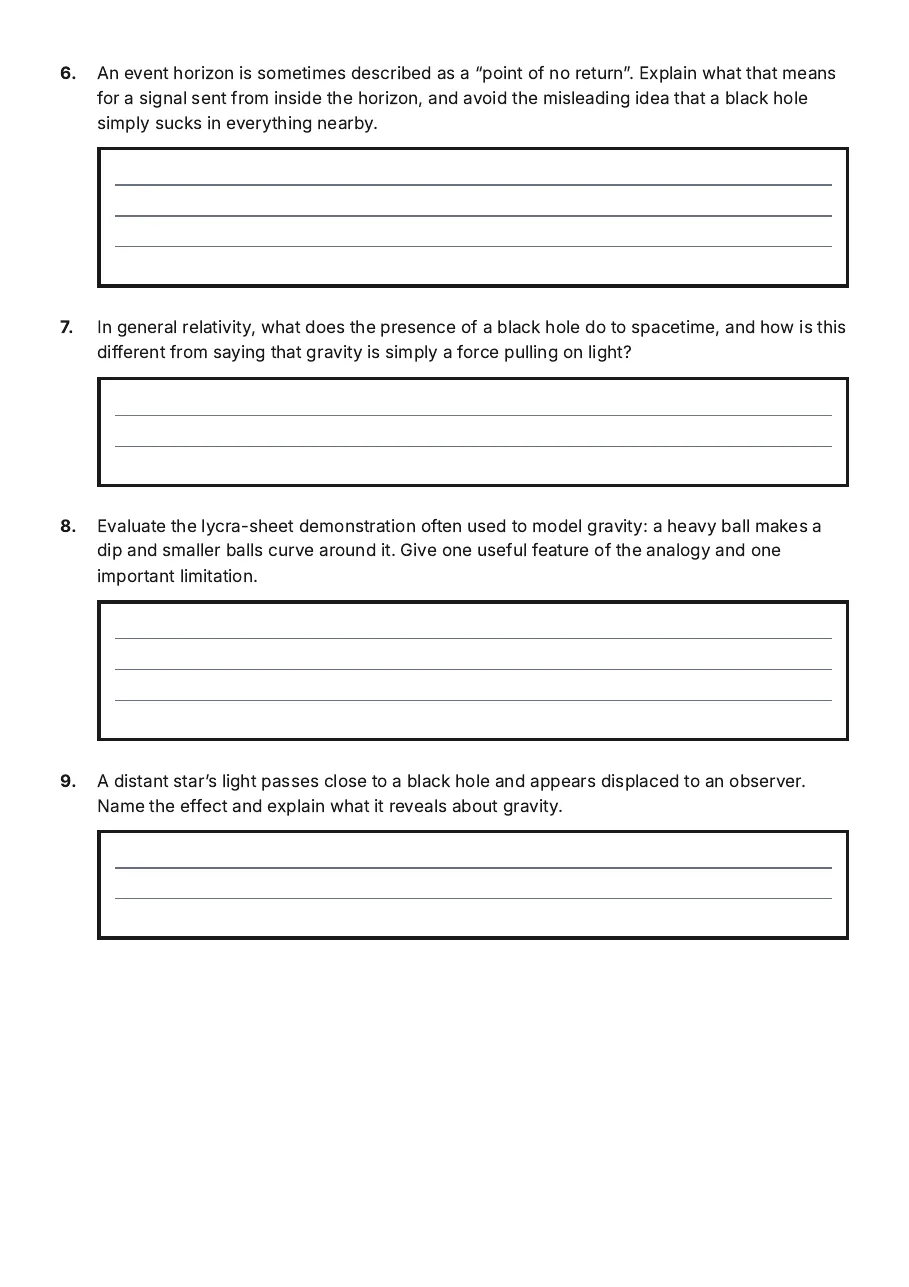
6.An event horizon is sometimes described as a “point of no return”. Explain what that means for a signal sent from inside the horizon, and avoid the misleading idea that a black hole simply sucks in everything nearby.
7.In general relativity, what does the presence of a black hole do to spacetime, and how is this different from saying that gravity is simply a force pulling on light?
8.Evaluate the lycra-sheet demonstration often used to model gravity: a heavy ball makes a dip and smaller balls curve around it. Give one useful feature of the analogy and one important limitation.
9.A distant star’s light passes close to a black hole and appears displaced to an observer. Name the effect and explain what it reveals about gravity.

3 printable pages

  • Gravity and Black Holes, page 1 of 3: Read the evidence

    Page 1

  • Gravity and Black Holes, page 2 of 3: Model a satellite’s motion, Investigate black holes

    Page 2

  • Gravity and Black Holes, page 3 of 3: 6. An event horizon is sometimes described as a “point of no return”. Explain what that…

    Page 3

About This Worksheet

Free in Kuraplan

Sign up free, grab the PDF, and customize it for your class.

Print-Ready

Formatted for standard paper. Clean layout, easy to read.

AI-Generated

Created with Kuraplan's AI, designed for real classroom use.

For Teachers & Parents

Use in classrooms, for homework, tutoring, or homeschool.

Need a custom version of this worksheet?

Kuraplan's AI generates custom worksheets in seconds — differentiated for every learner, aligned to your curriculum.

Generate Custom Worksheets — Free
No credit card Curriculum-aligned Under 60 seconds