Haka Across Pacific Cultures
A free te reo māori worksheet ready for your classroom. Open in Kuraplan to grab the print-ready PDF, customize it for your students, or generate a fresh version in seconds.
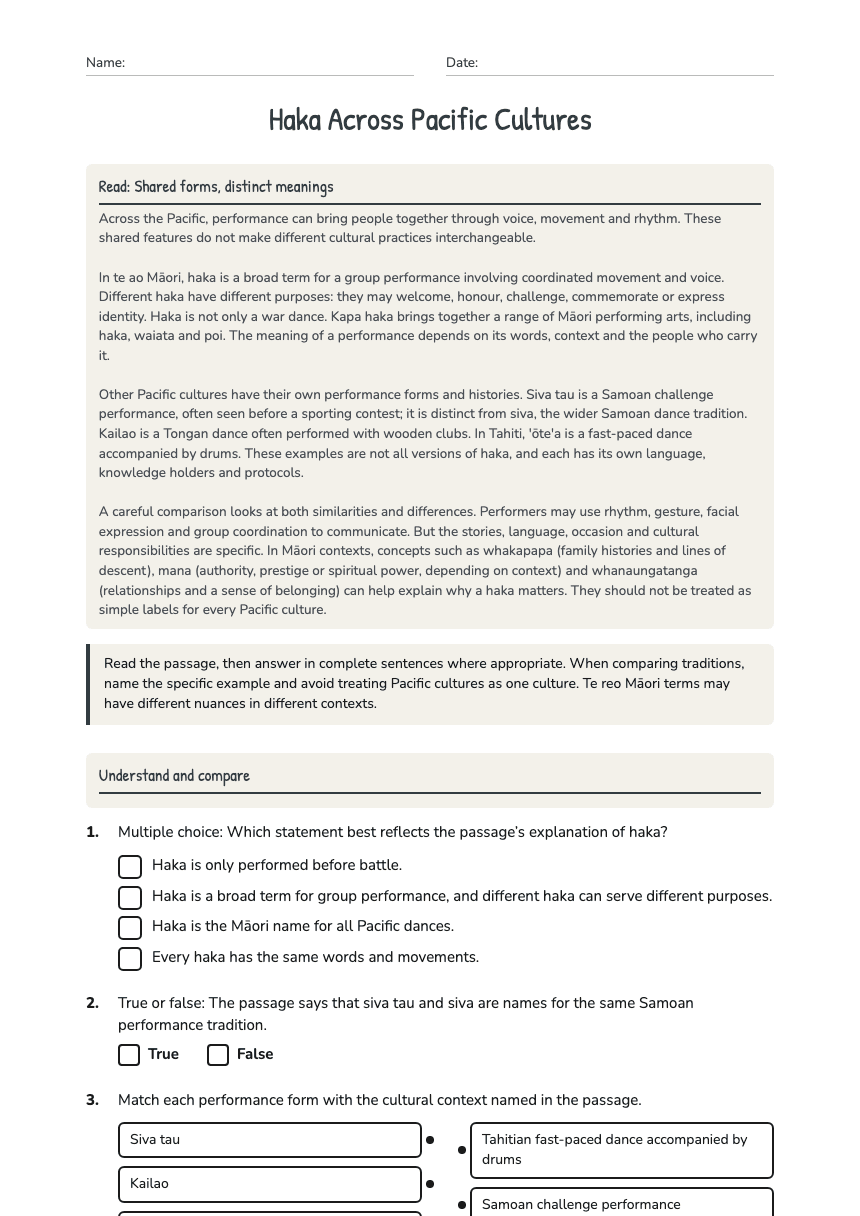
Haka Across Pacific Cultures
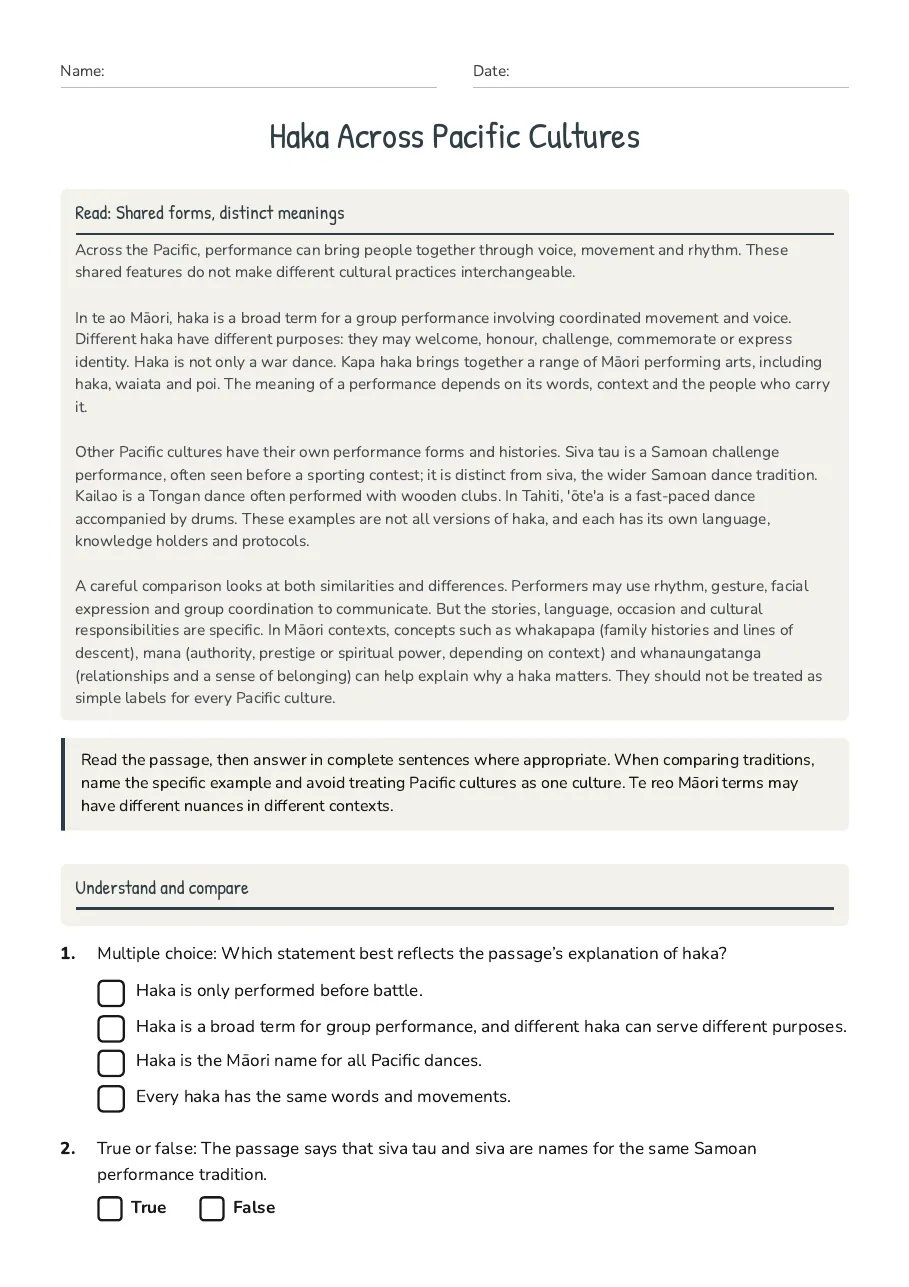
Read: Shared forms, distinct meanings
Across the Pacific, performance can bring people together through voice, movement and rhythm. These shared features do not make different cultural practices interchangeable. In te ao Māori, haka is a broad term for a group performance involving coordinated movement and voice. Different haka have different purposes: they may welcome, honour, challenge, commemorate or express identity. Haka is not only a war dance. Kapa haka brings together a range of Māori performing arts, including haka, waiata and poi. The meaning of a performance depends on its words, context and the people who carry it. Other Pacific cultures have their own performance forms and histories. Siva tau is a Samoan challenge performance, often seen before a sporting contest; it is distinct from siva, the wider Samoan dance tradition. Kailao is a Tongan dance often performed with wooden clubs. In Tahiti, 'ōte'a is a fast-paced dance accompanied by drums. These examples are not all versions of haka, and each has its own language, knowledge holders and protocols. A careful comparison looks at both similarities and differences. Performers may use rhythm, gesture, facial expression and group coordination to communicate. But the stories, language, occasion and cultural responsibilities are specific. In Māori contexts, concepts such as whakapapa (family histories and lines of descent), mana (authority, prestige or spiritual power, depending on context) and whanaungatanga (relationships and a sense of belonging) can help explain why a haka matters. They should not be treated as simple labels for every Pacific culture.
Understand and compare
- Haka is only performed before battle.
- Haka is a broad term for group performance, and different haka can serve different purposes.
- Haka is the Māori name for all Pacific dances.
- Every haka has the same words and movements.
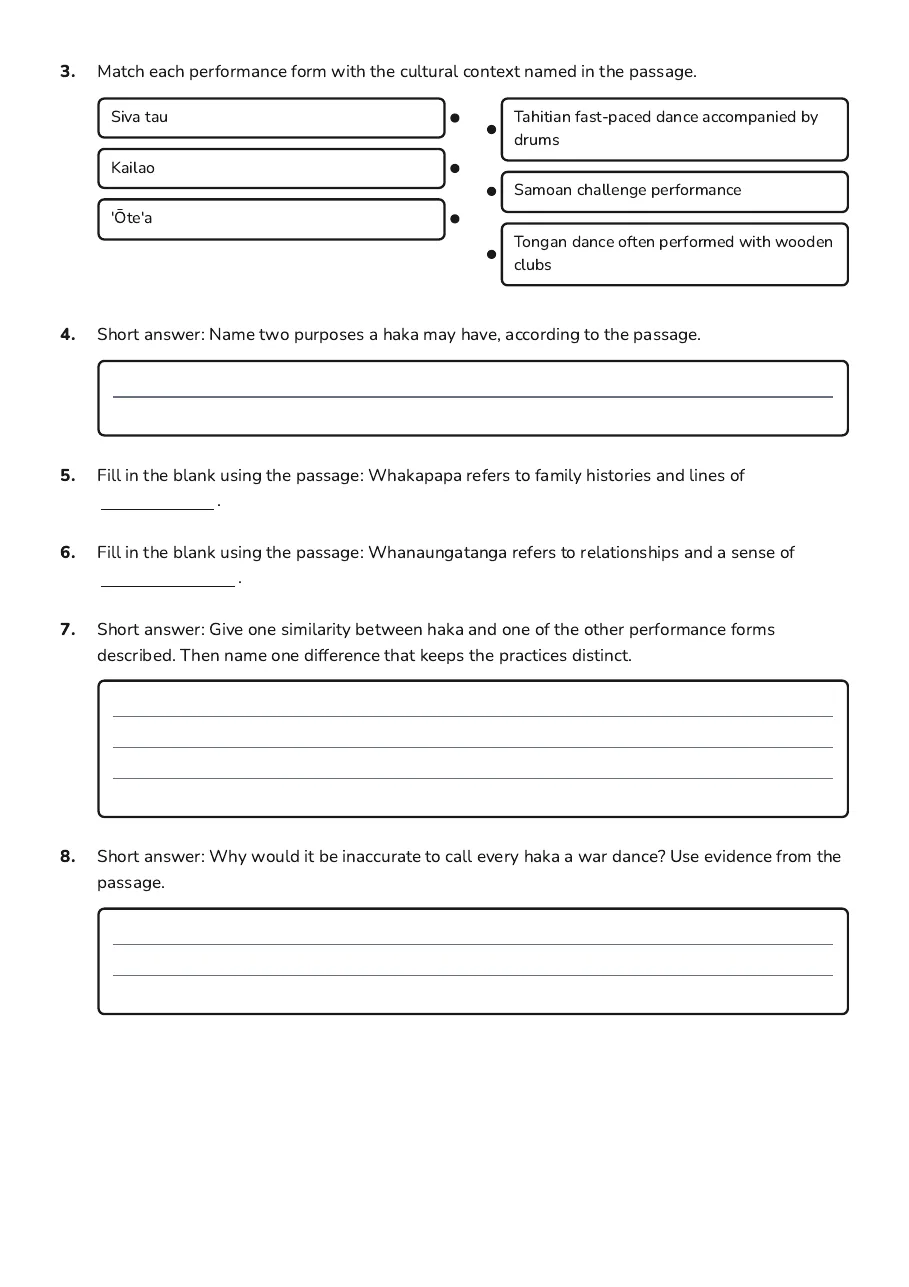
- Siva tau
- Kailao
- 'Ōte'a
- Tahitian fast-paced dance accompanied by drums
- Samoan challenge performance
- Tongan dance often performed with wooden clubs
3 printable pages
Page 1
Page 2
Page 3
About This Worksheet
Free in Kuraplan
Sign up free, grab the PDF, and customize it for your class.
Print-Ready
Formatted for standard paper. Clean layout, easy to read.
AI-Generated
Created with Kuraplan's AI, designed for real classroom use.
For Teachers & Parents
Use in classrooms, for homework, tutoring, or homeschool.
Need a custom version of this worksheet?
Kuraplan's AI generates custom worksheets in seconds — differentiated for every learner, aligned to your curriculum.
Generate Custom Worksheets — Free