A free social sciences worksheet ready for your classroom. Open in Kuraplan to grab the print-ready PDF, customize it for your students, or generate a fresh version in seconds.
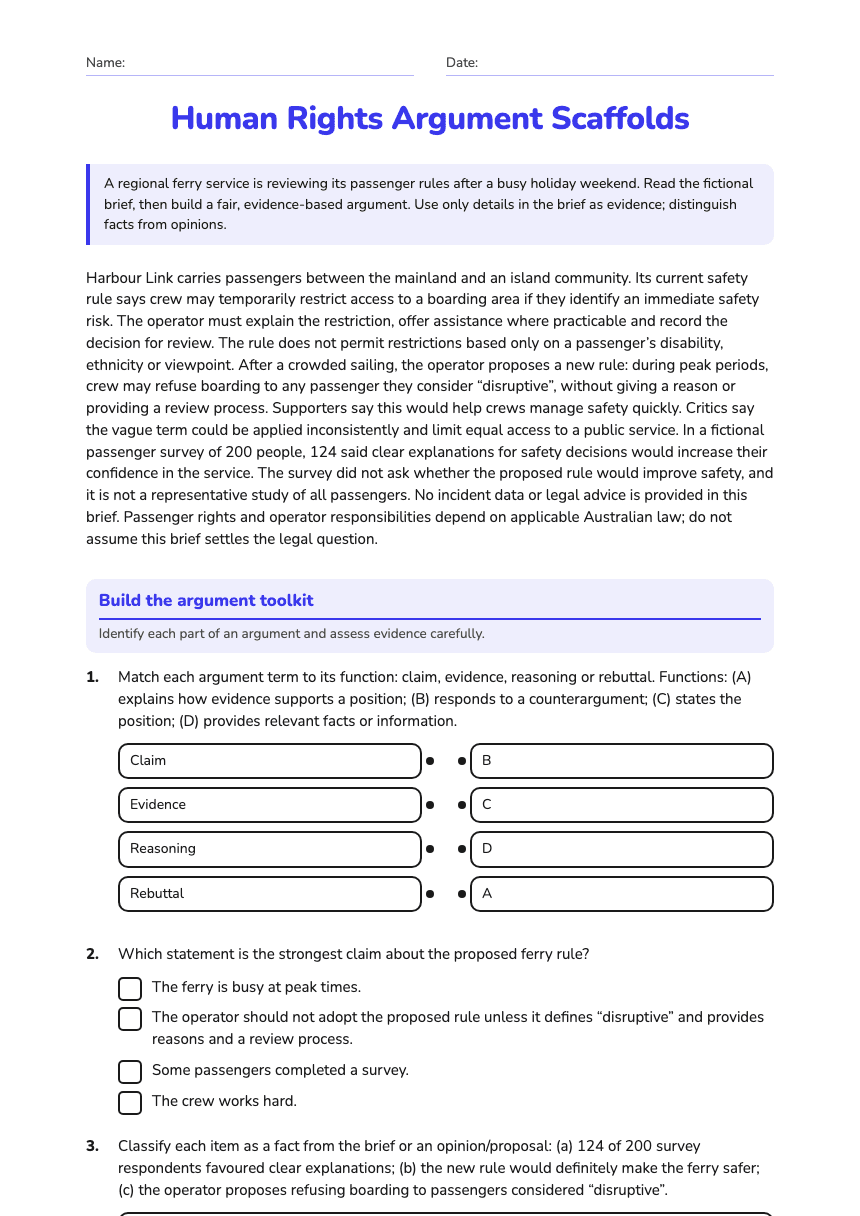
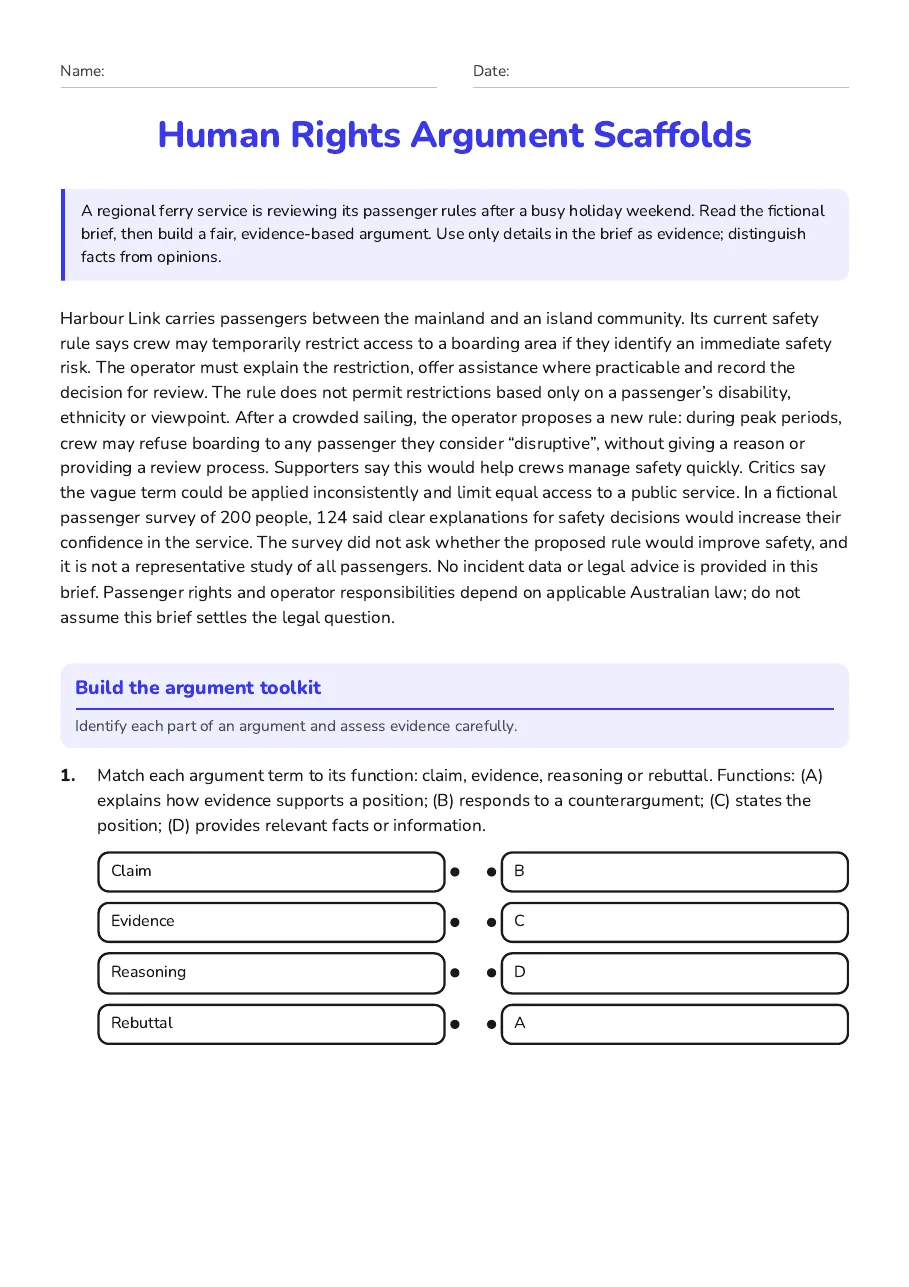
A regional ferry service is reviewing its passenger rules after a busy holiday weekend. Read the fictional brief, then build a fair, evidence-based argument. Use only details in the brief as evidence; distinguish facts from opinions.
Harbour Link carries passengers between the mainland and an island community. Its current safety rule says crew may temporarily restrict access to a boarding area if they identify an immediate safety risk. The operator must explain the restriction, offer assistance where practicable and record the decision for review. The rule does not permit restrictions based only on a passenger’s disability, ethnicity or viewpoint.
After a crowded sailing, the operator proposes a new rule: during peak periods, crew may refuse boarding to any passenger they consider “disruptive”, without giving a reason or providing a review process. Supporters say this would help crews manage safety quickly. Critics say the vague term could be applied inconsistently and limit equal access to a public service.
In a fictional passenger survey of 200 people, 124 said clear explanations for safety decisions would increase their confidence in the service. The survey did not ask whether the proposed rule would improve safety, and it is not a representative study of all passengers. No incident data or legal advice is provided in this brief. Passenger rights and operator responsibilities depend on applicable Australian law; do not assume this brief settles the legal question.
Build the argument toolkit
Identify each part of an argument and assess evidence carefully.
1.Match each argument term to its function: claim, evidence, reasoning or rebuttal. Functions: (A) explains how evidence supports a position; (B) responds to a counterargument; (C) states the position; (D) provides relevant facts or information.
Claim
Evidence
Reasoning
Rebuttal
B
C
D
A
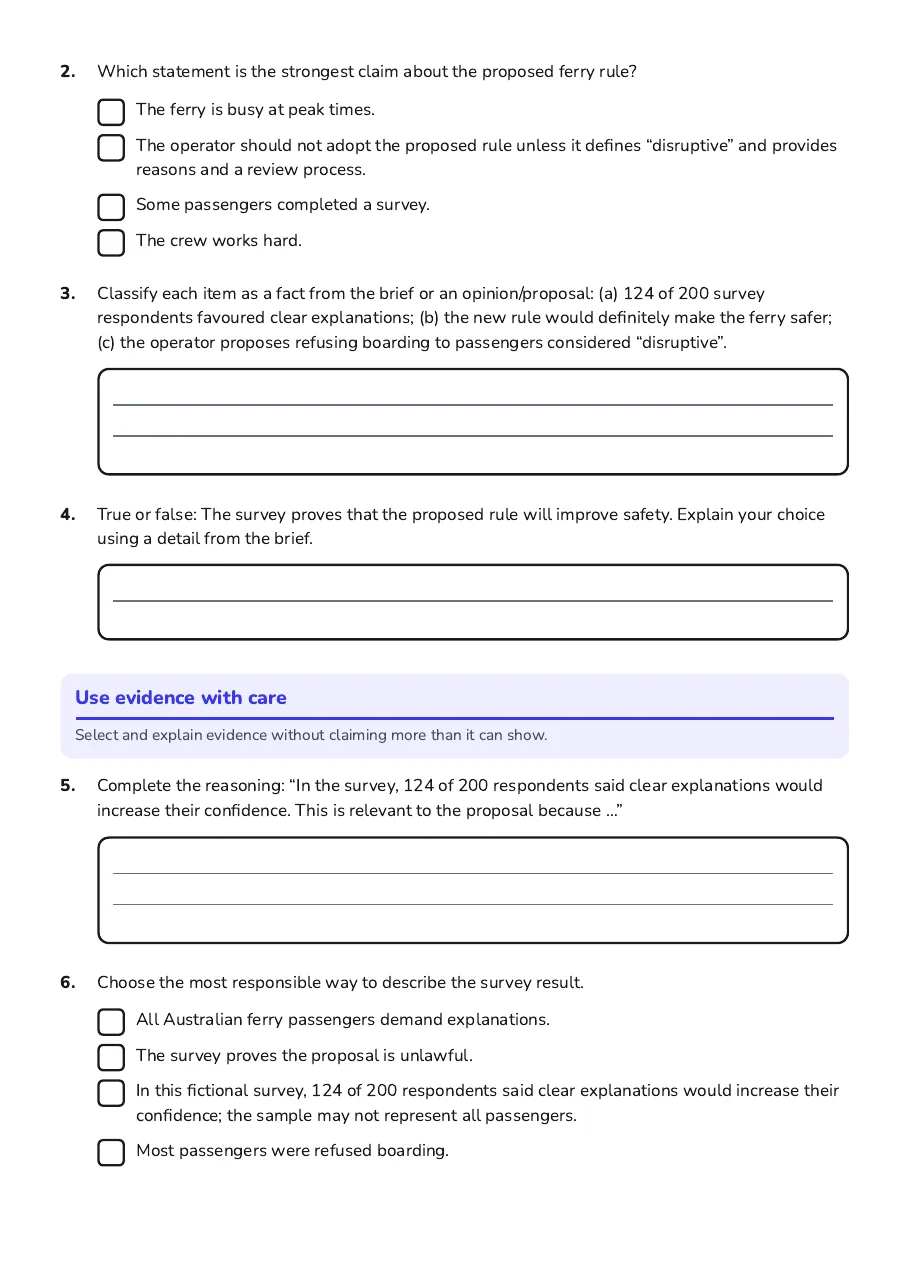
2.Which statement is the strongest claim about the proposed ferry rule?
The ferry is busy at peak times.
The operator should not adopt the proposed rule unless it defines “disruptive” and provides reasons and a review process.
Some passengers completed a survey.
The crew works hard.
3.Classify each item as a fact from the brief or an opinion/proposal: (a) 124 of 200 survey respondents favoured clear explanations; (b) the new rule would definitely make the ferry safer; (c) the operator proposes refusing boarding to passengers considered “disruptive”.
4.True or false: The survey proves that the proposed rule will improve safety. Explain your choice using a detail from the brief.
Use evidence with care
Select and explain evidence without claiming more than it can show.
5.Complete the reasoning: “In the survey, 124 of 200 respondents said clear explanations would increase their confidence. This is relevant to the proposal because …”
6.Choose the most responsible way to describe the survey result.
All Australian ferry passengers demand explanations.
The survey proves the proposal is unlawful.
In this fictional survey, 124 of 200 respondents said clear explanations would increase their confidence; the sample may not represent all passengers.
Most passengers were refused boarding.
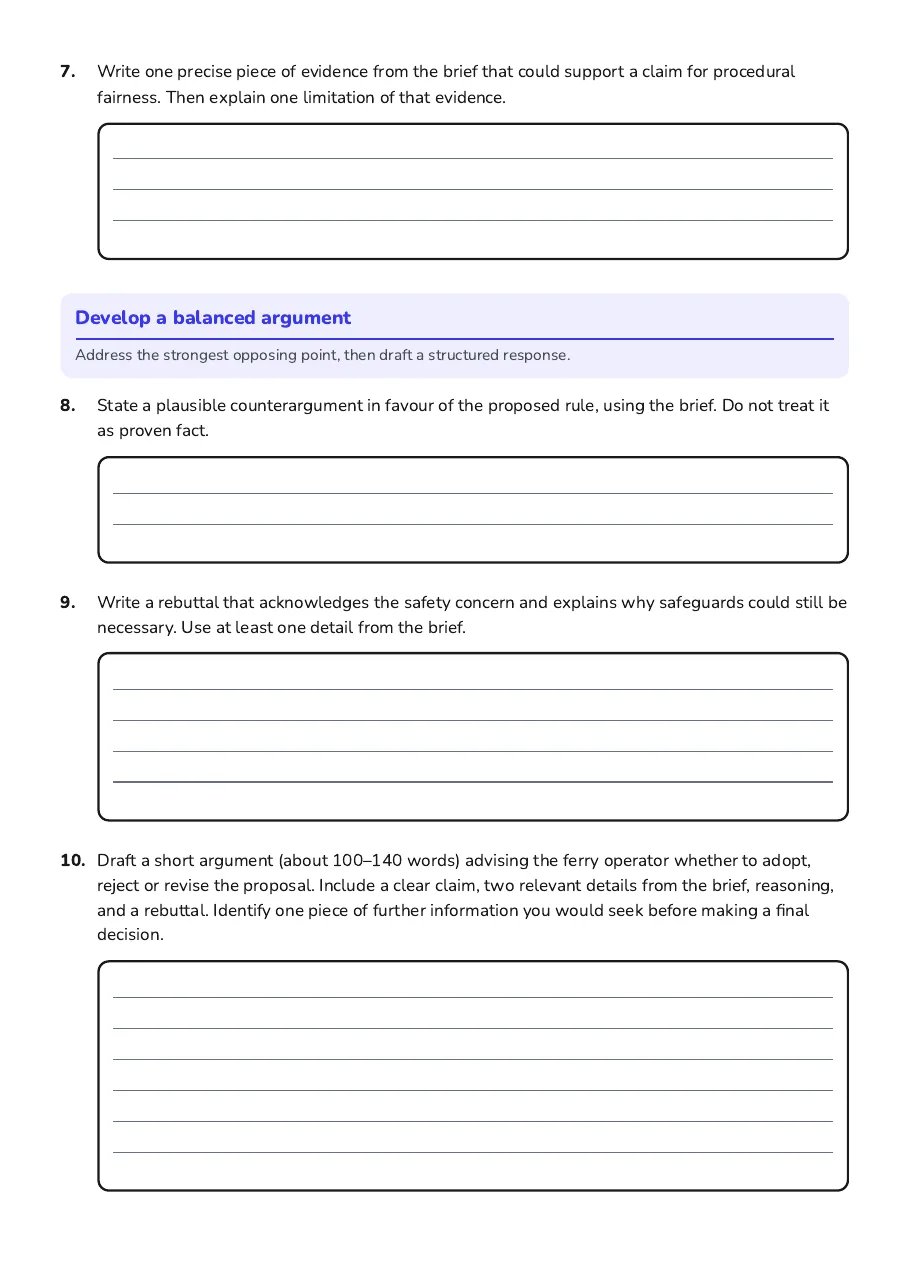
7.Write one precise piece of evidence from the brief that could support a claim for procedural fairness. Then explain one limitation of that evidence.
Develop a balanced argument
Address the strongest opposing point, then draft a structured response.
8.State a plausible counterargument in favour of the proposed rule, using the brief. Do not treat it as proven fact.
9.Write a rebuttal that acknowledges the safety concern and explains why safeguards could still be necessary. Use at least one detail from the brief.
10.Draft a short argument (about 100–140 words) advising the ferry operator whether to adopt, reject or revise the proposal. Include a clear claim, two relevant details from the brief, reasoning, and a rebuttal. Identify one piece of further information you would seek before making a final decision.
11.Before presenting a human rights argument, name two checks you should make about your sources or reasoning.