Social SciencesFreePrintable

Industrial Revolution Reflection Worksheet

A free social sciences worksheet ready for your classroom. Open in Kuraplan to grab the print-ready PDF, customize it for your students, or generate a fresh version in seconds.
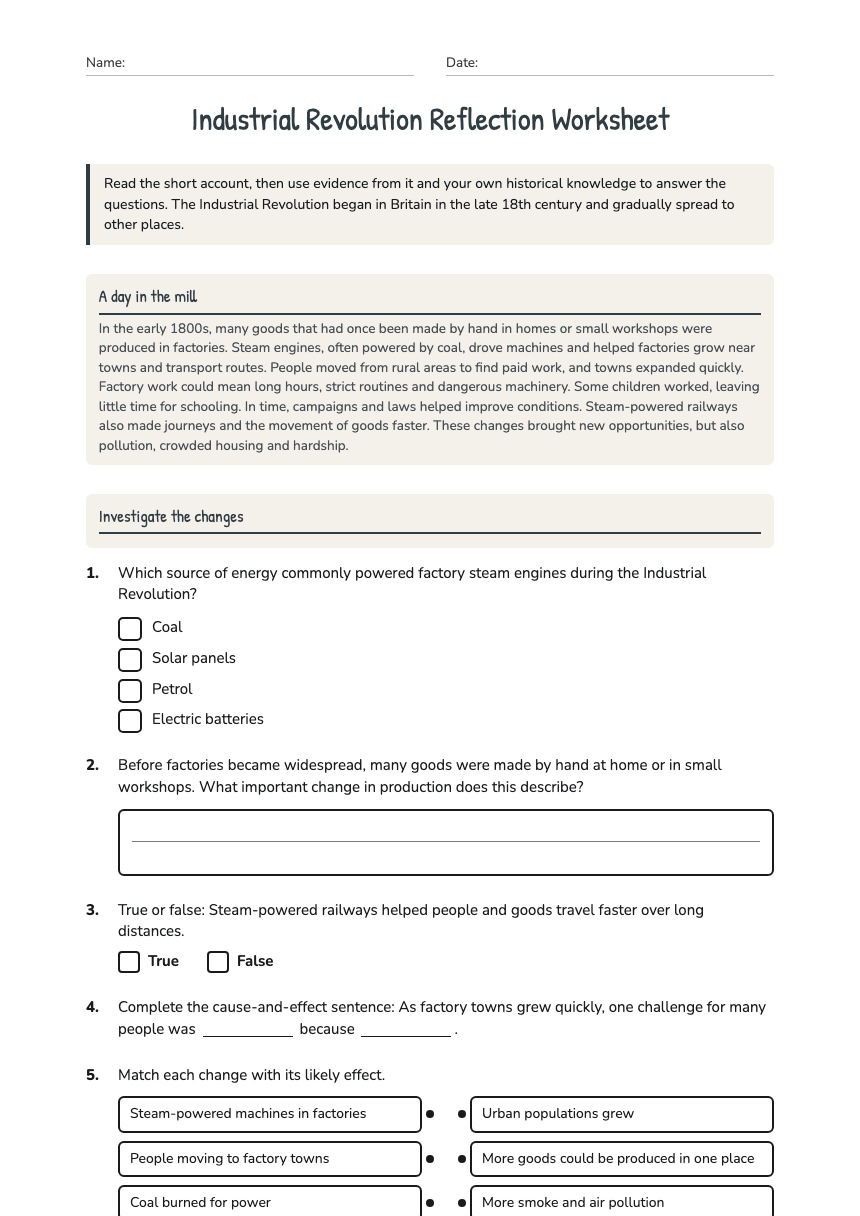
Industrial Revolution Reflection Worksheet worksheet preview
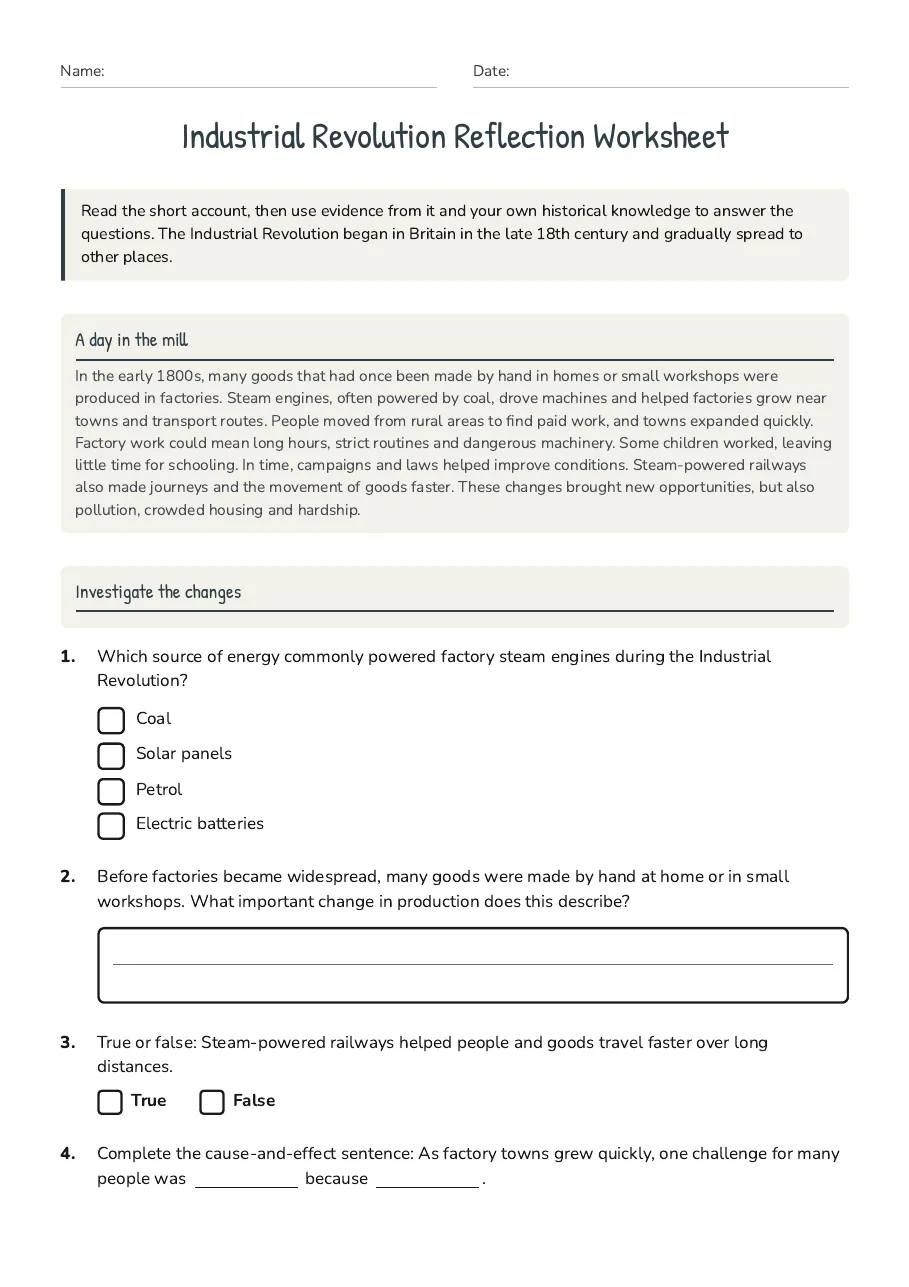
Name:Date:

Industrial Revolution Reflection Worksheet

Read the short account, then use evidence from it and your own historical knowledge to answer the questions. The Industrial Revolution began in Britain in the late 18th century and gradually spread to other places.

A day in the mill

In the early 1800s, many goods that had once been made by hand in homes or small workshops were produced in factories. Steam engines, often powered by coal, drove machines and helped factories grow near towns and transport routes. People moved from rural areas to find paid work, and towns expanded quickly. Factory work could mean long hours, strict routines and dangerous machinery. Some children worked, leaving little time for schooling. In time, campaigns and laws helped improve conditions. Steam-powered railways also made journeys and the movement of goods faster. These changes brought new opportunities, but also pollution, crowded housing and hardship.

Investigate the changes

1.Which source of energy commonly powered factory steam engines during the Industrial Revolution?
  • Coal
  • Solar panels
  • Petrol
  • Electric batteries
2.Before factories became widespread, many goods were made by hand at home or in small workshops. What important change in production does this describe?
3.True or false: Steam-powered railways helped people and goods travel faster over long distances.
TrueFalse
4.Complete the cause-and-effect sentence: As factory towns grew quickly, one challenge for many people was because .
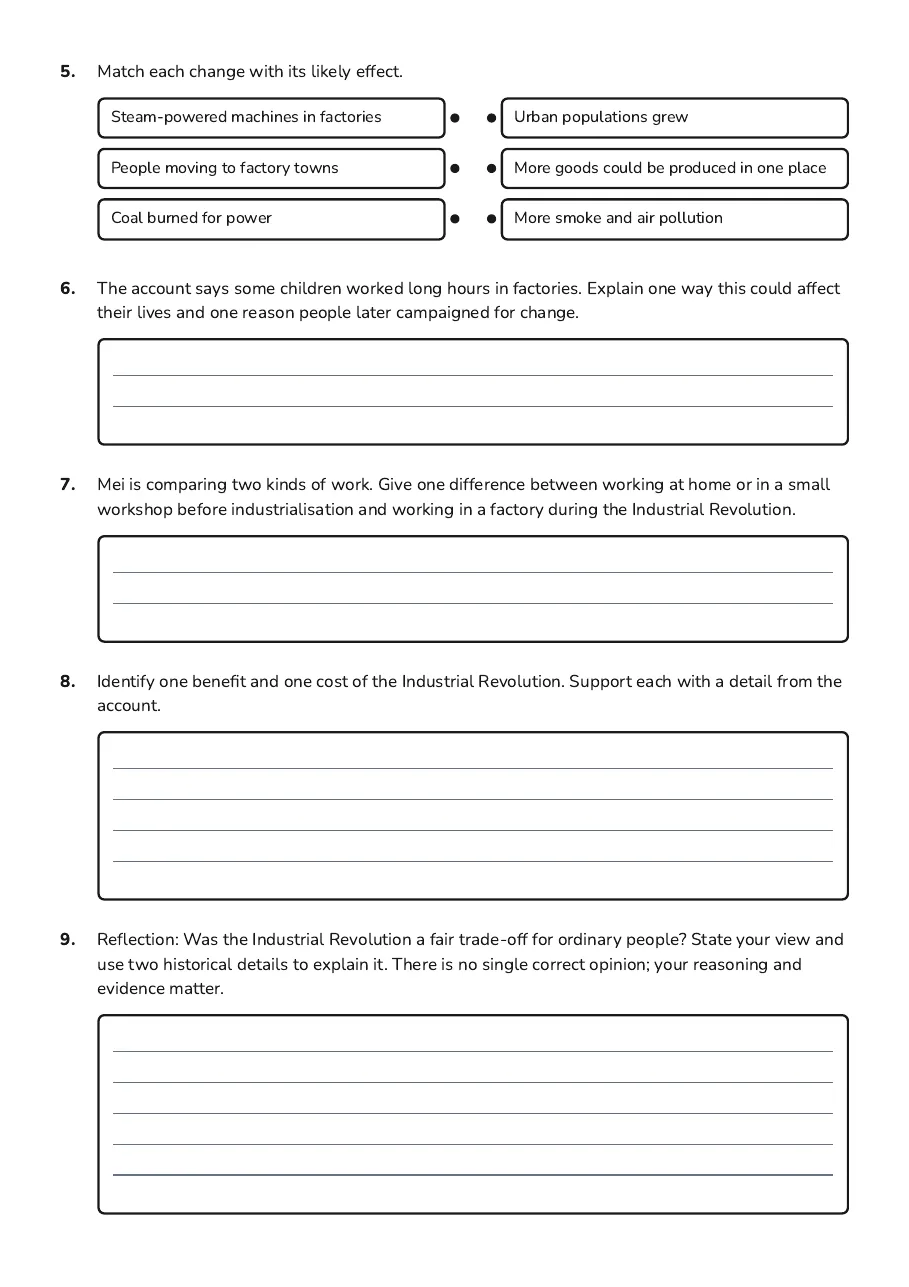
5.Match each change with its likely effect.
  • Steam-powered machines in factories
  • People moving to factory towns
  • Coal burned for power
  • Urban populations grew
  • More goods could be produced in one place
  • More smoke and air pollution
6.The account says some children worked long hours in factories. Explain one way this could affect their lives and one reason people later campaigned for change.
7.Mei is comparing two kinds of work. Give one difference between working at home or in a small workshop before industrialisation and working in a factory during the Industrial Revolution.
8.Identify one benefit and one cost of the Industrial Revolution. Support each with a detail from the account.
9.Reflection: Was the Industrial Revolution a fair trade-off for ordinary people? State your view and use two historical details to explain it. There is no single correct opinion; your reasoning and evidence matter.
10.Connect past and present: Name one object, service or feature of daily life today that depends on ideas developed during industrialisation. Explain the connection.

3 printable pages

  • Industrial Revolution Reflection Worksheet, page 1 of 3: A day in the mill, Investigate the changes

    Page 1

  • Industrial Revolution Reflection Worksheet, page 2 of 3: 5. Match each change with its likely effect.

    Page 2

  • Industrial Revolution Reflection Worksheet, page 3 of 3: 10. Connect past and present: Name one object, service or feature of daily life today…

    Page 3

About This Worksheet

Free in Kuraplan

Sign up free, grab the PDF, and customize it for your class.

Print-Ready

Formatted for standard paper. Clean layout, easy to read.

AI-Generated

Created with Kuraplan's AI, designed for real classroom use.

For Teachers & Parents

Use in classrooms, for homework, tutoring, or homeschool.

Need a custom version of this worksheet?

Kuraplan's AI generates custom worksheets in seconds — differentiated for every learner, aligned to your curriculum.

Generate Custom Worksheets — Free
No credit card Curriculum-aligned Under 60 seconds